 BURST
BURSTAs usual, lots of monopoly and finance-related news this week. Fox bought Roku, the FTC ended its enforcement of the Robinson-Patman Act against price discrimination, and the AI bubble got some bad news…
But I want to start by writing about Juneteenth, the holiday on Friday that commemorates the Emancipation Proclamation of 1863, the executive order that legally eliminated most slavery in the United States. Juneteenth was first recognized in 1866 by former slaves in Texas, celebrated as a second founding of America, when “all men are created equal” came a bit closer to fruition. Over the last ten years, this holiday has become something most Americans have heard of, which is a good step forward in terms of understanding who we are as a nation.
This last Juneteenth, the Obama Presidential Center opened to the public, an explicit linking of America’s first black President with the freeing of slaves. Before opening, Obama gave a speech encouraging Americans not to give in to “cynicism and despair,” but to keep the hope alive that animated his successful Presidency.
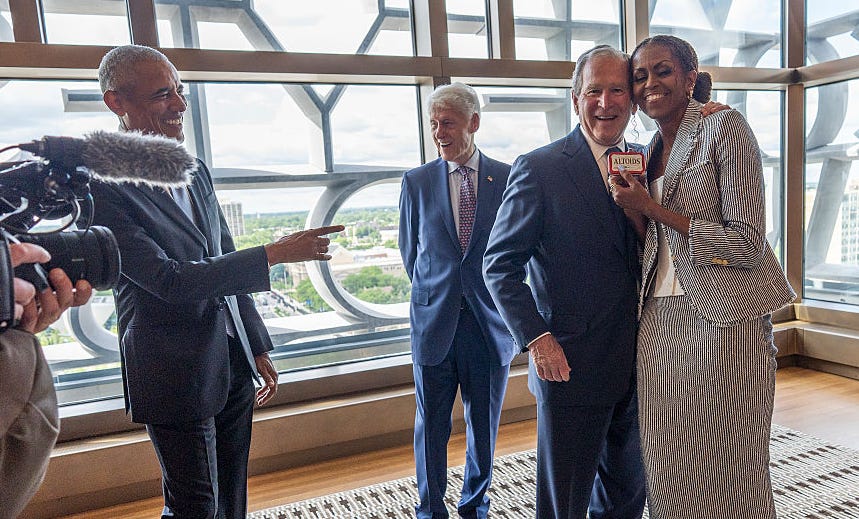
The center is not an official national archive, but a private nonprofit that doesn’t keep archival materials on site. It is an $850 million Presidential center, funded by donations of $100 million from Jeff Bezos, $125 million from Airbnb’s Jeff Cheskey, and another $50 million+ gift from Microsoft’s Steve Ballmer. Bill Gates, Reid Hoffman, Tony Xu, and Sean Parker round out the tech barons who gave so that the Obama center might live.

It’s fitting that Obama chose Juneteenth to dedicate his oligarch-funded library, because it really brings into stark relief some important tensions around civil rights and finance with which we must reckon.
I am always fascinated by moments of historical contingency, and the post-Civil War era is perhaps the one that took among the worst possible turns. And there are important parallels to what happened under President Obama, who was elected to great acclaim for transcending racial strife, but eight years later handed over the White House to a man seemingly dedicated to polarizing Americans.
In WEB Dubois’ Black Reconstruction, there is a passage which describes how the experience of white Union soldiers fighting with freed slaves nearly led to equality. “For a brief period,” he wrote, “the majority of thinking Americans of the North believed in the equal manhood of Negroes.”
And after the war, the possibilities were endless. In terms of social attitudes, the Republican Party’s slogan at the time was “Free men, free labor, free land;” Union soldiers had fought to break the oligarchy of the slaveholders, and bring forth a middle class society. Legally, the freeing of the slaves was one of the greatest redistributions of wealth in world history, and there were land grants to the whites in the form of the Homestead and Southern Homestead Acts. There was a Civil Rights movement of the 1860s and 1870s, with a set of laws enacted to attempt measures at equality.
During the “seven mystic years” between 1866 and 1873, as Dubois called them, the North wrestled with how to reintegrate Southern rebels into the Union, while recognizing that “black folk were men.”
A few years later, this vision lay in tatters. Why? The answer is Wall Street. During the war, the financial district in lower Manhattan had emerged as a gateway to move capital into huge projects, with government financing flourishing. And afterwards, it was a period of booming investment in railroads. But in 1873, Ulysses S. Grant’s administration sought to put the U.S. back on the gold standard, a form of brutal fiscal and monetary austerity.
The giant bubble of railroad financing through Wall Street popped, and America slid into a depression. There was no central bank, no deposit insurance, and corporations were regulated by states, so this downturn was one of the worst collapses in global history, which in the U.S. was known as the Panic of 1873. It fostered wage cuts en masse, and bitter battles as railroads threatened entire cities. Southern states, already economically destitute, defaulted on their bonds, which were owned by capitalists in the North. The multi-racial leadership groups attempting to build schools and welfare states were booted out, in some cases simply murdered, by white supremacist redeemers.
As Dubois noted:
Then came in 1873-76 sudden and complete disillusion not at Negroes but at the world-at business, at work, at religion, at art. A bitter protest of Southern property reenforced Northern reaction ; and while after long years the American world recovered in most matters, it has never yet quite understood why it could ever have thought that black men were altogether human.
The broad disillusionment of a financial crisis and a resulting failure to restore an egalitarian commercial republic eroded faith in equality as a principle. The experience was much worse for freed slaves, many of whom had put their savings in the Freedman’s Bank, an institution chartered by Congress in 1865. In 1874, Frederick Douglass himself took control of the bank to try and rescue it, lending his famous name to a collapse. Such is how republics lose their confidence. Racial hierarchies followed along easily, with attacks on voting by black men, and the establishment of routine terrorist activities to murder those seeking equality.
Even so, segregation was not actually established in 1873, or even at the formal end of Reconstruction, in 1877. For roughly twenty years, Americans fought a pitched battle, until 1896, when Southern elites and Northern bankers established the quasi-fascist system of Jim Crow. Legalized murder became the way Southern elites established low cost labor.
It took until the 1950s for the Civil Rights movement, what C. Vann Woodward called a “second Reconstruction,” to take root. And the Civil Rights Act in 1964 banned Jim Crow at the polls, creating the legal machinery for black citizens in the South to finally vote. No doubt this long and tortuous path is what Obama meant when he talked about “cynicism and despair.”
The Civil Rights movement was built on top of the New Deal, which not only restored some level of control of corporate power, but finally brought the Southern economy into rough parity with the rest of the nation. The Civil Rights Act didn’t stop at voting, it was also an explicit public utility law, banning discrimination based on race or creed in public accommodations, such theaters, hotels, restaurants, and so forth. It also barred discrimination in employment. Another such law in 1968 banned discrimination in housing.
Robert Bork, then a young antitrust lawyer, took issue with civil rights laws based on his view of property rights, arguing that it was wrong to force a racist hotel owner to serve those he otherwise wished not to. Bork’s hatred of public utility obligations meshed with a defense of Jim Crow, and that combination helped the Chicago School get into the GOP establishment, through the Barry Goldwater campaign in 1964. And it began the shift of the South from populism to a support of corporate libertarian power.
Less well-understood than the right-wing opposition to civil rights was the operational implementation of these laws. Unlike other legal arrangements during the New Deal era, like the labor law or securities law or environmental law, there was no real regulator, no EPA or SEC or NLRB for civil rights. So how did they get enforced?
Sociologist Frank Dobbin’s book, Inventing Equal Opportunity, describes their implementation as the sort of lost history of the civil rights movement. His argument is that it was human resources departments who ended up as the interpreters of the laws. To Dobbin, the American corporation created “equal opportunity” for blacks, women, gays, and so forth, doing the innovative work of figuring out what an egalitarian society might look like, as the legal and cultural frameworks changed over the decades.
In the 1960s, when defense contractors had Jim Crow setups in their factories, it was the corporate human resource officers who went to work. In the 1990s, when America turned against sexual harassment, again it was HR who took the lead. The backstop were judges, who, hearing cases in which companies were being sued for discrimination, would tend to look to the most prestigious corporate human resources practices as precedent.
When the Civil Rights Act of 1964 passed, America was a unionized country with competitive markets. There were basic rights to all. It was illegal to engage in price discrimination in most contexts, and it was hard to fire someone without cause. But there was rampant discrimination against women, gays, blacks, and people with disabilities. The civil rights laws redressed those specific grievances, meant to stand on top of the broader New Deal laws granting basic rights.
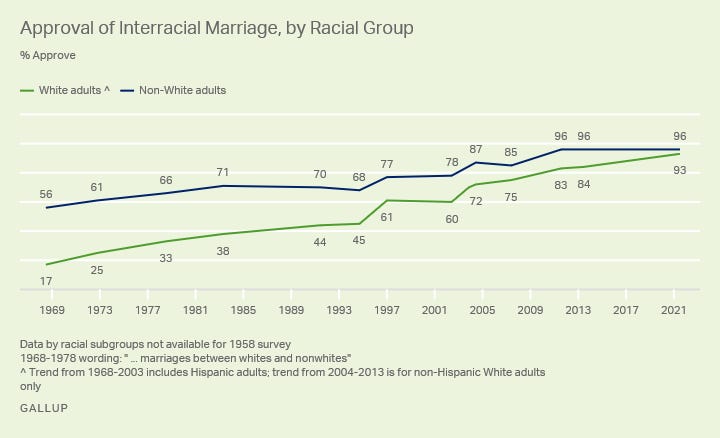
Over the course of many decades, the underlying racism supporting the Jim Crow racism in American life diminished. Look at the polling data, and you can see that a majority of Americans finally approved of interracial marriage in the 1990s. By the 2000s, approval went to 90%. There are similar attitudinal shifts for gay rights, women’s rights, and general religious tolerance. The legal changes generated cultural shifts, but those two elements, as was the case during Reconstruction, are not the same things. A country full of racists can still structure a legal regime to eliminate racism, as the New Dealers did.
But even as Americans became more tolerant, the structure of the civil rights laws shifted. Deregulation, de-unionization, mandatory arbitration, and monopolization stripped Americans of the basic rights they had against coercive economic power. Soon it was fine for an airline to price discriminate against customers for any reason, or to fire someone for any reason *except* identity. So people started to advance identity grievance purely to claim some form of basic economic right that no longer existed. And the conflicts became blurrier as the overt Jim Crow stuff disappeared, but softer forms of discrimination remained.
None of that is to diminish the fact that civil rights laws were and are critical mechanisms to promote and protect Americans. For instance, prior to the 1990s, women were routinely subjected to sexual harassment, until politicians established new legal frameworks and human resource officers implemented them. Just watch any 1980s movie, sexism was simply off the charts and normalized in a way that’s virtually impossible to fathom today. There’s much less discrimination against the disabled, gay people, or transgender individuals than there otherwise would be.
Even so, it’s impossible to look at the civil rights laws without examining how the corporate underpinnings of them shifted over the decades. One consequence is that the people making decisions about Americans’ economic livelihood if you get pregnant or had some sort of social conflict are corporate executives. Now of course the real power center are the CEOs, but human resource officers, who used to focus on training a workforce, increasingly are forced to become bagmen for monopolists who hate labor. This strange dynamic, of identity grievance becoming the only legitimate claim to rights even as a society became far more tolerant, fostered an immensely odd racial discourse.
In 2008, the Great Financial Crisis ripped through the Bork-organized system of concentrated economic power, and Americans elected a black leader, Barack Obama, to address it. Obama represented “hope and change,” the idea that we could transcend old conflicts, the color line that Dubois had discussed more than a hundred years earlier as the foundational 20th century problem of the American experiment.
Obama’s policy framework was to preside over the biggest loss of black wealth in our lifetimes, and a doubling down on the concentration of economic and political power. In the aftermath of his Presidency what returned was not racism, but deep disillusionment borne of frustration over lost wars, deindustrialization, the seizure of the American home, an opioid crisis elites didn’t notice, and deaths of despair. As American life spans stagnated in 2015, and then started dropping, establishment policymakers could not understand why Americans rejected what seemed to be a moral order organized to oppose racism and discrimination.
After Obama, the unthinkable happened. Instead of the historically righteous glide path into office of Hillary Clinton, Obama was replaced by President Trump. There was something of a liberal crack-up and a loss of faith in systems of law. If ever there were a moment to reexamine their priors, that was it. Yet, rather than fretting over yawing inequality and the rise of corporate oligarchs due to Obama’s policy framework, in effect, Obama’s betrayal, older Democrats decided to double down on the moral virtues of centering identity grievance. The corporatized human resources framework of equality was simply too baked into the institutional fabric of early 21st century liberalism.
Hamilton, a play celebrating Wall Street’s origin, with founding fathers played by a multi-racial cast singing hip hop songs, became a smash hit, attracting praise from everyone from national security officials to Hillary Clinton to Dick Cheney. There were billionaire-friendly phenomena as Lean In and a moral panic moment where accusations against all men were immediately seen as true. Democrats sought to judge and estimate power imbalances by looking at identity, which was, in some ways, a result of replacing law with shame as a key social regulator. The liberals had lost faith in the republic.
The New York Times published the 1619 Project, a history of America ostensibly centering the black experience. And yet, while there were discussions of a yawing wealth gap, originating in 1619, no one in that set of essays noted Obama and his Wall Street friendly policies. It was odd, to have the first black President who oversaw a historic destruction of black wealth in the form of mass foreclosures, not mentioned in a chronicle of blackness in America.
But while that dynamic may have gone unnoticed in the 2010s, it is no longer possible to ignore it today, after young black men peeled off from the Democrats in 2024 and voted for Donald Trump in noticeable numbers.
Ultimately, the incoherence of our racial discourse is a result of the same neoliberal drift we see everywhere else. The activism and legal fights in the Selma era turned into HR compliance regimes blessed by judges in the 1980s and onward. The bureaucratization of identity grievance, even as ordinary rights were stripped away, fostered a bitter and sullen citizenry. The right’s answer was to build their own grievance system, anger from white men over perceived slights. While there were some slights, as we can see now, the GOP was simply seeking to strengthen the age old scourge of discrimination.
Today, there is a long overdue re-gearing of liberal politics, a recognition that we all face a set of dangerous oligarchs who seek to set us upon one another. I see it in the rage that Americans are showing around AI data centers, or surveillance pricing, which is price discrimination based on impersonal dossiers of data. And there’s an important advantage that exists today.
In the Reconstruction era, all the way to the 1980s, the notion of “social equality” among races and creeds was at best a utopian vision. We could legislate forms of equality, but intolerance was normal. We are lucky enough to live in a society where that is no longer the case. That is not to say we are in a just society, or one without prejudice, but our moral challenges are not the same as they once were.
Indeed, the old sin of bigotry is not gone, and it can return with a vengeance if we allow it. The way to prevent that is to restore basic economic rights for everyone. That means centering opposition to arbitrary coercive power as the foundational element of American statecraft, whether that be improved mechanisms to stop monopoly power, financial scams, deprivation of material resources in a time of need, criminal violence, or racism/discrimination.
To put it differently, Americans all over the country celebrate Juneteenth as a national holiday. And we should, because equality is an ideal worth cherishing, even if Obama’s library and the slew of donors who built it cannot see the monument to cynicism they have built.
And now, the rest of the monopoly round-up. There is some enjoyable news, like the second largest loss for a private equity firm in history, a journalist getting ahold of OpenAI’s very ugly financials, and PE giant Blackstone getting caught violating the law in New Mexico… with actual consequences!
But then some very ugly stuff too, with organized labor selling out college athletes, Senator Kirsten Gillibrand engaging in what looks very close to bribery, and the Federal Trade Commission ending enforcement of Robinson-Patman. Oh, and Red Lobster continues to fall apart under its private equity owners. No more endless shrimp?
Read on for all that and more.