 BURST
BURSTToday’s monopoly round-up has a lot of news, as usual. Trump is going to pick a new antitrust chief, SpaceX bonds are in trouble, and it’s the end of cheap electronics.
But I want to focus on why Wall Street isn’t particularly worried about a left-wing takeover of politics, at least not yet. And it starts with two different stories about New York Mayor Zohran Mamdani, a generational talent of a politician.
A few days ago, the Rent Guidelines Board froze rents for 1 million rent-controlled apartments. Mamdani had reshaped the board with six new appointments, and used savvy legal tactics to deliver on a popular promise. By contrast, just a day earlier, his administration took a minor defeat. Mamdani’s Department of Education, led by Kamar Samuels, withdrew a proposal to put more AI in schools, after a fierce public backlash. “We cannot… be so worried about A.I. that we don’t utilize it,” Samuels had told the New York Times after becoming chancellor, using industry-friendly jargon. On Wednesday, he had to retreat.
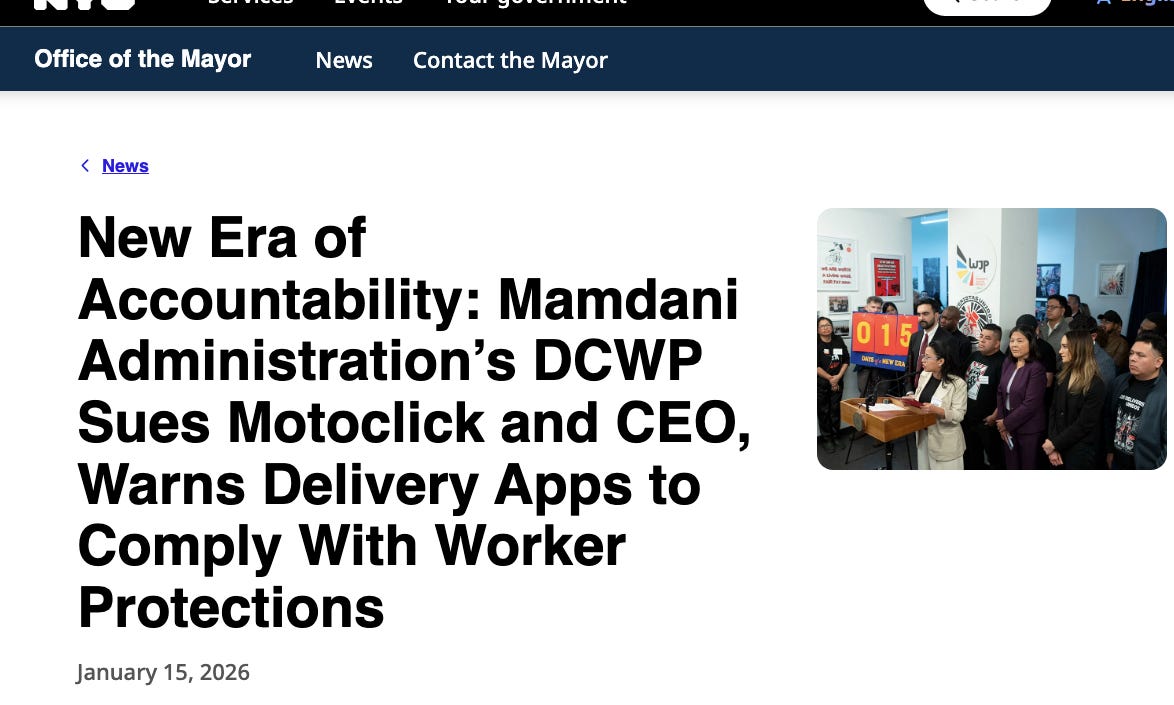
Mamdani is the starkest break from the status quo right now, and so how he runs New York City is an important pace-setter for what is possible. Mamdani has been most successful where his people have discovered credible legal tools to govern, such as the Rent Guidelines Board. That’s a big and obvious one, so to take a less obvious one, his consumer protection chief, Sam Levine, is basically running a campaign to tame corporate power in the city, blocking junk fees, ending difficult-to-cancel subscription products, and forcing Uber and DoorDash to stop cheating workers.
Levine, and the rent control move, scared Wall Street. Said one powerful lobbyist, “I hope this is just a small piece of the overall strategy for how this administration will deal with the city economy and employers in general… if not, we are in for a rough ride.” That’s because Levine knows the law, and knows business. Unfortunately, there aren’t many populists like Levine. There are a lot more Kamar Samuels-types, who lack the interest or ability to address power.
That’s not true on the right. Right now, Russ Vought, Trump’s head of the Office of Management and Budget, is operating creatively and effectively to do deeply malevolent things. He thought very hard about how to run budgets to organize the government. But there’s basically no analogue on the left, little capacity to govern. And that’s why Mamdani, despite a mandate for significant change, can’t go as far as he otherwise might. What I want to do is trace where this gap came from, and pose some suggestions on how to address it.
There is, as usual, a history here. Someone with great foresight killed the left’s ability to govern, a long time ago.
In 1995, the Republican Party took control of the U.S. House of Representatives. Led by Newt Gingrich and a small group of right-wing politicians who called themselves “Jihadists,” these men sought to revamp a legislative chamber held by the Democrats since 1949. Though the Reagan era had been conservative, no one in America had experienced an outright House Republican majority for forty-six years.
Gingrich was an intellectual, as were some of his colleagues. When he first was elected in 1978 as part of what was known as the “New Right,” every young Republican candidate was obsessively reading Robert Bork’s The Antitrust Paradox. In 1995, his goal wasn’t just to pass legislation, but to fundamentally re-gear Congress so it could no longer serve as the brains for the Democratic Party, as it had for the last half century. That was an institutional task, and he set about restructuring the institutions.
First to go was the Office of Technology Assessment, a nonpartisan think tank that conducted long-term studies on important scientific and engineering topics, like how to decommission the Space Shuttle or early warnings on climate change. Gingrich also slashed Congressional staff by a third, eliminated dozens of subcommittees, and killed budgets for the legislative service organizations that helped specific groups of members, like the Black Caucus, the Caucus on Women’s Issues, the Environment and Energy Study Conference, and so forth. Most importantly, the Democratic Study Group, a network of staff and members who organized the rhythm of the House, disappeared.
And Gingrich bulled the Congressional Budget Office, which was set up to rival the executive branch’s capacity to govern. “It’s our intention to largely replace CBO [sic] with more moderate economists,” Gingrich spokesperson Tony Blankley said. Other institutions, like the Congressional Research Service, got the message. Fall in line.
At the same time, Gingrich’s subordinate, a Texas Republican named Tom “The Hammer” DeLay, conducted the “K-Street Project,” which was designed to force corporate lobbyists to become loyal to the GOP. Corporate money poured into conservative think tanks, who did the thinking that used to be reserved for publicly funded committees and internal researchers. Congress had been lobotomized, but Gingrich was also building a set of parallel institutions. The power of the House was now in the hands of a highly centralized GOP leadership, not committee leaders, who had little capacity to know anything. And the GOP leadership got their content from corporate-backed outsiders.
The effect was revolutionary. From 1949 to 1995, there was immense institutional knowledge within Congress. There were staffers who know everything there was to know about the Mississippi River and could go toe-to-toe with the Army Corps of Engineers on reclamation projects. There were dozens of staff who understood the Post Office. The Antitrust Subcommittee had a swath of antitrust lawyers who could investigate industries and develop litigation.
When I was in the archives, I found that members of Congress like Wright Patman worked insanely hard, and were rewarded for it. Patman started working early and ended his day very late, reading books, publishing reports, and sending queries to figure how the banks worked. His lead investigator had a stack of blank subpoenas and a travel budget, and could just go anywhere he wanted to track down evidence. His people were confident they could do as good a job as the bankers in running powerful institutions, and so they could negotiate effectively.
But you don’t have to go back to the 1930s, just watch a Congressional hearing on C-Span from the early 1990s. The level of substantive knowledge is at an entirely different level than it is today. In 1995, Gingrich struck the death blow to that culture, and the House was soon staffed by 25-year-olds.
From 1995-2007, the GOP held the U.S. House of Representatives, and continued to strip out internal capacity. President Bill Clinton and Gingrich cooperated on the “Reinventing Government” initiative, to privatize many executive branch functions. Large numbers of regulatory agencies willingly gave up authority, knowledge, and staff.
And the culture changed, as the Democratic Party and liberal elites became dependent on the Clinton White House. The West Wing created a template for the Democratic insider, which was someone who pretended to be nerdy and detail-oriented, but was in fact just a political operative with an Ivy League degree. Pretty soon, the only way anyone could think about governing was through the lens of deference to fake experts, whether economist, pollster, or corporate lawyer.
Anyone who knew anything about governance, and wanted to act using public power, was perceived to be some sort of dirty hippie loser. Here’s a clip from The West Wing demonstrating the cultural attitude, where a main character sneeringly mocks protesters against globalization. Corporate trade agreements, he argues, bring world peace. Now, one could say that corporate trade agreements are complicated, but what they really do is make politics simpler - corporations handle stuff. The price of milk might go up or down, and no one but economists and CEOs need worry about how.
In 2004, when John Kerry lost the Presidency, and the Republicans controlled all three branches of government, along with a powerful set of think tanks and media outlets, rich Democrats finally responded. They built think tanks of their own, like the Center for American Progress and Media Matters. But this tactic, ironically, made liberals wholly dependent for their ideas and training on the same sources of capital as the right.
This dependency was different than campaign donations, it was in some senses more fundamental because it was about framing what could even be debated. The Democrats used to have a ready army of people who knew things, funded by the Federal dollars. After 1995, they could only get competent people from big corporate law firms or people otherwise skilled at raising money from the wealthy.
In 2006, when Nancy Pelosi led the Democrats to finally take back the House of Representatives, she promised a lot. But she did not rebuild the committees, or OTS, or the legislative service organizations. It turns out, Pelosi realized, centralizing power in her hands, as Gingrich had, made her job a lot easier. The Democrats had decided that living in Newt Gingrich’s world was quite comfy.
The consequences for governance were catastrophic. Almost immediately, Pelosi’s new majority faced a financial crisis. But from 2007-2011, the Financial Services Committee in the House, run by Pelosi-ally Barney Frank, did not issue a single subpoena. It did not have access to a single Bloomberg terminal. And Frank actually yelled at the bailout inspector general, Neil Barofsky, when he published reports revealing new and useful information about foreclosures and banks. What eventually became Dodd-Frank was written by Goldman Sachs lobbyists, passed to the Fed, to Treasury, and then to Barney Frank. Individual members did their best to strengthen it, but there just wasn’t much expertise or capacity to do that.
Similarly, when Barack Obama won the Presidency, the Democrats did not rebuild governing capacity. Indeed, for most of his administration, the government budget for regulators shrank under sequestration. And the pay of members of Congress has dropped steadily in inflation-adjusted terms since the 1990s, such that today a first-year associate at a major New York law firm gets paid far more than a U.S. Senator.
The net effect of these institutional changes has been to kill the ability of members of Congress to govern. Not only do they lack capacity to do so, but their very understanding of the job has changed. From 1995 onward, generations have learned that the job of a politician is to defer to experts presented by party leaders, grumble a little bit, maybe write letters or do other forms of busywork, be good at media, and wait.
In 2017, Donald Trump shattered this empty liberal world, which had become effectively a social club with no underlying substance. While some Democrats remembered what it was like prior to Gingrich, older generations were ebbing. Most Gen X Democratic think tank leaders simply made claims about how to win elections, using the veil of pretend policy.
There was one significant exception to this cultural trend - Elizabeth Warren, brought in from academia by Senator Harry Reid, had a deep and rich understanding of bankruptcy law and finance. And she was the patron of younger anti-monopolists, who gradually started to rebuild a form of governance based on actually learning about how markets work. The Biden administration, in some ways because Joe Biden was so old he remembered the pre-Gingrich era, accepted Warren’s advice, and brought it some fresh thinkers to helm antitrust agencies. It took time, but by 2024, liberals finally noticed that Lina Khan was doing interesting things, after billionaire Reid Hoffman tried to have her fired.
Despite these outliers, the Biden administration was still doing most policy in an earlier groove. Treasury Secretary Janet Yellen and Fed Chair Jay Powell, largely made decisions by deferring to Wall Street. Substantive policymakers in finance, such as Saule Omarova and Sarah Bloom Raskin, lost bitter confirmation battles. The Biden Domestic Policy Council was first run by Susan Rice, an Obama advisor who had zero expertise in domestic policy. Pete Buttigieg, though very smart, knew nothing about transportation, and was made Transportation Secretary.
Without knowledge or experience, it’s impossible to govern. And that became obvious during the crisis of inflation that ultimately destroyed the Biden administration. When prices began spiking, there was simply no capacity to even assess what was happening. Democrats were hearing from their political operatives that voters were in a rage, but their economists were telling them inflation had come down. So they were paralyzed. They simply had no way to rebut their experts, who were clearly wrong.
And this dynamic brought Trump into office. During her only debate against Trump, Kamala Harris couldn’t name anything specific she’d do differently about inflation. Her main argument was the “best economists in our country,” citing 16 Nobel Prize-winning economists, the Wharton School, and Goldman Sachs, preferred her plan to Trump’s. For thirty years, Democrats had deferred their understanding of money, power, and business to a cloistered class of economists and academics. When these experts are wrong or unsure, the Democratic Party was unable to govern.
And that gets to Mamdani. From 2025 onward, the populist left or democratic socialists, however you want to frame it, have diagnosed the problem of the Democratic Party as being corrupt, too in thrall to corporate influence or insufficiently dedicated to a certain way of winning elections. And those critiques are accurate, insofar as they go. However, there is still little intellectual culture, no ability to independently assess information, and little respect for what Gingrich did to lobotomize the left and our public institutions.
For example, there simply is no left-wing vision of what to do about the Federal Reserve. No one talks about it, few even notice it exists. To the extent it matters, it’s either “independence is great” or “capitalism is bad,” both of which are different flavors of not having done work. Similarly, there is no left-wing view of how to organize Google, or the U.S. military. The massive centers of power in America, from Wall Street to big tech to military spending, are mostly absent from any political discourse.
Is there anyone on the left who is thinking about how to use OMB? Of course not. Is there anyone who knows trains, or airline regulation, or Pentagon procurement? No.
Even on the big obvious stuff it’s thin. There’s a lot of left-wing sloganeering on things like Medicare for All, but does anyone know the legal authorities at the Food and Drug Administration and have the ability to use them to lower drug prices? No. If you ask what to do about the AI bubble or the underlying tech, what you’d find is little beyond big vague slogans. Centrists might talk about the need to “beat China” or the left might seek a pause on data centers, or perhaps gesture at Bernie Sanders and his quasi-nationalization proposal, which even he knows is just a starting point. What should we be using AI to do? How should we be developing this technology? No one has answers.
There’s just no sense at all that winning elections means being in charge of making difficult decisions about running complex systems. To govern, you can’t just say "corporate greed.” You have to actually know how specific corporations work, the prices they charge, their strategies, accounting choices, and legal obligations. You have to read the Wall Street Journal and 10K investor documents, not Politico or Punchbowl. You have to be hungry to learn. You have to read books. And not only that, you have to, like Gingrich, think institutionally.
It means doing detailed investigations into the legal authorities that most agencies have, to prepare in using those authorities. If you don’t, then it doesn’t matter your ideology, you’ll just go on with the status quo. In terms of Congress, that would mean restoring OTA, bullying GAO so they stop the pro-corporate garbage, going on a hiring spree of Congressional staff with real salaries, and ensuring that Congressional committees have actual budgets and subpoena power. In New York City, it might mean something different, but the basics of figuring out how to build around substance are the same.
Last year, I asked a foundational question. Is 2026 the year that Americans turn against oligarchy? The answer, as it turns out, is almost certainly yes. And that means they want a different leadership class to run our corporate, political, academic, and public institutions. You can’t snap your fingers, however, and put sloganeers into important slots. Powerful people will always say that taking away their power will cause capital flight, crash systems, or otherwise lead to catastrophe. To push back, to know where they are telling the truth or lying, we have to have substantive knowledge. If we don’t, then well, we’ll just end up deferring to corporate lawyers and economists.
In other words, somehow, the next leadership group has got to figure out how to think again. It’s been long enough.
And now, the full monopoly news round-up. Lots of interesting stories - what happened to egg prices? Well, there was just an antitrust settlement among egg producers. Plus, China gains market share in AI as SpaceX’s bonds wobble in value, Ford has to rehire human being engineers after an AI fiasco, Trump is going to nominate a new ‘populist’ antitrust chief, and a top Biden deputy for Merrick Garland is now working for Kalshi to legalize sports gambling nationwide. Hooray!
Oh and Republican-leaning Indiana went FULL COMMUNISM in imposing price controls on hospitals. Read on for more.