 BURST
BURST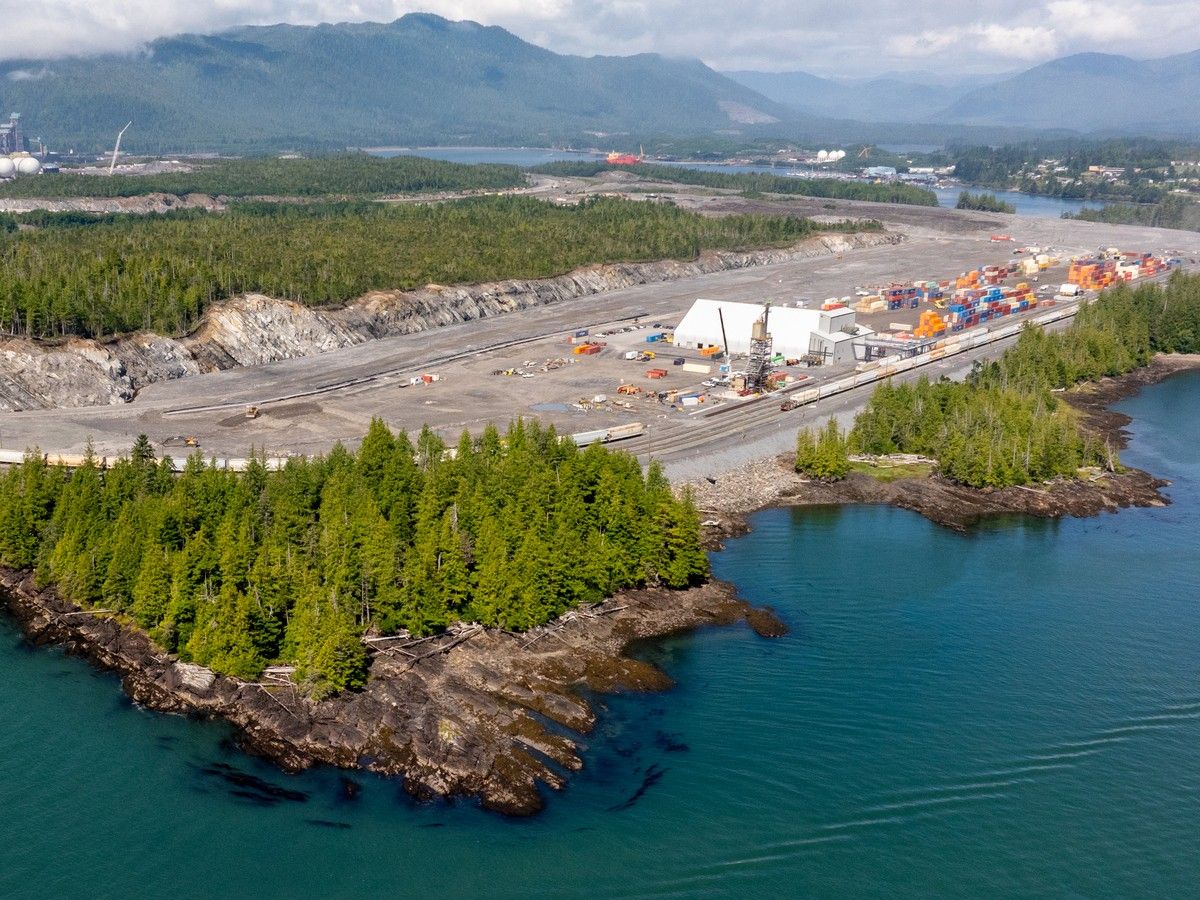
By a quirk of timing, a Montreal-headquartered logistics company has opened a new $750 million container-handling facility at the Port of Prince Rupert aimed at expanding Canada’s international trade, just as a trade war with the U.S. heats up.
On Friday, Ray-Mont Logistics, CN Rail, and the port opened what the transportation company is calling Canxport, a terminal with the capacity to trans-load commodities shipped to the port by rail into containers for shipment overseas.
The new facility, a huge expansion of Ray-Mont’s existing capacity at Prince Rupert, is designed to handle large quantities of agricultural goods, break-bulk forestry products and petrochemical products, starting with bulk plastic-resin pellets, according to company executive Stephen Paul.
However, the list of products could increase to potash and even bulk shipments of raw bitumen, he added.
Ray-Mont has been working toward building the $750 million terminal, at the front-end of $3 billion in expansion projects at the port, for the better part of a decade.
Paul, Ray-Mont’s chief strategy officer, said “the timing is fortuitous, (with) everything going on,” considering escalating trade tensions with the U.S.
“It allows us to immediately provide solutions for people who want to hit those goals,” Paul said, referring to Canada’s ambitions to double its non-U.S. export trade by 2035.
Canada’s West Coast Ports, including Prince Rupert, are positioning themselves as “the backbone” for that expansion, having handled $409 billion of Canada’s export trade in 2025.
Also coincident to Friday’s opening of Canxport, the Port of Prince Rupert, Port of Vancouver and Port of Nanaimo, jointly released an economic impact study highlighting their potential.
Peter Xotta, CEO of the Vancouver Fraser Port Authority, said the facilities “have an outsized role to play” in the expansion of trade.
With its own expansion projects, Xotta said they are “poised to unlock one of our country’s greatest trade opportunities,” in the Indo-Pacific.
In Prince Rupert, Paul said Ray-Mont’s phone has been ringing more often lately, particularly among agricultural shippers.
“People are definitely exploring and saying, ‘OK, with (the) trade war and various different things that are going on, could you do this?'”
He added that, “We’re open for trying to deliver more volumes and solutions, and the Port of Prince Rupert has an abundance of empty containers. It’s a perfect recipe to move exports out of the country effectively.”

Initially, Canxport will have the capacity to handle up to 400,000 twenty-foot-equivalent-units worth of cargo per year, with the capacity to expand, Paul said. That would be an additional six million tonnes of cargo moving through the port, according to the Port of Prince Rupert.
Ray-Mont, its partners in CN Rail, chemical company Dow and the Gixaala and Metlakatla Nations, along with the Port of Prince Rupert, opened the Canxport this week, during which Canada levelled counter-tariffs on about $28 billion of U.S. imports in the now tit-for-tat trade war.
Federal Transportation Minister Steven MacKinnon said the new facility will help Canadian exporters reach new markets.
“By expanding Canada’s trade capacity and opening new opportunities in fast-growing international markets, we are building a stronger, more resilient economy that delivers greater prosperity for communities across the country,” MacKinnon said in a news release.
Prince Rupert Port Authority CEO Kurt Slocombe said Canxport’s development was born out of a pilot project with Ray-Mont to test Prince Rupert’s ability to use more of the empty containers that wind up onshore in Canada.
Canadian ports receive millions of import containers every year, which head to distribution centres across the country, many of which used to wind up being shipped empty back to Asia.
It has become more common for Canadian exporters to use increasing numbers of such containers to ship products, even grains or lentils and peas, back to markets in Asia.
The Port of Vancouver has a handful of facilities that trans-load commodities for export, but Slocombe said Prince Rupert has an advantage in having room to receive such commodities at a much larger scale.
Canxport is built around the ability to bring trains dedicated to carrying a single commodity, such as resin pellets from Dow’s Fort Saskatchewan production plant, Slocombe said. The facility can immediately load product into containers that go directly to the port’s Fairview container terminal.
“That’s the connectivity,” Slocombe said. “It works to create a competitive advantage for Canadian exporters.”
Slocombe said the Fairview terminal has the capacity to handle 1.6 million twenty-foot-equivalent units of containers per year and the Canxport facility has the ability to increase that to two million, just from the flow of additional traffic.
He added that Canxport “(will be), if it’s not the largest in North America, it’s going to be in the top few.”
Between Ray-Mont’s facility and new propane export facilities due to be complete in 2027, Slocombe is anticipating a 10 per cent increase in export volumes in 2027, after several years of “relatively stable” export levels.