 BURST
BURST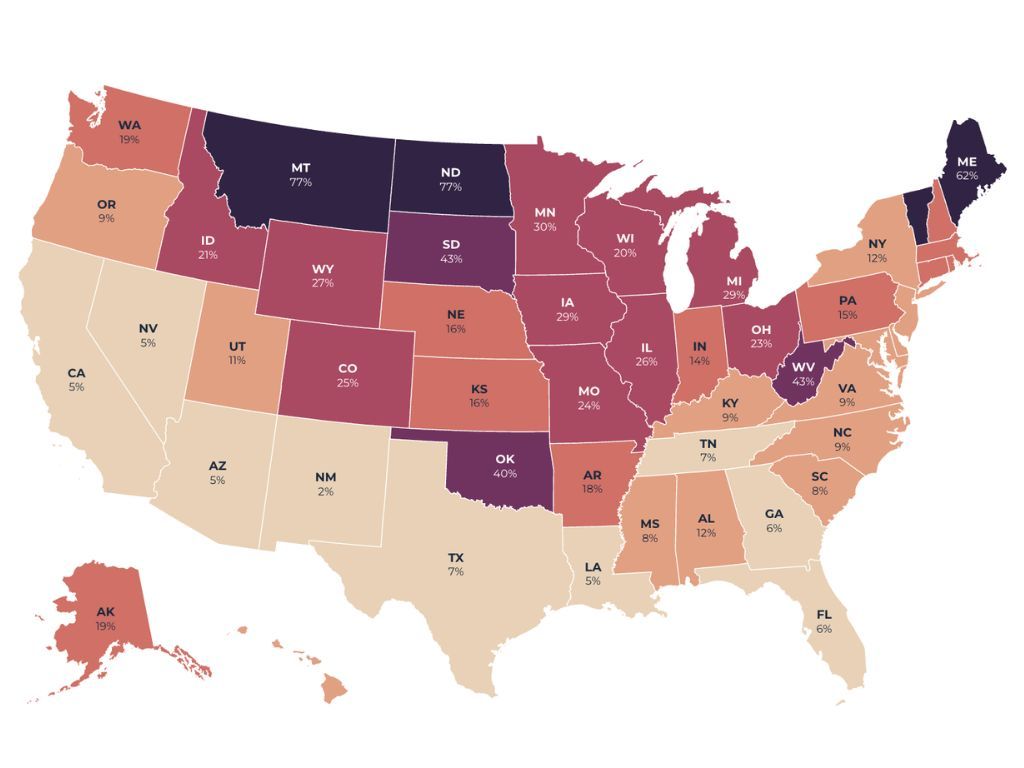
The ongoing trade war between the United States and Canada escalated again on Tuesday, as the Trump administration’s import ban on certain Canadian goods took effect. And some U.S. states are being hit harder by the dispute than others.
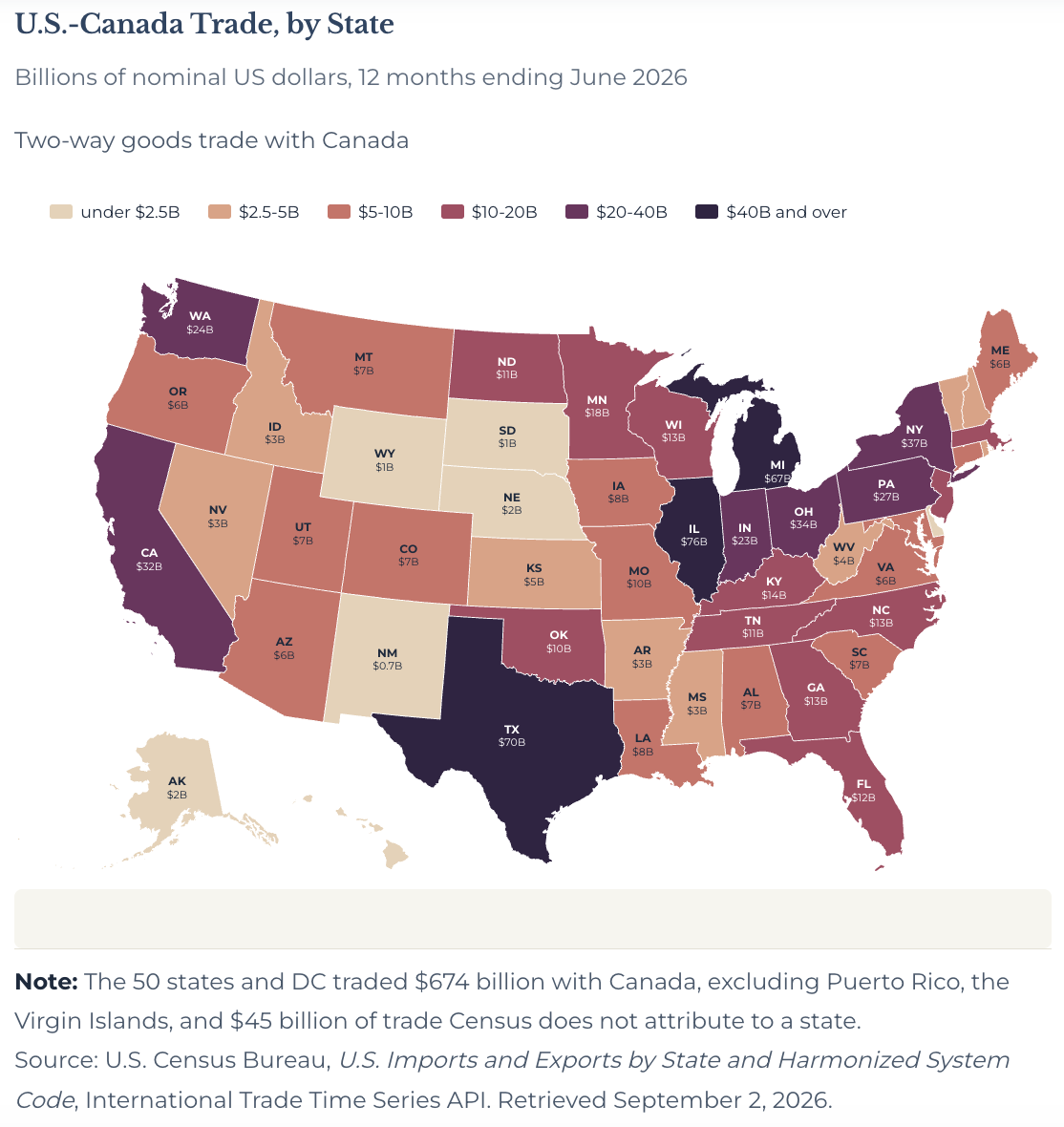
Canada is the U.S.’s second-largest trading partner , after Mexico, and according to a memo from the Advancing American Freedom Foundation (AAF), a conservative public policy organization founded by former U.S. Vice President Mike Pence, the annual volume of U.S.-Canada goods trade is US$674 billion.
But just five states account for $284 billion, or 42 per cent, of the total: Illinois, Texas, Michigan, New York, and Ohio. Illinois leads at $76 billion, followed by Texas ($70 billion) and Michigan ($67 billion). New York’s annual volume of trade with Canada equates to $37 billion, while Ohio’s is $34 billion.
However, the states with the largest overall volume of trade with Canada are not necessarily those most exposed to the economic effects of the dispute.
Analyst Kat Miller explains in the AAF memo: “A trade war with Canada will negatively impact many (U.S.) states, especially those heavily engaging in trade with Canada, including energy- and mineral-rich states, many heavy-industry dependent states, and our agricultural heartlands.”
She examined the share of each state’s total goods trade conducted with Canada, rather than the volume of trade with Canada, to provide a more accurate picture of which states are most dependent on Canada as a trading partner. Her analysis shows that the states with the highest shares are clustered along the northern border and the plains, with six of the nine highest-share states bordering Canada.
For example, North Dakota and Montana are most exposed to the impacts of the trade war, with Canada accounting for 77 per cent of each state’s total goods trade. They are followed by Maine at 62 per cent, Vermont at 55 per cent, West Virginia and South Dakota at 43 per cent, and Oklahoma at 40 per cent.

Meanwhile, several states that conduct a significant portion of their trade with Canada have become key battlegrounds in the upcoming U.S. midterms, including Maine, Michigan, Iowa and Ohio — all of which are considered a toss-up for the Senate race by The Cook Political Report .
Maine’s Republican Senator Susan Collins is among several U.S. politicians who have condemned Trump’s trade war against Canada. She previously wrote to U.S. Trade Representative Jamieson Greer and Commerce Secretary Howard Lutnick seeking clarity on the tariffs and urging a resumption of U.S.-Canada trade talks.
She has also voted in the Senate to rescind some of Trump tariffs, and successfully lobbied for Canadian rock salt and cement to be removed from the U.S. import tariff list , saying that the two products are “crucial” to Maine.
When the Canadian government announced its decision to exempt American seafood from its counter-tariff list, she expressed her gratitude in a statement , and emphasized Canada’s importance to the U.S. as a close ally and trading partner.
Approximately $170 million in Maine goods would be subject to Canada’s announced tariffs, with roughly 62 percent coming from the forest products sector. These tariffs would threaten Maine jobs and businesses while raising costs for families across our state.
— Sen. Susan Collins (@SenatorCollins) August 28, 2026
Today, I wrote to…
“When I spoke with U.S. Trade Representative Jamieson Greer this week, I stressed the negative impact U.S. tariffs will have on Maine — especially our forest, food, cement, road salt users and producers,” she said. “Tariffs will also stress municipal budgets, as small towns in Maine rely on Canadian road salt and cannot afford to incur extra costs to keep their roads safe in the winter.”
With the Senate race in Maine expected to be a tight one, key polls have varying assessments of Collins’ chances of reelection. While The Cook Political Report, Race to the White House and the Center for Politics all have it as a toss-up, NBC lists it as a Democrat lean and 270 to Win posts it as Republican lean.
At the same time, a recent Reuters/Ipsos opinion poll found Americans are about four times as likely to blame Washington rather than Ottawa for the current trade dispute. Even Republicans were somewhat split on the Trump administration’s approach, with less than half (44 per cent) supporting U.S. tariffs on Canada, and 33 per cent opposing them.
The Democrats need to gain four more seats to win back the Senate majority in the upcoming mid-term elections. Canada’s Industry Minister, Melanie Joly, has previously been open about the fact that Canadian counter-tariffs were in part designed to “target states” and “put political pressure” on the Trump administration.
Our website is the place for the latest breaking news, exclusive scoops, longreads and provocative commentary. Please bookmark nationalpost.com and sign up for our newsletters here.