BURST
BURST
Most Canadians have likely never given a thought to Benjamin Harrison, a Republican who was elected the 23rd president of the United States on Nov. 6, 1888.
But in light of Donald Trump’s proposals to annex Canada, they should. There’s a history of U.S. politicians wanting to take over the Great White North.
On Nov. 22, 1888, the Vancouver Daily News Advertiser reported “an intimate friend” of the incoming president “had reason to believe one of (Harrison’s) first official acts will be negotiations for the annexation of Canada.”
The news came out of Indianapolis, where Harrison lived.
“His idea is that the territory can be annexed to the United States by assuming Canada’s debts,” said the story. “If the territory cannot be obtained for that consideration, I think General Harrison would favour paying a considerable bonus.”
It sounds kind of wacky — the News Advertiser’s headline on the story was “Canada Amused.”
But others took it seriously. On Nov. 23, the Chicago Tribune reported that in Montreal, “it is hard to describe the sensation the (Harrison) dispatch has caused. In all the hotels it is being discussed, and at the clubs it is the sole topic.”
Still, the Tribune speculated the annexation report was a “feeler” designed to draw out opinions on the matter, rather than actual policy.
Harrison denied the annexation report, but the issue didn’t go away. On Dec. 13, 1888, a member of the U.S. House of Representatives put forward a resolution “looking to the assimilation and unity of all the people of the Dominion of Canada and the United States under one government.”
The U.S. brought in tariffs of almost 50 per cent during Harrison’s years in the White House, which some argued was designed to force Canada to join the U.S.
The big champion of the tariffs was William McKinley of the U.S. House of Representatives. McKinley was elected president in 1896 and 1900, and imposed tariffs of up to 57 per cent. He was assassinated in 1901.

The Vancouver World carried another wild story on Nov. 22, 1888 out of “Edmonton, N.W.T.” (Alberta didn’t become a province until 1905, it was then part of the Northwest Territories).
“The town is in a fever of excitement over the shooting of a policeman named Thomas Cairney by a woman named Nell Webb, who keeps a house of ill-fame in town,” said the story.
“Cairney and a couple of companions came up on Wednesday from Fort Saskatchewan, intending to go to Calgary the next day. Towards evening they started in to paint the town red, winding up in the house of ‘Big Nell.’”
A house of ill-fame was 1880s slang for a brothel.
“She refused them admittance, and locked and chained the door. Cairney and his companions then kicked the panels in, when ‘Nell’ fired through the broken panel, the bullet entering Cairney’s hip.”
Cairney was carried to a doctor and Nell was arrested, Two policemen named Watson and Casault were “placed on guard” at Nell’s house of ill-fame, but a couple of “young fellows from town” arrived and “made the guards drunk, took their arms and cartridge belts from them, and did as they pleased.”
“Casault’s arms were returned by the man who had them,” said the World, “but Watson’s were worn downtown by the other sport (until) they were taken from him by the police.”
Watson was sentenced to two months imprisonment and dismissed from the police force, Casault was “let off.” Cairney’s wound was said to be serious: “if he recovers he is likely to be a cripple for life.” There was no further information on what happened to Nell Webb.
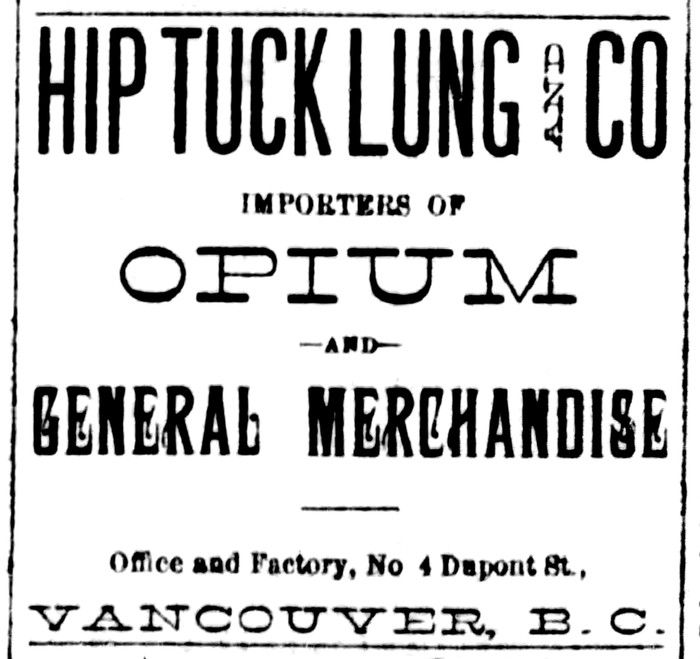
There is also an ad in the Nov. 22, 1888 World for Hip Tuck Ling and Company at 4 Dupont, “Importers of Opium and Other Merchandise.”
Opium was legal in Canada until 1908, but appears to have been frowned upon. On Nov. 23, the News Advertiser reported Fook Chung Lung had been charged “with infraction of the opium bylaw.”
Licence inspector Huntley told the court “Illicit trafficking in opium was causing the police much trouble and annoyance.” A man testified that he had purchased five pounds of opium off Fook Chung Lung at $8 a pound, and Huntley said Lung “had never procured a licence.”
But the case was dismissed.