 BURST
BURSTLots of monopoly news, as usual. A pollster finally asked about general approval ratings about AI, and it’s what you’d expect. Tyson’s is closing more meatpacking plants, a good appeals court decision on right-to-repair, and Apple keeps demanding the right to overcharge developers in its app store despite losing at the Supreme Court twice.
Before getting to the full round-up, I want to go over something that is a pretty common tool used to push back against populist policy - the capital strike. That is when an employer or financier uses their ability to withhold capital to threaten a political entity in order to secure desired policy changes. In the 1920s, then-Treasury Secretary Andrew Mellon explained the basics: “Just as labor cannot be forced to work against its will, so it can be taken for granted that capital will not work unless the return is worth while.”
We are seeing this situation play out right now, as Paramount CEO David Ellison has told executives at his company that he will move the studio out of California if the Attorney General, Rob Bonta, does not allow his merger with Warner Discovery. He is also threatening to move CBS out of New York City to punish New York Attorney General Leticia James.
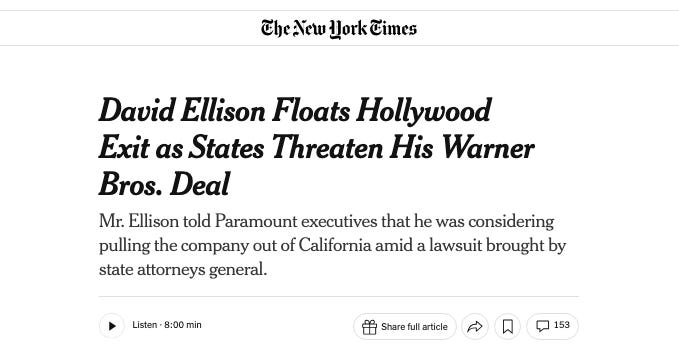
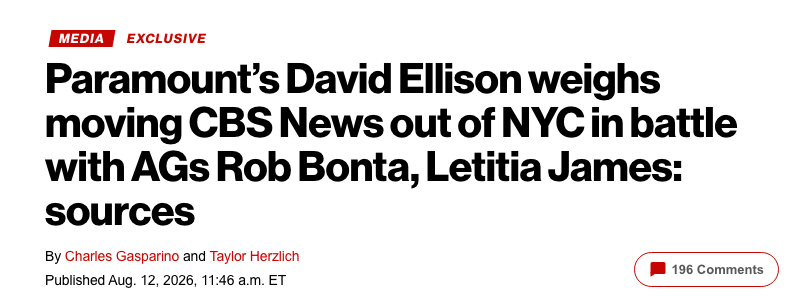
Paramount’s board has approved the plan. The idea is they would sell the iconic 65-acre Paramount lot in Hollywood to fund the relocation expenses. If they do end up winning the antitrust case, they would also sell the Warner campus in Burbank. It’s a stark turnaround from a few months ago, when Ellison was pitching himself as the savior of Hollywood.
The move reflects a sense of desperation, as the LA Times put it. It has potentially embarrassed the California Attorney General, Rob Bonta, and hardened the resolve of the judge, Araceli Martínez-Olguín. One research firm in D.C. that works for asset managers titled their piece on the situation “Ellison’s Ego Ends Near-Term Settlement Prospects.” Ouch.
The strategy here is risky, moving a headquarters of an industry a thousand miles away from the factory floor tends not to work out. One of the key signs, for instance, of Boeing’s decline, was when the aerospace company moved its headquarters from its factory town of Seattle to Chicago. The same would likely be true here; Paramount executives are creative and accomplished, they exist within an ecosystem of producers, writers, editors, actors, technologists, animators, sound engineers, musicians, and directors who can make great content, as well as a set of distributors, exhibitor and marketing specialists, financial planners, agents, talent managers, and so on and so forth who make the business work.
Can you really rip them from Los Angeles without a significant cost? And can you do that while promising to make 30 movies a year? Moreover, isn’t this threat suggestive of the actual power that comes along with the merger? That is, doesn’t it show exactly why it’s a problem for these companies to combine, if Ellison is going to use his might to attack the state of California itself?
That being said, I don’t know that the threat is real. But it’s certainly possible, not because of rational economic sensibilities but because the child of an extremely rich man has access to hundreds of billions of dollars of capital based on political connections. Indeed, merger arbitrage specialists have pushed up the stock of Warner to six month highs, indicating confidence on Wall Street it’ll close.
Ellison has used this threat to create a schism within the union world in California, with the Director’s Guild and IATSE both supporting the merger. Those unions are known to be weak and non-representative of their members, but these kinds of moves do matter politically.
But in addition to being interest in and of itself, the Ellison threat is a useful lens to understand what will happen as the populist wave crashes into an entrenched class of oligarchs. After all, right now, there are virtually no examples of challenging billionaires directly, the Paramount-Warner example stands alone. But that will soon change, and we can expect similar reactions from Ellison’s cohort as they face real democratic pushback.
What could this rolling set of conflicts look like?
Let’s go back to Andrew Mellon, who was Treasury Secretary but also the owner of the aluminum monopoly, Alcoa. In 1930, when Democrats in Congress tried to lower the protective tariff on aluminum imports from five to two cents a pound, New York Senator Royal Copeland got a threat which caused him to change his position. If that tariff change happened, Alcoa would offshore its production to Canada. Copeland said the “people of this country are at the mercy of this monster monopoly, no matter what we do.” It was on “account of fear of the power of this corporation to bring distress, poverty, and unemployment to the American toiling masses” that he reversed himself, and maintained the tariff, and Alcoa’s profit margins, at a high level.
Ultimately, New Dealers did break the power of Alcoa, but it took until the 1940s to do that, with a ground-breaking antitrust case, explicit government investment in new aluminum companies, and bauxite and power resources from public lands. The capital strike in 1930 did block the reduction in tariffs, because Mellon had the capital, and the government didn’t develop an alternative means of delivering aluminum for years.
Ellison is offering a faint echo of Mellon, but he’s not the only one. Indeed, the return of oligarchy in America has also returned the threat of capital strikes. Here are a few other examples.
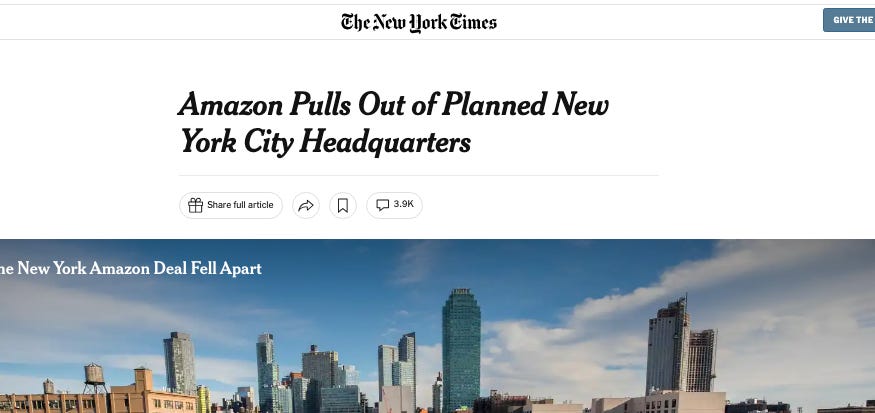
In 2019, Jeff Bezos had Amazon pull out of its proposed “second headquarters” in New York City due to pique that certain New York politicians thought the company did not deserve its $3 billion in subsidies. Bezos had earlier asked cities to put on a beauty contest to see who might be most attractive to Amazon for its HQ2. Put all your subsidies and infrastructure on the table, and we might choose you.
Over 200 cities bid, but it was clear the fix was in, Amazon awarded both New York City and Northern Virginia parts of its HQ2 plans. And clearly that was because Bezos himself wanted to spend time in New York, and because being near the Pentagon in Northern Virginia was good for securing government contracts.
Progressives in NYC, such as AOC, protested the award of subsidies, so Bezos canceled the HQ2 plans. He did follow through on the threat, but with a twist. A few years later, Amazon also laid off large numbers of its workers in Northern Virginia, as it had simply over-hired. The notion of a “second headquarters” never actually made any sense in the first place. And the company kept bringing in more staff in New York City, because it’s a big place with lots of customers.
More recently, there’s Ken Griffin, who runs Citadel.
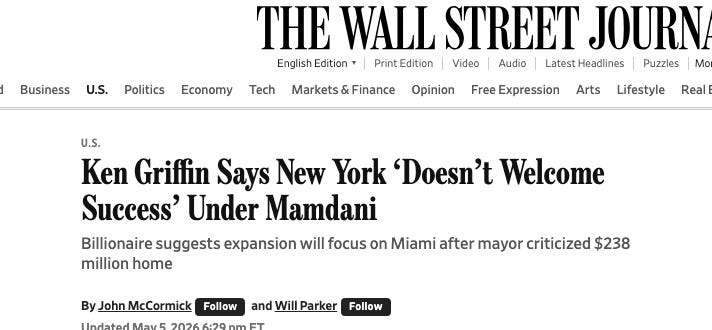
Over the past few weeks, New York City mayor Zohran Mamdani has been proposing a tax on vacation homes in New York City to balance the budget. As part of this campaign, Mamdani did a video outside Citadel billionaire Ken Griffin’s apartment, which Griffin had purchased in 2019 for $238 million.
Griffin went on a rampage, organizing the New York Governor, much of the New York City press, and even Donald Trump, to harass Mamdani. He claimed that Mamdani had put his life in danger, and threatened to move more of his operation to Miami as a result. “Mamdani is making it really clear: New York doesn’t welcome success,” he said.
People in the business press began referring to Mamdani’s gaffe, mistake, or scandal. A public assault of this ferocity for something so mild is unusual, and Mamdani’s people were no doubt questioning themselves. Did Mamdani do something wrong? Did they go too far? Of course, the answer is no. This kind of campaign is typical, a mild criticism of the wealthy leads to exactly this dynamic, a kind of mass gaslighting.
And sure enough, last week, Griffin said key projects would be staying in New York City, because the city is just too valuable for his investments to go elsewhere.
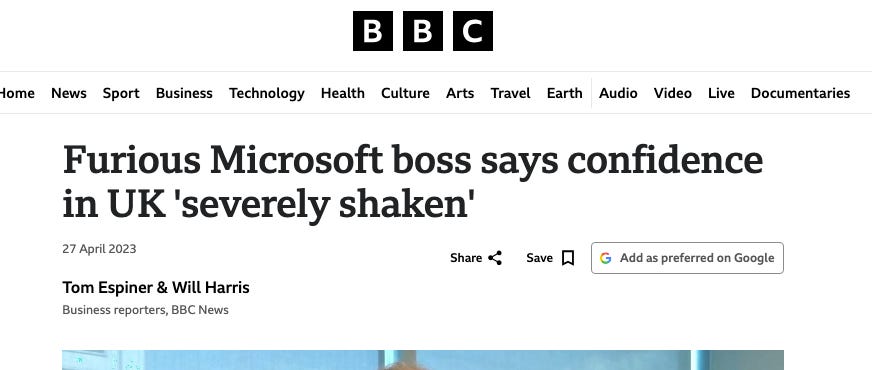
But just because these capital strikes didn’t work doesn’t mean the threat isn’t real. The final example I’ll use is when the UK’s competition authority sought to block the Microsoft-Activision merger. Microsoft President Brad Smith then threatened to pull investment out of the UK, which lead antitrust enforcers to reverse course. Then the Labor Party put the head of Amazon UK in charge of its antitrust shop, and constrained its ability to stop mergers. In other words, Microsoft broke the sovereignty of a nation to get its video game merger through.
Get ready for a lot more of this dynamic, because we now live in a society where a small number of firms and individuals command trillions of dollars in capital, with tight control of intellectual property and infrastructure. Of course, it’s conceptually easy to destroy these threats of capital strikes, the government could simply supply capital when the superrich balk. That’s why what Mamdani is doing with grocery stores is so infuriating to the rich. You’d also need to break monopolies, weaken copyright and patents, and generally impose public utility rules on vital infrastructure.
The answer, in other words, is democracy. But if you go to Hollywood right now, you’ll find some workers who now want the Paramount-Warner merger to go through, because they believe it’ll keep jobs in California. Threats work, at least until we stand up to them and win.
And now, the full round-up, after the paywall. Some fun stories. The Trump antitrust enforcers are investigating electronic health records monopolist Epic Systems, California blocked a big Western Union-Intermex money exchange merger, the private equity guy running the Pentagon wants to force-fee Palantir more money, and Trump gave his own crypto company a banking charter to get access to the Federal Reserve system. What could go wrong?