 BURST
BURSTThe monopoly round-up has lots of news, as usual. A judge just held up a middle finger to Trump FCC Chair Brendan Carr and blocked a major media merger, Israeli Defense Force soldiers are obsessed with betting on their own military operations, and Australia banned social media for kids under 16 with fascinating results.
But before getting to the full round-up, I want to focus on something obvious, but still worth pointing out. And that is, the historic supply shock resulting from the war in Iran is causing prices of all sorts of goods to go up. It is also increasing the cost of money by raising interest rates, throwing financial markets into chaos.
Most of the follow-on effects of this supply shock are bad, with living standards across the world set to decline. But there’s one upside. Unlike previous crises that were accompanied with bailouts, the superrich and the politically connected are not insulated. There is, for instance, a drop in merger financing, which will hurt such deals as the Paramount-Warner combination. And this shock is likely to discredit political leaders worldwide, especially those aligned with the man who kicked off this war - Donald Trump.
And we’re only at the beginning. Let’s dive in.
The Public Is Expecting Short-Term Trouble
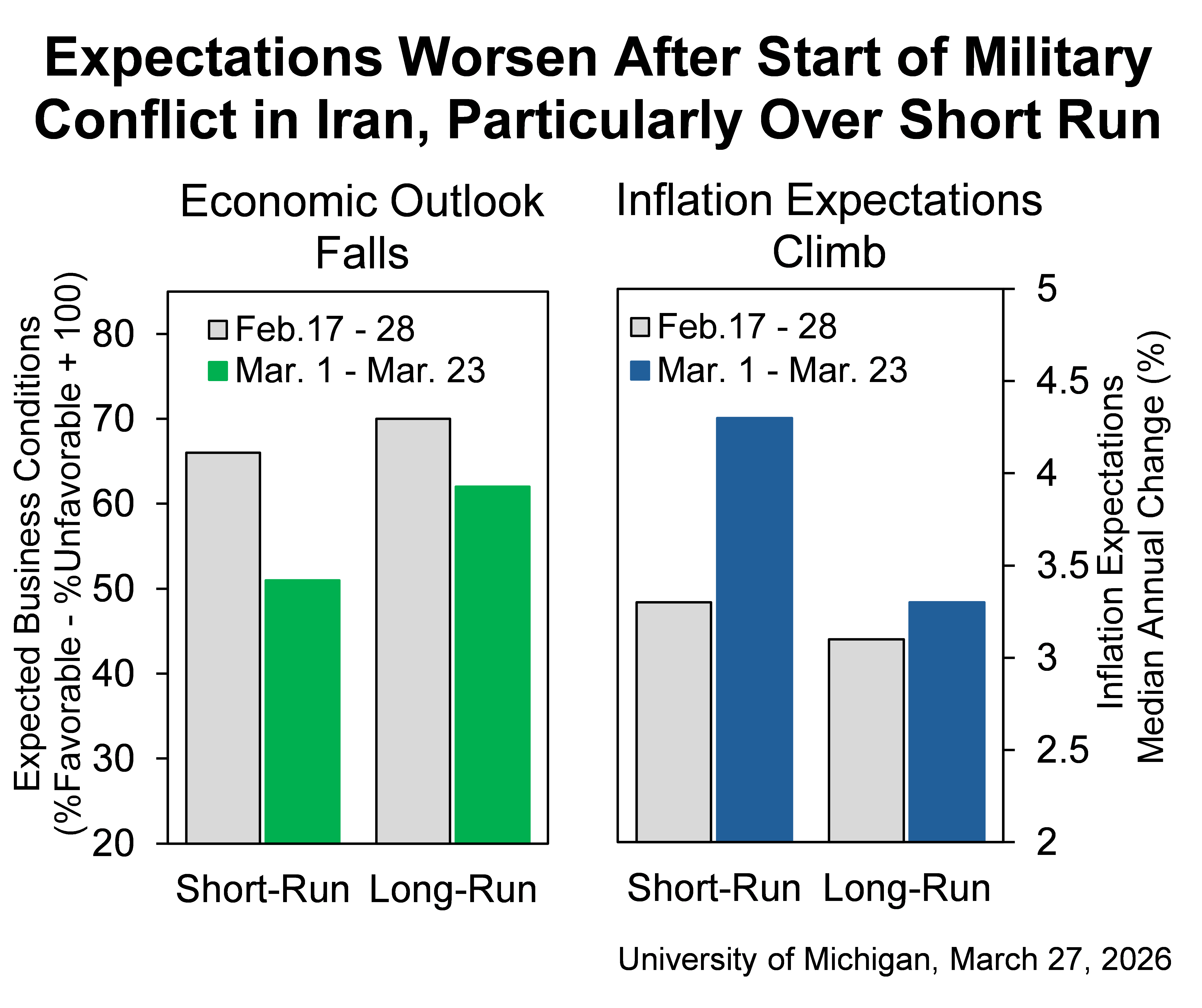
Every month, the University of Michigan releases consumer sentiment numbers. On Friday, sentiment metrics came out for the first time since the Iran war started. And it showed lows usually seen during deep recessions. Joanne Hsu, the director of surveys, noted that “declines were seen across age and political party,” and were especially large among “consumers with middle and higher incomes and stock wealth.” Basically, normal people understand this war as bad for their pocketbooks.
And they are expecting price hikes. Inflation expectations are up, “from 3.4% in February to 3.8% this month, the largest one-month increase since April 2025.”
The public is right. Prices are going up.
Oil, Gas, and Adjacent Products
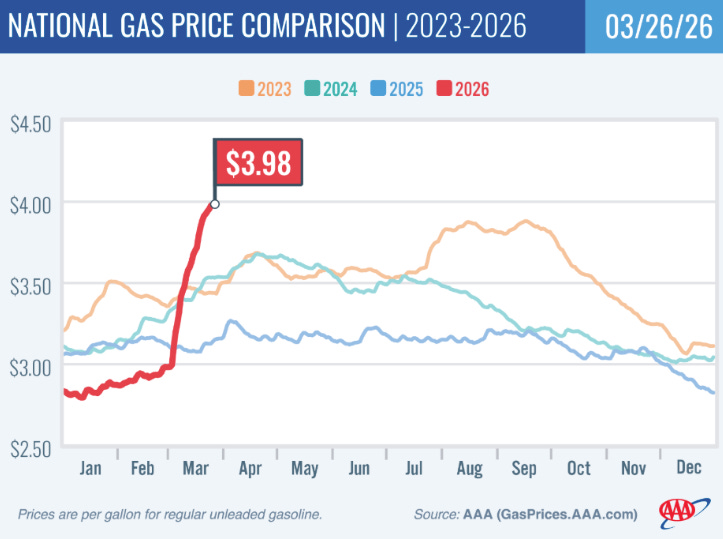
20% of the oil produced globally, as well as large chunks of gas, and fertilizer, come through the Strait of Hormuz. And that waterway is virtually shut, with a tiny fraction of normal traffic coming through. And that’s hitting America, even though the U.S. has our own domestic supply of oil and gas. The price of gasoline, an oil byproduct, jumped by a dollar in the last month. Diesel too is skyrocketing. These are key input costs to transportation, which goes into everything that physically moves.
Then there are the downstream refiners of oil and gas outside of fuel. Let’s start with something used in virtually everything - plastics. On Tuesday, chemical giant Dow announced it is doubling its price increase for polyethylene resin in North America, the key input into packaging, plastic bags, detergent bottles, cups, jars, automobile fuel tanks, clear food wrap, synthetic fibers, etc. Everything from meat to fruit is wrapped in plastic. For a frame of reference, the world uses 600 billion plastic bottles for water alone.
Random things like flame retardants are going up in price, ink producers are getting ready to lift what they charge, and restaurant supply giant Ecolab is hiking prices. Even the U.S. Post Office put a historic 8% energy surcharge on packages.
Are these price hikes necessary? Probably. But as we’ve seen in the Covid greedflation episode, they are also a great excuse for some profiteering. For instance, Dow’s stock jumped by 6% upon announcing its extra price hike on plastics, and its stock has increased by 25% since the war. I’m guessing Dow is pegging its price hikes at the higher end of its estimated range for what is “necessary.”
Non-Iran Price Hikes
Some price hikes have nothing to do with Iran, but are baked in through preexisting use of market power.
Netflix, which has obvious market power, just raised its fees by $1/month for its ad-tier, and $2/month for its ad-free tiers, a little over 10% in aggregate. Wall Street analysts called that hike “good news” and “a welcome relief for investors.” The subscription of video services sector of the Consumer Price Index has increased by 15.2% in the last year.
Utilities, having increased prices dramatically over the past year, and are continuing to do so. Very few use oil directly, and the natural gas they use mostly comes from the U.S. So they are hiking because they have convinced regulators to give them excessively high shareholder returns.
Electronics producers in general have been warning of 20% increases in price as a result of AI data center demand for memory chips. Sony is now charging $650 for its PS5 game console, up from $550, due to higher DRAM prices. Analysts are already expecting Nintendo and Microsoft to follow.
I’m guessing we’ll see a lot more here, in random places like uniforms, security services, waste disposal, industrial gasses, and among economic termites across the economy.
A Higher Price of Money
Then there’s the cost of money, or the interest rate, which is the key input for Wall Street. The main Trump economic strategy has been to keep interest rates down, and they are at a virtual war with the Federal Reserve over how to do that. The specific rate they care about is the 10-year Treasury Note, the rate at which the government borrows from investors for a term of ten years. That particular instrument is, according to Trump Treasury Secretary Scott Bessent, “probably the most important rate in the country, since mortgages and capital formation are based on it.”
The Iran War has wrecked their strategy, with the 10-year jumping from 3.96% in late February to 4.42% on Friday. The consequences are just beginning. Mortgage rates have increased, the cost of buying a home is up, and as a result, mortgage applications are down. In the financial markets, a host of shadow banks - Apollo Global Management Inc., BlackRock Inc. and Ares Management Corp - have told investors they can’t have their money back. These companies often lend money for acquisitions, which means the mergers and acquisitions market is likely to have trouble.
Take one particularly leveraged buy-out that we’re interested in, which is the attempt of Hollywood studio Paramount to buy Warner Brothers. That $110 billion deal is funded by Oracle billionaire Larry Ellison, a host of U.S. private equity funds and banks, and the Saudis and Qataris. When Ellison first bid, his net worth was $388 billion, a shockingly high number. Oracle stock, however, has since cratered. He is now worth “only” $188 billion, down over half since last September, and down $60 billion this year alone.
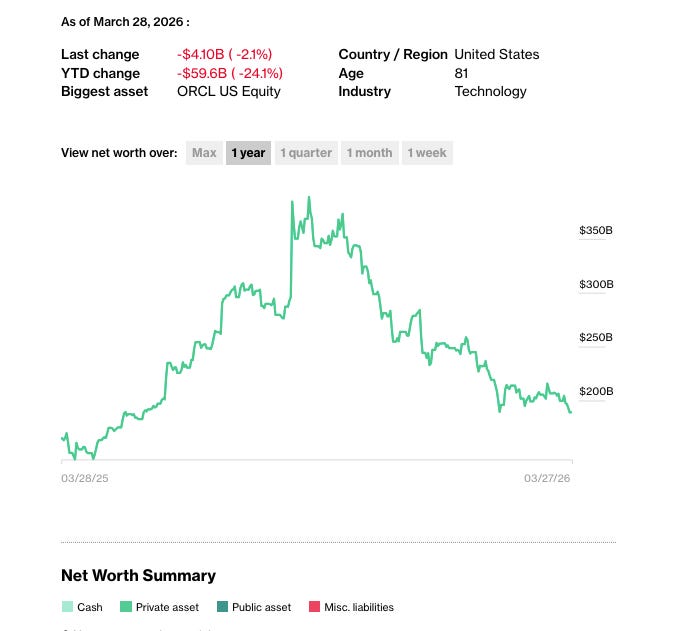
Ellison had about 30% of his Oracle shares pledged as collateral for loans for his lavish lifestyle, like owning various islands and mega-yachts, as well as the original acquisition of Paramount. He pledged another $40 billion to backstop the Warner deal. In other words, the backers of the roll-up of Hollywood - Larry Ellison, U.S. private equity funds, and Arab investors - are all having financing trouble right now. Will that hinder the Warner deal?
One way to tell whether investors think a deal will go through is to look at the difference between the price of a takeover bid and the current market price of the stock. If speculators are totally confident the deal closes, then there should be no difference. After all, if someone pledges $10 for a stock and that’s a guaranteed price, why would anyone sell their stock for less than that? However, if there’s concern that a deal won’t close, then investors will demand a discount. They might pay only $9 even though the bid is $10. In general, the bigger the discount, the less confidence it closes.
When Paramount won the auction, the bid price was $31 but the stock traded at $29. That’s a reasonable discount, enough to suggest there was some doubt among arbitrage specialists. Since the Iran War started, however, Warner stock has fallen further to $27. Despite this significant discount, a whole series of insiders, including Warner CEO David Zazlov, have sold large parts of their stock holdings. It appears that Warner insiders are not as confident the deal closes as they are saying publicly.
Now, if that deal can’t close, then a lot is going to go wrong in the plumbing of finance. So watch it closely.
The Theme from Jaws
Like you, I feel queasy about this moment. It is impossible to understand the full impacts of a supply chain crisis and geopolitical shift like the one we’re seeing unfold, and it is obviously still early. The Dow is down by just 10%, when a similar supply shock in the 1970s led to a drawdown of 50%. We haven’t experienced shortages yet in America, the shortages are just starting to hit Asia and Europe. But they will be here soon.
Even so, the entire leadership class is likely to be discredited in a fundamental way. Trump’s net approval rating is at a record low for his second term, but it is still at roughly 40% approval and 60% disapproval, which is in the normal bounds of an unpopular Presidency. That is almost certain to crack as things worsen, his base flees, and politics gets very weird.
It’s always possible that there’s a peace settlement of some sort. Or some angle I’m not seeing. But barring that, I’m not sure how an angry country reacts to a discredited leadership, a wounded Wall Street, desperate billionaires, and a struggling military. None of us have ever seen anything like that before.
In the meantime, what are you noticing in your neck of the woods? Are you seeing prices change? Are people still spending? Are there jobs? What’s it like out there?
And now, the rest of the monopoly round-up. Lots of important stories. A judge held up a middle finger to Trump’s main media regulator, Brendan Carr, as Trump’s aggressive attempt to reward companies for banning Jimmy Kimmel backfired. It appears that this judge, prompted by Democratic state attorneys general, will likely block the broadcast merger of Nexstar-TEGNA. In other words, Democrats actually did something useful and courageous to address corporate power, and a judge reacted well to it. Weird, I know.
Also, the Colorado House passed the first bill banning surveillance pricing, Australia banned social media for kids under 16, and juries nailed Meta and Google for faulty product design. In less good news, the Fed is allowing Morgan Stanley to take $85 billion of taxpayer money and gamble with it, Americans are obsessed with pornography, and Trump now has some Democratic allies in passing bad AI rules. Oh and Israeli soldiers are now gambling on war in prediction markets.
Read on for more in this very weird time.