 BURST
BURST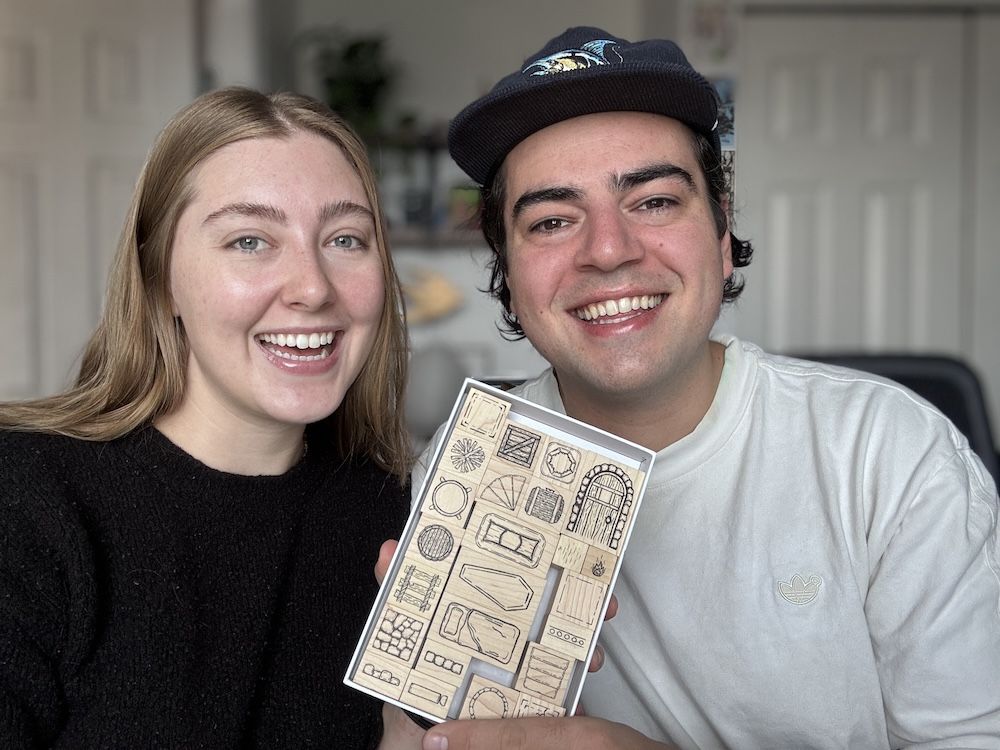
Jacob Harris was lying in that netherworld of consciousness, the fitful intermediary state between sleep and wakefulness, when inspiration struck. Suddenly awake and energized, he shared his idea with his sleepy wife — who predictably didn’t share his ill-timed excitement as she rolled over and groused at him to go back to sleep.
This wouldn’t be a woozy moment of forgotten genius . He didn’t go back to sleep, his mind racing and bouncing like a icosahedron dropped off a table. The seed of what would become his viral success had been planted.
It’s been seven months since his idea — a stamp-based tool kit that helps Dungeons & Dragons players create detailed maps using ink and paper — went from idea to prototype to Kickstarter platinum. The product, Tabletop Stamps , went live on Kickstarter on Nov. 11 with a goal of $14,000.
It hit that mark in 35 minutes. This past Saturday, it had reached US$223,000 .
“It was incredible. Definitely super surprised and super grateful,” said Harris, who lives in East Van. “I had an inkling that it would go well because I was doing videos that were doing views on Instagram before we launched.
“I knew there was a market brewing,” he added, saying one IG reel cracked 1.4 million views . I just didn’t know it would be this hot. The support’s blown us away.”
Another day, another dungeons @Wizards_DnD #dungeonsanddragons #dnd #boardgames pic.twitter.com/EHVXtSZd0R
— Tabletop Stamps (@tabletopstamps) October 19, 2025
His wife, Karoline Moore, was the unwitting inspiration for the idea, coming home from her weekly crafting meeting with some linocut materials. Once she heard the idea, she was fully invested and they began figuring out the next steps.
“Neither of us have any tangible experience in this,” said Moore, who just finished her master’s in environmental studies at UVic. Harris works in the film industry as a focus puller.
“We’ve just been shaking our heads, wow, this is crazy. The whole process has been kind of, like, figuring it out as we go. And it’s really been Jacob doing most of the figuring out. He’s been so in Stampland; it’s been kind of all-consuming, but also so undercover at the same time because we were sharing it on social media. There wasn’t any real material. We hadn’t sold anything. It was all ideas until we released the Kickstarter, and just like that it blew up.”
Dungeons and Dragons has been around since the mid-1970s, but shed its early shell of a refuge for nerds, or a target for rabid Christians accusing it of being Satanism disguised as a kids game.
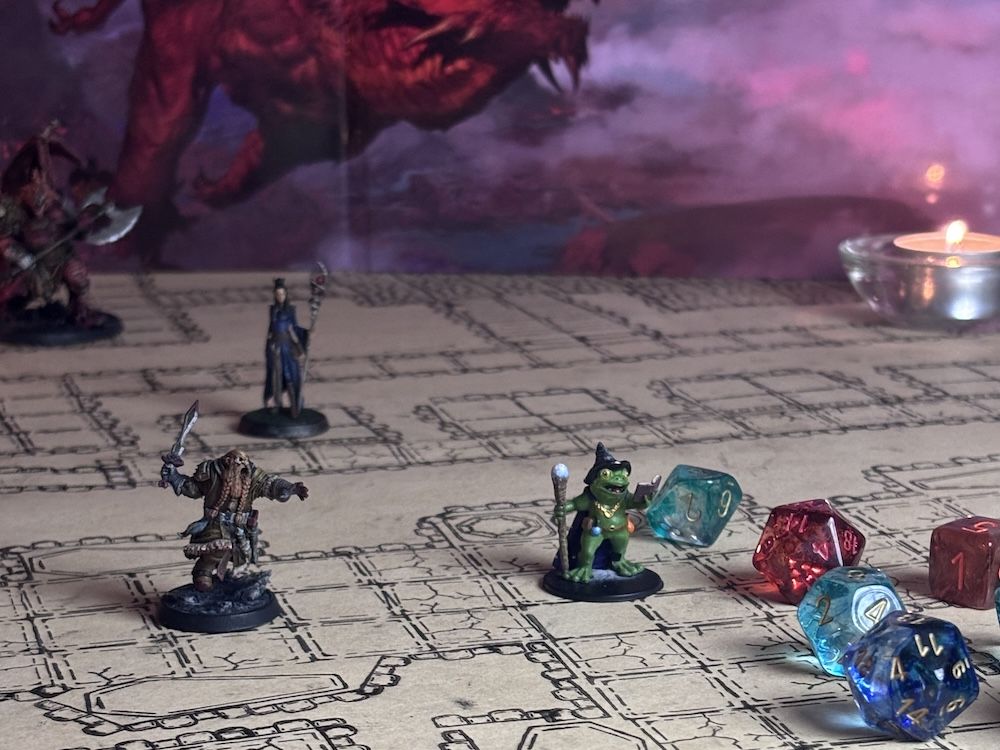
In its distilled form, the game requires dice — including the D20 icosahedron — paper, a pencil, and friends with some imagination. A board or map is nearly essential in helping visualize the story as it unfolds, but can take hours to draw or construct. Harris and Moore’s stamps streamline that process.
“It can kind of feel like a full-time job if you get super obsessively into the prep of it. And that’s where I was,” said Harris. “It can take hours.”
The morning after waking up with his idea, Harris carved one from the linocut materials from the night before. Soon, he had sketched out all the icons on his iPad and taken them to Maker Labs in East Van to use their laser cutter.
Once he’d had proof of concept, he found a manufacturer to produce wooden and clear acrylic versions.
Kickstarter is full of D&D projects for funding, including some products that fill a similar niche to the stamps, like a traceable map product that has also found traction with backers on the website.
But Tabletop Stamps is the hottest item.
“I think I fit in an interesting point,” said Harris. “These stamps are really different for a lot of people. It’s something that they’ve never seen for the game. And a lot of people are commenting: ‘Oh, man, I wish I thought of that. It’s so simple.’
“In terms of the competition, I think there’s lots of room in the D and D space for tons of different products, because there’s ultimately, so many different ways that people like to play the game.”
D&D has grown up and muscled into the mainstream. The Netflix hit Stranger Things begins with four boys playing the game in the 1980s, and figures prominently in the show. The game has had a resurgence as people have moved away from the social firewalls in exchange for face-to-face, real encounters.
“I think we’re starting to push back on it a lot,” said Harris. “I think, in the next few years, we’re going to see a lot of people — even more so than previous — want to unplug and get away from technology.
“D&D offers that break for people. It’s nice to be able to create for it without having to use your computer. I think that part has been really resonating with people, having something that’s tactile in the (digital) world.”
It’s nice to have something that you can actually put your hands on and put a little bit of humanity into, Harris added.
“The maps aren’t necessarily perfect, but that kind of gives it like a deeper sense of immersion. It makes it human.”
D&D and other tabletop role-playing games are part of such a huge world, but that world is also self-protective and insular “because of the kind of connotation that it’s weird and nerdy and embarrassing and whatever,” said Moore.
“It’s cool to be able to do a product that caters to those people. It’s cool … nerd culture is becoming more accepted.”
Moore met Harris at a Thanksgiving party three years ago, and invited Harris to their weekly D&D game. Soon, her character — a lightning-bolt hurling frog druid with poisonous skin named Todd Cabbage — was adventuring alongside Harris’s intelligent yet forgetful wizard prone to Klaatu Barada Necktie type moments.
A research-fixated Moore said she’d read some doctoral theses on how D&D provides a sense of community.
Getting to play somebody else in a fantasy world helps people work through decisions, Moore said, adding the theses explored how “women and gender-diverse people find D&D to be a space where they can really be who they want to be, test it out in that setting, and then kind of take that into the real world.”