 BURST
BURSTLots of monopoly news, as usual. The pro-monopoly Attorney General Pam Bondi was fired, Sysco is buying Restaurant Depot in a crisis for restaurants, and rents are dropping in Arizona after RealPage’s algorithmic cartel arrangement was busted up.
There’s a lot more in the news round-up, but I want to focus on an announcement this week from former Federal Trade Commission Chair Lina Khan. She is co-founding a new academic institute, the Center for Law and Economy, at Columbia University. The center will focus on the way “law and legal institutions structure the economy.” As such, it’s a useful moment to spend a bit of time looking at the long-term institution building of the anti-monopoly movement, and how it is addressing the democracy crisis in America.
Khan, of course, isn’t alone, she’s leading a movement. For instance, the Fordham Law Review just did an entire issue on Antitrust Law and Oligarchy, with articles by a host of former Biden officials. What these twin intellectual events show is that the movement to tame anti-democratic forces in America is growing, under the radar, in powerful ways.
Let’s get into it.
In 1964, Robert Bork, Milton Friedman, and George Stigler were all advisors to the conservative Republican Presidential candidate Barry Goldwater. It was the height of the Civil Rights movement, and if Goldwater lost, the government was sure to take over parts of the health care system. Corporate America would continue to lose power, receding in importance as it had for thirty years, since the New Deal. The President, Lyndon Baines Johnson, even called himself “LBJ,” mimicking the three letters that his idol, Franklin Delano Roosevelt used, FDR.
Sure enough, their nightmare came true. Goldwater was smashed, the government created Medicare and Medicaid, and the environmental, consumer rights, and women’s rights movements rewrote the American order. But Bork - a former Marxist - was not discouraged. Shortly after the election, he wrote a letter to a friend at Kirkland and Ellis, a major corporate law firm. “I am not as discouraged as people think I should be,” he said. “I think our general attitude should be that of the Bolsheviks after 1905.”
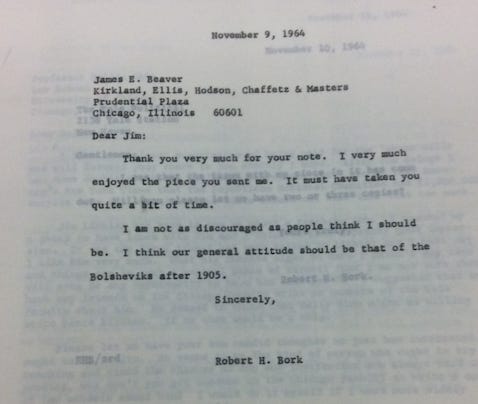
I found this letter in the Bork archives, and it shocked me because it shows just how radical Bork truly was. He hated the mid-20th century American system, and sought to overthrow it, as Lenin had the Russian monarchy.
He didn’t seek to do it via armed conflict, but through intellectual work, historical excavation, and organization. His movement told a different story about America than the populist stories animating the New Deal world in which they found themselves. To them, it was the power of concentrated capital that led to prosperity, not the ‘populistic’ regulations and antitrust laws regulating corporate America.
For Bork, the period of the mid-1960s and into the 1970s was a time of institution building, with allies constructing a host of organizations, from the Heritage Foundation to the Law and Economics Center to the Olin Foundation. They did not eschew governing, advising California Governor Ronald Reagan and building arguments cited by the judiciary. They encouraged a host of legal changes and helped the Nixon administration across the board. But they spent a lot of time on intellectual work, actually identifying the laws they wanted to reform, and building an new legal historical framework.
In the 1970s, the U.S. went into crisis, defeated in the Vietnam War and with its corporations losing market share to Japanese and European firms. The regulatory system was built on low interest rates, but then high rates and a series of financial shocks dealt blows to railroads, banks, and auto companies, with Penn Central and Chrysler needing massive bailouts. No one seemed to have any answers, except Bork and his crew. Just release the power of capital, they argued. And America listened. When Reagan came into office, he empowered Bork’s law and economics movement, and radically upended how we organize our society.
Significant change often comes to America through such methods, long-term patient intellectual and political work. Today, it’s worth looking at the anti-monopoly movement in this light. That movement emerged from the financial crisis of 2008. For a decade, they resurrected the pre-Bork legal and historical scaffolding, and under Biden, for a few years, they governed.
They inherited a world created by Bork-influenced law and economics thinkers, who pursued an agenda of deference to powerful corporate interests. It’s hard to overstate the lawlessness of what Bork accomplished. From Reagan onward, antitrust enforcers and judges simply erased or did not enforce laws they didn’t like.. They found ways, through judicial fiat or administrative repeal of statute, to impose their vision of corporate-friendly lawlessness. They even said it in secret campaign material.
When Lina Khan took over the FTC and Jonathan Kanter helmed the Antitrust Division, they brought back the rule of law itself. Instead of using guidance from theoretical economic models involving price theory, they focused on statutory text, Congressional intent, and precedent. Khan resurrected unenforced laws, such as the Clayton Act prohibitions against exclusive deals and tying, as well as price discrimination and unfair methods of competition. Kanter restored criminal monopolization law, and bans on interlocking directorates. Both wrote new merger guidelines that were organized around case law, instead of economic theory. Indeed, they were criticized for relying too heavily on law instead of “expert opinion and economic scholarship.”
And now, out of office, comes the institution-building piece, where the Biden era enforcers, now with experience, make their case for a much broader and more aggressive policy approach.
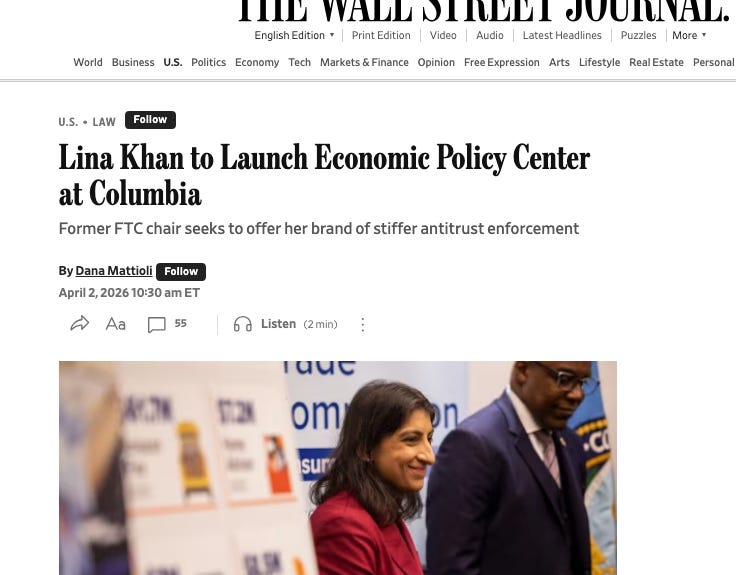
This week, Khan established a new economic policy center with financial expert Lev Menand. This new center has a host of important scholars on the advisory board.
There are a lot of parallels with earlier inflection periods. The old order is clearly dying, and has no answers for what confronts us. Corporate America is financially successful, but operationally decrepit, as the pursuit of monopolization has wholly replaced any attempt to produce useful products and services. China clearly offers superior and scalable production across most areas. And the American public has lost its faith in the current framework, with record low metrics on faith in institutions.
Khan’s new center is part of a set of nascent institutions, from plaintiff law firms to think tanks like the Vanderbilt Policy Accelerator and the Center for Public Enterprise and Employ America to media outlets like More Perfect Union, Breaking Points, Drop Site, and the Lever. These entities are mostly left-wing or center-left, but the ideas are being adopted and copied by the right. For instance, American Compass is putting them forth with a more conservative and corporate friendly valence, though with little influence on the Trump administration.
These entities are reordering how we think about macro-economics, antitrust, and economic policy. For instance, four scholars just published the first new textbook on public utility regulation in 25 years. And there are impacts in the old guard; Chris Hughes and Joshua Younger wrote an important paper for Brookings on the Federal Reserve’s new monetary policy tools, alleging they offer a $200 billion annual subsidy to banks. That subsidy is likely why the U.S. banking system, despite taking huge losses for the bonds on their books due to higher rates, is still solvent. This paper prompted a fierce reaction from former Vice-Chair of the Fed, Don Kohn.
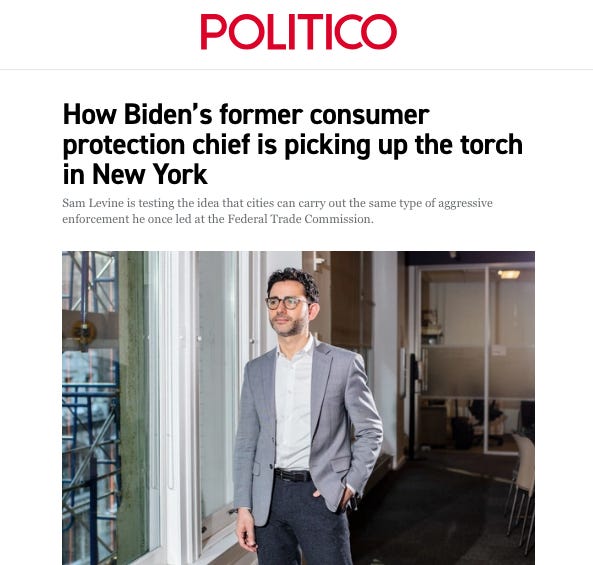
What unites this new set of thinkers is a shared view that the U.S. model of high finance-driven growth is immoral and unsustainable, and that what corporations and governments do should focus not on shareholders but on improving the welfare of the American public. A new set of politicians is also emerging, such as Zohran Mamdani in New York City, Graham Platner in Maine and Ruben Gallego in Arizona. These people are also jettisoning the old guard; Gallego called Merrick Garland a “coward.” And Mamdani’s head of consumer protection is Sam Levine, a key leader at the FTC under Khan.
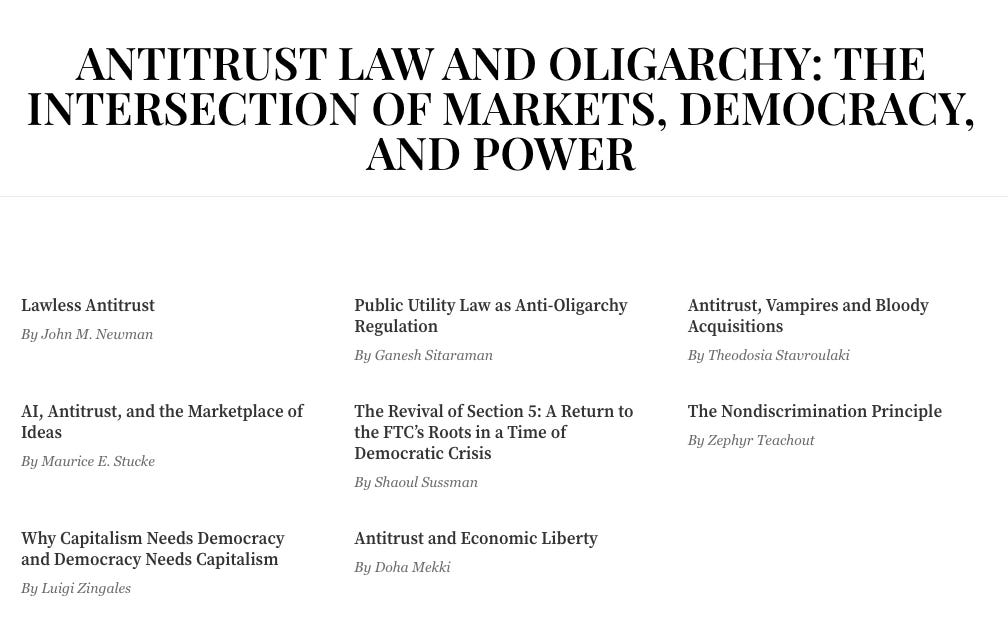
A reasonable tour of the intellectual landscape is in the Fordham Law Review, which just published an issue on the crisis of democracy and how it relates to corporations. It includes important articles from former acting Assistant Attorney General for Antitrust Doha Mekki on the link between civil rights and antitrust, a description of the lawlessness characterizing the old model of policymaking from enforcer John Newman, and arguments about nondiscrimination, legal doctrines on fairness, and the economic case for more democracy in capitalism.
And governance models are changing, with states exploring laws around surveillance pricing, noncompete bans, electric utility regulations, and stronger antitrust. State attorneys general are still going at Ticketmaster and challenging Nexstar-Tegna, and may challenge the Paramount acquisition of Warner.
Nothing remotely close to this level of challenge of corporate power was conceivable just a few years ago. It used to be that “the economy” was this thing that people outsourced to economists, whereas politics was arguing about social policy. Amazon, Google, and Facebook were beloved corporations in the 2010s. That’s no longer the case. Younger scholars, lawyers, and politicians are putting a corporate power lens into how they understand the world.
On a grassroots level, the small business and professional worlds are in ferment, with pharmacists, therapists, doctors, cattle ranchers, Hollywood creatives, grocers, and even mortgage bankers frustrated at various monopolists. Where the right really is shining is in the re-industrialization space; most of the new companies trying to re-shore manufacturing have a conservative ideology or aesthetic.
In the next few years, we’ll see how significant this intellectual and political change really is. There are many reasons to be skeptical, notably that the Citizens United flow of campaign contributions makes it difficult for politicians to address concentrated capital. Plus, the corporate world is not at all chastened by what they’ve done.
But the strongest reason for skepticism is that while the anti-monopoly movement has accomplished a lot in terms of changing minds on how to think about political economy, there is nothing similar happening in terms of trade or foreign policy. The old guard still runs there on autopilot, without much of a challenge. The war in Iran has prompted no serious attempt on the part of establishment thinkers to understand the U.S. place in the world. There is no attempt to understand supply chains among foreign policy people on the right or left. America’s place in the world is still largely the province of hobbyists in clubs designed to exclude the wrong kind of thinking. I mean, the New York Times just published John Bolton on the need to ‘finish the job in Iran.’
That said, everyone can now see how to change a worldview. Starting with antitrust but broadening out to every part of political economy, that’s what Khan and the anti-monopoly movement has accomplished. And maybe it’ll even start to affect our views of war and peace. Eight dollar per gallon gas tends to have a radicalizing effect on people.
And now, the rest of the monopoly news round-up. Lots of fascinating stories. The Italian government rolled back seven years of Netflix’s price increases and forced them to give refunds, Maine became the first state to block data center construction, and the NFL may lose its antitrust exemption if Amazon, et al puts too many games behind streaming paywalls.
The Live Nation and Nexstar-TEGNA antitrust cases get nasty and weird, private equity roll-up Bowlero is shutting down bowling leagues nationwide, and ex-Obama advisors go to work for gambling site Kalshi. Oh, and there’s an interesting name floated to replace Pam Bondi… Read on for more.