 BURST
BURST
Seniors and people living with disabilities warn that Vancouver’s network of Lime e-scooter docking stations is making sidewalks unsafe, though the city says it is listening to feedback and has rejected or modified dozens of proposed locations.
Several residents contacted Postmedia News in recent weeks, saying they were not meaningfully consulted about the U.S.-based company’s installation of docking stations on public roads and that the stations have made it difficult and unsafe to move in and out of their buildings.
In the West End, Patricia Gooch, who has Ehlers-Danlos syndrome, has nearly been struck by Lime riders on the sidewalk “on several occasions.” She said the station outside her apartment on Bute Street near Alberni Street has replaced short-term parking areas once used by taxis and HandyDART.
“Our strata now has to pay our janitors to clean up since Lime protocols are so abysmal,” said Gooch, who serves on the City of Vancouver’s accessibility committee. “We are effectively subsidizing this station and receive no financial benefit for having it imposed on the city property adjacent to us.”
The resident said she has raised these concerns repeatedly with Lime, but responses have not addressed safety.
Vancouver is the first North American city to require Lime’s shared e-scooters to use locking dock stations to prevent the machines from being parked anywhere.
During its initial rollout in the fall of 2024, the company installed docking stations in the Hastings-Sunrise and Grandview-Woodland neighbourhoods, areas the city identified as underserved by transit. The company has since expanded, adding stations downtown and now operating more than 98 stations in Vancouver. Lime plans further expansion, with the goal of a citywide system by 2028.
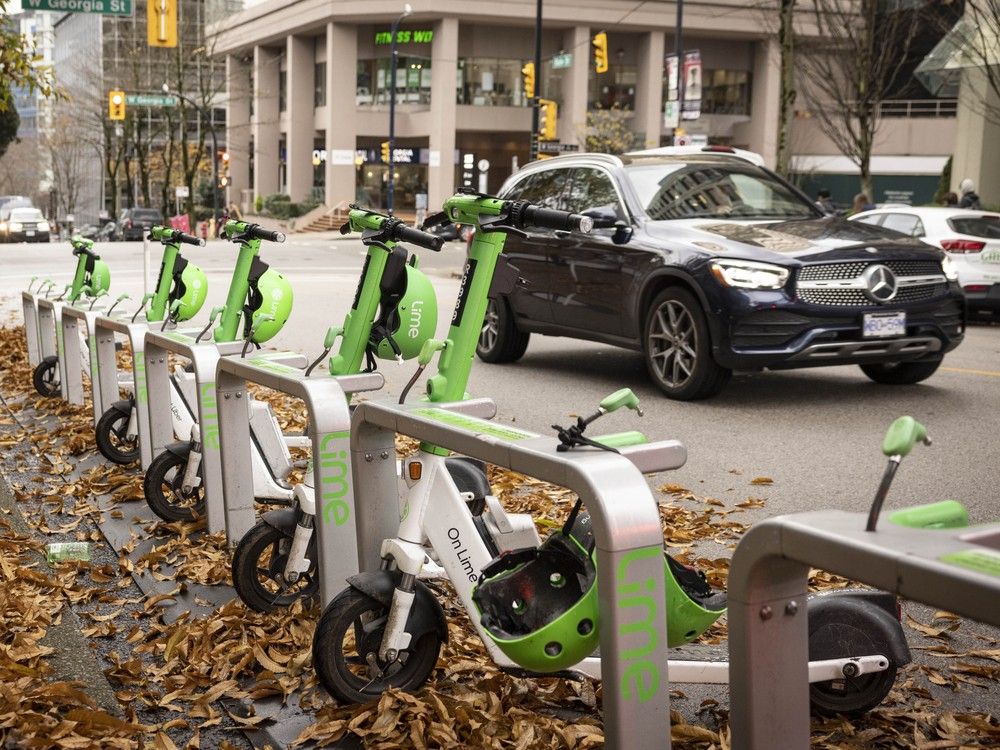
The city says that Lime is required to notify residents and solicit feedback within 20 metres of any proposed docking station, and that it considers submitted feedback before approval.
The city says it has received 342 public comments about Lime’s system between September 2024 and October 2025. A breakdown shows 75 per cent of inquiries concerned station placement, including impacts on parking removal, noise, litter or other issues; six per cent were related to enforcement, such as unsafe riding or sidewalk use; seven per cent involved the system operator and 12 per cent were other inquiries.
So far, 45 proposed Lime station locations were either not approved or modified following review of community feedback, technical feasibility and safety, the city told Postmedia.
Its website said stations can be set up on public or private land, in parks, or along streets. Sites are selected for safety, visibility, 24/7 access and proximity to transit, bike lanes, shopping areas, parks and community amenities. Safety rules, including clear sight lines and space for emergency vehicles, are also considered.
Concerns are also coming from Yaletown. A Lime station on Homer Street near Drake Street replaced what had previously been a passenger drop-off zone, according to area resident Andrew Karrasch. He said elderly people and residents with disabilities must now get in and out of vehicles in traffic.
Karrasch said signs seeking feedback “were put up one week before the (station’s) install,” and that despite “numerous emails and calls with Lime and city staff,” nothing has been done to address the residents’ concerns.
This month, the Lower Mainland Walkers Caucus began drafting a petition urging the provincial government to strengthen regulations for e-scooters and protect pedestrian safety.
Vic Leach, a pedestrian safety advocate with the group, said seniors and people who use walkers, canes or mobility aids have reported “being startled by e-scooters coming at a very fast rate from behind or from the side.” He added that many now “wonder where it is safe to walk.”
“The dramatic proliferation of e-scooters on the streets, sidewalks and park pathways in B.C.’s urban centres presents a significant and growing hazard to pedestrian safety, especially for seniors,” says Leach.
The issue has echoes in Toronto, where city council voted in 2021 to ban shared e-scooters after accessibility advocates and the city’s accessibility advisory committee warned they posed safety risks to seniors, people with visual impairments and wheelchair users.
Paris prohibited e-scooter rentals in 2023 following complaints from pedestrians. Melbourne, Australia, enforced similar restrictions.
Vancouver’s system operates under a provincial pilot e-scooter program launched in 2023, which includes 34 communities in B.C. The city’s five-year contract with Lime can be extended up to three more five-year terms, for a potential total of 20 year. The system is designed to be cost-neutral for the city, and Lime pays the city per trip.
Riders, who must be at least 18 years old and wear a helmet, use a smartphone app to locate and unlock a scooter. The machines can reach speeds of up to 24 km/h.