 BURST
BURST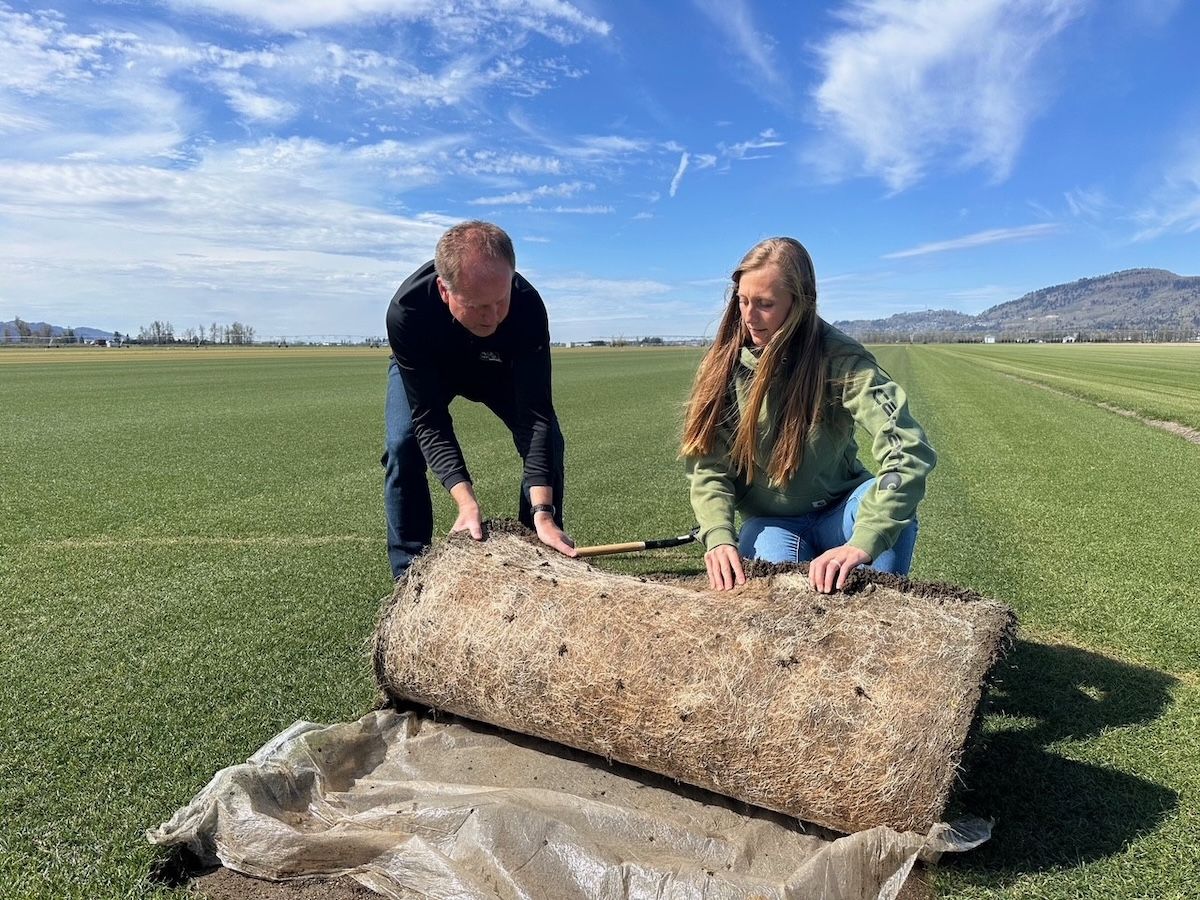
The job of producing a new grass surface at B.C. Place, which will be shown globally on hundreds of millions of screens during the World Cup, rests with an Abbotsford farm nestled at the base of Vedder Mountain in the Fraser Valley lowlands.
Bert Bos started Bos Sod Farm in 1993, a few years after moving to B.C. from Alberta, where his family has two other sod farms. He’s done big projects in the past, including a golf course in Whistler and Idaho’s Boise State University’s practice field, but this will be their highest-profile job.
And he didn’t want to do it at first.
“I was a little lax,” he said, laughing.
When Bos Sod found themselves on the shortlist for suppliers for B.C. Place — they were surprised as they hadn’t applied to do it — Bos was initially hesitant because of past lessons.
Drainage was a huge factor. Could they even grow it in the Valley, where their farm was under 1 1/2 metres of water in 2021, rendering their home and work buildings uninhabitable for months?
In the end, it was Bos’s children — Nicoline, Jaron and Caleb, who all work on the farm — who pushed him to seriously consider it. The more he thought about it, the more it seemed doable. The hybrid product FIFA planned to use in the North American stadiums would allow for flexibility, and Bos could tailor it to the facility and climate.

FIFA had a chance to experiment with the science when they hosted the Club World Cup — the marquee tournament for pro soccer clubs, not national teams — last year in the U.S.
Lessons were learned: Bermuda grass was out, Kentucky Bluegrass was in. There were myriad complaints from many of the same players who will lace up their boots for their countries this summer, likening the grass to a putting green instead of a soccer pitch.
The hybrid system works with a mesh grid with artificial grass fibres that stick up, forming about five per cent of the grass. It’s stitched together in long rows by an oversized sewing machine. It’s laid overtop of a laser-graded layer of sand and peat, seeded with a mix of 84 per cent Kentucky Bluegrass and 16 per cent perennial ryegrass.
Bert Bos had the latitude to determine the grass-seed ratio, the sand-peat ratio, and to tap Butler Concrete and Aggregate in Duncan as the sand supplier — keeping business in B.C. and avoiding potential tariffs.
When the grasses’ roots grow down through the artificial grid and hit the perforated plastic underlay, they begin spreading horizontally, creating a tight, robust root system that will be resistant to cleat divots and tearing.
The fields were planted in June, and have just reached 22 millimetres in height, the same as the artificial fibres. They will be trimmed back before the install at B.C. Place.
“I’m very glad they went with the carpet system for Vancouver; I think it’s really bulletproof. It’s going to be pretty tough to beat this,” he said. “One big thing with sod is … what you see now is a result of what took place six months prior. You cannot change on a dime. If you’re in the wrong, it’s hard to correct the last minute. With this kind of exposure and stuff, the stakes are pretty high. So here’s quite a lot of pressure to make sure you get everything on, everything correct … It’s huge pressure.
“It’s a living thing. That’s why, right? So let’s say you work in concrete. Don’t like it? Well, you take a jackhammer, you pop it out, you pop in new concrete. And you can probably do it in a certain amount of time.
“But this is a longer process, and if you mess it up, it’s hard to take corrective action.”

On April 26, truckloads of sand will be dumped on the much-maligned Polytan turf that makes up the B.C. Place playing surface. It will be buried in around 23 centimetres of sand: On top will be the high-tech, stunningly verdant, green, natural-grass hybrid pitch. It will be temporary, with a new artificial pitch being installed after the end of the tournament.
“The thing that’s been non-negotiable more than anything else, since the beginning, and the thing that’s been made so clear to us is: The pitch is the thing … And FIFA puts enormous amounts of effort into ensuring (its quality),” said B.C. Place general manager Chris May. “Like growing different types of seed in different places to try and figure out how the climate and ecosystem in Vancouver is different than that of Kansas City or Guadalajara, and which grass seed you have to grow, in which percentage, in which climate zone, to ensure the grass in Kansas City and Guadalajara and Vancouver end up essentially exactly the same despite different climates and open air versus closed stadiums.
“The science behind it is so interesting.”
Bos will supply specially designed equipment for the installation. It will take around 14 hours for the grass to be cut into 1.2-by-11-metre strips, rolled up, trucked to B.C. Place, and laid down on the new foundation. Irrigation and lighting will have been installed. The roof will, unfortunately, remain closed during the duration of the tournament.
“If the roof is open, it would create a lot of variation in light,” Bos said. “And once you do that, it mixes everything up. Let’s say you get sunlight in certain areas, certain areas you don’t — (the grass) is going to grow different. It’s going to dry different. Now you have to irrigate different. The nutrients are going to be used up different. So it all creates variability that you don’t want. You want consistency.”

The grass is attended to like a newborn baby.
At the sod farm, the fields are checked three times daily for moisture levels, and watered with a hovering boom that provides maximum efficiency. No tires other than the gigantic balloon-like rubber on the tractors are allowed on the field. It’s scoured, metre-by-metre for any unwanted or erratic growth. PH levels are tested. Growth of individual grass blades are counted in 10-centimetre squares.
The younger, soccer-playing Bos generation have, so far, even held off the impulse to lace up their cleats to run on the field, just so they can say they did. All for a field that will have the lifespan of 2 1/2 months, and be ripped out, never to be used again.
“Everything in this life is fleeting,” Bert Bos said, laughing. “It serves its purpose, right? And that’s really what it’s all about.”
