 BURST
BURST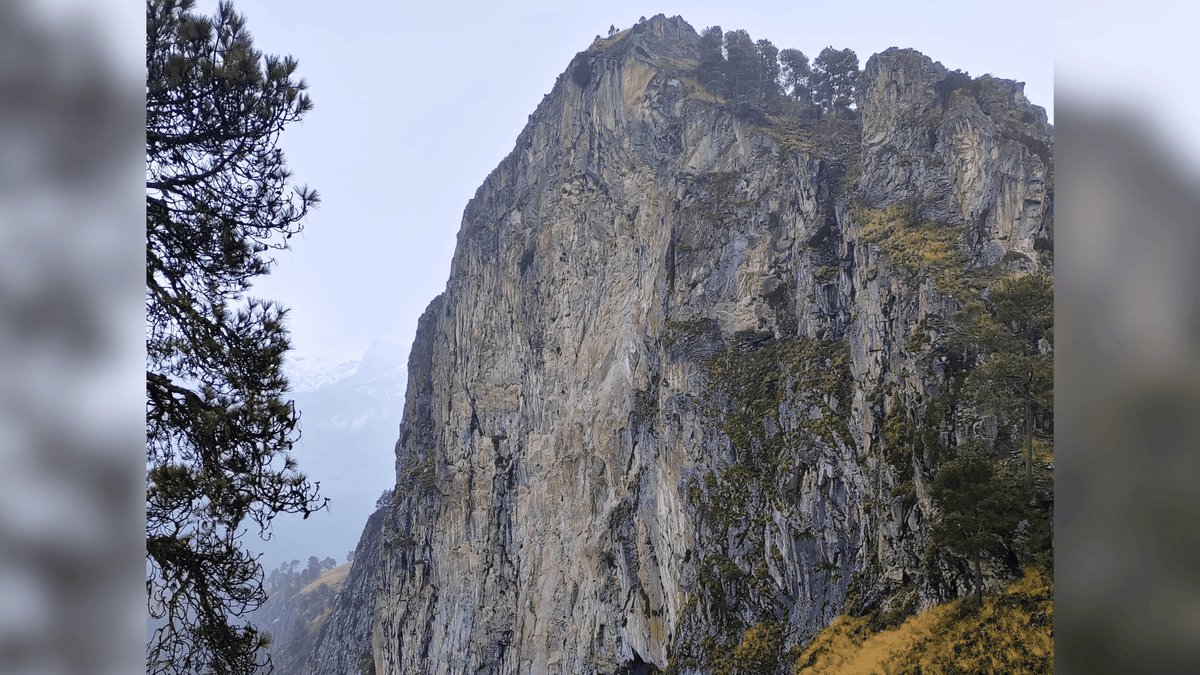
When most climbers think of Mexico, they picture one of two scenes: sport climbers clipping frequent bolts on the limestone cliffs throughout the country, or of mountaineers laboring through thin air atop a volcano. Now, thanks to a small, dedicated crew developing the steep wall of El Centinela, two hours from Mexico City, climbers can picture a more impressive version of both.
The first time Ulises Fierro told me about El Centinela, he spoke with the calm economy of someone who doesn’t need to convince you of anything. It was a wall on the volcano Iztaccíhuatl; he’d been going for months; getting there was complicated. And on April 4, a few weeks before our call, he had made the first free ascent of Tepeyóllotl (5.14a/b trad; 820ft) which tops out at 12,800 feet.
The climber who doesn’t seek recognition
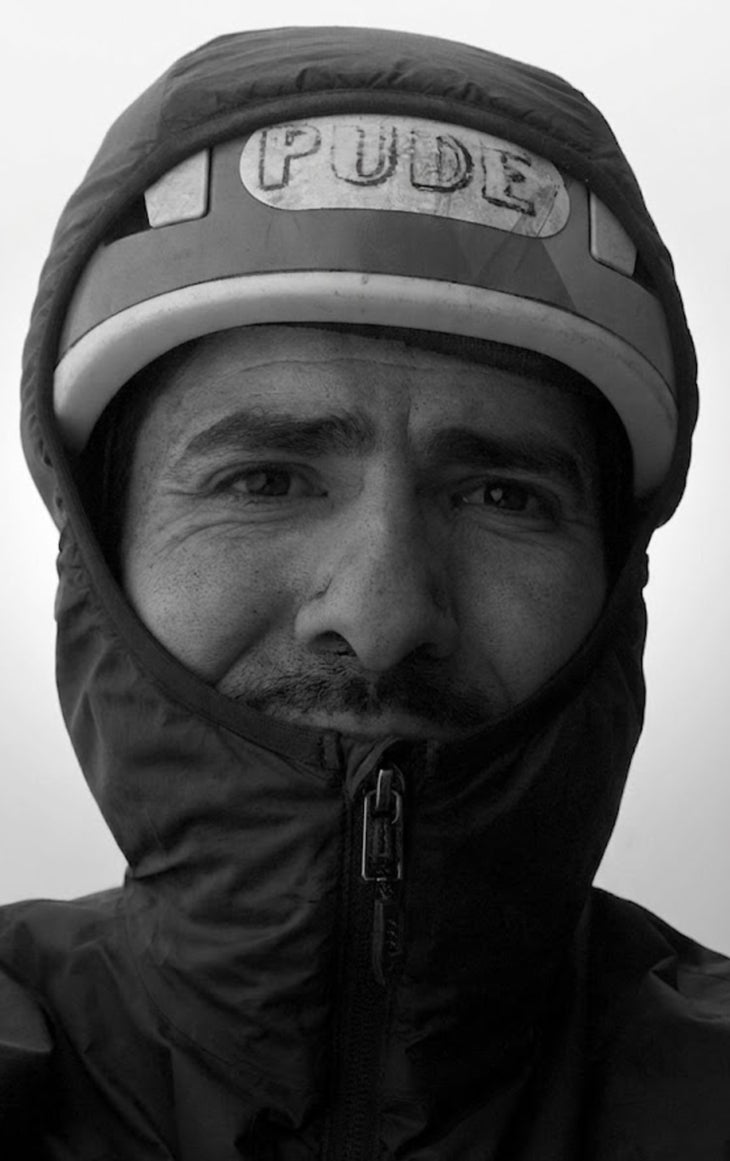
Ulises Fierro, or Chuy, as people call him, works as a climbing guide when he’s not developing his next wall project. Part of the year he spends in the United States, leading wilderness expeditions for young people. The rest of the time, he climbs. He has no sponsors. Little fanfare. He has, instead, hundreds of routes established across Mexico, sport and trad alike, and an increasingly unique way of approaching his daily climbing.
“Recognition is something that comes to you, not something you go looking for,” he told me when we sat down to talk, almost three weeks after the send. “If you’re looking for it, you’re already doing something wrong.” When Fierro began climbing 20 years ago, he became captivated by something very difficult to name: the ability to focus for hours on a single thing, without referee, without scoreboard, without an external system of rules. “The climbing I’m after is the gateway to a world that humans knew for millions of years and that we ourselves have taken away,” he explained. “What lies beyond us as a species. What connects us to something more animal, more instinctive.”
El Centinela: a wall with history
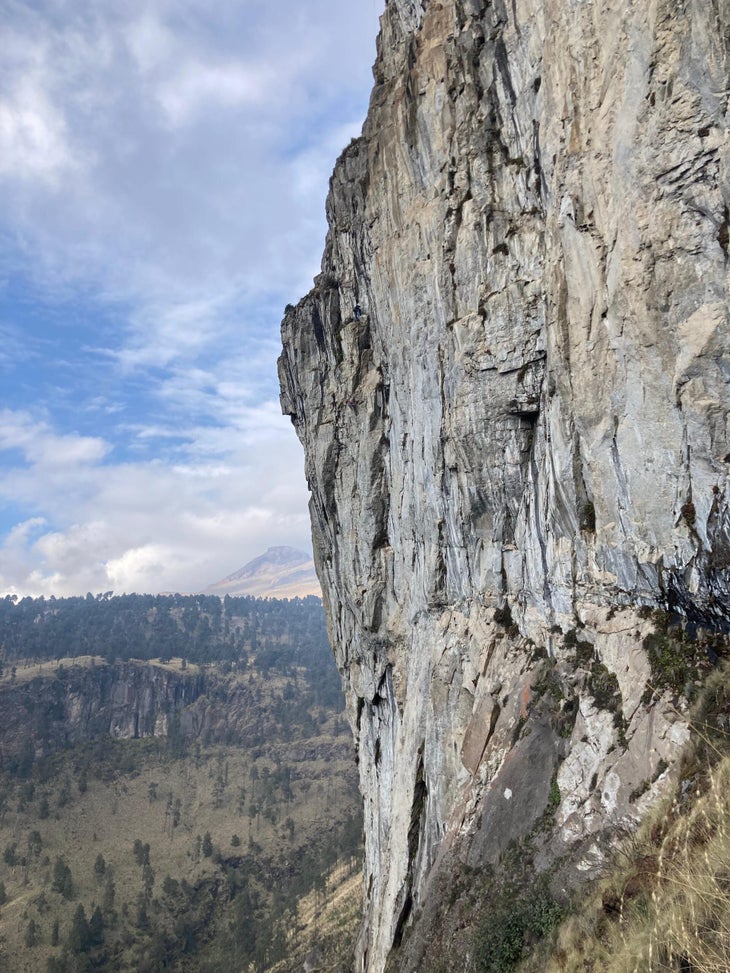
El Centinela is a rock formation on the Iztaccíhuatl massif, Mexico’s third-highest volcano, two hours from Mexico City by road and several more hours on dirt tracks. The wall, a great, imposing wave rising from the mountain’s flanks, faces northeast. The sun rarely hits it. The weather shifts without warning: mornings break clear, and by midday the sky closes and rain, hail, or snow arrives as if on schedule. Eagles pass every day at roughly the same time.
Mexican climbers first reached El Centinela in the 1950s. Guillermo Álvarez del Castillo, Santos Castro, Juan Gabriel Nieto, Pedro Díaz, among others, walked in from La Joya: hours on foot with all their gear on their backs, without the certainty of any established path. The first complete route on the wall was opened in that era.
“In a way I went looking for that wall because of the stories I heard from my more dinosaur-like friends,” Fierro told me. “They’d already seen it. It’s an iconic wall. And I wanted to climb it the way they would have climbed it if they’d had today’s technical tools: clean, committed, no shortcuts.” With the rise of sport climbing and the ease of permanent bolts, the heady volcanic climbs of Mexico fell from popularity.
Thirteen days of opening
Getting to El Centinela is already an adventure. From Amecameca there are 10 miles of dirt road with 3,000 feet of elevation gain that doesn’t always let through whoever tries. Fierro made it every way possible: by car, on foot, and once by bicycle —four hours pedaling uphill. From the riverside camp to the base of the wall is another half hour at a good pace. The adventure begins before you touch rock.
Fierro, Carolina Saucedo, and Daniel Rodríguez developed Tepeyóllotl in October and November 2024. But it would take more than a year to actually free the route: months working each pitch separately, learning the logic of the wall, returning every four to six weeks, managing the attrition. “Eight, 10 times last year,” Fierro recalls. “Every time we got there, day one was basically just arriving, setting up camp, and maybe getting on the first pitch.”
The ethic they imposed on themselves was simple yet demanding: place as few bolts as possible. “Pulling out a drill and placing a bolt is very easy,” Fierro explained. “[…] but making the call to say: no way, if we can’t do it with removable gear, come down and we’ll come back tomorrow and figure it out—that’s much harder.” On the fifth pitch, the crack disappears and the rock offers nothing to place natural protection. The team drilled six bolts to continue. In total, the route has 16 fixed pieces of protection, plus anchors atop every pitch.
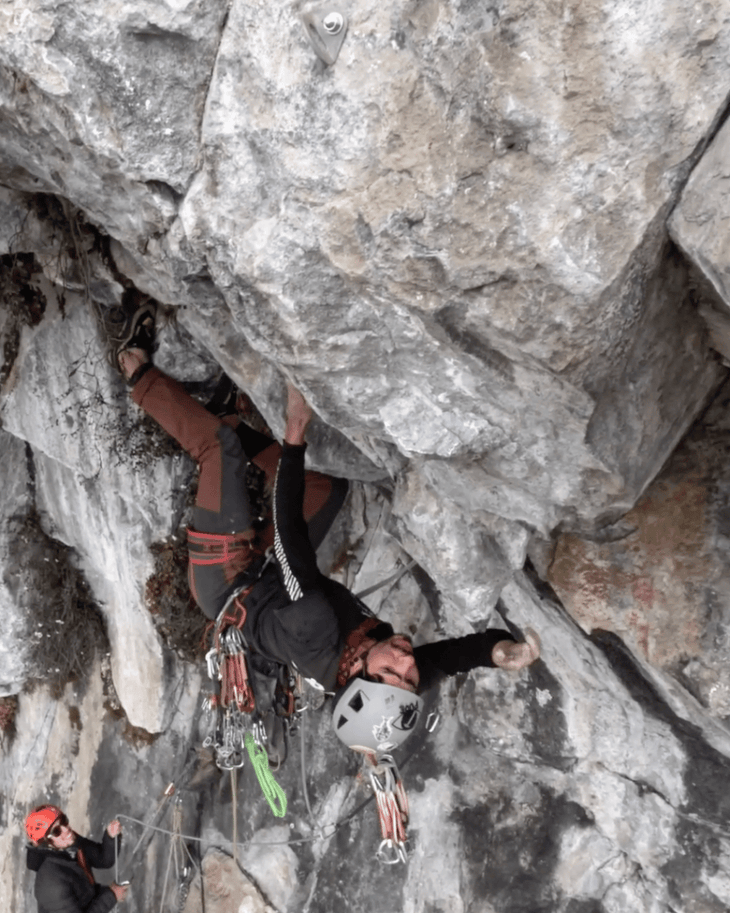
El Centinela traps water seeping through the volcano’s interior and pushes it out through the fissures, filling them with thick mud. Cleaning the cracks, meter by meter, was part of the work before they could even attempt to climb. The crux, second pitch, named Citlalnanácatl—dirt under the fingernails—took four days just to clean, aid, and then free. Four days of going up, failing, coming down, going back, failing again, coming down. “Injuries are strictly prohibited here,” they told themselves as a joke. But it was a joke in earnest: any rescue would be self-powered.
The team’s strategy for working the route was surgical. They fixed ropes through the second pitch (the most obvious crux) and ascended past it to work the upper pitches first. Pitch by pitch, they learned a wall that had no patience for rushing. There were days when accumulated fatigue, cold, and frustration brought out the worst in everyone. “When you’re that emotionally invested—and it’s not just emotional, you’re physically giving everything; you’re tired and hungry—you’re not always your best self,” Fierro admitted.
In May 2025, Chuy made his best attempt to date: he sent every pitch except the second. Shortly after, he left for the United States to work. The involuntary rest turned out to be the piece of his training he was missing: he came back in 2026 with a recovered body and a calm mind.
Tepeyóllotl
As Fierro and Saucedo worked the route month after month, the conversation about what to call it grew naturally. In Nahua mythology, of which Saucedo is proudly devoted, Tepeyóllotl is a jaguar, the god of the echo, the voice that returns from caves and ravines. It’s the heart of the mountain.
“When I heard it, I said yes immediately,” Fierro recalls. “It was exactly what I had been feeling all along without knowing what to call it.”
April 4
The night before, Chuy didn’t sleep well. Not from excitement; from months of accumulated tension. He had been training for that day for a long time, including a marathon of 40 trad routes in one day at La Coconetla, Mexico City, in December, one for each year of his life, between 5.9 and 5.13, all led, all without falling, over 4,000 feet climbed.
Fierro and Saucedo began their day at a relaxed pace. The first pitch went. At the base of the second, Fierro faced the boulder problem he had been working in sections for months—the crux within the crux. He asked El Centinela to share its wealth with him.
It went. For the first time, all of it together, in sequence, without stopping.
On the fourth pitch, Fierro fell with the flat certainty of extreme exhaustion. He lay down on a shoulder width ledge and closed his eyes. Thirty minutes, maybe 40. Something settled. He sent it on his second attempt.
At 4:30 in the afternoon it started to hail. Lightning fell on the summit, first distant, then close. They climbed the sixth pitch in rain and sleet. It had become dark. They reached the summit together. The happiness, Fierro told me, was quiet. Interior. Almost silent.
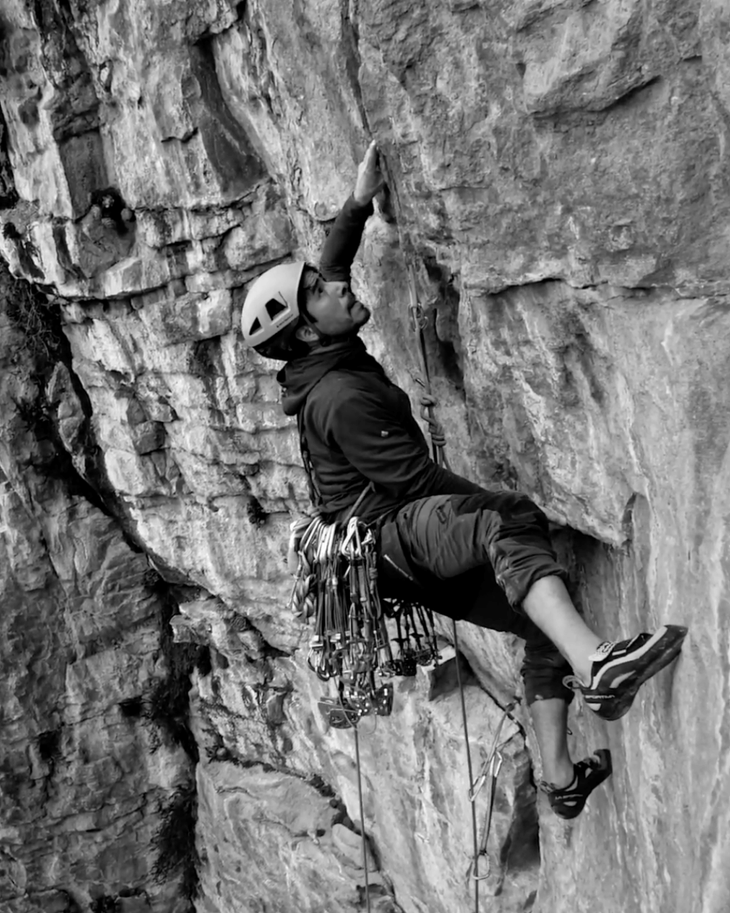
They descended through the night. He reached camp without hunger, though he’d eaten only an apple and an energy bar all day. There was a sandwich in his pack he never touched. He forced himself to eat dinner because his body needed it even if it wasn’t asking. And in the days that followed, the emptiness arrived.
Not sadness. Not exhaustion. Something stranger: the absence of what had been his north star for months. Tepeyóllotl had been pushing and pushing inside him (through training, through the long drives up, through the sleepless nights before) and suddenly it wasn’t there anymore. “It’s deeply paradoxical that such a strong sense of emptiness follows an achievement this big,” he told me. “Like you don’t even know what to do with yourself.” English-speaking climbers have a name for this: post-send depression. Fierro described it more precisely: it’s not depression, it’s disorientation. The compass that had pointed you in one direction for more than a year suddenly points nowhere.
What Tepeyóllotl means for climbers
Mexican climbing has a long and little-told history. It has pioneers who opened routes in the ‘50s carrying gear in from La Joya. It has world-class areas (El Potrero Chico, El Salto, Jilotepec) that international climbers visit but that appear as footnotes in the sport’s global narrative. It has climbers who have spent decades quietly establishing routes, without sponsors, without media expeditions, without the visibility apparatus that turns an achievement into a headline. Tepeyóllotl is part of that tradition, and also its most demanding continuation.
“What you do and how you do it, is also a way of saying things,” Fierro told me. “You’re saying: it can be done this way. It doesn’t have to be the other way.” He said it like someone talking about climbing. But he was also talking about everything else.
The post ‘Tepeyóllotl’ (5.14 Trad) Ushers in a New Era of Mexican Wall Climbing appeared first on Climbing.