 BURST
BURSTYesterday, Warner shareholders approved the $110 billion takeover of Warner Bros Discovery by Paramount. The vote was expected, because shareholders care about share price, which had roughly tripled since the bidding war for the studio started. What’s notable is Warner stock went down yesterday, meaning that investors thought it was a bad day for the prospects of the deal. And there’s a reason for that.
The vote was met with protests and political pushback from important elected officials, like Mayor Zohran Mamdani of New York City.
The populist anger coursing through America is moving to politicians, who are starting to take action. And this merger is a big fat target for them to shoot at.
Hollywood is often seen as a glitzy rich place, but the truth is that much of the industry is working class. Makeup artists, grips, and actors are skilled labor, very good at what they do, and a college education is not a requirement. The glitz, though, is also real. And over the past week and a half, four thousand artists have signed an open letter in opposition to the deal. These are major players too, from JJ Abrams to Don Cheadle to Emma Thompson to Robert De Niro. And they are speaking out not just for themselves, but for the hundreds of thousands of people who make commercial art in the form of TV and film.
This letter is not just a petition, it is evidence in a legal process. When a large chunk of an industry argues that a deal is dangerous, a judge has to take that seriously. So one thing that this letter has done is embolden state attorneys general, who are some of the few Democratic officials who have some power at a Federal level when Congress and the Presidency are controlled by Republicans. State-level attorneys general can enforce the Clayton Act, which prohibits illegal mergers.
A few days ago, California Attorney General Rob Bonta said there are “red flags everywhere” with the Paramount-Warner deal, which is the most assertive sign so far that states are going to act. The states are fresh off a winning streak on antitrust cases, from media merger Nexstar-TEGNA to Ticketmaster, so they feel emboldened.
There’s more. While Hollywood people often make political stands at ceremonies like the Oscars, those stands are usually on behalf of someone else, with the stakes distant from the celebrities who make them. But this time, the stakes are very real, and the question of power is front and center.
The content of the letter is a straightforward analysis of market structure you could put in front of a judge. I covered the merger guidelines put out in 2023 by Lina Khan and Jonathan Kanter, and if you read those, you’ll recognize a lot of what’s in here.
This transaction would further consolidate an already concentrated media landscape, reducing competition at a moment when our industries—and the audiences we serve—can least afford it. The result will be fewer opportunities for creators, fewer jobs across the production ecosystem, higher costs, and less choice for audiences in the United States and around the world. Alarmingly, this merger would reduce the number of major U.S. film studios to just four.
Our industry is already under severe strain, in large part due to prior waves of consolidation. We have witnessed a steep decline in the number of films produced and released, alongside a narrowing of the kinds of stories that are financed and distributed. Increasingly, a small number of powerful entities determine what gets made—and on what terms—leaving creators and independent businesses with fewer viable paths to sustain their work.
Media consolidation has accelerated the disappearance of the mid-budget film, the erosion of independent distribution, the collapse of the international sales market, the elimination of meaningful profit participation, and the weakening of screen credit integrity.
And important actors are making compelling arguments that are hard for any judge to ignore. Here’s Mark Ruffalo and Ben Stiller explaining that consolidation has, or would lead to, less output and fewer choices, a classic indication of a Clayton Act violation.
It helped that Paramount and Warner took a few steps that show how dangerous their combination will be. First, Paramount retaliated against a Hollywood publication, The Ankler, by removing its advertising from the site after one of its key writers opposed the deal. Second, a CNN producer refused to book a segment on the merger over fear of legal risk considering its parent company is Warner. And Paramount CEO David Ellison still refuses to testify.
I don’t want to overstate the situation, many top tier filmmakers, like Jerry Bruckheimer and James Cameron, feel comfortable with David Ellison and support the deal. While the Writer’s Guild and Teamsters are opposed, the unions for actors and stagehands have not taken a position. Still, the anger is widespread and real, as close to a consensus among the creative community as you can get.
Among the money people, it’s different. The big agencies haven’t said much at all, despite the damage such a merger will do to their shops. The closer the stakeholder is to seeing the world like a studio seeking to organize capital, aka a James Cameron-type, the more deferential to power and short-sighted. And Paramount, whose legal and political operation is run by a cynical Trump-aligned lawyer named Makan Delrahim, is falsely alleging that opposition is being funded and run by Netflix. I’m sure Netflix doesn’t like the deal, but their political operation is not strong. Since most money people can’t fathom people acting on something because they believe in it, Delrahim’s PR campaign has worked in some corners of the world.
But the bigger story here is about how Hollywood, a citadel of Americana, has re-embraced its anti-monopoly roots. From its founding in the early 1900s, the film and then tv industries were built on an anti-monopoly policy framework to ensure that culture was not controlled by a small group. Here’s a brief recap. The early studios located in California to get away from Thomas Edison’s patent control of film equipment, while the FTC helped break patent pools in the 1910s. Strikes and the Antitrust Division broke the studio system in the 1930s and 1940s, and the Federal Communications Commission took apart the tv broadcasters in the 1970s with financial syndication rules limiting both owning and exhibiting tv shows.
Since the 1980s, consolidation has been the rule, with the repeal of much of the anti-monopoly framework and the resulting merger spree. And for the last decade, the town has been morose, with jobs disappearing, offshoring and constant chatter that the collapse of the industry was ‘“inevitable.” But somehow, they have come to regain their understanding that the roots of the dysfunction are political in nature, and thus something they can affect. And that renewed sense of civic confidence may move to other parts of the country, as Americans recognize in what Hollywood is going through something akin to their own experience.
So how did it happen?
The answer is that it was a mix of anti-monopoly arguments coming from outside the industry, the revival of antitrust under Biden, financiers beginning to devastate tv and film, strikes from unions inside Hollywood, and left-leaning organizers angry at Trump’s attempted takeover of media assets. I put together a timeline illustrating the various pieces. It shows how the different parts of the saga, from state antitrust enforcers to anti-monopolists in D.C. to artists in Hollywood to Wall Street financiers seeking consolidation, came together to produce this moment.
The backstory is that in the 2010s, people in Hollywood were making a ton of money, as every studio but Sony started a streaming service in an attempt to build market power to compete with Netflix. This era was known as “peak TV,” and it started to come to an end by the end of the decade. Then came Covid, and a collapse in ticket sales. Finally, in 2026, there’s been a rebound as studios produced more films and audiences came back, along with some interesting new dynamics about film marketing.. But that was paired with this new threat of consolidation during a deeply corrupt administration.
This timeline starts with the first major antitrust action of the modern era.
2018
A judge ruled against the government challenge to AT&T’s acquisition of Time Warner. The Trump Antitrust Division, then led by Delrahim, had brought the case, alleging that AT&T would hike prices if it succeeded in the purchase. After the judge’s decision, the head of Time Warner, Jeff Bewkes, gets a $400 million golden parachute. HBO was mismanaged, and AT&T enacted price increases and layoffs.
The first major state enforcement challenge occurred. Sprint-T-Mobile announced a merger, consolidating the mobile phone system from four players to three. Federal enforcers and the Trump Federal Communications Commission approved the deal, Democratic state lawmakers brought a challenge in court. After two years, a Clinton-appointed judge, Victor Marrero, approved the deal, citing Federal support as a key part of his dismissal of the challenge. It’s a blow to the states.
2019
The Trump administration Antitrust Division rescinded an important legal doctrine, the Paramount decrees. These were the restrictions on studios preventing them from acquiring theater chains. While it had become somewhat symbolic with the rise of streaming, repealing it was an indication that policymakers wanted to see more vertical integration. Immediately, Amazon considered buying AMC
BIG published its first article on the industry, the “Slow Death of Hollywood,” which went viral. This article introduced the core problems at the heart of the dysfunction, vertical integration and consolidation. BIG followed with articles on the market power of Disney.
Time chose Disney CEO Bob Iger as “businessman of the year.”
2020
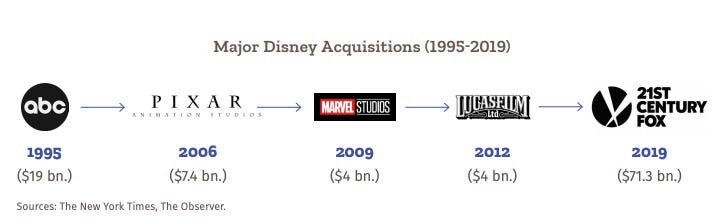
Disney merged with Fox, removing one of the six traditional movie studios. The Trump administration had Disney sign a consent decree on regional sports networks, which failed. Production of films collapsed.
Covid shut down most theaters.
2021
AT&T announced its sale of Time Warner to Discovery in May. The political person running point on the deal was an official named Gene Kimmelman, known for his deference to large corporations. (Kimmelman also approved the Ticketmaster-Live Nation deal while working for the Obama administration in 2010.)
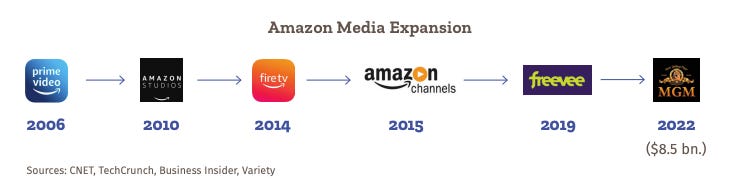
Amazon announced its acquisition of MGM.
Lina Khan became the FTC Chair in June. She did not have a majority on the commission until May of 2022, when FTC Commissioner Alvaro Bedoya was finally confirmed. The two Republicans at the FTC would oppose a challenge to the MGM purchase, so Amazon was able to complete its acquisition.
Jonathan Kanter was confirmed as Antitrust chief for Biden in November.
2022
AT&T finalized the sale of Time Warner to Discovery, leading to more layoffs. There was some opposition to the deal, but not enough. Kanter was finally confirmed towards the end of the investigation, but it was too late to stop it.
The Antitrust Division blocked the merger of Penguin and Simon & Schuster, two of the five big trade book publishers. The opposition was based on a new theory, that the deal would harm authors’ ability to secure buyers for books, as well as their right to express themselves. Stephen King was a key witness. This deal was a key moment when the precedent for opposition to further Hollywood consolidation emerges.
Ticketmaster-Live Nation had a scandal around the Taylor Swift Eras tour. A government investigation of the live entertainment company, run out of Kanter’s division, became public.
Kanter and Khan hosted roundtables to rewrite merger guidelines, the way enforcers and judges understand mergers. Writers Guild board member Adam Conover was a witness. Many Hollywood artists submitted comments.
2023
“Barbenheimer,” or the weekend of two immensely successful movies, Oppenheimer and Barbie, showed there is still demand and love for theatrical films.
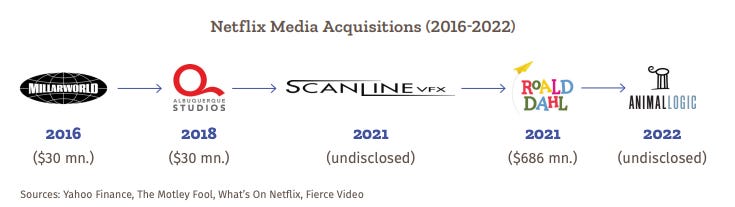
The writer’s went on strike over declining prospects in the industry. The Writers Guild West put out a report on consolidation, calling for the break-up of the industry along vertical lines. Here are some charts from the document.
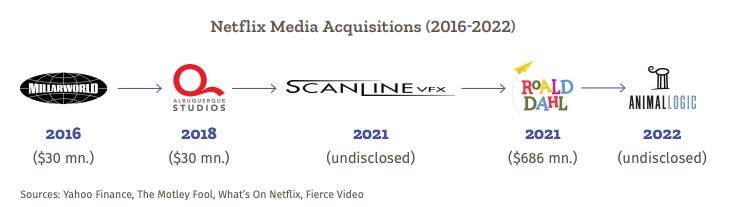
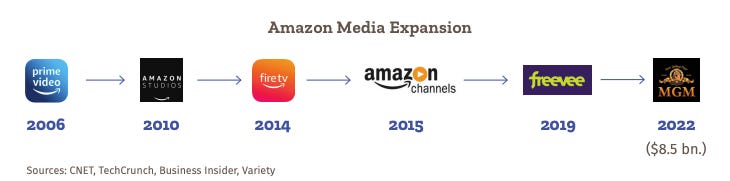
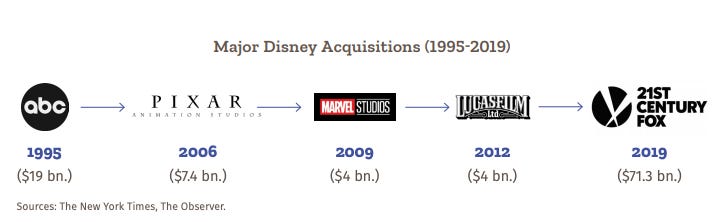
The BIG piece analyzing the strike and its relationship with consolidation, “Make Hollywood Great Again,” went viral.
Lina Khan was hosted on Hollywood outlet The Ankler, where she discussed mergers and AI. The FTC and Antitrust Division finalized the merger guidelines.
The FTC filed an antitrust case against Amazon, centering it on how Prime is a mechanism to extract from suppliers.
An important bad moment around vertical integration. Judge Jacqueline Scott Corley ruled to allow Microsoft to buy Activision in the largest tech merger of all time. The judge believed vertical consolidation is good and would lead to lower prices and consumer benefits, particularly around Activision’s key hit game, Call of Duty. Within two years, Microsoft hiked prices, enacted mass layoffs, and pulled Call of Duty, the focal point of the merger, from streaming. Corley’s ruling was rolled back but not overturned by the Ninth Circuit on appeal.
2024
The Antitrust Division filed a case against Ticketmaster. Kanter worked closely with state enforcers, who were co-plaintiffs.
Trump was elected, and Hollywood chiefs gear up for consolidation in the hopes of a new more lax antitrust regime.
2025-2026
Trump announced a commission of Jon Voight, Sylvester Stallone, and Mel Gibson to save Hollywood. Voight came out with a proposal to end vertical integration by prohibiting streamers from controlling all intellectual property, but Trump ignored it and embraced tariffs. That proposal was also quickly dropped. Trump’s Antitrust Division was immediately enmeshed in corruption, as a corporate lobbyist Mike Davis had his antitrust chief fired.
Trump’s FCC approved Skydance-Paramount merger, likely on the condition of firing Stephen Colbert. Trump discussed the need for new ownership of CNN.
Warner Bros Discover had a plan to split itself up, instead Netflix and Paramount got in a bidding war for the company. Netflix initially won the bid, but had significant bipartisan opposition on antitrust grounds, Paramount then bid a higher amount and won. A big part of Paramount’s pitch was the relationship of its owner, Oracle founder Larry Ellison, with Trump.
Nexstar and TEGNA, two local broadcasting conglomerates, heled push Jimmy Kimmel off the air in hopes of securing approval for their merger, which they then got.
Trump settled the Ticketmaster case at the behest of Ari Emanuel, with state enforcers continuing the case.
Democratic state attorneys general challenged Hewlett-Packard merger on corruption grounds, won an injunction against Nexstar-TEGNA despite Federal support for the deal, and won Ticketmaster case. They also began investigating the Paramount-Warner deal.
So that’s where we are. I’m sure I’ve missed a few things, but you can see the interaction of legal cases, politics, industry dynamics, and mergers, all framed by new arguments about monopoly. If you want a blow-by-blow of the Trump-era corruption, former FTC commissioner Alvaro Bedoya has it right here.
The bottom line is that Americans are beginning to get a sense of confidence that they can do something about the chaos and dysfunction they see all around them. It’s tentative, and there’s a lot of fear, and most Democrats in Congress are embarrassingly out of touch. But there’s a real desire to fight back against corporate power among major portions of the public, and that’s something I’ve never seen before.
Thanks for reading! Your tips make this newsletter what it is, so please send tips on weird monopolies, stories I’ve missed, or other thoughts. And if you liked this issue of BIG, you can sign up here for more issues, a newsletter on how to restore fair commerce, innovation, and democracy. Consider becoming a paying subscriber to support this work, or if you are a paying subscriber, giving a gift subscription to a friend, colleague, or family member. If you really liked it, read my book, Goliath: The 100-Year War Between Monopoly Power and Democracy.
cheers,
Matt Stoller