 BURST
BURST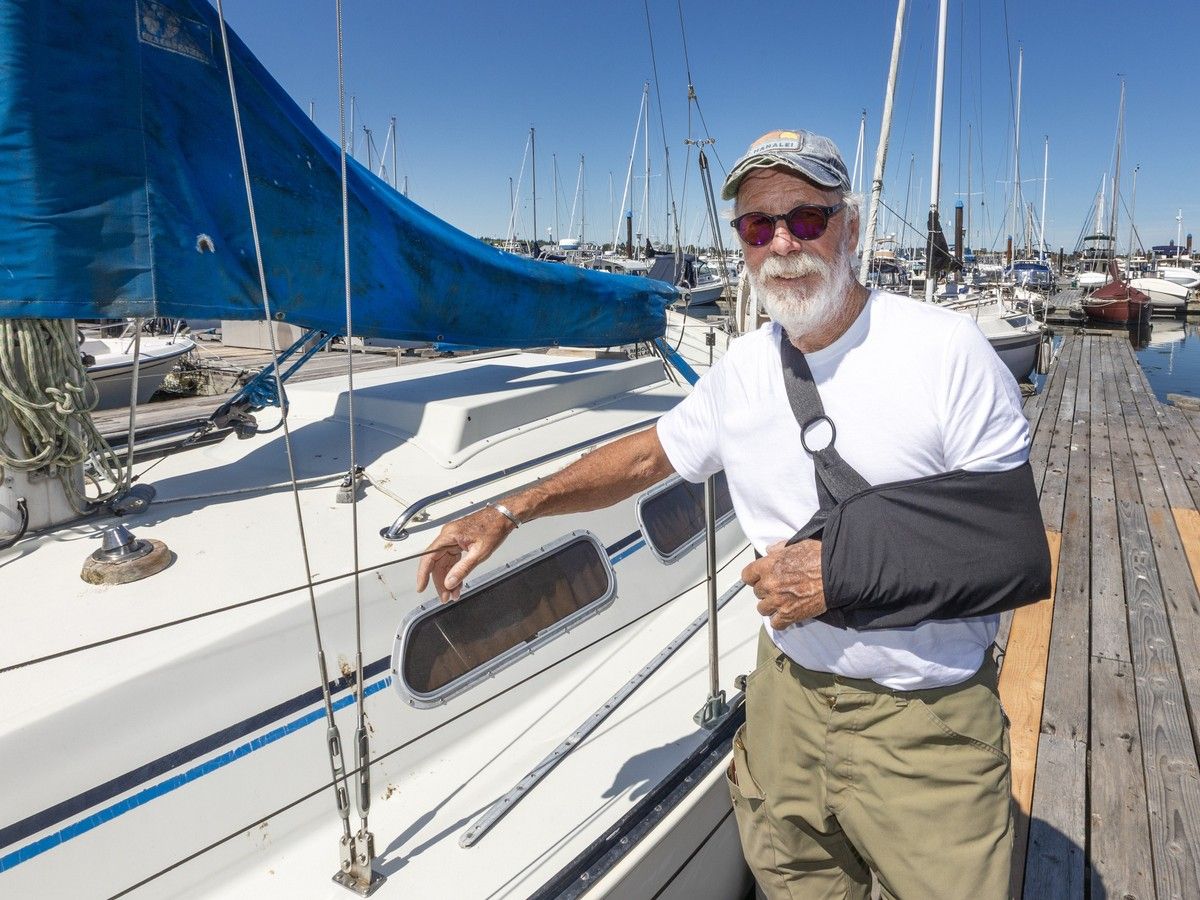
Over decades spent at sea, 73-year-old John Campbell has swum alongside whale sharks off Baja Mexico, sailed through a lightning storm near Hawaii and toasted a solo crossing of the equator with a bottle of champagne.
But last week, trapped in a violent Pacific storm hundreds of miles from shore, the B.C. man wasn’t sure if he and his trusty sailboat April Alice would survive.
“I remember looking out the companionway and the waves were so high they actually blocked out half the sky,” said Campbell in an interview on Tuesday. “I thought ‘yeah, I don’t think I’ll last.'”
The boat didn’t make it.
But Campbell did, thanks to the U.S. Coast Guard and the cruise ship Silver Whisper, which answered the distress call and rescued Campbell from his disabled vessel.
“ They didn’t stop working ,” said Campbell of the Coast Guard, which facilitated his rescue. “They just kept looking for what they called assets and they found a cruise ship whose captain said ‘I’ll do it.'”
Campbell had departed Hilo, Hawaii on April 30, bound for Vancouver Island aboard the Alice, an ocean-faring pocket cruiser designed by Canadian Robert Harris for a solo sailor or cruising couple.

The Alice had been Campbell’s travel companion for 17 years and his home for the past decade. In the summer, he’d take her out to ocean; in the winter, he lived aboard the boat, docked in a marina in Brentwood Bay.
The April Alice was named by the previous owner: Alice for his mother, and April because she was born April 1st. Campbell kept the name. “It was too good,” he chuckled.
Several days into the crossing, about 420 nautical miles off the Oregon coast, Campbell’s brother, who was monitoring weather reports and communicating with him through a satellite device, warned him a cold front carrying powerful winds was moving south from Alaska.
Campbell thought he would miss the worst of it. “All of a sudden it reached out and wanted to include me in the party,” he said.
Winds climbed steadily as the seas built to mast height, roughly 10 metres or 30 feet above the deck.
One by one, Campbell reduced sail until he had none left.
He decided to “lie a-hull,” a tactic in which sailors take down the sails, lash the helm, and allow the vessel to drift while riding out the storm.
Conditions continued to deteriorate, with wind gusts exceeding 50 knots, nearly 100 km/h, while breaking waves repeatedly slammed into the side of the boat.
“It was like a wrecking ball,” said Campbell. “It just slams you on the side.”
Every five to 10 minutes, a wave would crash into the boat, tossing Campbell across the cabin.
“Each time we were hit, it sounded and felt like a cannonball smashing into April Alice’s side,” he said.
For hours, the vessel shuddered and shivered. Then came a brief lull.
After about 20 minutes without being struck, Campbell thought the worst had passed.
Without warning, a massive wave rolled the vessel completely over. The boat performed a full 360-degree roll, said Campbell, who was hurled into the cabin ceiling and thrown across the boat.
“I knew right away the mast was gone,” said Campbell.
He injured his left leg and shoulder and, though he nearly blacked out, managed to activate the SOS function on his Garmin satellite communicator.
The distress signal was received by his brother in Vancouver, who called 911. The call was eventually routed to the U.S. Coast Guard.
Because Campbell was too far from shore for a helicopter rescue, the Coast Guard dispatched a plane, which dropped a locator beacon near the vessel to help track its position and activated the Automated Mutual-Assistance Vessel Rescue (AMVER) system, which tracks nearby commercial vessels and allows them to put out a call for help .
A freighter was identified, but could not safely attempt a rescue in the stormy conditions.

The Silver Whisper, a luxury cruise ship operated by Silversea Cruises, was about 120 miles away on a Pacific voyage from Pepeete, Tahiti, via Hawaii when it got the distress call.
The captain diverted the route and reached the Alice hours later, carefully maneuvering the vessel alongside Campbell’s sailboat.
An initial attempt failed. On a second attempt, a crew member jumped onto the sailboat and tied a line around a cleat, then helped transfer Campbell onto the larger vessel.
He was able to bring a small backpack with him. Among the items he packed were a photograph of his two daughters, a handmade cutting board and shell necklaces intended for his granddaughters.
He was treated by the ship’s doctor before arriving in Vancouver, where he was reunited with family.
The Coast Guard credited Campbell’s preparation and experience for making the rescue possible.
“This mariner’s experience and preparedness allowed the Coast Guard and other agencies to communicate with him and effect a rescue,” said Scott Giard, a Coast Guard search and rescue program manager in a news release. “His foresight to bring a satellite communicator averted a tragedy. We would also like to thank Silver Whisper for their assistance with this rescue.”
Left behind was April Alice.
He became emotional recalling the moment he left the crippled vessel drifting in the ocean. “It was like she got me safe for the last time,” he said. “I just felt so bad about leaving her out there in the middle of the Pacific after all she’s done for me.”
A GoFundMe campaign has been launched to help Campbell purchase another boat to call home. “That’s where I want to live. I can’t imagine living on land,” he said.
Despite his ordeal, he’s not ready to close the door to future voyages just yet. His two young granddaughters, a four-month old infant and a three-year-old toddler, are his “anchors,” he said, but the ocean has a powerful pull.
“I know I’m telling you now ‘that’s it,’ but I can’t guarantee it.”
Related