 BURST
BURSTLast night, something happened that I’ve never seen in my time in politics - a bunch of Democratic incumbent politicians in New York and Maryland lost to left-wing challengers. New York in particular has an intensely wired Democratic machine, with advocacy groups, unions, and identity rights groups cemented together with big money. This machine rarely loses, and never loses en masse. Yesterday, they did, as voters said no to the entire political establishment.
The winners mostly ran on a platform of opposition to the U.S. alliance with Israel, as well as subordinate themes like opposition to corporate greed. For instance, Antonio Reynoso, the Brooklyn borough president and a well-respected establishment figure with virtually every endorsement possible from both liberal groups and real estate interests, lost to Democratic Socialist Claire Valdez by more than 25 percentage points. Adriano Espaillat, the head of the Congressional Hispanic Caucus, was unseated by fellow DSA member Darializa Avila Chevalier. State assembly incumbents lost, and both the state and Federal delegation are now far more progressive.
The New York machine, in other words, got wrecked. New York mayor Zohran Mamdani is being framed as a “kingmaker” since the winners at a Federal level were his endorsements, but the frustration goes far beyond a set of personalities. There was a similar, though less pronounced, trend in Maryland, where other primary elections took place.
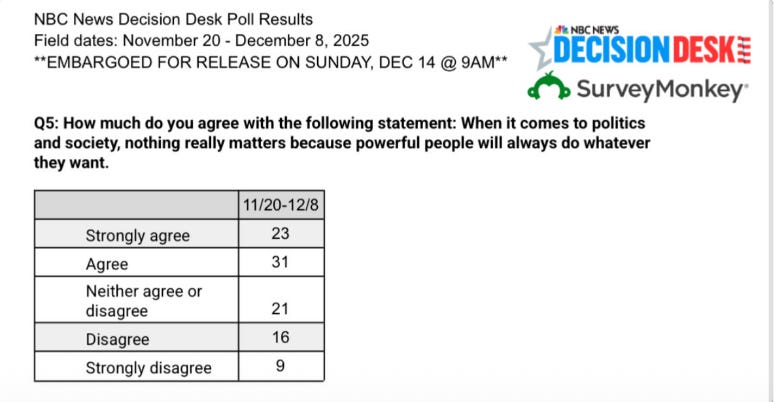
What happened is part of the popular turn against oligarchy, which is anchored by the sentiment revealed in a poll from NBC late last year. In that poll, 54% of Americans agreed that “when it comes to politics and society, nothing really matters because powerful people will always do whatever they want.” At some level, the rage is coming from voters tired of seeing the Democratic Party agenda of doing nothing but rearranging seating charts while placating the wealthy and powerful.
This political shift is happening even as Elon Musk became the world’s first trillionaire. With data centers opening every week despite popular opposition, and Mark Zuckerberg directing Facebook to go into gambling, the actions of business leaders are just wildly out of step with the popular mood. In a recent paper, three economists, including Nobel Prize winner Daron Acemoglu, offered a cheeky theoretical framework for what that could mean. They created an economic model showing that high concentrations of capital “encourages the capitalists to support a coup against democracy and set up a repressive system.”
In other words, as Louis Brandeis ostensibly said, “We can have democracy in this country, or we can have great wealth concentrated in the hands of a few, but we can’t have both.” The dramatic increase in the concentration of wealth, and the frustration revealed as populists win at the polls, suggest real and unavoidable tension.
And yet, there won’t be one dramatic moment or showdown where such a conflict occurs. There will be many. And the risk for the public is not that elections will be canceled, but that the people they elect simply will not have the tools or capabilities to govern. That’s how Alexander Hamilton controlled a populist Congress, the members just wouldn’t do the work to understand how he ran the Treasury Department, so they had no leverage to change anything.
We see this dynamic all the time today; a few months ago, former Wall Street banker and current Maryland Governor Wes Moore signed a bill he claims banned surveillance pricing for grocery stores in the state. Of course, it was written by big retailers, and it didn’t stop their ability to engage in personalized pricing to gouge consumers. Yet, Moore continues to brag about his new law to keep grocery costs low. And it’s depressing, because he has been told what he’s saying a lie, and yet there’s this bravado about empty gestures. It’s not clear if politicians like Moore even know what they are saying isn’t true.
That’s the worry, the “oppose oligarchy” arguments won’t turn into anything real. Perhaps there will be a bunch of electoral wins, a lot of well-meaning but information thin new leaders, followed by very little substantive change. Eventually, the public will once again throw the bums out, and at some point, they will just start believing that democracy doesn’t work. So where are we now? If there is a new set of political leaders in the U.S., will they actually be able to address the high cost of living in America, which is clearly fostered by collusive arrangements among the rich and powerful? Or will it be empty gestures?
I don’t have an answer, and frankly, I’m mildly pessimistic. But if you want to know what it would look like to govern as a populist, I’ll point you to a lawsuit filed two days ago against Walmart, Marathon, 7-Eleven, BP, Speedway, Circle K, Albertsons, and a host of other firms for fixing the price of gas in California. Because this lawsuit, not just the filing but the entire lawmaking process around it, shows in miniature how populist governance works in practice.
The complaint centers on a firm called Kalibrate, which sells “fuel pricing software” to gas station owners, particularly large chains. Basically, Kalibrate sells price fixing software to thousands of gas stations in the state, software that may have juiced gas prices up by as much as 30 cents a gallon across California. (The big chains who don’t use Kalibrate have other means of hiking prices.)
In California, gas prices are about $1.60 higher than elsewhere in the country, so it’s an especially painful situation. Every cent increase in the price of gas is $134 million a year for California residents. We’re talking a multi-billion dollar scheme, costing something on the order of $25 to $50 per resident, annually.
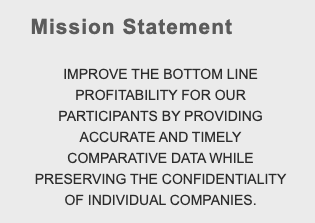
This kind of arrangement, of economic termites causing meaningful cost bloat in nooks and crannies of our world, is routine in America. Kalibrate is part of an entire ecosystem of what I’ll call Price Fixing Tech, pioneered by companies like Uber, but occurring with rents, hotels, turkey, ecommerce, equipment rentals, and likely hundreds if not thousands of other markets. Kalibrate itself sells software for restaurants, health care, retail, service retail, franchises, education, groceries, and financial services. But it’s not just Kalbrate. Here’s a mission statement for Agri-Stats, which coordinated pricing in meat markets.
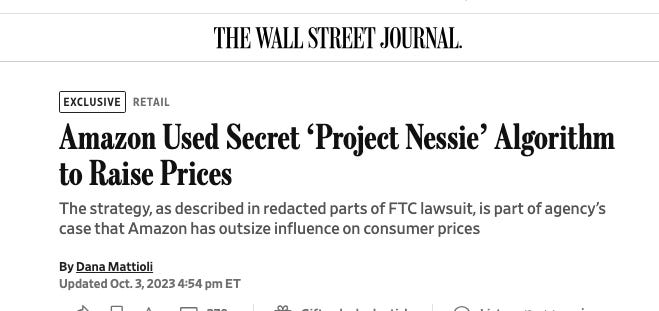
Even Amazon got busted for doing it.
This kind of Price Fixing Tech is driving broad based political anger, because it’s unfair and extractive behavior, a real conspiracy over the necessities of life. So how do we put a stop to this nonsense? Well you don’t attack these kinds of problems with abstract arguments, you attack them with law, details, and enforcement. So looking at this specific case is a good way of seeing the conflict with oligarchy, up close.
Here’s how the alleged conspiracy works. The product, Kalibrate Fuel Pricing, has gas station owners share their commercially sensitive and non-public data, such as confidential historical gas sale costs and volumes, planned and forecasted costs and volumes, and past and planned margins. It then offers recommendations, based on information from public sources and this private data, on what to charge for gas. Kalibrate calls it “competitor-led fuel pricing decisions” and “complete visibility on your competitors.”
The software has a mechanism to allow Kalibrate to automatically set the gas station’s fuel price at its pumps, signage, and points of sale. Gas stations that were formerly engaged in independent price setting, using Kalibrate, have now outsourced to that cartel operator. According to the company’s marketing material, roughly 90% of Kalibrate customer pricing decisions have their prices set automatically, which allows for a “significant” increase in gross margins. So basically, instead of a smoky backroom where a bunch of guys organize a cartel, it’s all done through a third party algorithm.
And it works.
When a high percentage of stations in an area begin using this software, gas prices in aggregate go up by 30 cents a gallon. In Canada, the government found that Kalibrate software was lessening competition in retail fuel prices. In Germany, a large scale study found average retail station margins increased by 15% after adopting this kind of software. Interestingly, where there was already monopoly control of a market, prices didn’t change much, but when there was vigorous competition, adoption of this software fostered significant price hikes. Basically, it tamps down on competition.
The company’s marketing material makes it clear what they are doing:

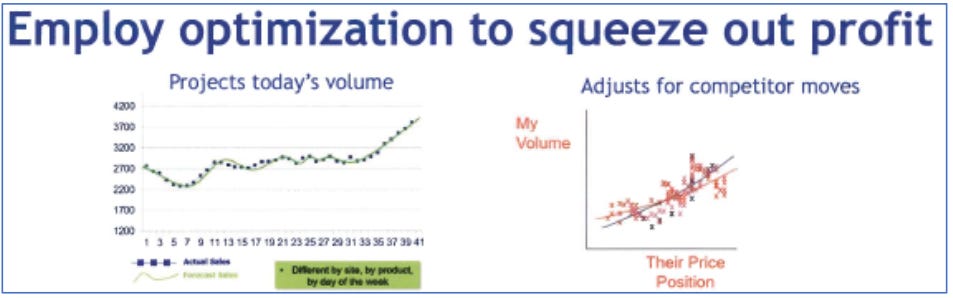
I went onto the Kalibrate website today, and it has likely been scrubbed of information that might suggest antitrust liability. Even so, the marketing content is about how the software helps decision-makers raise prices by knowing what competitors are doing. It has magic words like "protecting margin,” “optimization to squeeze out profit,” and “avoid triggering competitor price wars.” In one client scenario, Kalibrate bragged it was able to use its software to talk a customer out of lowering prices.
Here’s a client story, a guy named Trent Davis for KwikTrip, and the main value-add he discusses is how Kalibrate effectively helps him understand his competitor’s pricing moves.
Going After Price Fixing Tech
So that’s the scheme. What about the pushback? Well, BIG has discussed this problem of Price Fixing Tech for years. Antitrust lawyer Lee Hepner wrote it up with The Price-Fixing Economy in 2023, I first noted it on Naked Capitalism all the way back in 2014. The Biden Department of Justice filed algorithmic price-fixing suits against RealPage in rentals and Agri-Stats in meat, while the Federal Trade Commission used unfair methods of competition law to attack Amazon’s tacit collusion with online sellers via algorithm.
And politicians have been discussing Price Fixing Tech, and trying to figure out how to pass laws to address it. And it looks like this lawsuit shows that there is a path.
As I noted above, the Biden administration brought a bunch of cases. Unfortunately, Trump settled the RealPage and Agri-Stats complaints, and we’ll see what happens with Amazon. But Hepner, who wrote for BIG, helped pass a new law last year in California, AB 325. That law bars distributing “a common pricing algorithm as part of a contract, combination in the form of a trust, or conspiracy to restrain trade or commerce.” And it can be enforced, importantly, by private citizens, not just government officials.
State Attorney General Rob Bonta, who helped win the antitrust case against Ticketmaster, testified for the law. “AB 325 simply makes it clear,” he said, “that using common pricing algorithms to fix prices among competitors is just as illegal as traditional price fixing methods under the [Cartwright] Act.” AB 325 is premised on a 1940 case United States v. Socony-Vacuum Oil, which says that price fixing can manifest not just through a formal agreement but through many factors, including a “formula underlying price policies.”
So we have a new law to ban Price Fixing Tech. But laws don’t executive themselves, they must be enforced. In this case, the enforcement isn’t coming from government, but from private attorneys representing a class of consumers. And looking at how the case was put together helps highlight a larger ecosystem of governance.
Who are those lawyers? It’s Simonsen Sussman, a new law firm started by two former FTC enforcers working under Lina Khan. And in the complaint, they cited evidence put out by the California Energy Commission, a division of which is run by former Antitrust Division lawyer Tai Milder. Even Kalibrate’s scheme got publicized in a new way. Krista Brown, an anti-monopoly researcher turned journalist, exposed the company in 2025 in The Capitol Forum, a new publication focused on corruption and antitrust.
In other words, the attempt here to stop a few billion dollars a year from moving from consumers to big corporate gas chains is the result of a bunch of anti-monopolists learning over the years how to use the tools of law and governance. Nobody knew how to do this kind of work in 2021, when the Biden administration gave anti-monopolists some authority over antitrust. But they do now.
Eventually, this case will be put in front of a judge, and briefed. The new law, AB 325, will then have a framework, and other lawyers and enforcers can grab it and use it to stop collusion in other markets. As companies develop pricing strategies, they will ask their general counsels if it is legal to use a third party algorithmic cartel manager, and their general counsels will hopefully have to tell them it isn’t. The new political leaders elected on a populist wave will then be able to pass laws like this in other states, or on a Federal level. New York, for instance, has a host of legislative initiatives to address surveillance pricing, price discrimination, and price fixing. When that happens, Price Fixing Tech will go away, leading to fair treatment of consumers.
So that’s how you take down an oligarchy. One bite at a time. It’s not fast, and it’s not satisfying, at least not at first. But a few billion here, a few billion there, and pretty soon you’re talking real money. Or to put it differently, someone has to give shape to the vague bromides against corporate greed and oligarchy. I am not sure there’s enough time to figure out the levers of power to do this in every sector, in health care, defense, AI, and so forth before 2029, to build out a set of capable people who know how to use the law on behalf of the public. Some of it will have to be figured out on the fly, as it was under the New Deal.
Regardless, the republic has not had a unified and capable set of policymakers and a populist political environment since the 1970s. Maybe we’ll have one again. That’s what the oligarchs fear, anyway.
Thanks for reading! Your tips make this newsletter what it is, so please send tips on weird monopolies, stories I’ve missed, or other thoughts. And if you liked this issue of BIG, you can sign up here for more issues, a newsletter on how to restore fair commerce, innovation, and democracy. Consider becoming a paying subscriber to support this work, or if you are a paying subscriber, giving a gift subscription to a friend, colleague, or family member. If you really liked it, read my book, Goliath: The 100-Year War Between Monopoly Power and Democracy.
cheers,
Matt Stoller