BURST
BURST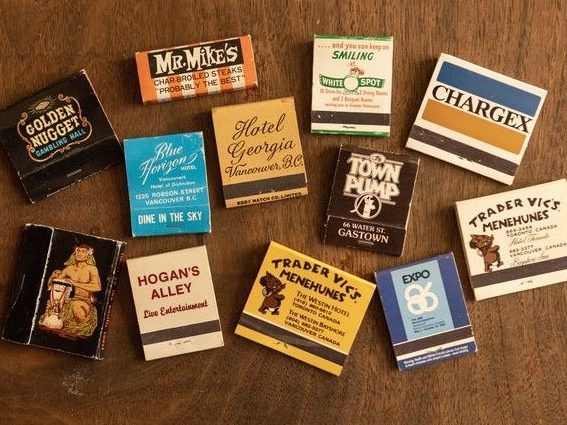
They call things that were intended to be used for a short time ephemera.
A good example is the humble book of matches.
Back when a lot of people smoked, most every bar, restaurant or hotel made personalized matchbooks with their logo.
You opened them up, ripped out a match, and lit it on the “striker strip” at the bottom of the matchbook cover. When the 20 or 30 matches in the matchbook were used up, you tossed it and got another one.
But some people kept them. It might have a cool design, be a souvenir of a trip, or something they picked up at a favourite restaurant.
Over time, small collections became sizable. Matchbooks were easy to store — you can fit several hundred in a relatively small bag.
A woman named Leslie had a bag like this. For years, she collected matchbooks from her travels and favourite restaurants.
At 88, Leslie has had health issues and moved into a care home. Her friend Vern helped clean out her apartment and storage lockers, and came across the match collection. So he phoned me.
It’s quite extensive — 426 matchbooks in one small plastic bag from Parfait at 1195 Robson.
She must have loved La Bodega, a tapas restaurant and bar on Howe Street — she had 29 La Bodega matchbooks. For some reason she had a whole box of matchbooks from The Mansion on Davie, about 90 in total.
Unfortunately, neither the La Bodega or Mansion matches are that visually interesting.
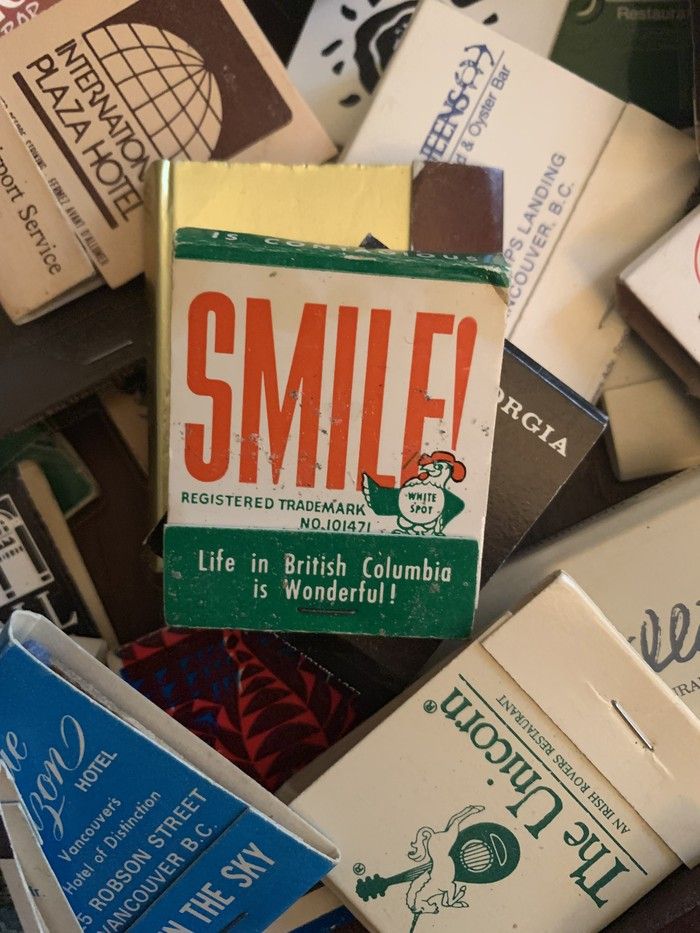
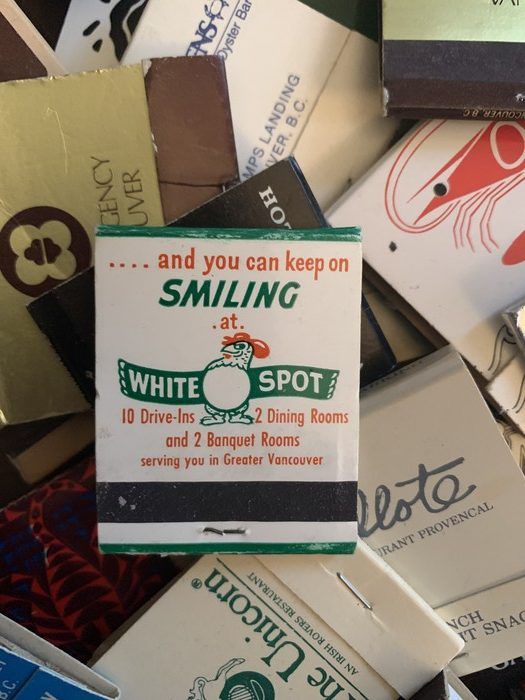
But the White Spot matchbox is fabulous. It’s ingeniously designed, with no wasted space. The inside of the matchbook is green and white stripes with White Spot’s 10 locations when it was made, probably in the 1960s.
At the bottom of the matchbook is the message “Life in British Columbia is Wonderful!” The top of the matchbook reads “Courtesy is Contagious.”
The front is white, green and red, and has giant letters that read “SMILE!” It also has a tiny White Spot chicken logo — back in the day it was known mostly for its chicken, not the legendary burger with the Triple O sauce.
A bigger chicken logo is on the back of the matchbook, with “White” on one extended arm and “Spot” on the other. In the middle is the chicken’s round white belly — a white spot.
Some matchbooks are slightly larger, such as Chargex, a Canadian bank credit card that was taken over by Visa in 1977. Seeing the blue and tan striped Chargex logo is instant nostalgia for people who lived through the late 1960s and 70s, as is its old advertising slogan, “Will that be cash or Chargex?”
Some matchbooks are from restaurants in buildings that no longer exist, such as the Seafood House in the Devonshire Hotel. The Dev was demolished in 1981, but the Blue Horizon Hotel is still standing on Robson Street. Alas, the Blue Horizon’s cool penthouse bar/dining room is long gone, but Leslie still had matches that advertise patrons could “Dine In The Sky.”
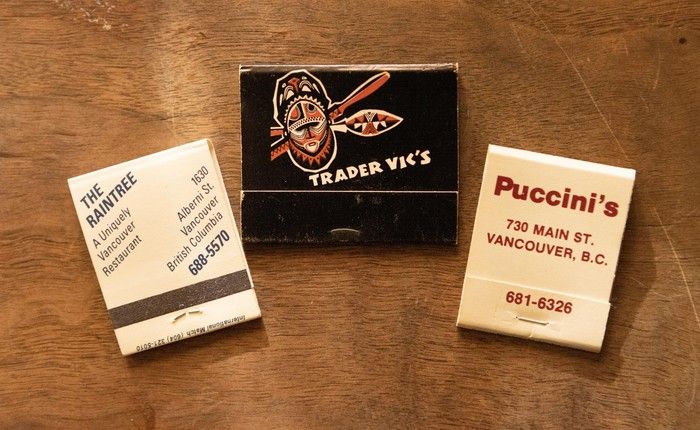
Leslie must have frequented tiki bars — there are matchbooks from both of Vancouver’s tiki hot spots, Trader Vic’s and the Waldorf Hotel. She also has a matchbook from The Chalet “International Cuisine Motel” in Kitimat.
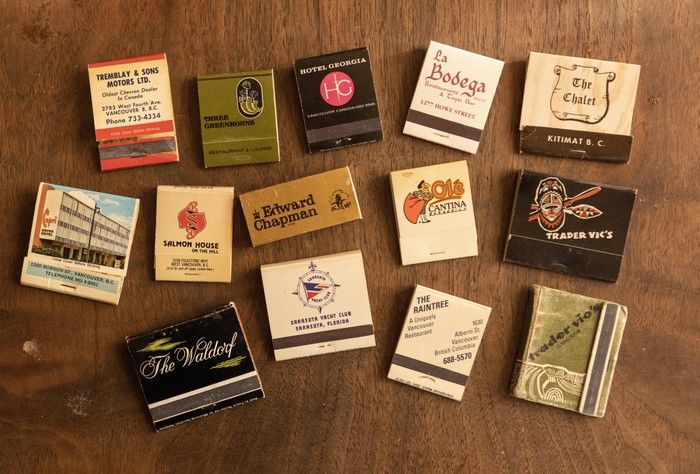
Matchbooks like this aren’t worth a lot of money, but people still love them.
“At our shop, we always had a bin of old matches for 50 cents, and people bought them endlessly,” said Chris Switzer of the collectible store Stepback, which has closed its retail space and is now doing a pop-up store.
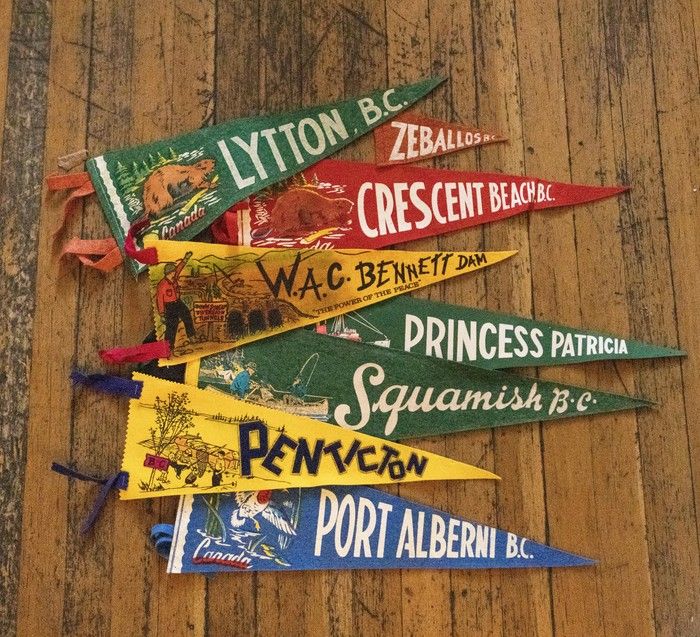
Leslie also had a collection of old pennants, which people also love, and don’t cost a fortune.
“Typically, when we were buying big wacks of them, like we’re at some flea market and some guy’s got his dad’s collection of 60 or whatever, we’d pay three or four bucks apiece for them,” said Switzer.
Retail might be $14 to $20, but online some people are asking crazy amounts for vintage pennants like Leslie’s one from the Indianapolis Speedway, which features a race car and stylish winged logo.
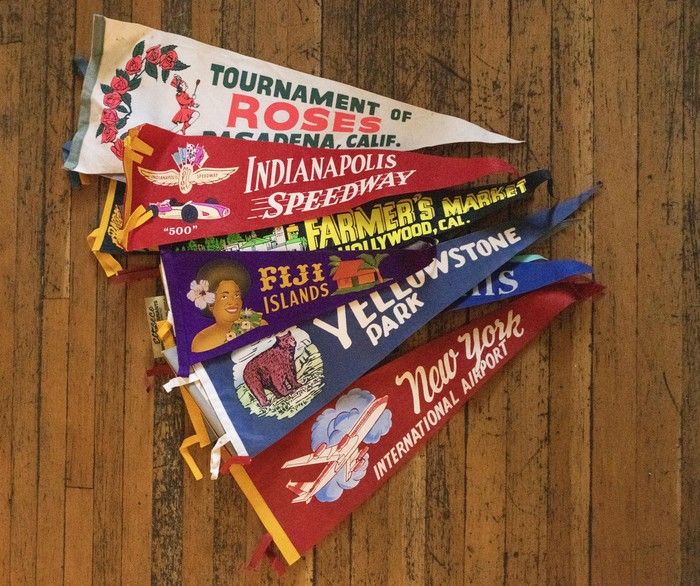
You can trace her travels around the world through the pennants, which include a smiling woman from Fiji, a bear in Yellowstone Park and a 1960s jetliner at New York International Airport.
It’s amazing how even small towns produced pennants as souvenirs — the collection includes B.C. pennants from Lytton, Zeballos and Crescent Beach. Most feature a standard image, such as a native chief, a beaver or a fish.
“I had an Abbotsford one with a moose on it,” said Switzer.
But some are unique, like a yellow pennant advertising the W.A.C. Bennett Dam, which opened in 1968.
It features a worker in a hard hat hailing the three “downstream diversion tunnels” in the project, has wonderfully jumbled letters and a message at the bottom reading “The Power of The Peace.” That would be the Peace River, where the hydroelectric dam is located in northern B.C.
As a memento of Wacky Bennett/Socred-era B.C., it’s pure gold. Good eye, Leslie.