 BURST
BURST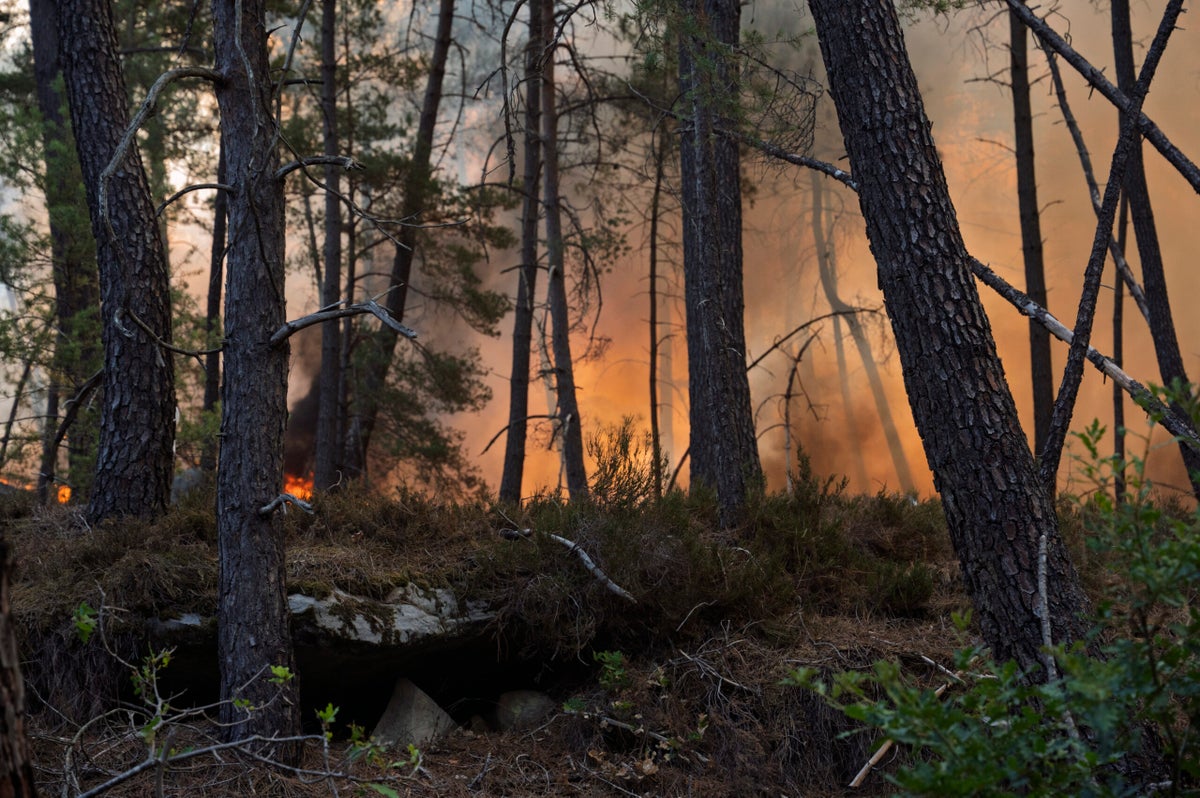
The world-class bouldering area of Fontainebleau is on fire—and police believe that it was intentional. Yesterday, French authorities arrested two people under the suspicion of arson after discovering 10 separate ignition points about 60 kilometers southeast of Paris. Since the fire began on Sunday, it has consumed more than 5,000 acres of land and forced the evacuation of nearly 1,000 people.
This evacuation comes amidst an intense heat wave that’s created extremely high fire risk for much of Western Europe. Drought conditions, gusty winds, and record temperatures of up to 40 degrees Celsius (100 degrees Fahrenheit) have contributed to the flames, which have now been contained but not yet extinguished. According to Sortir à Paris, a local Parisian news site, more than 850 firefighters remained on the ground as of Tuesday.
Alberta-based climber Tracy Wood recalls the conditions in Font just before the fires erupted. “Everything [was] bone dry,” she told Climbing. “Good god. Even if it rained a bit, everything was absorbed or evaporated so quickly [that] it was dry within an hour. It was bad. The heat waves are getting earlier and earlier as well. We were there during the first one of the season and it was brutal.” She described the terrain as “dry and crunchy” and says she wasn’t surprised that fires have erupted already this season.
Now, the fire is raging through some of the most popular and historically significant boulders in the world. Out of Fontainebleau’s 16 bouldering areas listed on the Bleau.info website, more than half are currently closed, including the entire Trois Pignons, Franchard, Larchant, and Apremont areas. As of today, Trois Pignons, Corne Biche, Mont Aigu are still considered active fire zones. It is not yet clear which boulders, if any, have sustained direct fire damage, but all visitors are being warned to stay away from the area.
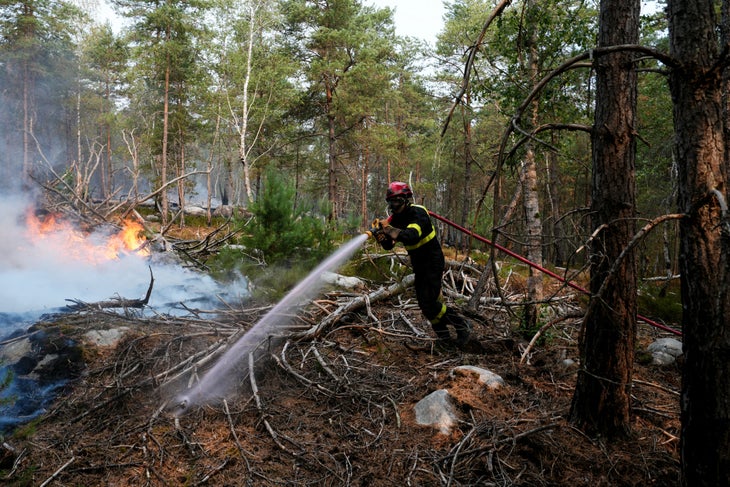
One of the two arson suspects in police custody is a volunteer firefighter in Fontainebleau. After his arrest, the public prosecutor’s office said that he admitted to using a lighter and gasoline to light twigs on fire, for reasons unknown. The second suspect reportedly contributed to a second fire by tossing his cigarette on the ground.
Rebecca Crowe, a Liverpool-based climber who frequents Font, has watched the devastation from afar. “Font is a happy place for me, where [I] can climb from morning to night and not be anywhere close to being done,” she told Climbing. “There’s a community here, everyone is psyched, and it’s just the home of European bouldering in its best form. To see it ablaze like this, which could’ve been avoidable, is heartbreaking.”
She added that the fires have caused damages beyond climbing. “There are hectares of the forest going up in flames, so while Font is a Mecca for boulderers, this is a much wider issue for anyone who loves nature. Being responsible in the forest and avoiding open flames in a time of horrific heat and dry periods should be a no-brainer. And with rising temperatures year [after] year, this could become a more consistent issue if climbers and tourists aren’t more considerate.”
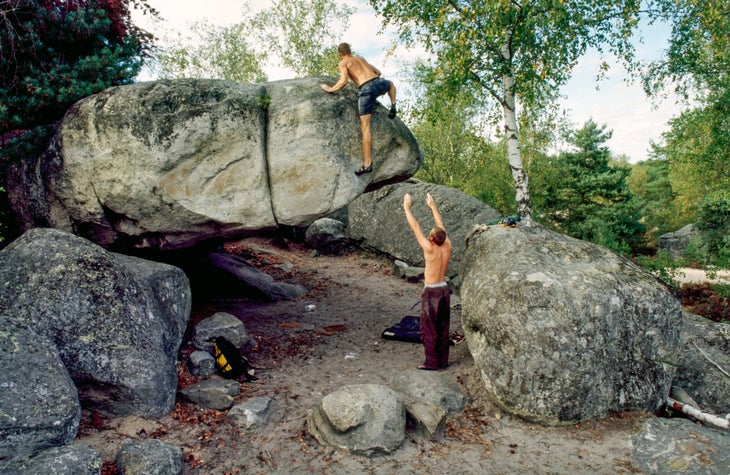
Few climbing areas rival the significance of Fontainebleau in climbing history. The area is often considered the birthplace of modern bouldering and contains an estimated 40,000 boulder problems, making it one of the largest concentrations of high-quality boulders anywhere in the world. Font’s compact, sandstone blocks seldom exceed a height of 20 feet, but generations of climbers have built its reputation of technical movement, precise footwork, and notoriously sandbagged grades that often feel harder than numerical ratings suggest. According to Fontainebleau’s official tourism website, the forest receives more than 11 million annual visitors—more than the Louvre Museum in Paris.
Depending on the extent of the wildfire damage, climbing crags can quickly reopen after a blaze dies out, remain damaged for months, or experience permanent damage. In 2002, Elephant Knob in the Sierra Mountains experienced the latter, becoming irreparably destroyed during a 2002 fire, leaving chossy rock and questionable hardware in its wake.
While Font’s future is uncertain, several local climbing organizations, including the Women’s Bouldering Festival, are already raising funds to support the forest’s future restoration.
This is a developing story and will be updated as more information becomes available.
The post A Human-Induced Fire Has Destroyed More Than 5,000 Acres in Fontainebleau appeared first on Climbing.