 BURST
Lots of news in the monopoly round-up, including a disastrous turn in the Paramount-Warner as the key state attorney general lead, Rob Bonta, caves. It’s not over, but this one took a bad turn. In better news, the crypto lobby lost its main objective for this Congress, and basically collapsed in an orgy of corruption and incompetence. Fitting, that. There’s also a bunch of news on AI, and a fascinating market power story involving musician Macklemore, Ticketmaster and Israel.
But I want to start with something you may have missed, which was a procedural vote in the Senate last week to give the National Collegiate Athletic Association a special exemption from antitrust law. The NCAA is a widely loathed organization that has for decades prevented college athletes from being paid, despite them working what are essentially full-time jobs as minor league professionals. In 2020, the Supreme Court took away the NCAA’s authority to set wages for college athletes and run college sports. Now, Congress is on the verge of restoring their monopoly power. I’ve asked Katie Van Dyck, an antitrust lawyer working on sports, to lay out what’s happening.
In July, Stanford football players elected representatives and formed the first player-led chapter of the College Football Players Association. The CFBPA’s ultimate goal is collective bargaining on a conference-by-conference basis. From Ernest Cooper, a Stanford linebacker and one of the team’s elected representatives:
“As a Power 4 college football player you’re working out year-round, you’re getting paid …. I don’t see why people wouldn’t see us as employees.”
Just a few days later, the Oregon State women’s basketball team collected enough signatures to seek an election with the United College Athletes Association. They have filed a petition with the Oregon Employment Relations Board. From the university, which is opposing the effort:
“Playing on a college basketball team is not service performed for hire …. Student athletes at OSU matriculate to obtain and [sic] education and voluntarily pursue basketball as part of that experience.”
Last year, over 100 women’s basketball players wrote to Big Ten commissioner Tony Petitti and SEC commissioner Greg Sankey asking for a formal way to be heard on the rules that govern their sport. Neither agreed to meet.
The Senate is about to weigh in against these athletes’ efforts, with the Protect College Sports Act (the “PCSA”), which has been taking up valuable debating time in the House and Senate. The two lead Senators on the bill are Republican Ted Cruz from Texas, and Democrat Maria Cantwell, from Washington state. Both have very sharp elbows and have used them to move this legislation.
It passed a procedural hurdle last week, by a 74–24 margin, to proceed to a full vote, which will happen shortly. Populist politicians like Bernie Sanders and Elizabeth Warren were opposed, but the “aye” column included most of the Senate, including some surprising center-left supporters, like Senators Amy Klobuchar (D-Minn.), Ruben Gallego (D-Ariz.), Ron Wyden (D-Ore.), and co-sponsor Peter Welch (D-Vt.).
It’s worth saying upfront that it is weird that Congress is focusing on this topic to the exclusion of most other things. There are massive cost increases in health care, a war in Iran driving up prices, risky problems with artificial intelligence technology and financing, and on and on, but Congress is spending its time on… college sports.
There have been countless commercials during football season promoting this legislation. Nick Saban has made his case before the Senate and on ESPN GameDay. Amazon, Paramount, and Disney are on the Hill lobbying. Even Deion Sanders has joined the bandwagon. All of them say that college sports, a $20 billion industry and growing, are in chaos. Ted Cruz even went on ESPN GameDay, and was hilariously booed with “Ted You Suck!” chants as he pitched this legislation for ten full minutes.
Still, this lobbying campaign isn’t the sole reason Congress is focusing on college athletics to the exclusion of everything else. Another reason is that, as BIG often chronicles, the superrich tend to have their priorities addressed in our political system. And the superrich love college sports. For instance, billionaire Larry Ellison, who is right now financing the Paramount-Warner takeover, and owns TikTok and Oracle, is deeply involved in the University of Michigan’s athletic department finances, because his sixth wife is an alumni of the school.
For decades, wealthy alumni, known as “boosters,” have played a part in funding college sports, as a sort of passionate high-end hobby. Key here was that the athletes didn’t get paid, which not only reduced costs but also contributed to an endless series of scandals involving athletes paid under the table.
But this whole system got a rude awakening in 2021, when the Supreme Court unanimously rejected the NCAA’s request for “immunity from the normal operation of the antitrust laws” in its landmark NCAA v. Alston decision. It did so at least in part based on the NCAA’s admission that it “enjoy[ed] monopsony control” and was “capable of depressing wages below competitive levels.” Justice Kavanaugh wrote that “[t]he NCAA’s business model would be flatly illegal in almost any other industry in America.”
The Alston decision created a sea change in college athletics, forcing the NCAA to abandon a long-standing ban on athlete compensation within days of the opinion’s release. Before 2021, universities were only allowed to award scholarships and certain “education-related” benefits like tutors and laptops. The result was coaches and administrators earning millions while the athletes on the field brought home nothing beyond a scholarship. It was a blatantly unfair and exploitative system. The Alston decision forced the NCAA to make a change.
Today, athletes can sign name, image, and likeness (“NIL”) deals with sponsors like Nike and Gatorade. Boosters frequently set up funds to bring in star players. And starting in 2025, schools can pay athletes directly via revenue-sharing, named for the athletic department revenue that funds it. Revenue-sharing is currently capped at $20.5 million per school, but a report published by The Athletic shows that the biggest programs are spending over $50 million a year on their rosters.
Alston also ushered a wave of lawsuits challenging other NCAA rules, including those limiting the number of transfers, restricting eligibility for older players and professional athletes, and capping the amount of prize money tennis players can collect. These have frustrated coaches, administrators, and some fans alike. And it changed the way universities finance athletics, since traditionally they cross-subsidize revenue-generating sports with those that don’t bring in enough cash.
Given the massive changes in college athletics wrought by the Alston decision, universities began a big lobbying campaign. Enter the Protect College Sports Act. To its proponents, the PCSA restores balance to college sports, putting the NCAA back as the governor of the system. It limits revenue sharing, regulates NIL deals, and imposes uniform rules on transfers and recruiting. It also grants an antitrust exemption to schools to pool and sell media rights. The idea here is to “fix” college athletics and make it more sustainable. Senator Cantwell’s office even released a financial report during the first PCSA procedural vote claiming that her bill will put an end to “unsustainable athletics spending [] amplifying the broader fiscal pressures facing higher education.”
But there’s a reason athletes and labor unions are opposed. The truth is, the PCSA is the culmination of a 5-year, multi-million-dollar lobbying campaign by the NCAA to secure an antitrust exemption that will allow it to unilaterally set the rules governing athletes’ compensation and eligibility.
But college sports need rules just like the NFL, right?
Antitrust exemptions are not unusual in American professional sports, to facilitate forms of collaboration in league play. However, there are other mechanisms to balance power, notably unions. And those are absent among college athletes.
The NFL, NBA, MLB, NHL, NWSL, and WNBA all have players’ associations that they negotiate with. The end results of those negotiations are collective bargaining agreements. They cover the draft, salary caps, free agency, health and safety standards, and a lot more. The NFL’s agreement with its players is over 400 pages long. And it is subject to antitrust exemptions that have existed for over 100 years. These labor exemptions were created, by Congress and courts, with the express goal of “restoring equality of bargaining power between employers and employees.” The NCAA could enjoy this exemption too. It just has to recognize a union and sit down with the athletes, the way nearly every other sports league does.
But the NCAA doesn’t want to negotiate, and the antitrust exemption it’s lobbying for, designed to give the organization more power over its workforce, means it wouldn’t have to.
Won’t this save athletic departments from financial ruin?
The biggest myth surrounding the PCSA is that it will bring much needed relief to universities that are financially shaken by the Alston decision. There are a few problems with that claim.
First, claims that this legislation would mitigate unsustainable pressures on university athletic departments are highly misleading. For instance, Senator Cantwell cited a report from the Government Accountability Office that looked at spending between 2014 and 2024, when most spending growth was focused primarily on coaches, support staff, and team travel. Universities couldn’t even pay athletes directly until 2025; the money going to athletes from 2021 to 2024 came from boosters and advertisers.
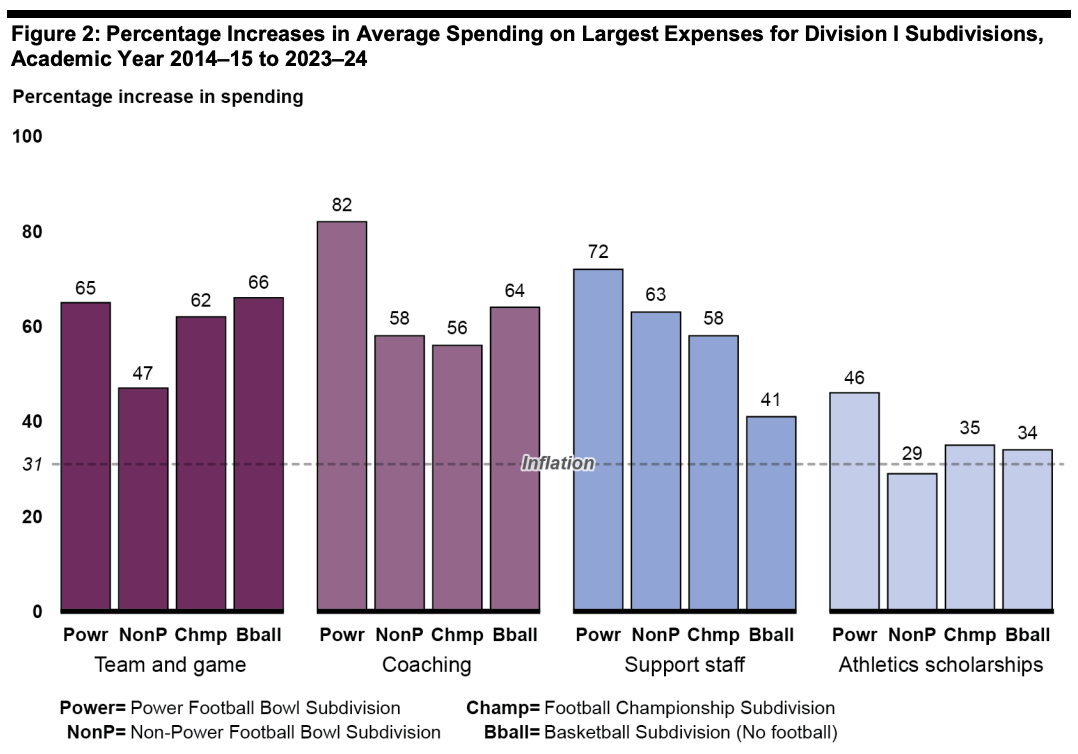
The PCSA does not cap any of this spending. It only takes on the athletes’ compensation. So outrageous coaching salaries and buyouts are fine; it’s only the people who work for a living playing the sports that get dinged.
How significant are coaching salaries?
Indiana’s head football coach Curt Cignetti secured a $105 million contract after winning a national championship. LSU signed a $91 million contract with new head coach Lane Kiffin last year, and it owes the two coaches before him $70 million in buyouts. Data from the Knight Commission shows that, for the 2025 season, universities owe $225 million in buyouts for just 15 coaches. According to the GAO, the median spend on these severance payments by Power 4 schools more than quadrupled between 2014 and 2024, from $328,000 to $1.5 million.
Second, the PCSA places enormous and entirely new financial burdens on universities. The health and safety mandates, which are a start but hardly complete, bring new out-of-pocket expenses for injuries, catastrophic injury insurance, and new health and safety officers. And reporting obligations will require significant hires to prepare NIL databases and meet academic support requirements.
Third, there is no evidence that Title II of the bill, which allows media rights pooling, will actually generate more money for the schools. The SEC’s deal with ESPN runs 10 years and $3 billion, the Big Ten’s with Fox and NBC is 7 years and $7 billion, and the Big 12’s with ESPN and Fox is 6 years and $2.3 billion. On top of that, 75% of FBS schools (the 138 biggest football programs) have to agree on pooling before new negotiations can start. But folks seem to be accepting claims to the contrary — mostly made by Texas Tech Board of Regents chairman, billionaire booster, and Trump confidant Cody Campbell — that the provisions will save college sports. Public reporting says it will save his effort to form a super league.
What comes next?
Last week’s procedural vote is a good indication that the PCSA will pass the Senate, but the NCAA’s path through the House has been bumpy. Still, Donald Trump reportedly wants to sign the bill into law on GameDay at a University of Georgia game, meaning Speaker Mike Johnson will face a lot of pressure from the White House.
If the Protect College Sports Act does become law, it will ensure that athletes on the Stanford football team and Oregon State women’s basketball team will not have a chance to collectively bargain for better pay or better health and safety provisions. The bill would cement all of the economic terms governing their participation in college sports into U.S. law, and their overseers would have no incentive to come to the bargaining table. It will be a giant step backwards for college athletes, and it will bail the NCAA out of a “crisis” of its own creation.
What makes this all the more tragic is that the PCSA will not save the small schools that support it. The Big Ten and SEC will continue to dominate college sports, and the small schools will continue to fall behind. The only things that will be saved are the salaries of millionaire coaches and the people who pay them.
But then, there’s deep rage in America for a reason. This Congress is frittering away its waning days with failed attempts at crypto deregulation and antitrust exemptions that harm college athletes. They’ve given up on even pretending to address what frustrates Americans. Hopefully, this legislation dies. But the good news is that regardless, there’s an election in two months.
-Katie Van Dyck
And now, the rest of the monopoly news round-up. There’s a very important set of stories, most notably that California Attorney General Rob Bonta somehow was convinced to cave and essentially permit the Paramount-Warner merger to go through. But the other state AGs are not on board his decision. Plus, private equity is getting crushed via higher interest rates, musician Macklemore somehow took on a conspiracy of NFL stadium owners and Ticketmaster and won, and polling shows anger at Republicans in weird places could bring a wave of unorthodox anti-monopolists into the next Congress.
That, and more, after the paywall.