 BURST
BURSTFor the past week, BIG has been doing daily coverage of the Live Nation/Ticketmaster monopolization trial with a reporter in the courtroom. Writ large, the argument is that the company controls 70% of key performing venues, 86% market share in primary ticket sales, and substantial amounts of talent promotion, and it uses these different lines of business to coerce rivals and preserve and fortify its market power. The case was filed in 2024, and a jury was assembled last week. We also heard opening statements and testimony from a few witnesses who ran concert venues.
But today, something very significant happened, one of the wilder courtroom spectacles we’ve seen. The Antitrust Division abruptly announced that it has reached a deal with Live Nation/Ticketmaster, which led to the company’s stock skyrocketing on the news. But then the state enforcers, who are also plaintiffs, said they would not be sandbagged, and pledged to continue the trial. This kind of split, in a monopolization case, is exceedingly rare, and it never happens in a single day in court.
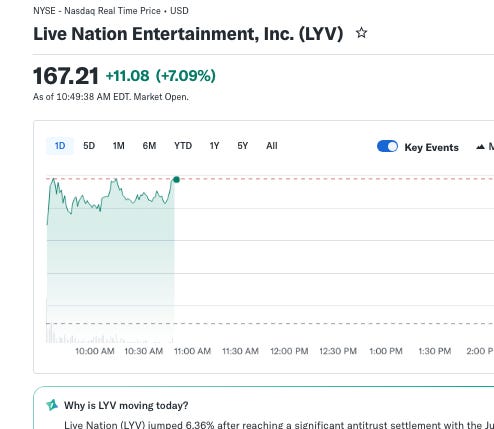
So what did the DOJ and Live Nation agree on? Well the details are probably the least important part of the deal. There is conflicting reporting and the terms aren’t public. Different outlets report that the settlement may involve Live Nation paying $300 million to states for restitution to consumers, some behavioral remedies to allow rivals to sell tickets, a restriction on exclusive contracts, and the sale of 10 amphitheaters, though Axios says there will be no divestments. Broadly, this consent decree would be the third Ticketmaster ‘deal’ since 2010, and none of them have delivered competition to the market. So there’s no reason to assume this one will either.
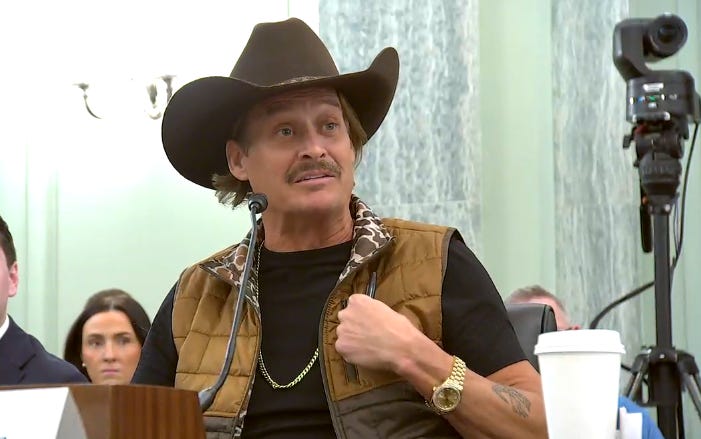
Taking a step back, tt’s worth noting that Ticketmaster is a wildly unpopular company, not just among people like Taylor Swift fans, but also with MAGA influencer Kid Rock. Indeed, he just testified two months ago at a Senate hearing titled “Fees Rolled on All Summer Long: Examining the Live Entertainment Industry,” and he may have been a witness at trial. So this deal is not going to be well-liked anywhere.
There are a also bunch of oddities in the process, to say the leaset. First, the settlement was seemingly hidden from Judge Arun Subramanian. The term sheet was signed on March 5th by the CEO of Live Nation and the Acting Assistant Attorney General. The following day, there was a meeting in chambers with the judge. No one brought up the fact that there was movement with a settlement. “It was never stated to me that there was an executed term sheet that was signed the prior day,” Judge Subramanian said.
The judge apparently first found out about the executed term sheet last night. “Among other things I received notification of at 8pm last night that the parties had a term sheet,” he said. “You know what was not attached to that email? A term sheet.” He didn’t get eyes on the term sheet until 6:30 am this morning. The closest to irate this otherwise temperate judge has gotten, he told the DOJ and Live Nation that their conduct “shows absolute disrespect for the court, for the jury, for this entire process.”
And that’s not all. David Dahlquist, who is lead counsel for DOJ, didn’t see the term agreement till this morning either, the same time as the judge. That’s extremely weird, and suggests this deal was cooked up by the higher up politicos. It’s unclear exactly when Live Nation’s counsel learned that the term sheet had been executed.
“We cannot agree to it.”
That said, there are other parties to this trial, which is to say, the state attorneys general. And they have not relented. New York AG Tish James said the deal “fails to address the monopoly at the center of this case, and would benefit Live Nation at the expense of consumers.” And they will continue litigating. James issued a list, which notably includes both red and blue states.
Joining Attorney General James in continuing the lawsuit against Live Nation are the attorneys general of Arizona, California, Colorado, Connecticut, Illinois, Kansas, Maryland, Massachusetts, Michigan, Minnesota, Nevada, New Hampshire, New Jersey, New Mexico, North Carolina, Ohio, Pennsylvania, Rhode Island, Tennessee, Utah, Vermont, Virginia, Washington, Wisconsin, Wyoming, and the District of Columbia.
The states have asked for a mistrial, arguing that the settlement has “has materially and irreparably prejudiced the Plaintiff States before the currently empaneled jury, and materially altered the character of these proceedings, including by jeopardizing Plaintiff States’ access to experts, witnesses, trial exhibits, demonstratives and necessary support staff (including graphic designers, trial technicians, related personnel).”
The DOJ has carried the majority of the government’s litigation (including the states’). It currently has about 40 lawyers working round-the-clock on this case. The states do not. To run this trial on their own, state enforcers say, they would need to obtain large swaths of materials, transfer data bases and reallocate their own resources. There are also questions about whether the states could retain the same key experts expected to testify on behalf of the plaintiffs.
The judge didn’t buy this as reason enough to grant their request and was just as unhappy with them as he was with the other parties. The states knew, he said, that there was discussion of settlement, as early as January 29. Why weren’t they preparing? “Now you’re saying to the court we don’t like where we are and we want a redo,” he said.
Trump’s Department of Justice Doesn’t Want to Break Up Live Nation
The judge has dismissed the jury for a week, and will have the parties in tomorrow to talk about the motion for a mistrial, including the Acting Assistant Attorney General, Omeed Assefi, and the CEO of Live Nation, Michael Rapino.
It seems clear that the DOJ leaders don’t see what they did as a concession, they just don’t want to break up the company. Here’s a quote by a top DOJ official given to Ben Remaly of the Global Competition Review. “If the concern is that Ticketmaster operates as a monopoly, how does the American consumer benefit from an existing monopoly being offloaded to a third party... probably private equity.” My guess is that quote is coming from outside of the Antitrust Division. And it shows how they can’t imagine a non-dysfunctional economic order.
Ultimately, hanging over these proceedings is the specter of corruption. Live Nation retained well-known MAGA lobbyist and fixer Mike Davis, who was able to force the previous antitrust chief, Gail Slater, from office. Another Trump lobbyist, Kellyanne Conway, works for Ticketmaster. And the company donated $500,000 to Trump’s inaugural.
It’s an ugly time at the Federal level. But we are seeing action nonetheless from state-level elected officials. The Swifties may yet have their revenge.
Thanks for reading! Your tips make this newsletter what it is, so please send me tips on weird monopolies, stories I’ve missed, or other thoughts. And if you liked this issue of BIG, you can sign up here for more issues, a newsletter on how to restore fair commerce, innovation, and democracy. Consider becoming a paying subscriber to support this work, or if you are a paying subscriber, giving a gift subscription to a friend, colleague, or family member. If you really liked it, read my book, Goliath: The 100-Year War Between Monopoly Power and Democracy.
cheers,
Matt Stoller