 BURST
BURST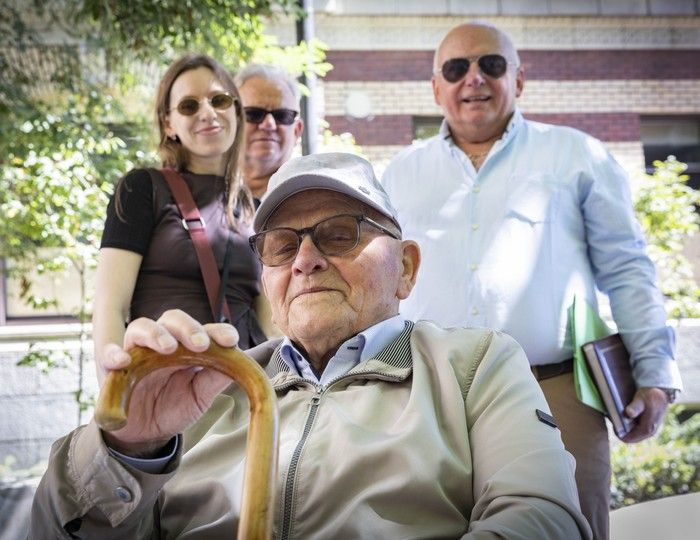
On June 5, 1981 Polish navigation officer Benedykt Hewelt was working on the Panamanian ship Saint Innes, checking the ship’s readiness to receive cargo.
He accidentally fell four storeys into the hold of the ship, which was docked in Vancouver Harbour.
He was badly injured, receiving an open fracture to his left elbow, a fractured pelvis, damage to the right kidney (which was later removed), fractured ribs on the left side, a concussion and damage to the lower spine.
But he wasn’t knocked out.
“His right hand was free, and so he whistled, and somebody heard that,” said his granddaughter Basia.
Paramedics took him to St. Paul’s Hospital, where he had an eight-hour operation .
Hewelt spent four months in St. Paul’s before he was healthy enough to return home. And he has never forgotten how the staff at the hospital saved his life.
He is now 95 years old, and decided to thank the staff. At Christmas, Basia helped him draft an email to St. Paul’s.
“After the surgery, I saw doctors standing by my operating table,” Benedykt wrote in the email. “I asked, ‘How am I doing?’ One of the doctors, as I understood it, said among other things: ‘You will live.’”
Much to their surprise, they received a reply the next day. So his family decided to bring him to Vancouver to thank St. Paul’s staff in person.
“Grandpa always wanted to come,” said Basia. “Once we had this answer from the hospital … of course we wanted to bring him.”
On Tuesday, three generations of the Hewelt family — Benedykt, his sons Marek and Oleg, and granddaughters Basia and Aleksandra — came to St. Paul’s for a touching rendezvous with hospital staff.
It was three days shy of the 45th anniversary of Hewelt entering the hospital.

Hewelt entered on a wheelchair, but inside the hospital he walked around with the help of a cane that had been given to him at St. Paul’s in 1981.
He was met by Providence Health Care CEO Fiona Dalton, who he thanked “for giving me second life after accident.” He apologized for his English, and she smiled and said, “your English is a lot better than my Polish.”
Upstairs, he was met by representatives of several of the departments that would have helped him in 1981. He was in good spirits, slipping between Polish and English, telling stories. He even had a short conversation in German.
He has incredible spirit. He was off work for nine years after his accident, but returned to sea and worked for another decade before retiring.
Basia read a story he had written, about his family’s struggles to survive when the Nazis occupied Poland during the Second World War. He was sent to work camps and various sites.
“Thank God we survived,” he wrote. “The hardships of those years shaped my character. They taught me empathy, respect for others, courtesy, fairness, and perseverance. These values combined with honest work and education helped me build a successful career at sea.”
Those qualities also helped him survive his near-death from his fall. He caught pneumonia at St. Paul’s and his health “deteriorated significantly,” but he slowly built his strength back.
He was particularly thankful for the hospital chaplain, who spoke Polish and gave him Holy Communion. His Catholic faith helped him through — he had prayed shortly before his accident.
He survived and was able to return to his wife and five children in Poland. Forty-five years later, he was able to return to the hospital that saved his life.
Related

