 BURST
BURST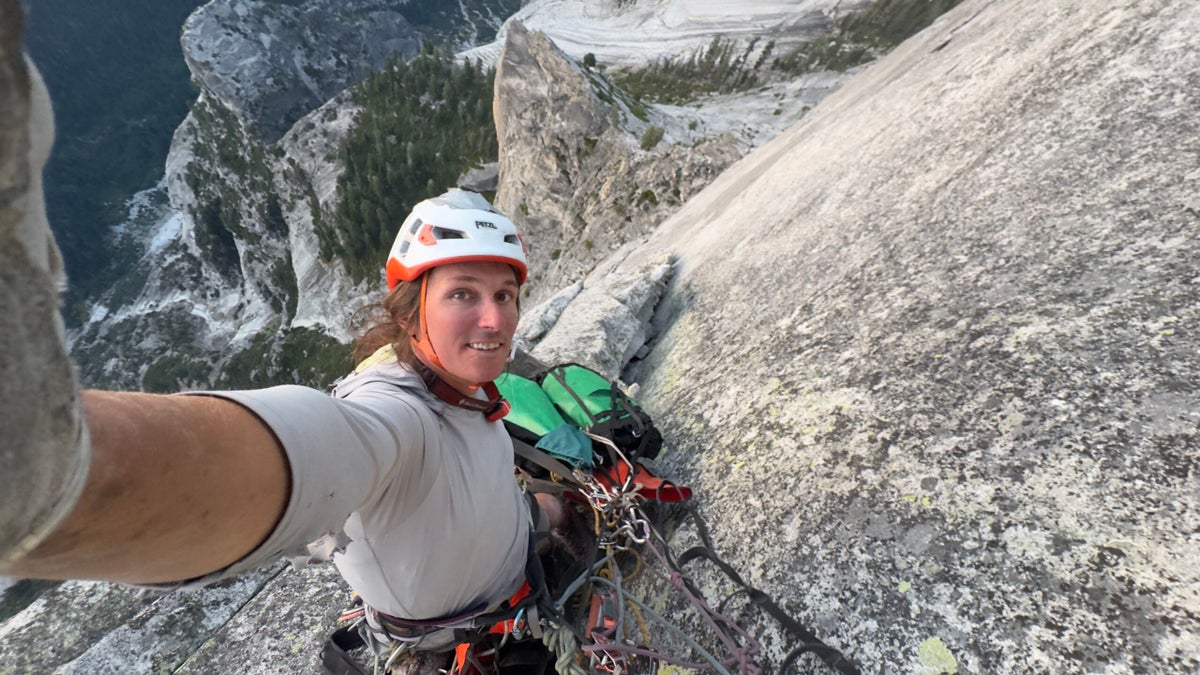
The first time I tried to climb a new route on Half Dome, I couldn’t even get to the base. Snow melted on my haul bag and dripped down onto the back of my rain pants as I hiked. I’d drawn the hood on my rain jacket and counted water droplets as they poured off the blue brim that framed my view. Eight miles into a 16-mile day, I’d reached the subdome, where the granite monolith breaks out of the trees into the sky. A day hiker would continue up to the cables and the summit. But instead of following the standard trail, I turned and headed down towards the Northwest Face—the climber’s route— in a blinding squall of snow. Trees along the north ridge terminated up into the low clouds. The forest grew darker as I walked, with the snow starting to evenly blanket the forest floor.
I felt small and alone as I descended along the edge of the cliff. With the snow falling over my head, I couldn’t help but be reminded of what it took to get here, and how uniquely challenging my last few years had been. The previous winter had been wrought with loneliness, political oppression, and the need for change, both geographically and socially. After two years of actively pursuing a gender transition, Utah, where I’d spent most of my time over the last decade, no longer seemed like home. I’d been in a community that was difficult to relate with, and this really wore on me into the depths of that winter. Politically, it seemed—and still seems—as though there was less and less space for the queer community to exist in. There was no air to be the person I am. There in the storm, I felt as though I was physically playing out a metaphor for my struggles over the past few years. I’d felt a coldness from society at times that I never thought I’d experience. In public, I felt on display as a trans person, and alone. The outdoor world hadn’t seemed to make a space for trans people yet, and it was hard to not feel isolated and intrusive at times. I read the comments from posts made about my past climbs which was a mistake. There are people that just couldn’t get past my preferred pronouns, and instead choose to bash me online. Unfortunately some of them were people that inspired me in climbing. They couldn’t see that all I really wanted was to simply climb, feel comfortable in my skin, and exist.
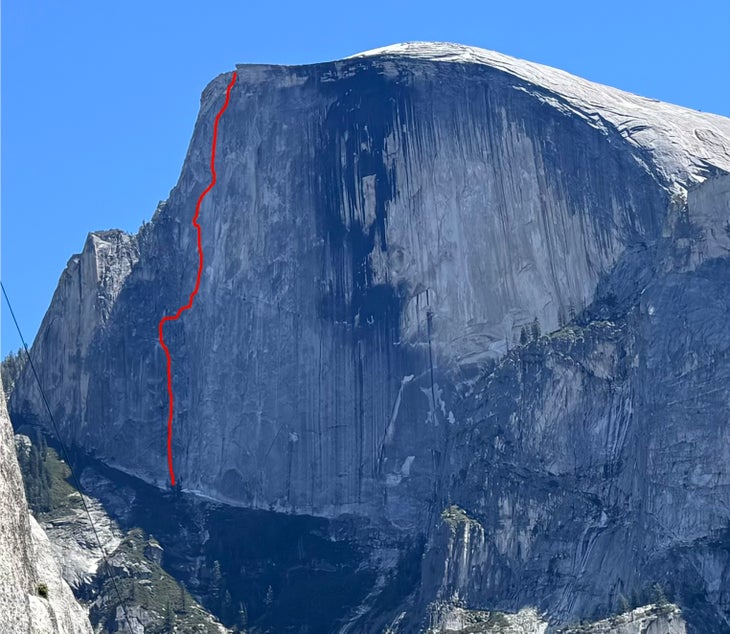
Above the forest, the granite rose for over 1,000 feet into the clouds. Straining to look up, I was struck with the first feelings of doubt. My shoulders ached, and my feet were soaked from the snow. There, with that feeling weighing me down far more than my 80 pounds of gear, I decided to turn around, leaving my bag covered by a tarp to hopefully keep the expensive gear dry. Tucking tail, I climbed back up to the trail, slipping and sliding in the wet snow and headed home.
For me, all great solo climbs begin and end with complete self-reliance. Those efforts are less about the climbs themselves and more about the experience, external and internal. Climbing new first ascents alone is the current catalyst to such introspective experiences. Though I love climbing with partners, there’s nothing like being alone on a new piece of ground. The goal mainly being to forgo maps, instruction, and embrace uncertainty.
Days went by until I found myself humping another equally large load up the Death Slabs. The rain and snow had subsided, but the lingering low clouds still clung to the face halfway up the wall. Along the base, I noticed fresh rockfall, with one rock in the debris sporting an old bolt stud that stuck out like a death threat. I shuddered at the thought of rock previously climbed, previously strong enough to hold a bolt, peeling off the face from an unknown height. I was going into unclimbed terrain on untested rock. The image of myself pulling down some large feature catastrophically, smearing the anchor, the gear and myself off the face into oblivion, through the clouds, down to the base, weighed heavily as I walked. Continuing to the base of the climb, there was no use ruminating over such things. No use sitting in fear. Nothing good could come from such a feeling. I just needed to climb and put up a pitch. The fear would wear off as I climbed into my comfort zone and into the repetitive routines of wall climbing where I’d move up a few pitches a day, chipping slowly away at the larger goal. Each day waking, eating, focusing on the pitch ahead, and repeating the process. Progress would be therapeutic.
After three days of living at the base of the route, and sleeping in my old, single-person portaledge, I’d made around 600 feet of progress. On my next trip up, I continued climbing onto the Regular Northwest Face’s seventh pitch before breaking off again. The climbing thus far had been mostly aid, with beaks: thin, pointed, talon shaped pitons designed for thin seams. On one 50-meter pitch, I used 35 of these pitons in a row. The climbing had been mostly type-one fun. It’s funny how making progress and simply working towards the end goal can relieve the stress and fear with such ease. Once climbing, stress just seems to wash away, and, unless it’s dangerous and insecure, it’s usually a joy.
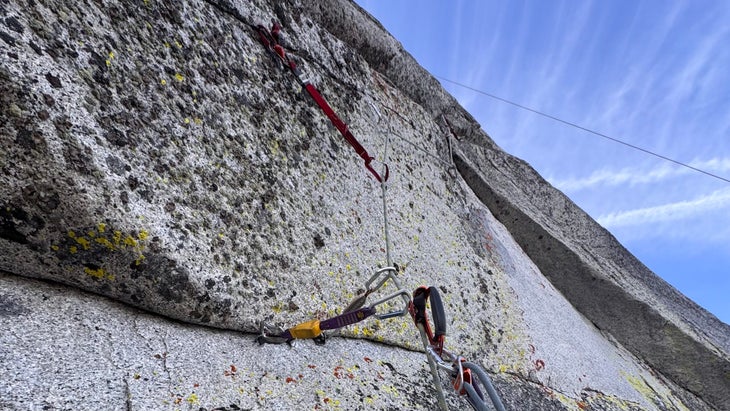
With the first three days of climbing and descending to sleep at the base down, I fixed ropes as high as I possibly could. Taking all of my gear up to the highpoint, I neatly packed everything away for the month-long wait before I could return to finish the wall. As I buttoned everything up, I looked out over the Northwest Face. Over the past few days, the weather had cleared and become cold and dry. There, while I packed, the golden California sun beamed across the wall and began to set. Dusk crept up the face, and wind began to pull hard up the wall as energy from the day dissipated.
In the gold light of that evening, it dawned on me that I’d come a long way on my own terms in climbing. I’d never imagined being there hand drilling anchor bolts on a new route on Half Dome. Four years earlier, I’d failed to climb the face by its easiest route, not getting even three pitches off the ground. Afterward, I decided that even though I’d failed, I wanted to become a climber capable of tackling routes like the Regular Northwest Face. I went and climbed all over the West, traveling and then working in Yosemite Valley and dedicating myself to its walls. I spent winters climbing all of the formations solo in the Fisher Towers, most by harder aid routes. I’d become obsessed with being proficient in the little understood art of aid climbing. Now, a few years later, I’d put myself in a position to blast off on a new route on the same face, only this route would be much more technical. I couldn’t help but be proud of how far I’d come. Sealing the bag, I rappelled my fixed lines down into the dusk of my last night on the wall for that week.
A month went by, the weather became more stable and summerlike, and a busy spring SAR season had me frothing to get back on the Half Dome project. After I finally hiked back to the base of the route, I hauled bags up the wall with enough food and water for 12 days. I ascended and hauled simultaneously, reaching the high point just as the sun was setting. From here, there was no telling when I’d be on solid ground again. The climb had begun.
The following day had found me merging with the Regular Northwest Face and up through 400 feet of that climb. This terrain was technically simple and quick to climb, but hauling became a nightmare. My flotilla of haulbags weighed almost as much as I did and required mechanical advantage and lots of rappelling to pull free from roofs and other features where they kept getting stuck. What would have normally taken half an hour to climb without bags and with a partner took me over eight hours by myself. So began the pace of the journey. After 400 feet of climbing “easy” terrain, I was exhausted and full of doubt.
That night, I slept deeply until being startled awake by rockfall on the Porcelain Wall to Half Dome’s west. The initial impact pulled me from deep dreams of safety somewhere far away. Flipping over in the portaledge onto my belly, I could look out as many tons of rock impacted the base of the wall and began an avalanche down the slabs below. From my position, with a full moon out, I could clearly make out the scenery. The debris glowed and sent sparks as it went into the forest below. The night air, at first deafeningly loud, began to calm into weighty silence. The moon had an unusual red brilliance. Granite dust rose into the sky far below the Porcelain Wall. The night air felt like mine, and mine alone to experience, and I stayed awake for a time looking out over the red moonlit valley until sleep once again took me.
The following few days saw me through new terrain away from the trade route and back in the vertical wilderness. The climbing, while expanding and thin, had been really natural thus far, and I’d only used a few bolts, all for anchors. Move by move, I headed directly up towards the summit, and hauling became much easier due to the steepness of the wall. Pitches went by in a routine sort of way with few words being said. Maybe a few expletives out of fear, or a song, but mostly I just worked away in silence or listening to music. On day four, I turned the speaker up all the way as I cast off into what would be the crux of the route.
“I’ll smoke the roach! Go on down that slide, man, go on down!”
Janes Addiction’s “Slow Divers” blared as I hooked bodylength after bodylength into nothingness, without any gear that would really hold a decent fall. Below, the long corner leading up to the belay ledge crossed the wall perpendicular to the fall line. If I were to blow it, I’d take a ride far below the belay.
Hooks creaked and popped as I climbed onto them. Their noisy flexes on small edges sent a cold shiver down my spine. Peering down, I noticed that if I fell from my current position, I would, at a minimum, break both of my legs.
Holding my breath, I climbed up a few more rungs on my aiders and placed the next hook, aware that I was in a no-fall zone. When the climbing gets hard or scary, I go somewhere else, only to come out the other side wondering what happened. Finally I hand-drilled a bolt, ending the danger. Tensioning to the left on the rope, I was able to reach an expanding feature and after climbing that, drilled an anchor. After finishing the belay, I looked back at a pitch of loose naked rope with a lone good bolt, which afterward continued to blow in the wind. After that, I had no protection for another 40 feet or so.
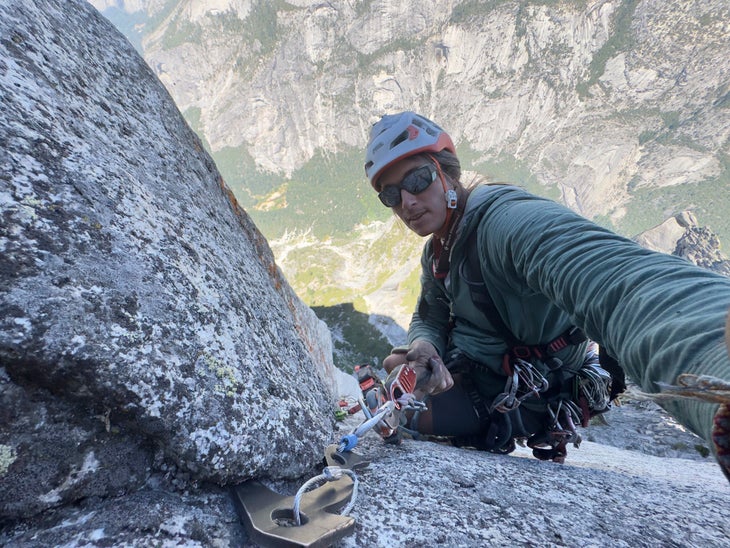
That evening, I sat in the portaledge full of dread. As I quietly ate dinner, I stared out and down to the base, and occasionally up at the wall. Ahead the climbing looked grim, even blank in places. It became apparent that the next pitch or so would require more drilling and difficult, potentially dangerous climbing on a thin, expanding flake feature created by old rockfall. The space beyond looked blank, and would require much more drilling.
I spent a few days sleeping at the same belay, while pushing the ropes higher through the difficult climbing. Pitch 10 required a rivet ladder, continued through a steep roof above slab, and finished with the thinnest flake I’ve ever climbed. At times, the flake was less than an inch thick and would open with light pressure like a door. Small bits of sand trickled out the bottom into the air below. That night, I looked up at the flake, which was directly above where I slept. I’d left the pitch uncleaned, and became terribly afraid that once the temperature changed in the night, the flake would simply separate from the wall and guillotine my camp off the wall. Sleep didn’t come easily.
On the morning of the sixth day, I moved camp up to pitch 11. All day, I drilled at a 45 degree angle to the climber’s right. The sun rose rapidly and crested overhead, while I hand-drilled my way across blank stone. The wind had picked up in the middle of the day. My shirt and hair bound in a long ponytail floated in the updraft as I rested on a freshly drilled bolt. To my left, a large runout on bathooks and to my right, blankness threatened to wear me down with drilling for the next 100 feet or more. Beyond it, however, lay a grouping of small trees in a solid corner system: hope. I could build natural anchors there. Reaching this small grouping of trees became my sole focus on that day.
I was a dot in a grey-green, lichen sea, all alone without any way out other than going through the blankness. I’d run out of water on lead hours ago, and my tongue stuck to the roof of my mouth like Velcro. The only way to get more water was to finish the pitch and rappel back to the bags over to my left. Through the howling wind, I looked out over the Valley floor and remembered a quote from the song “Three Days” from Jane’s Addiction’s 1990 live “Kettle Whistle” album:
“It’s once in a lifetime! This moment is once in a lifetime! It will not be presented to you again like a beer commercial. You better suck on it now, because it will be gone. Take a look around. Not too bad.”
I couldn’t help but smile as I looked out west towards El Cap. Not too bad at all, I thought. Not too bad.
Eventually I touched the tree, its bristles brushing my sunburned skin. I’d finally stepped out of the cramped ladders onto a small perch from which the tree grew, and I could rest one tired foot behind its trunk. It took me nine hours on lead to climb out of the blankness and into a prominent corner system. The way above was mapped out by known terrain. Thin corners reached up into the sky as far as I could see. The sky had turned pink with light wispy clouds. Quickly I cleaned the pitch and hauled, fighting nightfall.
After hanging my camp off a mix of cams and small trees, I relaxed. For years, I’d thought of myself as an imposter because I started climbing at 27. I’ve always felt like I was behind, or that I’d run out of time before I could ever climb the things that inspired me. Solo climbing had been a great way to work through the confusions of identity and I’d come out the other end of a few years of wall climbing having learned much about myself in that context. During my budding years as a climber, I’d come out as transgender and had been widely accepted by my friends in the Yosemite Valley climbing community and treated with respect. I felt at home amongst that community and truly comfortable amongst others for the first time ever in life. Climbing doesn’t care who, or what you are, and neither does its community; however, I do hope that one day some fringes of the community can get beyond what a person’s gender is, and focus on the person’s climbing. It’s not perfect, yet I see hope, and feel like the negativity is the minority. As a whole, the climbing community is the most accepting group I’ve ever been a part of.
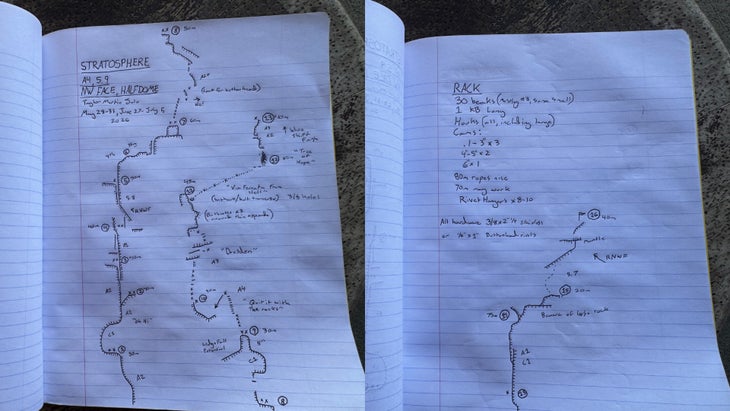
At the tree it all came to a head. I had earned the experience through years of hard work. Through many days of solitude and hard pitches that forced me to step out of the comfort zone into fear and insecurity. From that first solo climbing experience on Kingfisher Tower in the Fisher Towers of Moab, to my first time up El Cap via a four-day, solo ascent of the Zodiac (5.7 A3; 2,500ft). From my first big wall solo to a first ascent on the Camp 4 Wall behind the classic campground I called home. I’d somehow arrived, beyond these ascents and others, at that tree, thousands of feet up on Half Dome.
I had earned this ascent.
The sun set, and I stayed up smoking cigarettes in the portaledge with stars beginning to appear overhead. Then, in the complete darkness of night, to the northeast I could faintly make out the Aurora Borealis along the horizon. This deep, red glow with one linear beam of light gently illuminated the sky above Tuolumne. Four more pitches would see me through to the top of the route and onto the summit via Jay Smith’s Blue Shift (5.11d A4). The tree making up the belay, at the base of that route, felt like the true summit for me. I’d done the best that I could to get there, and beyond the way felt more certain. Just two more days ’til the top felt realistic.
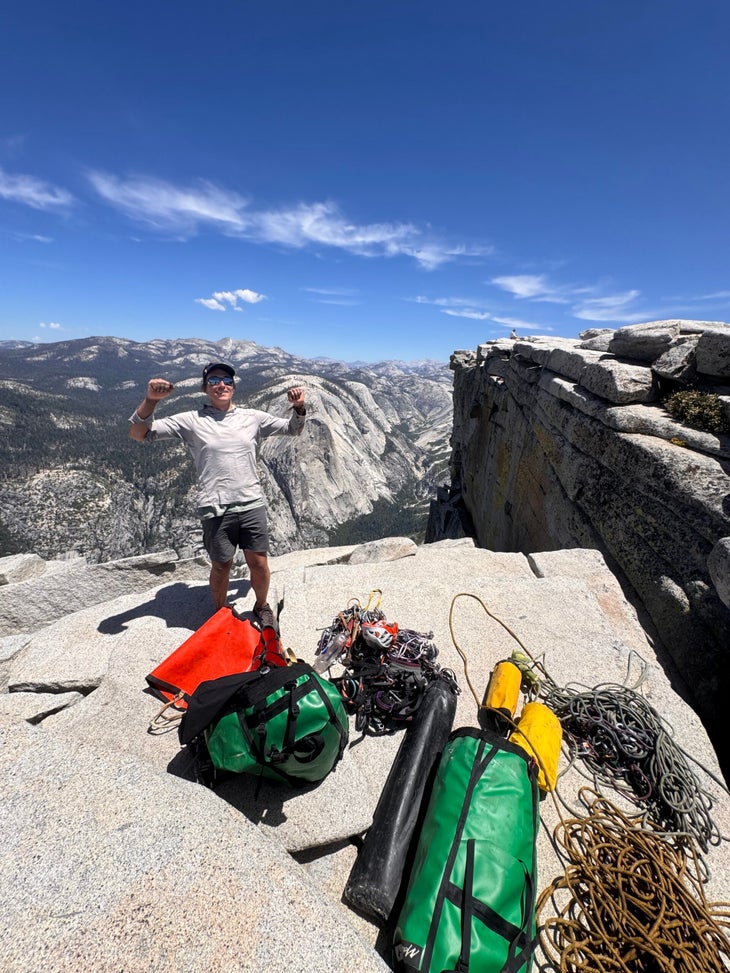
The last days on the wall were filled with easier climbing through thin long corners. I could begin to hear voices on the summit The day I topped out, mantling onto Half Dome’s busy summit, I was immediately surrounded by tourists wondering what the hell I was up to. I mostly avoided their questions and didn’t linger long with my gear unpacked.
That night, after shuttling gear down the cables to the base of the subdome, I slept alone on the summit. In the last light of the day, a lone hiker summited and made their way swiftly over to the diving board. Their frame was simply a black silhouette on the orange alpenglow as they changed into a wingsuit and donned a full-face helmet. In the silence of the evening, they took a moment to collect themselves and shake out their limbs before jumping. They stepped forward and left the mountain behind them. The rush of wind quickly dissipated as they dropped out of view. Then, the sky turned dark, and under the new stars, all was still and calm. Again, I found myself alone on the summit.
The base jumper filled me with a great sense of joy. That’s what it’s all about. Stepping out of the comfort zone, taking a leap of faith into an environment where humans should never be. Some of us have just found that thing, out in the Stratosphere.
At the end of the day, I was happy. In a way, the physical summit is meaningless; it’s the months and years of experience, growth, and imagination that are the real beauty of this lifestyle. Climbing Half Dome felt like a special privilege to get to appreciate and exist in such a beautiful place for a time. Getting to climb a first ascent was simply the cherry on top.
The post Big Wall Soloist Taylor Martin Establishes New A4 on Half Dome appeared first on Climbing.