 BURST
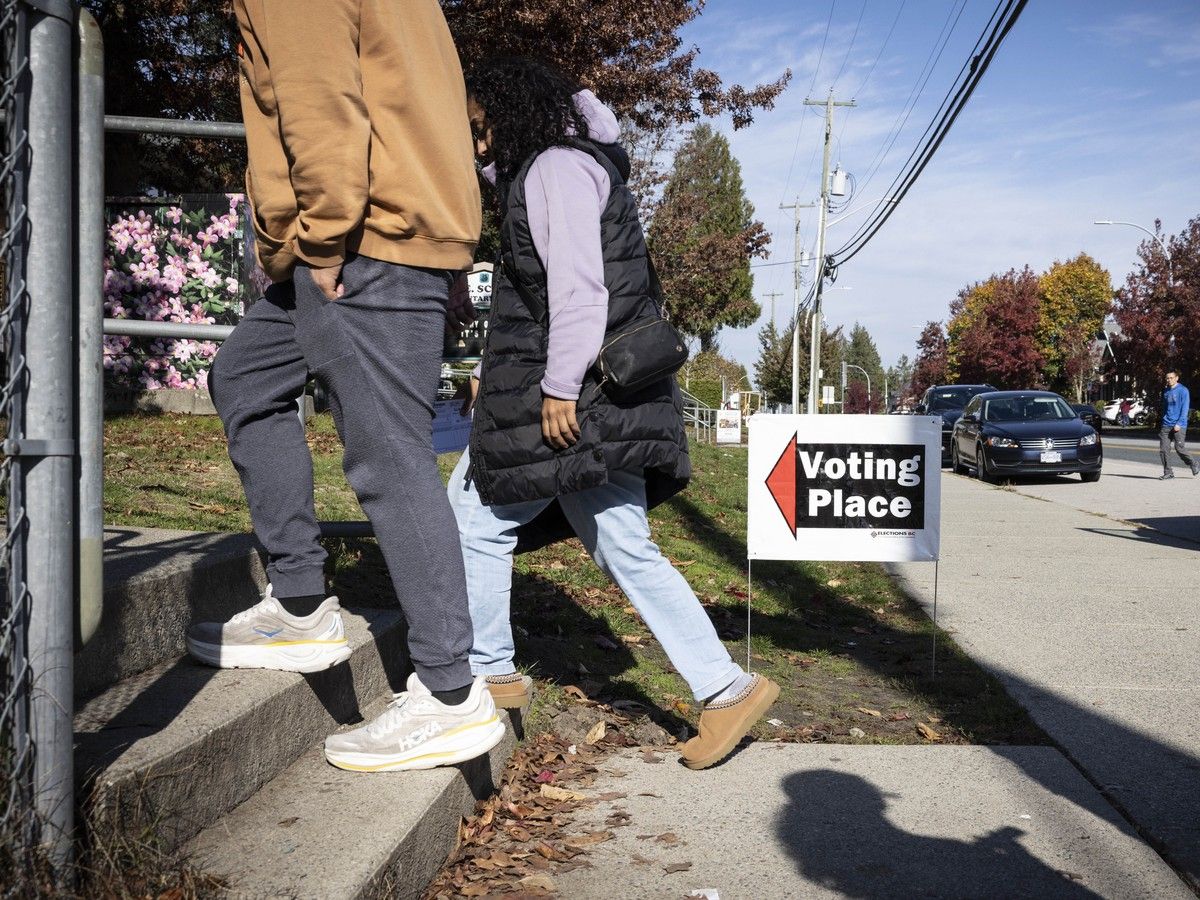
The number of British Columbians who voted in advance of Saturday’s provincial election is down four per cent from 2024, with only a handful of ridings registering a jump.
Over six days of advance voting from Oct. 16 to 21, 891,348 voters turned out across B.C., representing about 24 per cent of registered voters. That’s compared with 1,001,331 voters in 2024, or about 28 per cent of registered voters. In almost every riding numbers spiked Saturday, the second day of voting, but ultimately fell short of the 2024 turnout over the full six days.
While reduced advance voting could signal a similar decrease on election night, political scientists cautioned against reading too much into the numbers.
“It’s all so darn speculative,” said David Black, a communication theorist and political-science professor at Royal Roads University.
That’s because studies show turnout for advance voting isn’t a very reliable indicator of what turnout will be like on election day, he said. The absence of exit polls, coupled with the accessibility and acceptance of advance voting in B.C., mean it’s also hard to generalize about what type of voter chooses to vote in advance. The little information that is available tends to suggest advance voters may be more partisan and “locked-in” to their choices.
“With recent polls showing a fairly large undecided voter block, it makes sense that we would see less advance vote turnout,” said Black.
Confusion and voter fatigue related to a snap election, which was called amid a municipal election campaign, might also play a role.
Black recalled speaking to a taxi driver who had voted in both the municipal election and provincial election on the same day.
“That is an exceedingly rare thing,” he said.
While advance voting was down in a majority of ridings across the province, there were a few exceptions, including Surrey-Serpentine River, in the middle of a region that looks like it will be a key battleground for the NDP and the Conservatives, and Vancouver-Quilchena, where OneBC Leader Dallas Brodie is running.
In ridings where there has been some “excitement” it makes sense to see increased advance voter turnout, said Edana Beauvais, a political science professor at Simon Fraser University.
“Those spikes might tells us where voters are more motivated (and) where they don’t want to miss the chance to vote,” she said.
Beauvais will be watching Surrey and Richmond closely on election night, predicting the outcome in those ridings could determine who forms government.
Advance voting numbers were down across Surrey, where 22 per cent of voters came out to advance polls in 2026 compared with 24 per cent in 2024. Several ridings saw an even greater decrease, like Surrey-Cloverdale, where numbers dropped seven per cent between this election and the last election, and Surrey-Fleetwood, where they dropped six per cent.
In Vancouver, 22 per cent of voters came out to advance polls in 2026 compared with 27 per cent in 2024. Only Vancouver-Quilchena and Vancouver-Strathcona saw a jump this time around.
They joined a handful of ridings across B.C. where advance voting turnout increased between 2026 and 2024, including Kamloops-North Thompson (25 per cent compared with 23); Kootenay-Monashee (24 per cent compared with 21); Ladysmith-Oceanside (which was among the ridings with the greatest advance voter turnout this election, with 34 per cent compared with 32); and Powell River-Sunshine Coast (29 per cent compared with 28).
Abbotsford-Mission, where a hotly contested and high-profile byelection campaign preceded the current campaign, saw a dip in turnout with 25 per cent compared with 27 per cent two years ago.
After polls close on election night, the advanced votes will likely be released sooner than those cast on election day because they’ll have been tabulated electronically, while those cast Saturday will need to be counted, said Black.
He called recent advances in how we vote — and the democratization of voting by allowing people more time to cast their votes through advance voting — a “Canadian achievement.”
Read more of our coverage of the B.C. election campaign here.