 BURST
BURST
This morning, the World Climbing Association voted to block a motion on suspending Israel’s national climbing federation, the Association for Sport Climbing and Mountaineering in Israel (ILCA), from international competition. More than 70 national climbing federations attended the virtual General Assembly on July 23 dedicated to geopolitical issues, where members were additionally scheduled to vote on suspending the Belarusian and Russian federations.
On July 8th, the final day to introduce amendments for the General Assembly, climbing federations from the U.S., Australia, and Cyprus submitted eleventh-hour motions to halt the scheduled vote. During today’s meeting, a slight majority of the federations approved a unified version of the motions, which called for the Executive Board to adopt a future “principles-based framework” for determining national participation.
The vote on Israel, Belarus, and Russia’s participation was subsequently cancelled.
In March 2022, World Climbing banned Russian and Belarusian athletes over Russia’s war in Ukraine; that ban was lifted in February 2026, but the athletes still cannot compete under their national flags. To date, an international governing body for an Olympic sport has never sanctioned Israeli athletes or blocked them from competition.
Climbers for Palestine Spain, the advocacy group that spearheaded the campaign to suspend Israel, argues that World Climbing risks violating its own statutes alongside international law by cooperating with the ICLA, which promotes climbing on land where Palestinians have recently been expelled.
The group says ICLA climbing routes are being developed on land only made accessible through violations of the Fourth Geneva Convention, which prohibits the forcible transfer of a population by an occupying power.
“We are deeply concerned that the ILCA is permitted to engage in activities that contribute to serious breaches of international law, including the annexation of climbing crags in the occupied West Bank,” Michael Concannon, the representative of Climbers for Palestine Colorado, told Climbing.
Since 1967, Israeli forces have occupied the West Bank, a military occupation that the United Nations (UN) General Assembly and its International Court of Justice deemed illegal in 2024. In the decades since, Israelis have moved en masse to the occupied territory, building Jewish-only housing settlements and launching coordinated attacks against Palestinian villages to expel their residents.
The Israeli Climbing Association organizes events using the guidebook Climbing Israel (2015), which features routes throughout Israel and the occupied West Bank alongside a map that presents the entire region as Israeli territory. Some entries in the guidebook Climbing Palestine (2019) appear to have been copied word-for-word into Climbing Israel (2022), the official ICLA digital guidebook. On social media, the ICLA promotes climbing trips to the occupied territory, with no mention of its legal status: Climbing previously profiled Israeli climbers on a trip to Ein Fara in the West Bank.
“Credible evidence of these activities has been submitted to World Climbing nearly a year ago, yet World Climbing has invoked the principle that sport should be kept separate from politics,” said Concannon. “We believe sporting federations should be able to distinguish between taking political positions and holding a member federation accountable for its own conduct and compliance with World Climbing statutes. These statutes must apply equally to every federation, regardless of the geopolitical context.”
Marc Norman, CEO of USA Climbing, addressed the “principles-based framework” that replaced today’s vote. “This framework does not shield any federation from consequences. USA Climbing believes this approach protects the integrity, autonomy, and credibility of World Climbing and aligns with USA Climbing’s Board-approved principles for athlete and international federation participation,” he said.
The ICLA did not respond to requests for comment.
Why climbing and politics are intertwined in the West Bank
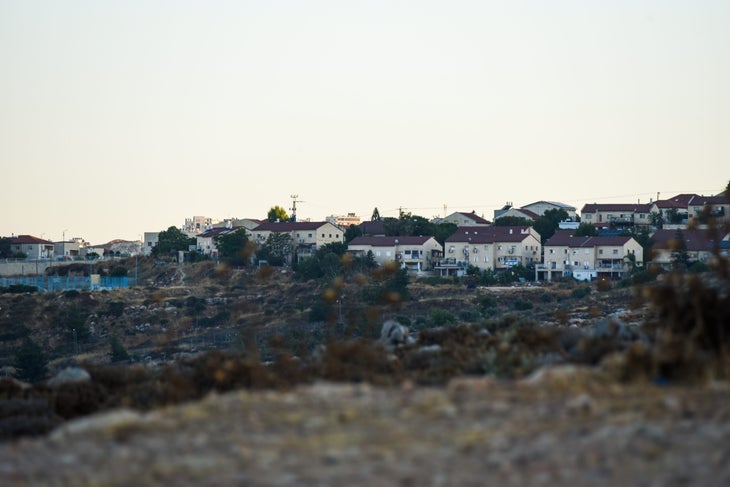
The West Bank’s landscape is defined by rolling hills, ancient olive groves, and expansive wadis—the Arabic word for canyon or dry riverbed. Yet despite the preponderance of limestone, Palestinian climbers in the West Bank must navigate a sea of obstacles to reach the rock: military checkpoints, a segregated road network, violent settler militias, and arbitrary security closures.
Since Hamas attacked Israel on October 7, 2023, killing 1,195 people, Israel has killed more than 72,700 Palestinians in Gaza, a figure accepted by Israeli authorities but believed to be a significant underestimate. In the West Bank, Israeli settlers, emboldened by the war in Gaza, have violently expanded into the surrounding areas at a record pace.
Palestinian climbers have been forced to abandon five crags—New Ein Qiniya, Yabrud, Ein Yabrud, Burqa, and Albirah—that were previously documented in the guidebook Climbing Palestine. They told Climbing that it’s simply too dangerous now to even attempt to approach these climbing locations, despite having drilled the bolts themselves.
Though technically civilians, Israeli settlers in the West Bank are often armed and violent.
In February 2023, a group of climbers with the climbing organization Wadi Palestine were standing below the cliffs in the village of Burqa, east of Ramallah, when a group of Israeli settlers appeared above and began threatening the climbers to leave the area, brandishing automatic weapons. Wadi Palestine had bolted fifteen routes there in the previous two years.
“The settlers kept saying, ‘This is our land. God gave us this land,’ and things like that,” explained Momin Abuyacoub, Wadi Palestine’s Executive Director. “Then soldiers came and left, allowing the settlers to remain there and harass us.” A video of the incident was later uploaded to YouTube.
Shortly after, in August 2023, an Israeli settler, believed to be a part of the group who harassed the climbers, shot and killed 19-year-old Qusai Jamal Maatan in the same village. Three new settlements appeared around Burqa, and settlers claimed the surrounding hillsides as their own. Wadi Palestine hasn’t returned to the crag since.
In at least one documented case, a climbing area that Palestinians lost to Israeli settlers later appeared in Climbing Israel (2022) under a newly assigned Hebrew name. The Ein Yabrud crag was bolted by international and Palestinian climbers and listed in Climbing Palestine, but the ICLA digital guidebook renamed the crag using the name of the nearby illegal Israeli settlement of Beit El, while claiming the ICLA developed the area “with the blessing of the original climbers.”
The Israeli army later declared the area a closed military zone, and Palestinian climbers have since been barred from accessing the area.
Wadi Palestine claims the Israeli military often collaborates with settlers to block Palestinian climbers, declaring climbing areas near settlements as “closed military zones” to restrict access and movement. The military often allows Israelis to freely move within the security zones, while sending Palestinian climbers packing under threat of arrest. Approximately 20% of the West Bank has been declared a closed military zone.
“These are crags that were bolted by Palestinian climbers. Now they are off-limits to Palestinians, but Israelis can climb there,” said Hiba Shaheen, president of the Palestinian Climbing Association, in an interview with Vertige Media last year. “I do not think this has ever happened anywhere else in the world: a national federation taking routes equipped by another climbing community, changes their names, and puts it in their guidebooks.”
One climber’s indefinite detention
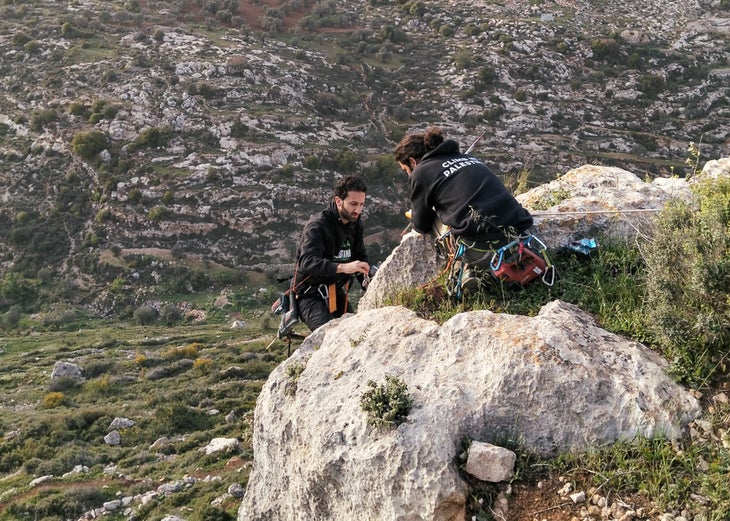
Movement restrictions are one of numerous barriers to climbing in the West Bank while Palestinian. Another is administrative detention, as is the case with Abdallah Motan, an award-winning documentary filmmaker, prominent rock climber, and a resident of Burqa, the village where the climbers were threatened by settlers. In January 2025, Mottan was detained by Israeli authorities while attempting to exit the West Bank and travel to Dubai for a film festival.
Administrative detention permits Palestinians to be detained in Israeli prisons for six months without charge, a sentence that can be renewed indefinitely. Yet Israel explicitly forbids the practice from being used against Israeli settlers. On July 14, 2026, Abdallah’s detention was renewed for another six months, marking the third extension. Neither he nor his lawyers, who asked that they not be identified to protect their safety, have learned the charges against him.
Shortly before being detained, Abdallah filmed a documentary about Palestinian climbers, Never Stop Climbing, in collaboration with Wadi Palestine. Nearly two years later, the film’s release is on hold, and his friends and family still await his freedom.
Speaking to me in her garden in Burqa, under the shade of a fig tree on a scorching June day, Motan’s mother reminisced on her son’s childhood and fretted about his mental and physical health in prison.
“Abdallah doesn’t like to stay in one place; he likes to move and camp and sleep outside,” she said. She gestured to a treehouse he built as a child in the backyard. The hammock he slept in as an adult swings between two trees, untouched since his arrest.
“He would never hurt anyone,” she added. “Everyone loved him. Life has been very hard since they took him, very hard.”
Moments later, the conversation was interrupted as a group of Israeli settlers entered the village on ATVs. The raid passed without a major incident, but it underscored the threat of violence Burqa’s residents say they must live with daily.
“They come everyday now,” a resident explained, sighing, while sweeping away broken glass from the previous night’s attack. Settlers had entered the village and smashed the windshields of three cars.
Across the occupied West Bank, settler violence has reached record levels, averaging around six incidents per day. Despite the pressure, Palestinian climbers have refused to abandon the sport.
“We lost five crags,” Abuyacoub said. “So we bolted another five.”
The post World Climbing Assembly Cancels Vote on Banning Israel, Russia, and Belarus appeared first on Climbing.