 BURST
BURST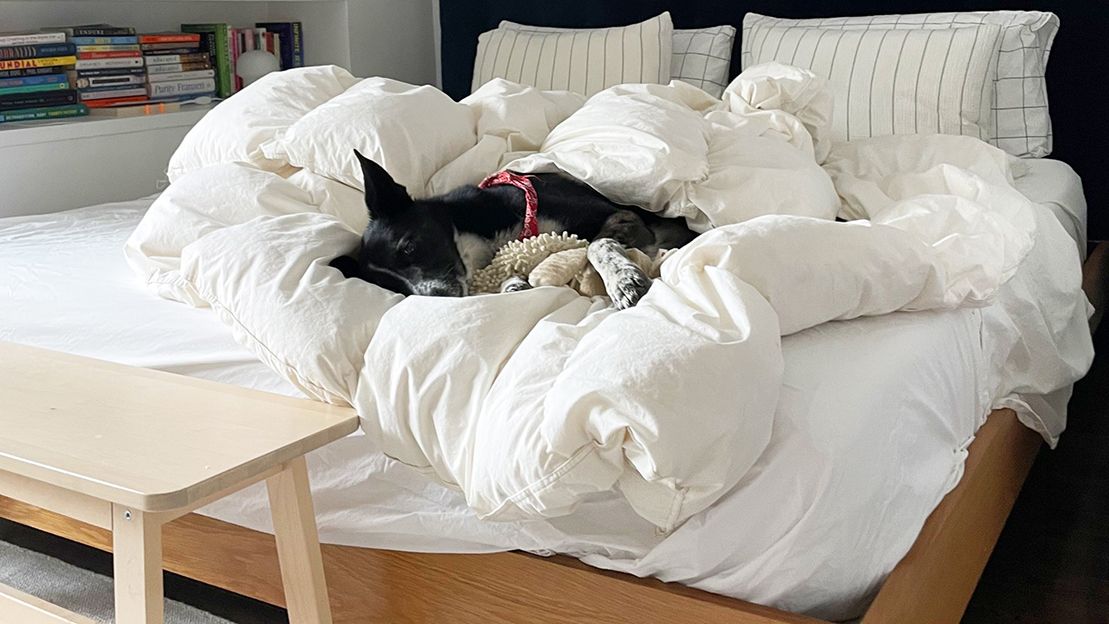
We brought canines into our earliest settlements for security, hunting and companionship. They stayed for affection, food and shelter. In the past century, they’ve moved from the barn to, in many cases, the bed. Today, 95 per cent of Canadians consider their pets part of the family and that number is even higher — 99 per cent — in households without children.
The proportion of people who consider themselves “pet parents” has increased with each generation, from boomers at 44 per cent to Gen X at 47 per cent and millennials at 54 per cent, according to a survey by pet care app Pawzy.
For most of Canada’s 8.3 million dogs , the doghouse is a relic of the past. A survey of 1,900 pet owners and 100 vets by “human-grade” dog food delivery service Spot & Tango found that over half (55 per cent) let their pets sleep in bed with them. Gen Zers’ favourite activity is eating with their dog (63 per cent). Nine in 10 dog owners consider their pet’s health to be “just as” or “even more” important than their own. Half would clone their dogs, an especially strong sentiment among Gen Zs at 74 per cent, and 10 per cent said there’s “no limit” to what they’d pay to create a genetic twin .
While the humanization of pets has existed since we invited them in, it’s reached new levels. People are forming deep emotional bonds with their dogs comparable to the ones they have with humans and feel obligations beyond fulfilling their basic animal needs.
People are structuring their days around their pet’s walks, sending pups to doggie daycare and buying human-grade meals; apps that track their dog’s activity, heart rate and sleep; stimulating toys; weatherproof clothing and cute costumes.
The benefits people say they get in return, though, are many. Beyond companionship, dogs can provide happiness, a sense of purpose and support. Studies have shown that dogs improve human health in myriad ways, including reducing anxiety, depression and stress, encouraging exercise and fending off loneliness.
But as humans and their dogs grow ever closer, evidence is also growing that this can interfere with people’s ability to understand their needs as animals, resulting in behavioural issues. And for humans, guilt comes into play when they’re not spending as much time with their pet as they might like.
Some owners feel the script has flipped, and that it’s the dogs who are in command of the household. “It’s people rushing home to take care of their dogs, whereas in the past, it wasn’t that for most people,” says Amy Fitzgerald, a professor in the University of Windsor’s Department of Sociology and Criminology with expertise in critical animal studies.
“The ‘humanization’ of pets describes the psychological, moral and consumer view of owners perceiving their pets as family members,” Beatriz Luz, a data researcher for consumer goods at Statista, told Food Navigator . Some of the drivers of the trend could be demographic. Canada’s fertility rate hit an all-time low of 1.25 children per woman in 2024, and one-person households have been the most common type nationwide since 2016. People who want companionship are filling that role with pets. “And because so many people in these more recent generations have been socialized with animals, it’s kind of a given now,” says Fitzgerald.
Even the late Pope Francis waded into the matter when he said in 2022 that having dogs and cats instead of children “takes away our humanity,” raising the ire of many pet lovers. “In the past, that wouldn’t have been on anyone’s radar as a threat to people having children,” says Fitzgerald, laughing. “But now, it’s definitely viewed as competing more for attention and space than it used to.”
Welcome to the family
Toronto marketing consultant Gigi Rabnett envisioned her 18-month-old child, Felix, and her border collie mix, Chips, being best friends, sleeping in the crib together. Though she can’t leave them alone quite yet, the transition has been a smooth one. Rabnett says she can already tell that Felix is a dog person. “Dog” was his first word, followed by “woof woof.”
Before her son was born, people told Rabnett that once she became a parent, her dog would take a back seat. “I can confidently say that did not happen to me,” she says, laughing. “I still love my dog more than anything in the world. He’s my therapy dog. He sleeps on the bed with me at night, and he’s my husband’s therapy dog, too. But I truly believe we have a special bond — just Chips and me.”
Chips is a rescue dog, and Rabnett and her husband got him as a puppy. “He’s 11, which makes me very sad, because that’s just one year closer — sorry to be grim — to death, but I do think about it obsessively.”
Rabnett’s priorities for Chips’ care have changed since his puppy years. Though he looks sprightly and still joins them on jogs, like humans, aging has brought health issues. Last year, Chips had a tooth infection that resulted in the removal of multiple teeth. Rabnett and her husband had two hours to decide whether to proceed with the surgery and pay the $6,000 bill. “My husband essentially fainted,” Rabnett recalls. “We did it because you don’t blink an eye. Did we have $6,000 to spend at the time? No, but it led to a discussion about, ‘How much would we actually pay?'” They now have a plan in place, including starting a GoFundMe and asking family members. “We would probably pay anything, like sell our house. The sky’s the limit.”
Food and supplements are the primary expenditures for Chips’ care. They’ve bought raw food since Chips’ early days, and give him a long list of supplements, including omega-3s, probiotics and spirulina. As a marketer, Rabnett says she’s well aware some of these products may not make much of a difference, but because their dog is important to them, they’re willing to try.
Rabnett has even researched dog cloning, which can cost up to US$50,000, but ultimately decided against it. Using the same somatic cell nuclear transfer process as Dolly the sheep in 1996, cloned dogs share identical DNA. A deciding factor for Rabnett was that cloned dogs don’t have the same personality, which is shaped by their environment and experiences. “I’m becoming more and more at peace with maybe there’s just going to be one of him, and this will be the life that he gets to live with us.”
When Chips was two years old, Rabnett and her husband got tattoos showing the outline of his expressive ears. “He’s going to be a part of us forever.”
‘Pawternity’ leave
Even in the past 10 years, there’s been a shift from seeing dogs as companion animals to members of the family, says Jen Wrye, a Cumberland, B.C.-based sociologist with expertise in animal-human relations and a faculty member at North Island College. “It’s almost an unequivocal family member relationship. People refer to themselves as pet parents and to seeing and treating their dogs as true members of the family. I don’t want to say equal to children or spouses, but not so distant, either.”
As we’ve urbanized, there’s been an even more pronounced change, says Wrye: greater expenditure on toys, food, preventive veterinary care, health and wellness, specialized burials and coffins.
Some companies have recognized the humanlike role pets play in people’s lives by introducing “pawternity” leave, or “pawrental” leave. Similar to parental leave, the benefit allows employees to take paid time off to help pets settle into their new homes. American multinational confectionery, pet care, food and nutrition manufacturer Mars, communications agency Talk Shop (with locations in Vancouver, Toronto and Los Angeles), and Calgary human resources firm Wendy Ellen Inc. are among the companies that offer pawternity leave for employees. Wrye adds that some companies now offer pet bereavement leave as well.
Dogs are also more present in shared human spaces such as bars, breweries, cafés and pubs. There’s been an explosion of emotional support animals and other designations allowing people to take their animals with them in ways they couldn’t before. “There has definitely been a shift to including animals in society in ways that, historically, we just didn’t do,” says Fitzgerald.
‘An emotional anchor’
Baker, photographer and writer Jason Hudson has two dogs and three horses on the farm he shares with his best friend in Ontario’s Prince Edward County. Their first dog, Zorrito, is a rescue from Mexico. Spanish for “little fox,” Hudson says the name suits him: “Sly and sneaky.” Vida, who joined them later, is from the Dominican Republic.
Out of curiosity, Hudson had DNA testing done to identify Zorrito and Vida’s breeds. The results suggested that Zorrito is part Chihuahua, “which is hilarious, because he’s much bigger than a Chihuahua,” and part Xoloitzcuintli (a.k.a. Xolo), “one of the world’s oldest and rarest breeds,” according to the Canadian Kennel Club.
Vida was listed as part Rottweiler and part mixed terrier. When he pictures a Rottweiler without a docked tail, Hudson sees the resemblance. “It’s a bit funny to see this little 10-pound dog who kind of looks like a Rottweiler.”
If money were no object, Hudson says he would probably cook for Zorrito and Vida. “But the cost of groceries is wild, so you have to draw the line somewhere. But they get wet food. They get toppers and vegetables and proteins that we’re eating. They get some scrambled eggs in the morning, and I definitely treat them like little people.”
As committed as he is to his dogs, Hudson doesn’t consider himself a dog parent or compare them to nieces or nephews or friends’ children. He recalls some advice a friend shared before he adopted Zorrito in 2021, when he asked what her dog had brought to her life. “She compared a dog, not to a human or a baby, but to a fireplace that must be tended and must be cared for and must be maintained in order to provide the warmth that it is designed to provide. So, it’s a life force. It’s an emotional anchor point in your daily life, just shy of being a person.”
Dogs require a specific kind of care, he adds. They’re ever-present and responsive to the “emotional temperature” of a household. Zorrito especially likes to be in Hudson’s presence at all times, and they share a special morning routine.
“He’ll come up to my face from wherever he’s been in the bed or elsewhere, and we have a morning little snuggle. He puts his head on my pillow, and we just look at each other and say, ‘Hello. Are you ready to start the day? Let’s start the day.’ And it’s ridiculous and silly, but it’s just very, very sweet.”
$7.4 billion spent on pet products
Even as consumers cut back on discretionary expenses as they navigate the high cost of living, they’re continuing to protect their pet spending, says associate professor Jenna Jacobson, the director of Toronto Metropolitan University’s Retail Leadership Institute.
“Many owners are continuing to invest in these premium, emotionally loaded purchases, like treats and wellness, while at the same time looking for value in their ongoing purchases with their pets, like perhaps in food or private label or seeking out promotions.”
Canadian households collectively spent $7.4 billion on pets and pet food in 2024, up from $5.7 billion in 2019, according to Statistics Canada . Spending on veterinary and other services for pets increased from $3.9 billion to $6.6 billion in the same time frame. According to the Competition Bureau , individual pet owners can expect to spend roughly $5,200 annually on a puppy and about $4,137 per year on an adult dog.
The love people have for their pets, the guilt they might feel from spending long work hours away from them, and the influence of social media all play a role in driving the premiumization of pet products, says Jacobson. “You have this foundation of love that’s at the basis of it, the world around you changing, also seeing what other people are doing on social media, how their pets are treated, it creates a bit of a perfect storm, and retailers are tapping into this and trying to diversify these categories.”
She sees the pet aisle, whether virtual or physical, mirroring what you might see in beauty, wellness or lifestyle retail. People aren’t just shopping for dog food but products with claims such as high protein, probiotic, and free from artificial preservatives or flavourings. There are supplements, calming products, premium grooming, apparel and accessories, travel gear and other products that signal care, identity and status. Products like smart feeders have emerged as new categories.
“We’ve always had dog food,” adds Jacobson, “but we haven’t previously had a device that could have a video camera on your dog that can throw treats.”
Pet humanization’s effect on the marketplace has been building, but premium pet brands are nothing new. Canada Pooch , for example (which Jacobson’s dog Pixel modelled for), has been selling high-end apparel and accessories for dogs, such as rain boots and slush suits, since 2011. The $112 a pet owner might spend on a waterproof puffer is comparable to what a parent might spend on a jacket for their child or themselves.
Much like their human counterparts, animal influencers have massive online followings and make money from brand deals and partnerships. Jacobson and her sister started an Instagram account for their twin Chihuahuas, Pixel and Atti, in 2017. “We lost steam about five years ago, when I had my first human child,” says Jacobson, laughing.
Through Pixel and Atti, Jacobson experienced the pet influencer space firsthand — and published research on the topic in Technological Forecasting and Social Change . Pet brands sent free products, and they were in photo shoots and a Serena Ryder music video . “That’s real influencer stuff, but done at a very micro-scale. And even more micro in talking about a five-pound, long-haired Chihuahua.”
Families have taken photos with Fido in the front row for decades, but with social media, they’re now shareable content. “Maybe you would have celebrated your dog’s birthday at home, but maybe now it’s got a little bit more of an esthetic appeal to it because you’re going to take a picture and post it on social media. You’re going to connect with a community of people who also love their pets,” says Jacobson. “So, it’s not just an attention-seeking thing, but rather a way of signalling your identity and also being part of a larger community.”
What’s for dinner?
The pet food market is booming. From plant-based to organic, “ clean labels ” (short lists of recognizable ingredients) or functional benefits such as improved digestion, immunity, weight control, joint, bone and muscle health, dog owners are extending their food preferences to their pets.
Sixty-eight per cent of Canadian pet owners are willing to spend more on pet foods that have additional health and wellness benefits, according to the Canadian Pet Market Survey by Packaged Facts, a division of market research firm The Freedonia Group. “Notably, the fresh, gently cooked pet food movement that has taken the U.S. market by storm is making headway in Canada as well.”
Fitzgerald has human-grade treats for her Labrador retriever mix, Dino, who she adopted after he flunked out of guide dog school. Her 11-year-old son asked if he could eat them. “I had to explain, ‘Well, no. They’re still for the dog, not for you,'” she says.
Dylan Munro, chief operating officer and co-founder of human-grade dog food brand Spot & Tango , has eaten their products, and so have investors. “It’s really a sign of how much we believe in the product,” he says.
Growing up in Oakville, Ont., teaching drums and guitar at his parents’ music school, Munro says his family named all their dogs after famous music references. There was the schnoodle Rigby, as in Eleanor Rigby, Cash and Hendrix. “Our next dog here will probably be Bowie,” says Munro, now based in New York.
In 2018, after attending Harvard on a scholarship and graduating with a degree in applied mathematics and astrophysics and consulting for two years at McKinsey & Company, where he was hooked by the direct-to-consumer model, Munro co-founded Spot & Tango with chief executive officer Russell Breuer.
The company started with a line of fresh dog food as a team of two, three if you include Breuer’s late goldendoodle, Jack. Today, the 150-employee company owns a manufacturing plant, has delivered more than 150 million meals and expanded into Canada on March 3 with its “fresh-dry” UnKibble, “a minimally processed, human-grade alternative to traditional kibble.”
“Last year, we did over US$130 million in revenue. We’re growing 60 per cent year-over-year, profitably, and we expect a similar sort of trajectory in Canada, maybe even faster, honestly. The start has been really, really strong,” says Munro.
In the company’s early days, “it took a lot of convincing to get people to work with us,” recalls Munro. To produce human-grade dog food, they needed human-grade suppliers and manufacturers. The fresh ground beef, carrots, green beans and sweet potato used in their products weren’t the issue. “Human facilities didn’t want to do it because ‘dog’ was a four-letter word,” he adds. “It really felt like, ‘This is something that just hasn’t been done before,’ and feels like a category that we can make a big difference in and really own as a differentiator for our brand.”
‘An important source of human comfort’
As an illustration of the significance of animals in people’s lives, one-third of Canadian pet owners brought a new animal into their home during the pandemic, representing an estimated three million pets . “One of the first things that happened was that people went out and got cats and dogs, in particular, for companionship that they weren’t getting from people. So, animals really have become an important source of human comfort and even socialization,” says Fitzgerald.
On the flip side, return-to-office mandates mean some people aren’t spending as much time at home with their dogs as they may like, which has exacerbated a sense of guilt. “In addition, behavioural issues with animals also increased because they were socialized in a specific, unusual situation with people being home a lot of the time,” Fitzgerald says.
Some owners are under additional stress because their dogs are experiencing issues such as separation anxiety — or they can’t leave a relationship because of a pet, adds Fitzgerald. “As someone who had a dog from an abusive, puppy mill situation, I know what it’s like when you can’t just have people over because you don’t know how the dog’s going to react, and it definitely can constrain what some people can do in some ways.”
Whether out of guilt or necessity, spending on dog care services such as boarding or daycare, even with the high cost of living, is increasing — especially among Gen Z owners , who are most likely to pay for doggie daycare (35 per cent) and dog walking services (31 per cent).
With a projected annual growth rate of 8.5 per cent, the global pet daycare market is expected to reach US$4.8 billion by 2032. The North American dog boarding services market is similarly booming , expected to reach US$583 million by 2032, increasing by 8.8 per cent annually.
Silvia Jay, the Calgary-based author of In Kinship With Dogs (2026) and a dog behaviour consultant, says the rise of doggie daycare has had an effect. “Since the popularity of daycare facilities, I’ve seen increasingly more rude and frustrated dogs on walks and at off-leash places.”
Jay notes that while small facilities (up to 10 dogs) can work, many daycares have too many dogs in too small a space. “Crowding is overwhelming or overstimulating or both for most dogs. For sound- and motion-sensitive herding dogs, that can be especially troublesome. They’re compelled to control the chaos.”
Rise in behavioural issues
According to Karen Machin, an associate professor in the Department of Veterinary Biomedical Sciences at the University of Saskatchewan’s Western College of Veterinary Medicine, a resident in animal behaviour and a founder of New Hope Dog Rescue in Saskatoon, the behavioural issues some pet owners face could be due to many factors, including a lack of socialization left over from the pandemic.
“I view socialization as sort of an inoculation against stress. Every new experience is a stressor to an extent, in a child’s life, in a dog’s life or cat’s life, and that when you are exposed early, then you get accustomed to it, you habituate to it, you learn that, ‘Oh, this happens, but it’s fine, I’m not going to die,’” says Machin. “Those early socialization experiences were lost completely for many animals or were minimized.”
The early experiences of dogs matter when it comes to behaviour, and so do epigenetics. “We know from studies in people but also laboratory studies that it’s not just about the experiences of an individual — people, animals — in their lifetime. It’s the parents, grandparents and so on. In mice, they can actually show it out to five generations, where if something traumatic happens, that will be carried forward to an extent,” says Machin.
One of the downsides of the surge of pet ownership in the early 2020s is that “indiscriminate breeding” arose to profit from it, “and that is continuing,” says Machin. Early experiences when the animals are still young — “good experiences, not frightening experiences” — are vital. And no two pets are alike. “They’re individuals. They’re not little robots. They respond to everything in their environment, their interactions, and then they navigate the world based on what they learn from the last experience.”
‘If a dog feels safe, then a dog is safe’
As the dynamic between dogs and humans has changed, so too has the training philosophy. Viewing dogs as sentient beings with their own unique personalities and needs has led to a focus on rewarding desired behaviours with treats or praise rather than using punitive methods rooted in pain or fear, such as shock collars or e-collars.
In their book, In Kinship With Dogs, Jay proposes embracing “a new A-word: attuned in place of assertive.” Paying attention to what your dog is interested in, what they shy away from, and what they’re trying to communicate. What a dog needs to have good welfare varies by breed and individual. “We can follow through when we ask our dog to do something, but we have to teach them what we want with patience, and being gentle and kind and reinforcing, so they understand what we want without being stressed out,” says Jay. “If a dog feels safe, then a dog is safe.”
Andre Yeu, the founder of When Hounds Fly , a dog training school with locations in Toronto and Vancouver, was inspired to become a dog trainer after he adopted his first dog, Duke the beagle. In his original home, Duke had been an outdoor hunting dog with only an unheated wooden doghouse for shelter. After Yeu and his partner adopted him, Duke suffered from separation anxiety. “I often joke, if I had adopted an easy dog with no problems, who knows what I’d be doing.”
When Yeu was a new dog owner in the mid-2000s, beginning to think about starting a dog training business, many people thought they needed to assert their dominance. “But fortunately, through a lot of hard work and education, over time it’s shifted … They have complex emotional lives. They have similar, if not the same basic needs as we do in terms of having safety, psychological and physical, and enrichment and mental stimulation needs, and understanding a lot of behavioural issues with dogs are not about dominance or leadership, but are, in fact, symptoms of dogs that live in urban societies where their basic needs aren’t met.”
Yeu takes a positive reinforcement-based approach to training. But even before rewarding behaviours he’d like to encourage, such as sitting and not jumping, is ensuring the dog’s needs are met. “Because if a dog is underexercised, understimulated mentally, isn’t psychologically safe in the environment they live in, no amount of training is going to have that dog be successful if it’s constantly under stress.”
Some of the spending and investments people make in their dogs may appear to be for the benefit of the pet but are often for the owner, says Yeu. “I’m fairly sure that no dog feels more fulfilled having more costumes or outfits. Now, if you like seeing your dog have multiple raincoats and different Halloween costumes, by all means, go for it. But if we want to really do the best for our dogs in terms of enrichment, and their well-being, then we really should remember what is the reason for being or, like, the ikigai of a dog.”
Approximating their biological needs, even by playing fetch in the park, can go a long way. Border collies, for example, are ideal herding trial participants. “You may have to drive out to the country to a farm where there are these sheep herding trials,” he says, “but I think that your dog will be like, ‘this is the best day of my life,’ because you did that.”
‘She saved my life’
Humans go to great lengths to include their pets in their lives, but it isn’t just the dogs that benefit. “That also has a huge, massive benefit for people as well,” says Machin. Dogs must be walked, which helps keep people active. Studies have shown that interacting with animals can decrease cortisol levels (a stress-related hormone), lower blood pressure and reduce loneliness.
While many owners give a lot, they get a lot, too. “In every relationship, you’re going to gain, and you’re going to give,” says Wrye.
Zoe, a seven-year-old caramel-coloured mixed breed with “a lot of terrier,” is a striking example of this. “I see her as my saviour,” says owner Danielle Melisse of the ESA (emotional support animal) dog, whom she got at eight weeks old in 2019. “I one hundred per cent feel like she saved my life.”
Melisse’s career producing and planning large-scale art and fashion events changed overnight during the pandemic. She moved six times in four years, settling in new, small towns in a time of social distancing. After three traumatic life events in close succession — a second miscarriage, her partner leaving and her father dying — Melisse “got extremely, extremely sick.”
She went from being “a super high-functioning person living in New York” to experiencing chronic anxiety, panic disorder and clinical depression. Having a high-energy dog that required her to be focused and follow their schedule kept her on track. Needing to continue taking care of Zoe served as a reminder for Melisse to take care of herself. She sees their health as being in tandem, and approaches Zoe’s diet and supplement regimen similarly to her own, especially now that Zoe is recovering from her second knee surgery. “She got injured, and I’m not well, and we kind of did it as a team.”
Now that Zoe has almost recovered, Melisse and Zoe spend a lot of time together outdoors, doing hikes in the woods. “She’s such an explorer. She’s so inquisitive. She’s so playful and energetic. I can be down, and I can be depressed or just having a moment, and as soon as I turn my energy to her, it’s impossible,” says Melisse. “I’m indebted to her.”
Some dog owners, including Melisse, don’t relate to the idea that their pets are the ones calling the shots. But others, such as Rabnett, see some truth in that.
“My life very much revolves around my dog’s schedule, and that’s because I understand my dog,” says Rabnett. Chips’ morning and midday walks are non-negotiable. “I bring the dog with me to pick up my son from daycare. That’s because we do things as a family. But I also think that the dog thinks he needs certain things,” she adds, laughing. “My husband’s always the first to remind me, ‘Sometimes he can skip his walk. Like, he’s not asking you in English for the walk.’ So, I do think very much, I’m under this dog’s spell.”
Canada’s top 10 most popular breeds in 2025
1. Labrador retriever (32-year streak as Canada’s most popular breed)
2. Golden retriever
3. German shepherd
4. Poodle
5. French bulldog
6. Australian shepherd
7. Havanese
8. Cavalier King Charles spaniel
9. Bernese mountain dog
10. Shetland sheepdog (Sheltie)
Source: Canadian Kennel Club (released March 12, 2026)