 BURST
BURST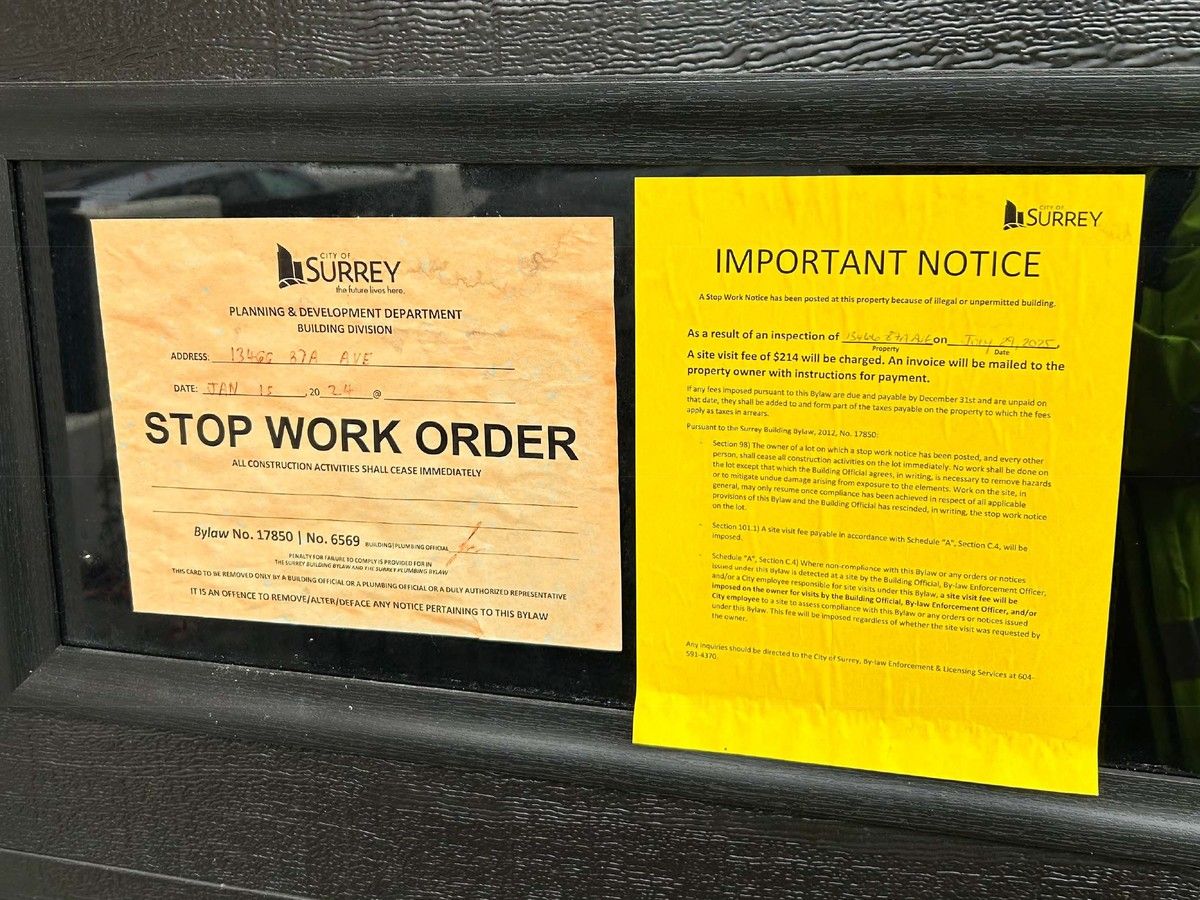
The City of Surrey says a decision this week to ease up on enforcement of illegal construction sites is intended to treat residents more reasonably by taking a compliance-based approached. But one opposition councillor questioned the timing of the move, noting an election is around the corner.
Mayor Brenda Locke instructed city staff at the end of April to review current building permit, inspection, bylaw compliance, and stop-work order processes, to see if there was a way to get more homeowners to voluntarily comply.
The staff review found that stop-work orders were being issued on projects where there was no immediate life-safety risk, projects that could have been brought into compliance after the unpermitted work was done, and for first-time offenders. Staff then recommended a pilot program in which stop-work orders would only be issued if the construction work posed a risk to someone’s life.
“The intent of the motion is not to weaken building safety standards, and the city will continue to act quickly and decisively where there is an immediate and serious life-safety concern,” said the staff report from Ron Gill, general manager of planning and development, and Brian Edwards, general manager of public safety.
Council passed the motion Monday night, with the exception of opposition Coun. Doug Elford.
In an interview Tuesday, Elford accused Locke and her slate of being “hypocritical,” noting that it was Surrey Connect — through former councillor Jack Hundial — that introduced the crackdown on illegal construction in the first place in 2021. The slate continued making the issue a priority, with Locke establishing a bylaw enforcement team in 2022.
“It’s five months before the election, but we’re giving this a one-year trial. If this was so problematic, why didn’t we do this before?” Elford told Postmedia.
The councillor said he believes there is a lobby group complaining about the stop-work orders, and that may be the intent behind the motion.
The city did not respond to Postmedia’s questions by deadline.

Under the pilot program, staff will consider if un-permitted work could be made compliant, and whether the owner is a first-time offender. In those cases, and if the project isn’t an immediate safety risk, the owner may receive a warning instead of a stop-work order.
The warning letter would instruct homeowners to stop construction for a period of time in order to obtain a permit, bring the construction work into compliance, or apply for a demolition permit.
“The letter will provide clear instructions to the property owner on how to bring the property into compliance. It will include a phone number and email for staff who will be able to assist, provide resources (including identifying appropriate consultants/professionals), clarify next steps, deadlines, and consequences for failing to comply,” the report states.
Stop-work orders would only be issued if the site has work done that poses an immediate safety risk to someone’s life, the owner of the property refuses to comply with the deadlines set out in the warning letter, or if work continues after the owner has been asked to cease work.
Elford, a retired environmental protection officer with the City of Vancouver, said he has years of experience posting stop-work orders, and those are done “for good reason.”
“I think it’s going to be very challenging for inspectors to determine when not to post stop-work orders, and I’m also concerned a little bit about liability as well on the city,” he said.
“If somebody builds a retaining wall, and they say, ‘Well, it’s not life-threatening.’ What happens if it falls over and crushes somebody? To me, it’s very black and white. You’re breaking the building code or you’re not.”
The councillor said that many people have been taking advantage of the system and fines should be higher for breaking bylaws.
After the one-year pilot, staff will assess its outcomes to evaluate next steps.