 BURST
BURST“A more moral AI is not enough if that morality is determined by a few.” - Pope Leo XIV
I always start off my round-up by saying that a lot of monopoly related news happened over the past week. And it’s true, courts hear cases, mergers occur, financial markets rise and fall, and militaries reorder economic flows. Today, it’s an ostensible deal between the U.S. and Iran over the Strait of Hormuz, with vague and unknowable outlines. Tomorrow it might be an undoing of that deal.
But on another level, this era feels quite repetitive. The pattern goes as follows. The public is angry over some obvious social problem we choose not to solve, the stock market goes up, a narrow group celebrates the winners, the public gets angrier. Rinse, repeat.
So today, before getting to the full round-up of news, I’m going to take a step back and try to focus on the spiritual dimensions behind our political economy, since all rules are fundamentally oriented around how any society sees the human soul. And the two key characters I’ll look at are Elon Musk and Pope Leo XIV. Because Musk, more than anyone else, represents the dominant institutional set-up for how our societies operate, while the Pope, with his social justice teachings, represents the older set of traditions we have tossed aside, but know are true.
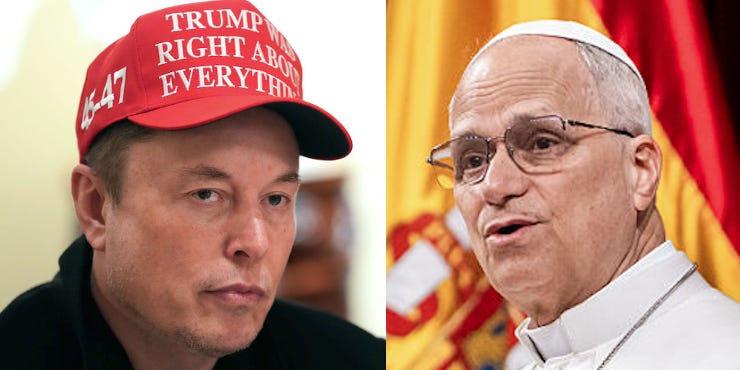
On Friday, Elon Musk’s net worth went over a trillion dollars, after his company SpaceX sold shares to the public. In its listing, SpaceX raised $75 billion, and financial markets valued it as the sixth largest corporation in America, roughly two trillion dollars. Musk owns about half of it, and controls 80% of the voting shares, with investment banks earning a half a billion on the event.
What does SpaceX do? And why is it so valuable? While SpaceX was started as a rocket company, Musk has talked up its capabilities as an AI firm, having signed contracts to sell compute to AI and Google. It is part of an all-encompassing “AI-tech-crypto-futuristic-bro” boom that has been going on since the Great Financial Crisis.
One way to think of Musk is as a technologist. But that is not, I think, the best way to understand him and the appeal he offers to hundreds of millions of admirers all over the world. Musk is a man who believes so strongly in the virtues of efficiency that he seeks to optimize humanity. And his offer, his “brand,” is not really technology. A Tesla is a nice car, but it’s not that different from any other car. And a SpaceX rocket is fundamentally just doing what NASA and the Soviets achieved in the 1950s, though with a great deal more efficiency.
Musk is compelling because he offers a vision, a temptation really, of a world in which we can become God-like. He likes to analogize himself to “Iron Man,” the Marvel character who wears a sci-fi magical set of armor to do battle. That is exactly what he peddles - fiction about becoming more than human.
Musk is part of a group in Silicon Valley who believe in a philosophy of ‘trans-humanism,’ or the belief that we can use technology to transcend human limits. "Let's give people superpowers," he has said about creating human-AI symbiosis through his brain interface firm Neuralink. He has compared what he build with some of the technologies on Star Trek. "Do you want to see it in radar? No problem," Musk said. "You could see ultraviolet, infrared, eagle vision, whatever you want." Musk wants humans to be able to save and replay memories, or think more quickly, but mostly, he seeks to end aging, death, and disease. "The future is going to be weird," he said.
This vision is also paired with a hard-to-describe megalomania; Musk has 14 kids with different mothers, and he refers to them as a “legion,” meaning a Roman military unit. “To reach legion-level before the apocalypse,” he told one of his partners, “we will need to use surrogates.” His stated goal of SpaceX is to turn humankind into a multi-planetary species. Musk also has eugenics-style views, encouraging “smart people” to have more children. Such views are pretty common among powerful tech magnates; Sam Altman said people will eventually upload their consciousness to a computer, thus living forever. They seek, as some always have, immortality, a Fountain of Youth.
Musk is widely admired in business, and among certain swaths of our population, and they say it’s because he’s good at building technology. In truth, it’s because he has a lot of money and is able to manipulate financial markets with exaggerated narratives, and that’s one archetype of heroism today. It’s also because of his zealotry in attempting to scrub out of existence the things that are scary about being human - inevitable pain, sickness, death, and loss.
A few weeks ago, Pope Leo XIV, a Chicago native named Robert Francis Prevost, offered a different vision of the future. The first American-born Pope, Prevost’s career is rooted in missionary work in Peru, the spiritual opposite of seeking immense wealth. As Pope, he issued what is called an “encyclical,” an official Church statement to denote something of meaningful social and religious significance. Previous encyclicals tackled problems like industrialization, this one was titled “On safeguarding the human person in the time of artificial intelligence.” The document is the result of an institutional track that has nothing to do with financial markets, but a decade-long discussion in and around the church on digital platforms.
The Pope represents something odd in modern American life, an explicit moral force completely outside of the realm of finance. This document is the anti-Musk argument. AI, and all technologies, offer new physical circumstances, but they do not imply a new stage of humanity. Artificial Intelligence, he writes, is “a form of statistical adaptation based on data and feedback, which can be very effective, but does not imply inner growth.” The Pope gave a basic anti-monopoly framework for understanding the power of digital platforms, saying that stateless power “concentrated in the hands of a few” tends to “give rise to new dependencies, exclusions, manipulations and inequalities.”
That is bad. And it is not enough, as Bernie Sanders seeks, to socialize what is created. “Social justice,” says the encyclical, “is not only a goal to be safeguarded after technologies are deployed, but a condition that must shape their very design from the outset.” Digital platforms are a form of “invisible infrastructure” that embeds power in their very creation. The broad mass of people should be involved in making choices about how to build it, not just a few oligarchs.
The Pope’s influence comes entirely from the ancient view that mankind is not different, cannot fundamentally transcend suffering, death, and limits. The Catholic Church, while deeply corrupt, does hold an institutional link to a distant past, and all must acknowledge that its staying power means something.
The point of his encyclical was to temper the temptation that technologies can, or should, offer a route out of the human experience. “Our relationship with life seems to be in crisis today,” he wrote. “Everything that appears as a ‘limit’ — incapacity, illness, old age, suffering, vulnerability — tends to be seen primarily as a defect to be corrected, rather than as a reality through which our humanity matures and opens itself to relationship.”
The encyclical was a critique of the deeply technocratic school of thought animating national policymaking, which are focused on the most aggressive deployment of technology, no matter what the cost. “When efficiency becomes the ultimate measure of value,” the Pope offered, “human beings are tempted to see themselves as a project to be optimized rather than as persons called to relationship and communion.” That temptation described what Musk offers his legions of fans.
The Pope and Musk aren’t the only ones having this debate, of course. We all are. The fight between the efficiency of capital and safeguarding what makes us human animates most political conflict today. Hundreds of books come out every year on this tension. To name a few, Senator Chris Murphy’s book, The Crisis of the Common Good, discusses this tension, as did Senator Josh Hawley in The Tyranny of Big Tech. It’s not a coincidence that Silicon Valley and gambling companies embrace Robert Bork and the Chicago School, and populists are hostile to it.
Efficiency is what Amazon offers to customers in the form of low prices, what Wall Street gives in the form of temporary speculative fervor, and how modern economists understand the point of statecraft. You can have more, get it cheaper, and transcend your place of birth and who you are.
Of course, the offer of efficiency isn’t really true. The Chicago School promised a society with cheap goods, but Americans find themselves beset by a high-cost world of low wages, sometimes, at important moments, shortages. Walmart and Amazon have the lowest prices around, but that’s only because they inflate prices everywhere else. And what Musk promises is not actually real. Musk’s technologies are good, but not exceptional. For every SpaceX rocket able to send a satellite into low-earth orbit, there’s a fake enterprise like his Boring Company, or lies about increasing user engagement and advertising on Twitter.
And the idea he is worth a trillion dollars is comical, but also dangerous.
SpaceX does have some real lines of business, but nothing close to what would support the valuation his company now has. It’s true that its Starlink internet service is quite popular, important, and profitable. Like a lot of such businesses, it turns out that it has immense market power, particularly in rural areas where it is the only provider of internet access. But a telecom monopoly line of business, while profitable, doesn’t approach trillions in market capitalization. And if you add up all of the business lines, the company as a whole has less than $20 billion in revenue, is growing slowly, and is losing money.
What’s going on? Well, it’s two things: self-dealing and rigged markets. To give you an example of how corrupt this situation is, I’ll point out the following. Last week, in preparation for the IPO, Google signed a deal to pay SpaceX $920 million a month for compute capacity, or $11 billion a year, which is clearly just a way to raise SpaceX’s revenue. Why would Google want to do that? Simple. Google bought 10% of SpaceX a decade ago. It now owns about 5% of the company, because of dilution. SpaceX was valued at 94 times revenue, so this deal, $11 billion of revenue, times 94, is equal to a trillion dollars. Since Google owns 5%, it means Google spent $10 billion to increase its investment by $50 billion. Not bad!
In addition, this deal means that SpaceX is now profitable according to Generally Accepted Accounting Principles. Musk wants SpaceX to be included in indexes, thus rising with the buying power of index funds. He helped persuaded the NASDAQ to change its rules so that unprofitable companies can be in the NASDAQ 100. But the S&P refused to make the change. So SpaceX has to be profitable according to GAAP rules 12 months to be included in the S&P 500. Now because of this Google deal, it will be. Does Google really want the compute from xAI? Maybe. Maybe not. But the conflicts of interest here suggest that’s the wrong question.
Then there’s the broad market manipulation aspect of the situation. I don’t want to get too deep in the weeds here, except to note that our financial markets have become increasingly disconnected from the underlying economy for years. Crypto has no use cases, and is worth a trillion dollars. Tesla is worth $1.25 trillion dollars, and sells fewer cars than Toyota, which has a market cap of just $270 billion. There are many illustrations of bubble-style valuations, like GameStop, or pre-pandemic, WeWork and “gig economy” firms.
And that brings me back to Musk, whose wealth is very different than most of the other tech oligarchs. Larry Page, Mark Zuckerberg, Jeff Bezos, and so forth, they are worth a lot of money, but their companies do fundamentally generate the cash flow to justify it. That is not true of Musk. He now has two public companies with giant valuations - Tesla and SpaceX - neither of which makes much money. Where will cash ever come from? Rockets? Satellites/starlink? Data centers? Space data centers? Self-driving cars?
The most likely answer is that he will never generate the cash flow, and that he will have to continue telling fables of giving humanity superpowers and multi-planetary species and data centers in space, simply to maintain the overvaluations of his companies. It’s a psychological set up for him and his fans to keep going as fast as possible with as much money as possible, until it all crashes down. Everything he has done, his successes and failures and bullshitting and his litigious streak that allows him to avoid accountability, confirms his priors that he is above normal human rules.
Ultimately, while we can tell ourselves stories, and give in to the temptation to believe them, we cannot avoid limits. We cannot avoid being human beings. We can only choose to accept that with limits is a touch of the divine, and build lives and communities with love. Or we can pretend to be Gods, and act like sociopaths. The latter path may seem to work for a while, especially in moments when financial markets demand stories that are fantastical lies. But wisdom is earned in remembering ancient truths that transcend the NASDAQ.
And now, the rest of the monopoly round-up.
There are a bunch of important stories. There’s news of a deal between the U.S. and Iran, and while we don’t know the full scope, it has all sorts of implications for the Middle East, oil, and market power.
Also, Meta is falling apart as employees complain of a “Gulag-like” atmosphere in its pursuit of AI products, Paramount manipulated the Antitrust Division into producing an embarrassing lobbying document for its attempted acquisition of Warner, a bankruptcy judge allowed Spirit Air executives to collect bonuses even as they liquidate the airline, and the surprising turnaround of American chipmaking giant Intel continues.
That and more after the paywall.