 BURST
BURST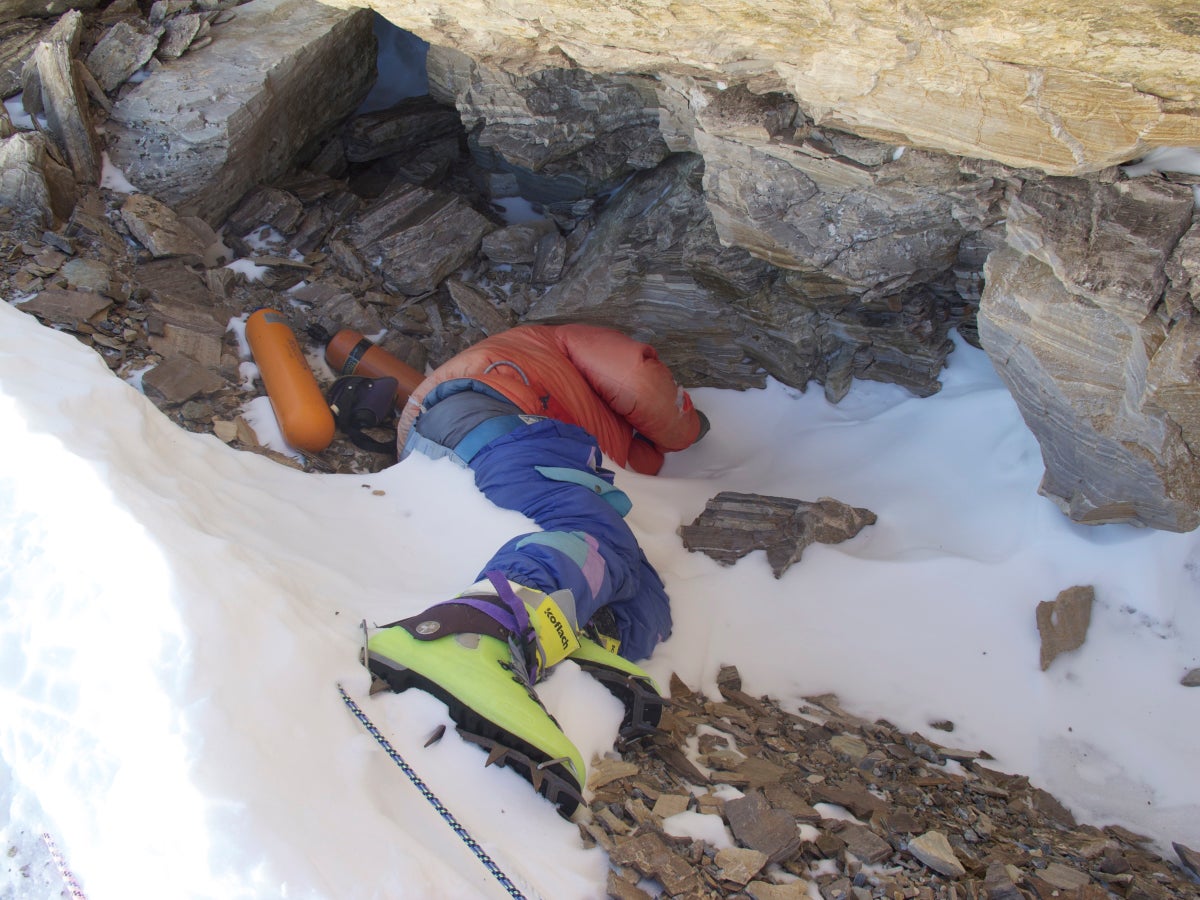
“Padhega toh kuch banega,” Dorje Morup would often say. “Study, and you’ll make something of yourself” is the translation from Hindi. Three decades later, they’re still the first words his eldest son hears when he thinks of his father.
In 1996, Morup left for Mount Everest and never returned.
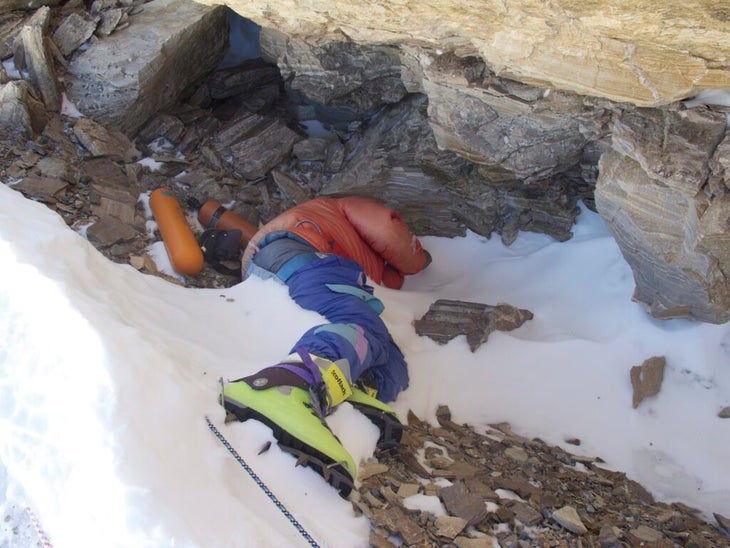
For years, an unidentified male body on Everest’s Northeast Ridge was known simply as “Green Boots,” after the neon green Koflach boots he wore. Tucked beneath a limestone overhang, the body—one of an estimated 200-plus corpses lingering on Everest—became one of the mountain’s most recognizable landmarks.
Until about a month ago, the body was believed to belong to climber Tsewang Paljor. Morup and Paljor were both part of the ITBP (Indo-Tibetan Border Police) summit team on Everest in May 1996. Only this year did Indian authorities publicly identify the body as Morup through what they described as a DNA-based verification process. Government documents now outline a plan to recover his remains using a team of six experienced Nepali Sherpas. Why the recovery effort is being undertaken three decades later has not been publicly explained.
The life of Dorje Morup, according to his son
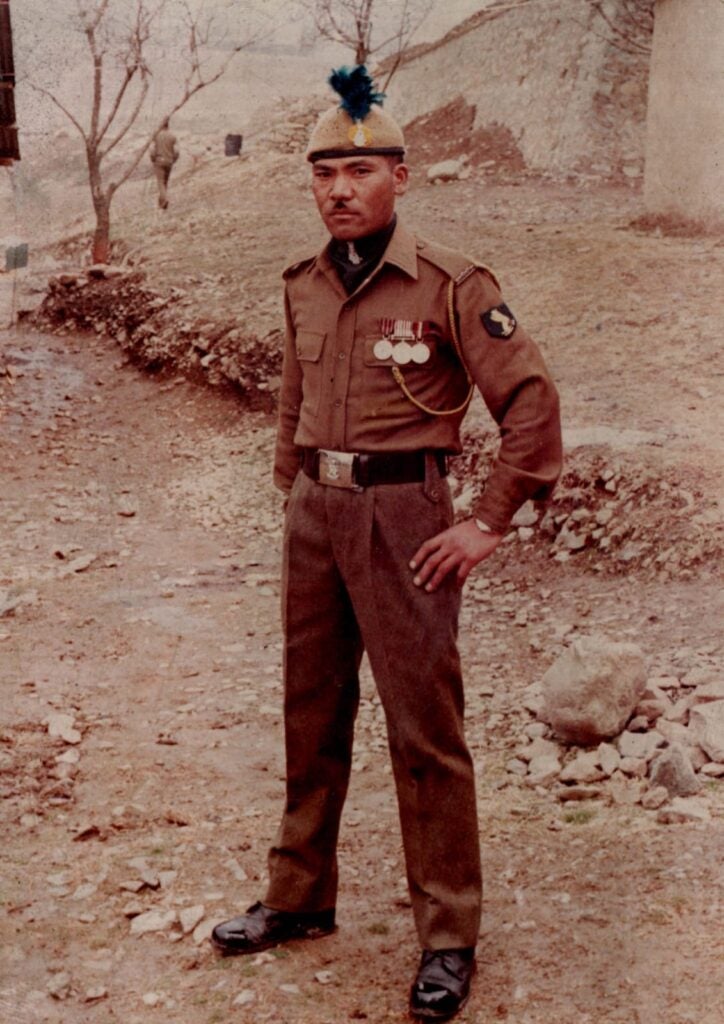
“Ever since people started talking about him again on social media about a month ago, it hurts,” Phunchok Dorjai, Morup’s eldest son, told me. (Unlike in many parts of India, family members in Ladakh do not always share a hereditary surname.) “It brings back memories from 30 years ago. It feels as though everything happened yesterday.”
Over several conversations, Dorjai helps me piece together the life of a man who had long been remembered more for the way he died than the life he lived.
Morup grew up in Skurbuchan, a village of just under 2,000 people in the rugged, high-altitude mountains of western Ladakh. Before joining the ITBP, he worked as a labourer building the roads that would eventually connect villages like his to the rest of the world. Having left school after the third grade, Morup felt determined that his own children go further academically—and they did. Dorjai studied until the sixth or seventh grade before joining the army, while his three younger brothers stayed in school until the tenth grade.
His work in the ITBP and at home in the Ladakh region
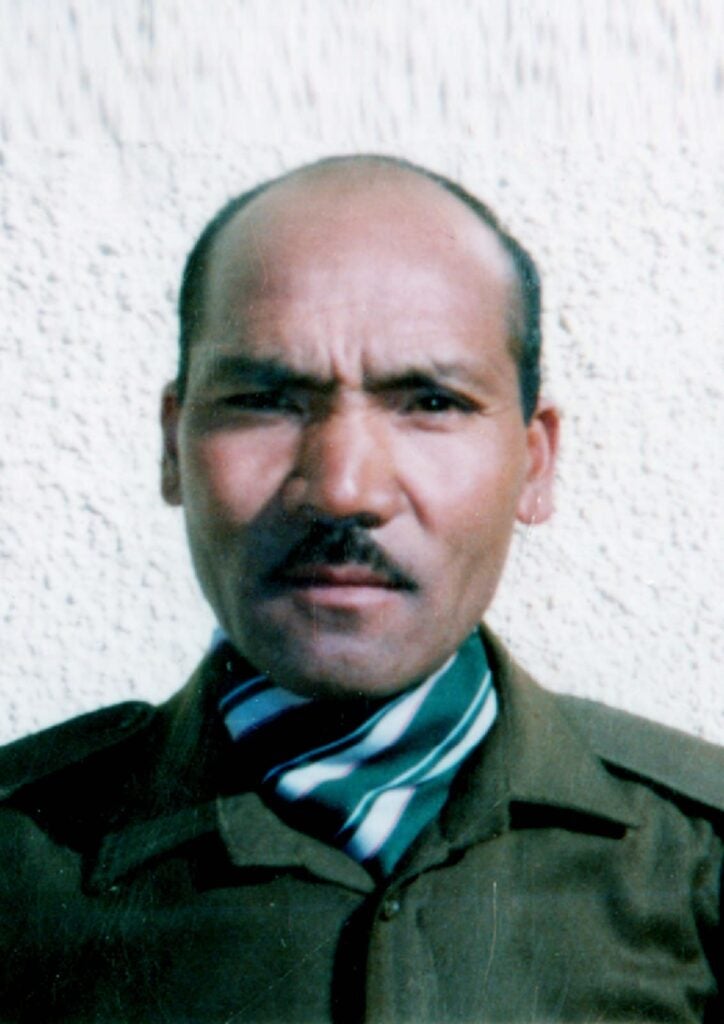
Morup’s work with the ITBP kept him away from home for months at a time, posted at remote outposts above 16,000 feet. As a result, Dorjai spent little of his childhood with his father. But he eagerly looked forward to the day he would return—usually without warning. “At that time, there was no phone facility,” Dorjai recalls. “The buses that ran to the village came only once a week, that too with great difficulty. We rarely knew when he was returning.”
Still, Morup’s family could count on one thing: that he typically came home during harvest season, when there was no shortage of work to get done. According to Dorjai, his father rarely rested. The family spent entire days hiking into the mountains to cut fodder for livestock, collect firewood for the winter, and work the grain fields. “There was a lot of work, but also a lot of laughter,” Dorjai recalls. “My mother would excitedly cook for him before he had to leave again.”
Morup in the mountains
Morup had already proved himself on numerous expeditions across Ladakh before he was selected to climb the world’s tallest mountain—a decision his wife, Konchok Yangsket, struggled to come to terms with.
“She didn’t want him to go,” Dorjai says. “He was 48 at the time, and I, too, worried that maybe he shouldn’t go. But who was I to say anything? It was his dream to become an Everester. So I simply shook his hand when he left.” Dorjai, then 21, remembers it as the last time he saw his father. Morup never met Dorjai’s eldest daughter, his first grandchild, who was born in March 1996, shortly before he left for the Tibet side of Everest.
According to Morup’s family, the same determination he exhibited in day-to-day life also defined his time in the mountains. Harbhajan Singh, deputy leader of the ITBP Everest expedition, had climbed with Morup on several expeditions before Everest and fondly remembers him as a “thorough gentleman.”
“He was a silent worker who always kept the group’s morale going,” Singh told me. “There was no adamancy whatsoever. Over so many years of knowing him, I never saw him fight with anyone.”
Singh says Morup embodied what makes Ladakhi climbers exceptional. “He’s been in the mountains even before his birth; in his mother’s womb,” he says with a laugh. “It’s no surprise he was such a great climber.” Growing up and working at high altitudes gave Morup a natural advantage in the mountains, Singh says. He acclimatized quickly, and got on with whatever needed to be done. “Even after reaching the higher camps, he’d make fresh, hot tea for us in extreme conditions,” Singh recalls.
May 10, 1996: Morup’s fateful day on Everest
On May 10, 1996, the morning of the summit push, Singh shared a tent with Morup and the two other Ladakhi climbers. Before setting out, they handed Singh a full glass of sattu, a roasted barley drink that sustained him for much of the day. “At that height, it was a big thing,” Singh says. “After that, I didn’t need to eat anything—maybe just some black tea.”
The team paused near the Second Step, roughly 250 meters (820 feet) below the summit. Dark clouds had begun gathering over Everest. Sensing the weather turning, Singh urged the three of them to abandon the climb. “Today’s not the day,” he remembers telling them. “We shouldn’t take the risk. We must go back. We can always attempt Everest again—it’s not going anywhere.”
But the trio chose to continue towards the summit, while Singh descended. “I think they must have thought, ‘Let’s just try now that we’re this far,'” he says. “It’s hard to think straight at those altitudes. The brain isn’t getting enough oxygen.”
Looking back, Singh says returning safely that day remains one of the greatest achievements of his life. The three Ladakhi climbers went on to reach the summit, but perished in a blizzard while descending, in the mountain’s ill-famed “death zone.” It was the same notorious and fatal storm that Jon Krakauer documented in Into Thin Air.
Is Dorje Morup really Green Boots?
Singh says he had been telling people for years that “Green Boots” was Morup, not Paljor. “We recognised Dorje… we knew him,” he says, recalling that Morup survived into the morning after the summit push. “We sent a team with oxygen to help him, but by the time they reached him, he was no more.”
Dorjai, however, remains unconvinced by it all. He says he and his brother provided DNA samples but the government never formally informed them of the results. “I’m only going by what I’ve seen on social media and in the news,” he says. “No one has officially told us it’s Abba.”
His doubts are compounded by the fact that, according to him, the proposed recovery mission has been delayed because of unfavourable weather. “If the body hasn’t even been brought down yet, how did they identify it?” he asks. “Humse toh DNA le gaya, par udhar se kaise laaya?” (“They took DNA from us, but how did they get DNA from up there?”) To Dorjai’s credit, the government states that DNA testing led to the identification of Green Boots as Morup, but has not mentioned when or how they collected a DNA sample from the body.
Why Morup’s family remains in limbo
Even so, he says the family would welcome the recovery team if the Indian government eventually recovers and returns Morup’s remains. “If the body comes back and the DNA matches, we’ll receive him with honour,” he says.
As per Dorjai, the unanswered questions—whether Green Boots really is his father, when the recovery mission will take place, and whether it will succeed—have left the family in limbo.
His mother, now in her seventies, still struggles to accept that her husband never returned home. “She says she’ll only believe it’s him when she sees his face,” Dorjai says. “Even now, somewhere in her heart, she thinks one day he might suddenly come back.”
The post The Son of “Green Boots,” Whose Body Has Rested on Everest for 30 Years, Shares His Story appeared first on Climbing.