 BURST
BURST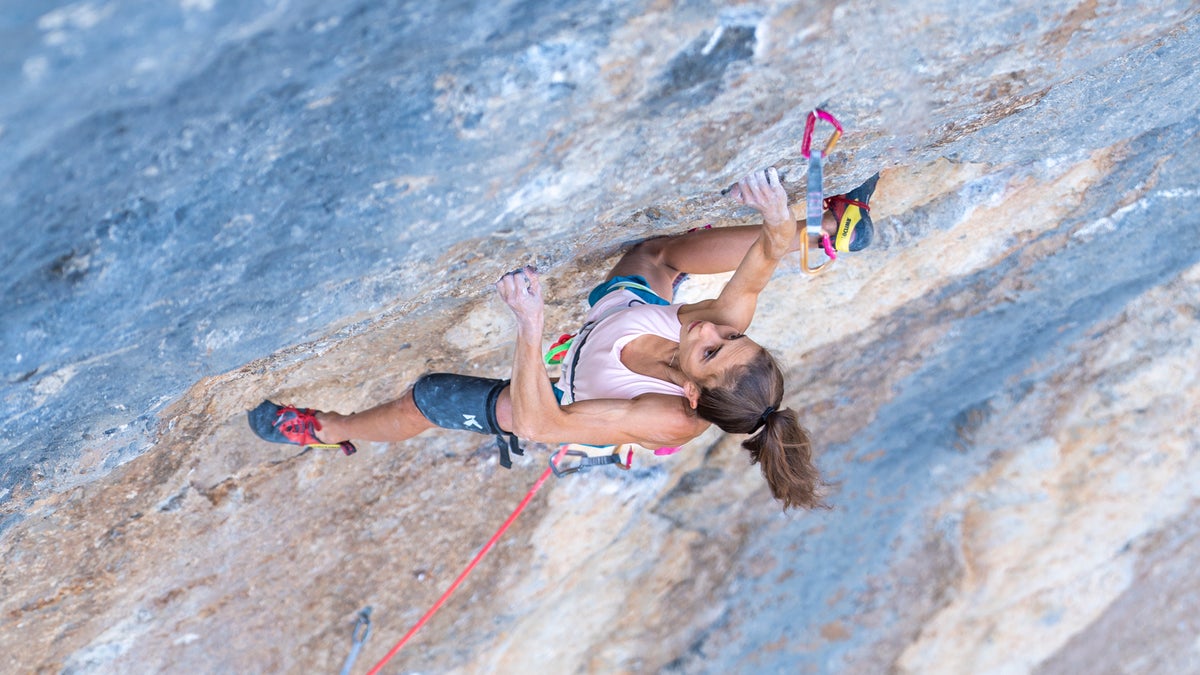
The name says it all: Bibliographie. It’s a record of sources, a nod to the legacy that others have put forth. For the climbing world, Alex Megos’s 115-foot, 5.15c limestone route in Céüse, France, has unofficially kept tabs on some of the best sport climbers in history. Before August, everyone who repeated Bibliographie had either proposed their own 5.15d routes (Stefano Ghisolfi, Sean Bailey, Seb Bouin, and Jorge Díaz-Rullo) or won the Olympics twice (Janja Garnbret). Yet despite their talent, they still took between 21 and 60 sessions to send Bibliographie.
Then, on August 16, Laura Rogora did it in six.
“I had never tried a route this hard before, so I really had no idea how long it would take,” Rogora told Climbing in an email. “Six days was definitely not something I expected when I first arrived.”
Three days ago, the 25-year-old Italian clipped the chains on Bibliographie in a historic flourish above the small village of Sigoyer, France. In climbing her first 9c+/5.15c, she joined Garnbret, who just recently sent Bibliographie on June 6, 2026, and Brooke Raboutou, who ticked Excalibur on April 8, 2025. Rogora had already established herself as the best female onsight climber in the world (excluding indoor competition), with more onsights of 5.14c or harder than anyone except Adam Ondra and Alex Megos.
Chasing a historic route
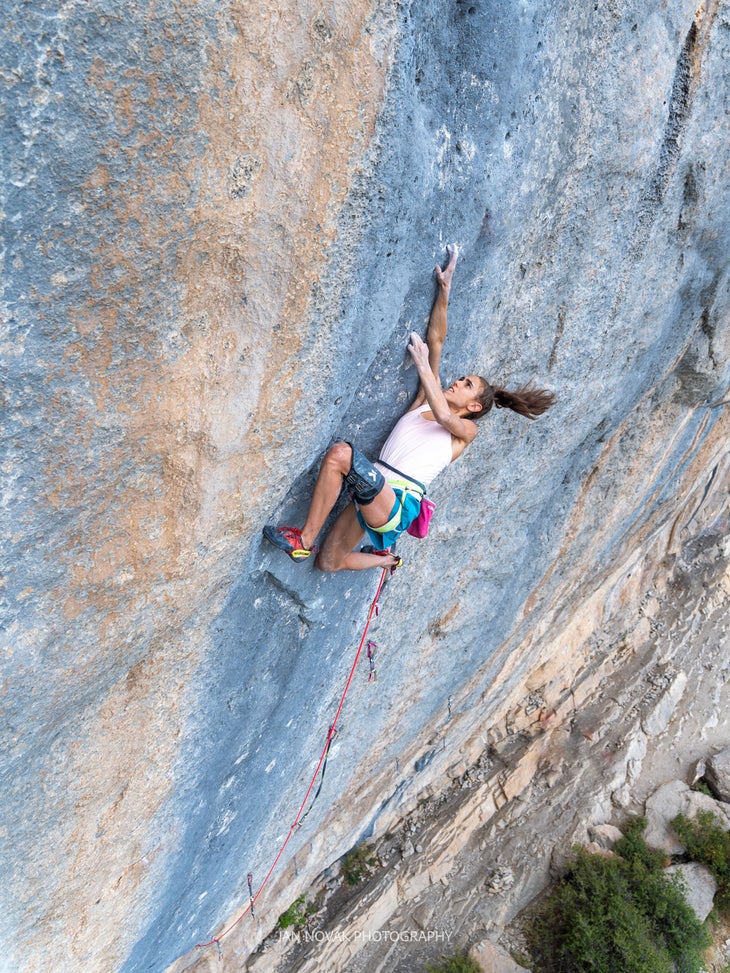
Six days is a startling number, particularly for a route with a history measured in months and years. But it also makes for an imperfect comparison. When Megos first began working Bibliographie in 2017, there was no established sequence to study. Sure, the infrastructure was there, placed years earlier by American climber Ethan Pringle, but Megos still had to determine how, or if, the individual pieces could be linked.
When he finally finished the route in August 2020, Megos proposed 9c/5.15d, putting Bibliographie alongside Adam Ondra’s Silence in a grade that, at the time, barely existed.
It lasted until Ghisolfi arrived the following year and found different beta through some of its hardest sections. After Ghisolfi’s 2021 ascent, he proposed a downgrade to 9b+/5.15c, and Megos agreed.
When it was Rogora’s turn to tie in beneath Bibliographie, six years of successful climbing had created something closer to what its name suggests: a record of what worked. However, she used the existing beta videos more as reconnaissance than as a prescription.
“The videos were useful to have a general idea of the sections, but I didn’t really follow someone else’s sequence,” she said. “I quickly started looking for the solutions that felt most natural for me.”
Sending Bibliographie wasn’t initially part of Rogora’s plan for her trip to France. Originally, she wanted to give the route two days of effort before moving on to other crags in the country. On the first day, she worked all the moves. On the second, she started making links and decided to extend her stay. Then she split a finger.
Two rest days followed. Her finger healed enough for another go, but split again during her next session. That meant another two days of rest. In between attempts, Rogora did some weight training and waited for her skin to heal enough to try again.
On her sixth day, Rogora hit a wall. At the midway point of Bibliographie sits a four-move V12 boulder problem, culminating in a gnarly two-finger pocket that stumped her on her initial run. Still, on her second attempt of the day, she pulled through. Sixteen attempts after first pulling onto Bibliographie, Rogora clipped the chains.
What helped Rogora succeed?
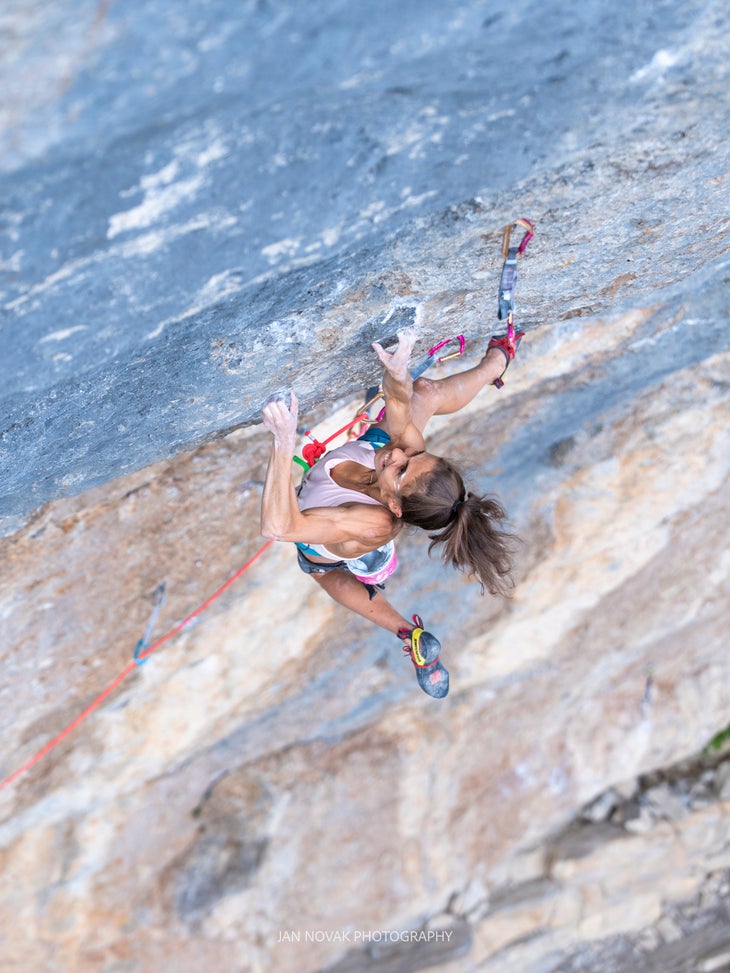
Part of the speed, Rogora thinks, came down to how she projects. She tends to settle on beta quickly, which leaves more time for linking sections rather than continuing to solve individual moves. Bibliographie also happened to “play to her strengths,” combining powerful climbing on small holds with endurance.
“I usually find the beta that works best for me relatively fast,” she said. “Once I understand the movements, I can focus on putting the sections together rather than spending a lot of time figuring out the climbing.”
Rogora doesn’t give much weight to comparing projecting timelines. “When you establish a route, you’re doing something completely different,” Rogora said. “You have to find the line, clean it, figure out the movements and develop all the beta yourself. You don’t know if the route is even possible yet.”
Projecting time, Rogora added, is only one measure of difficulty. “I think it tells us something, but probably much less than people think,” she said. “Projecting time depends on so many things: the climber’s strengths and weaknesses, how much information they have, their previous experience, their physical and mental shape, the conditions and even how much time they have available.”
For the young Italian, the surprise wasn’t necessarily that she could climb 9b+/5.15c. She had already thought the grade was within reach. It was finding out how quickly she could get there. Before Bibliographie, she imagined a route at the grade would demand a much longer project. Six days changed that calculation, though she’s reluctant to turn one fast ascent into heavy expectations for the next. Already, some fans are speculating that if she dedicated more than a week to a route, she could be the first woman in history to climb 5.15d, closing the top-grade gender gap for sport climbers.
“I don’t want to put too much pressure on myself,” Rogora said, “but it definitely makes me curious to see what else might be possible.”
The post Laura Rogora Sends ‘Bibliographie’ (5.15c) in a Record Six Days appeared first on Climbing.