 BURST
BURST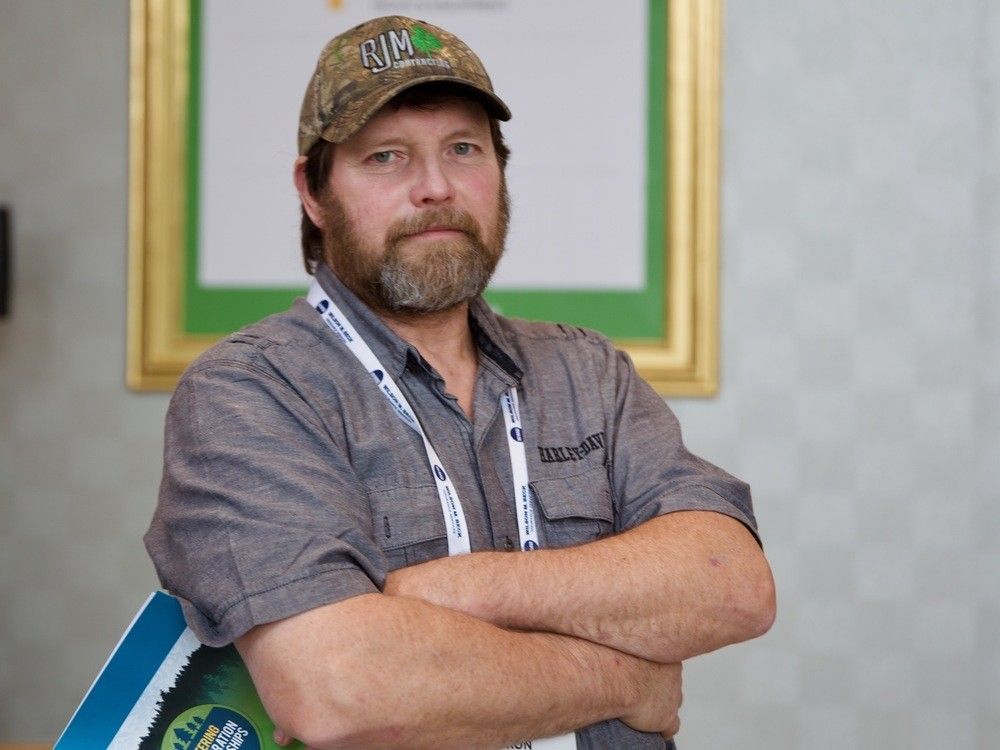
Logging contractor Ron MacFarlane feels fortunate to have work for his eight-person crew, cutting mostly second-growth Douglas fir on a cut block a 30-minute boat ride up an inlet on B.C.’s Sunshine Coast, while business in his industry is otherwise “flatlined.”
“We’re busy until March, and then we’ll see from there,” MacFarlane said Thursday in the Truck Loggers Association annual convention in Vancouver.
Conditions in his industry, however, have “definitely gone downhill in the last two years.”
Ideally, MacFarlane would like his firm, RJM Contracting, to have contracts for up to 10 months a year, which would make it easier to attract and keep employees.
Lately its only been five or six months a year as he’s found himself “stumbling over the same amount of wood,” with his competitors in a B.C. timber harvest that has shrunk dramatically.
Last year, which was characterized by mill curtailments and closures, including Domtar Corp.’s decision to close its major pulp mill at Crofton, forestry companies logged 32 million cubic metres of timber, far short of an annual allowable harvest of 45 million cubic metres.
Difficulties in getting the province to speed up permits to cut more of that timber has put the industry “in a state of crisis,” said Peter Lister, executive director of the Truck Loggers Association.
“I’ve never seen it as bad. I’ve been involved in the forest industry for over 35 years, yeah, and it is really on the edge of collapse.”
Lister acknowledged there are factors that are hurting the industry that are beyond Forest Minister Ravi Parmar’s control, such as punitive U.S. softwood lumber duties, which now average 45 per cent. But he wants the minister to act on the things that he can.
Parmar, who was the speaker at the convention, came with an agreement with China to work to integrate modern wood construction into that country’s construction sector. The deal was unveiled during Prime Minister Mark Carney’s trade mission in Beijing.
Parmar said his hope is that it will result in “more jobs, more certainty and more stability for contractors and forestry workers in every corner of our province.”
He said he will roll out in coming months more of the concrete actions the industry has been calling for. A key one will move the province away from a cut block by cut block permitting process and towards area-based permitting based on comprehensive land use plans being devised by government, industry and First Nations.
“I see a future where we have no need for cutting permits in forestry here in British Columbia,” Parmar said.
Instead, Parmar wants to work toward “forest operational plans,” where government, loggers, First Nations and communities agree on parameters that “provide years of certainty on the land base, stability on that land base, that will allow us to build multi year timber inventories.”
Parmar said he didn’t accomplish all of the goals he set in 2025, and when asked by the session’s moderator, Vancouver Sun columnist Vaughn Palmer, to grade his performance against the mandate letter he was given by Premier David Eby, he candidly acknowledged it would be an “incomplete.”
The minister added that he expects 2026 to be another “tough year,” but he’ll continue working on what he sees as a necessary transformation for the industry.
Lister said Parmar’s commitment to forest operational plans sound promising, but his group will reserve judgment on what is being proposed until they see the details.
“I feel like he understands better today what some of the issues are facing the forest sector,” Lister said, but, “we’ll know when we hear what those announcements are. So I would say my feeling right now is cautiously optimistic.”
For forest-management executive John Mohammed, however, Parmar is still missing a connection to short-term actions the industry desperately needs to free up some of the cutting permits companies have sitting on the shelf because they are uneconomic.
“His first year, he’s gone backwards in terms of the harvest,” Mohammed said. “His scorecard doesn’t look very good.”
In the coastal forest sector, Mohammed said Parmar could take the risk of lowering stumpage rates, the fees the province charges for trees harvested, to help economics.
“The minister says all the right things, and he’s got a fantastic team, but we’ve got to have change,” Mohammed said. “Like, we can’t have another 2025, we are all at the brink, and we need to have immediate action to test the waters with the softwood lumber duty and make the changes necessary to protect the jobs in B.C.”