 BURST
BURSTFor a few months now, there’s been a bidding war between Paramount and Netflix to buy Warner Bros Discovery. Netflix seemed to have clinched the deal when the board of WBD accepted their offer. Paramount, which is owned by the billionaire Ellison family, got very nasty about the situation, suing on procedural grounds and trying to get shareholders to revolt. Ultimately, they are going to do what they had to do from the very beginning to win the bidding war - offer more money.
But a contact let me on to something odd about the Paramount approach: the company says it has mostly completed the extensive legal paperwork necessary to acquire WBD. And that’s both very weird and very important, for reasons I’ll get into, because it suggests Paramount’s people believe the fix is in, on their behalf.
First, let’s discuss the bidding war itself. Both the Paramount and Netflix offers are legally problematic, for slightly different reasons. If Netflix wins, it will likely end up killing the theatrical release business, and entrenching its dominance in streaming. European antitrust enforcers are wary of Netflix, as is the Trump DOJ. Paramount has a different legal problem. The case is much simpler, because it’s a combination of two direct rivals going head-to-head in a concentrated market. A merger of Paramount and WBD would include two out of five movie studios and distributors, two major TV studios, two big sports distributors, and so forth.
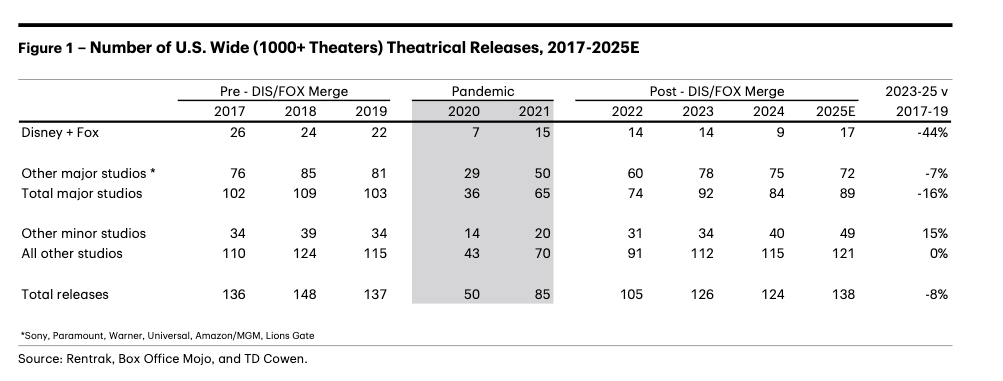
We know what happened when Disney bought Fox - the number of released movies decreased by 44%. The same thing will happen here, especially considering how many people Paramount is likely to fire. That violates all sorts of merger guidelines, which are the way enforcers think about how the Clayton Act works.
There’s an additional problem for Paramount, and that’s the obvious censorship and cronyism. The Ellison’s are new to owning Paramount, having bought it last year. And in that time, they have taken a number of steps, including firing Stephen Colbert, that are obvious attempts to please Trump. Then this Monday night, Colbert, in his last few months on the job, claimed that CBS, which is owned by Paramount, would not allow him to interview a Democratic Senate candidate, James Talarico. As former FTC commissioner Alvaro Bedoya notes, the conspiracy is pretty open.
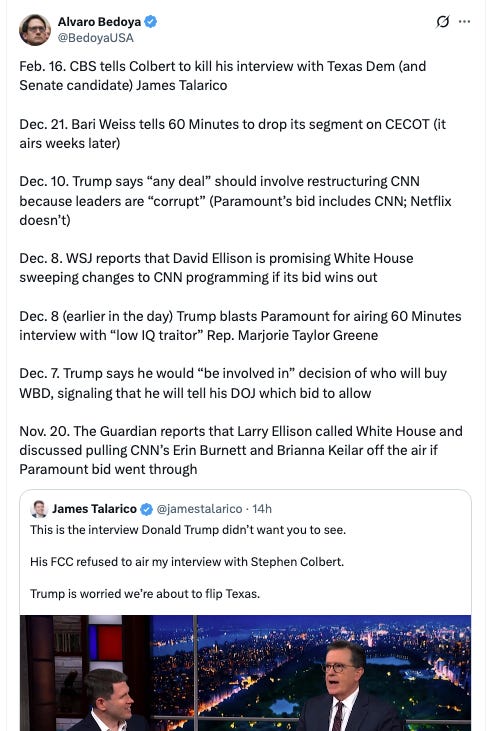
Now, it’s not an antitrust problem that CBS censored this interview, but it is a media consolidation issue. As I’ve noted, we should repeal the Telecom Act of 1996 and break up these conglomerates, restoring vertical separation between distribution and production of video content and update that for the streaming world. Otherwise, we’re living in a censorship machine.
The way this behavior intersects with antitrust law is that it will change who might want to challenge each merger. A Netflix acquisition brings Trump enforcers and anti-big tech Europeans into play, while a Paramount acquisition likely puts them on the sidelines. At the same time, Democratic state officials will be more likely to challenge a Paramount deal, because of the obvious partisan cronyism going on.
And that’s where the legal strategy of Paramount comes in. The company’s main antitrust lawyer is a savvy and cynical operator named Makan Delrahim. Delrahim is a close confidante of David Ellison, the son of Oracle founder and billionaire Larry Ellison, who is financing the deal. And Delrahim’s goal is to get the deal through before enforcers know what hit them.
To understand how requires a bit of a detour into the technical details of merger law. When two big companies announce a merger, they don’t immediately combine operations. They can’t just start moving the furniture, firing people, reordering business lines, and redesigning org charts. Both companies must remain independent, with two CEOs, two CFOs, two marketing departments, and so forth, in case the merger falls apart and they have to go their separate ways. That remains the case until the companies sign a deal, line up financing, get permission from their shareholders, and clear antitrust hurdles.
There are a number of steps to overcoming potential antitrust objections. A merger of big companies must go through what’s called the Hart-Scott-Rodino process. Both companies file a form with the antitrust enforcers offering “such documentary material and information” that would help the Federal Trade Commission or Department of Justice figure out whether the combination is a violation of antitrust laws.
Once they file that form, there’s an automatic delay of 30 days, during which time the companies can’t merge operations. If enforcers decide to investigate further, they can send a bunch of questions, known as a “second request,” to the two parties. The merger then gets delayed until they parties answer those questions.
Fulfilling that second request is time-consuming and expensive. Corporations will negotiate with the government over the extent of the document requests and search terms, trying to limit the amount of information they have to hand over to minimize exposure to legal risk. There’s a reason for that, monopolization cases can come out of information acquired in the merger process. Once enforcers start poking around in your dirty laundry, they are apt to notice things you didn’t want them to see. So second requests take between a year or two, costing millions or tens of millions in legal fees.
Once a second request is done, the shot clock for the government starts ticking again. At that point, enforcers have to actually file a case and ask a judge to keep the operations of the company separate until the litigation is over. If they don’t, the deal closes and the companies can combine operations. Layoffs start, people get moved around, new projects get green lit.
That doesn’t mean challenging a deal that has already closed is impossible. Technically, there’s no legal difference between undoing a deal rather than preemptively stopping one. But the incentives for the merging parties change once a deal closes. If they are still separate, time works against the merging parties. They will cooperate with the government on document requests so as to to get the process over, get their deal bonuses, and so forth. But once a deal closes, there’s no more incentive to do anything but delay, as they already have what they want, aka a completed merger. In fact, they will work hard to mingle the assets immediately to make it hard to untangle them, and even shut things down.
Delrahim knows how this process works, and so he’s had Paramount do something unusual for an acquiring party. His company has filed an HSR form without signing a merger deal or even winning the bid for the company with whom it is trying to combine. And not only has Paramount filed an HSR form, it has already “substantially” fulfilled the second request for information from the DOJ. That’s astonishing. It means Paramount paid tens of millions to lawyers to comb through documents on a rush job. It also likely implies they did no negotiations whatsoever with the government, and just gave them everything they asked for. I’m told that is unheard of.
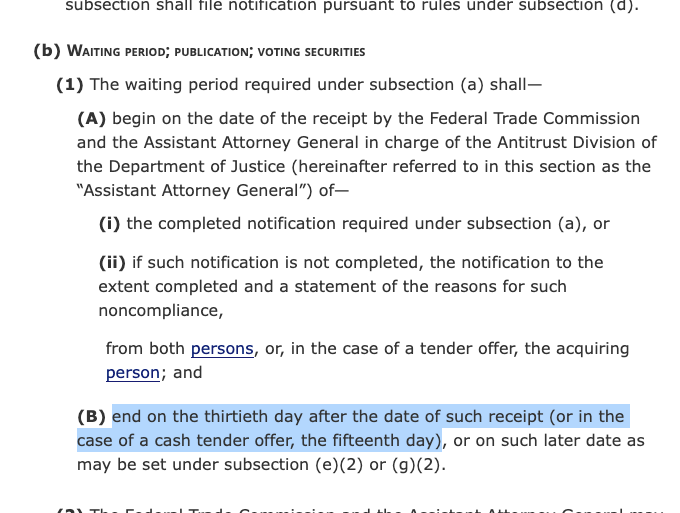
Why take such cumbersome and risky steps if Paramount is not even assured victory in the bidding war? Well, there’s a specific timeline involved if they make a cash tender offer. If the Netflix deal falls apart and Paramount wins the bidding war, then the antitrust enforcers have just fifteen days to rush a complaint out to a court to ask to pause the merger.
Now, the DOJ Antitrust Division may still be able to file a case. They have hundreds of lawyers and they know how to challenge mergers. They examined the Disney-Fox deal, the Warner-Discovery deal, they are antitrust enforcers first and foremost. But Delrahim believes, not without reason, that the Trump Antitrust Division will be fine with Paramount buying WBD. He is also likely banking on enforcers being unable/unwilling to comb through all of their documents and put a case together on time, because DOGE slashed the number of capable antitrust lawyers there.
Of course, I’ve never been particularly optimistic about this administration challenging mergers. But there are other possible litigators - state attorneys general, particularly from Democratic states. State enforcement lawyers are not experienced at challenging mergers, especially big ones, they rely on the DOJ to do that for them. There are opportunities here - a savvy state AG could send a civil demand to Paramount and get all the second request data sent over to the Federal government, which is a treasure trove of sensitive information.
Still, a fifteen day crunch to challenge a $90 billion deal is difficult. And while there is a broad anger in Hollywood over the deal, it’s not clear the institutions representing creatives are prioritizing a merger challenge over more prosaic things like bargaining with studios over health care. And so far, key industry leaders, a generally cautious and wealthy bunch, are still weighing on whether to engage. That’s why we’re mostly not seeing Hollywood stars speaking out.
So if the Trump enforcers refuse to challenge the merger, or do some sort of consent decree where Paramount makes promises to release a certain number of films, that erects an additional hurdle to state enforcers. At that point, if the states don’t prepare and file a case very quickly, the deal closes. Then Paramount will own WBD. It will start layoffs, renegotiating terms with theaters and sports leagues, combining streaming properties, and restructuring entities like CNN.
Even if state enforcers bring a case, it will be much harder to win. It could take many years, and in that time, Paramount will effectively have consolidated the industry. Enforcers won’t be asking for a judge to halt a merger, but to break up a company. And judges get very nervous about that.
Moreover, states will have to prove to a judge not only that the deal is illegal, but also that the Federal government was wrong in its analysis of the deal. The last time they attempted such a challenge was in 2019-2020, during the first Trump administration, when states brought a case against the Sprint-T-Mobile merger even as the Federal antitrust enforcers did a consent decree. The judge let the merger happen because he believed the Federal government was more credible than the states.
Oh, and who was the Assistant Attorney General for Antitrust when that Sprint-T-Mobile merger happened over state objections? It was a guy named… Makan Delrahim. So that’s the plan. Buy off the Feds, overwhelm and intimidate the states, roll-up Hollywood.
Of course, that plan relies on a number of things to fall into place, including Paramount winning the bidding war and sustaining its financing. If that happens, then what’s standing in the way of a combination of Paramount and WBD is Hollywood power players and Democratic state attorneys general. Now, there are reasons they could challenge, and I know they are paying close attention. But… it’s the Democrats. There are moments when they could actually change their brand to a party willing to take risks for working people, instead of box-checking bureaucrats using tired rhetoric about fighting. This could be one of them.
Thanks for reading! Your tips make this newsletter what it is, so please send me tips on weird monopolies, stories I’ve missed, or other thoughts. And if you liked this issue of BIG, you can sign up here for more issues, a newsletter on how to restore fair commerce, innovation, and democracy. Consider becoming a paying subscriber to support this work, or if you are a paying subscriber, giving a gift subscription to a friend, colleague, or family member. If you really liked it, read my book, Goliath: The 100-Year War Between Monopoly Power and Democracy.
cheers,
Matt Stoller