 BURST
BURSTJapan's mission to Mars is one of the most ambitious in spaceflight history. It aims to become the first spacecraft to return to Earth from Mars orbit, carrying with it the first-ever samples from the Red Planet system.
The mission, known as Martian Moons eXploration (MMX), is a first-of-its-kind endeavor to study the origin of Mars' moons Phobos and Deimos. The robust undertaking includes a landing on Phobos to collect the samples — which will likely be the first from the Mars system to return to Earth — and a search for evidence that could shed light on events during the formation of the solar system billions of years ago.
MMX is scheduled to launch on an H3 rocket from Japan's Tanegashima Space Center on Monday (Oct. 19) at 3:41 p.m. EDT (1941 GMT; 4:41 a.m. local time in Japan, Oct. 20). After a 10-month journey to reach Mars, the spacecraft will spend about three years studying Phobos, deploying a rover and landing to collect its samples. The mission will then shift its focus to Deimos for a series of flybys before departing for Earth in November 2030. If all goes according to plan, the MMX sample-return capsule is scheduled to land in Australia in 2031.
The spacecraft
The MMX spacecraft is comprised of three main parts, as well as a small rover. After release from its H3 launch vehicle, a propulsion module will provide the boost to put MMX on course for Mars. MMX's main exploration module carries the microwave-size IDEFIX rover and most of the mission's scientific instruments, while the return module houses the sample-return capsule.
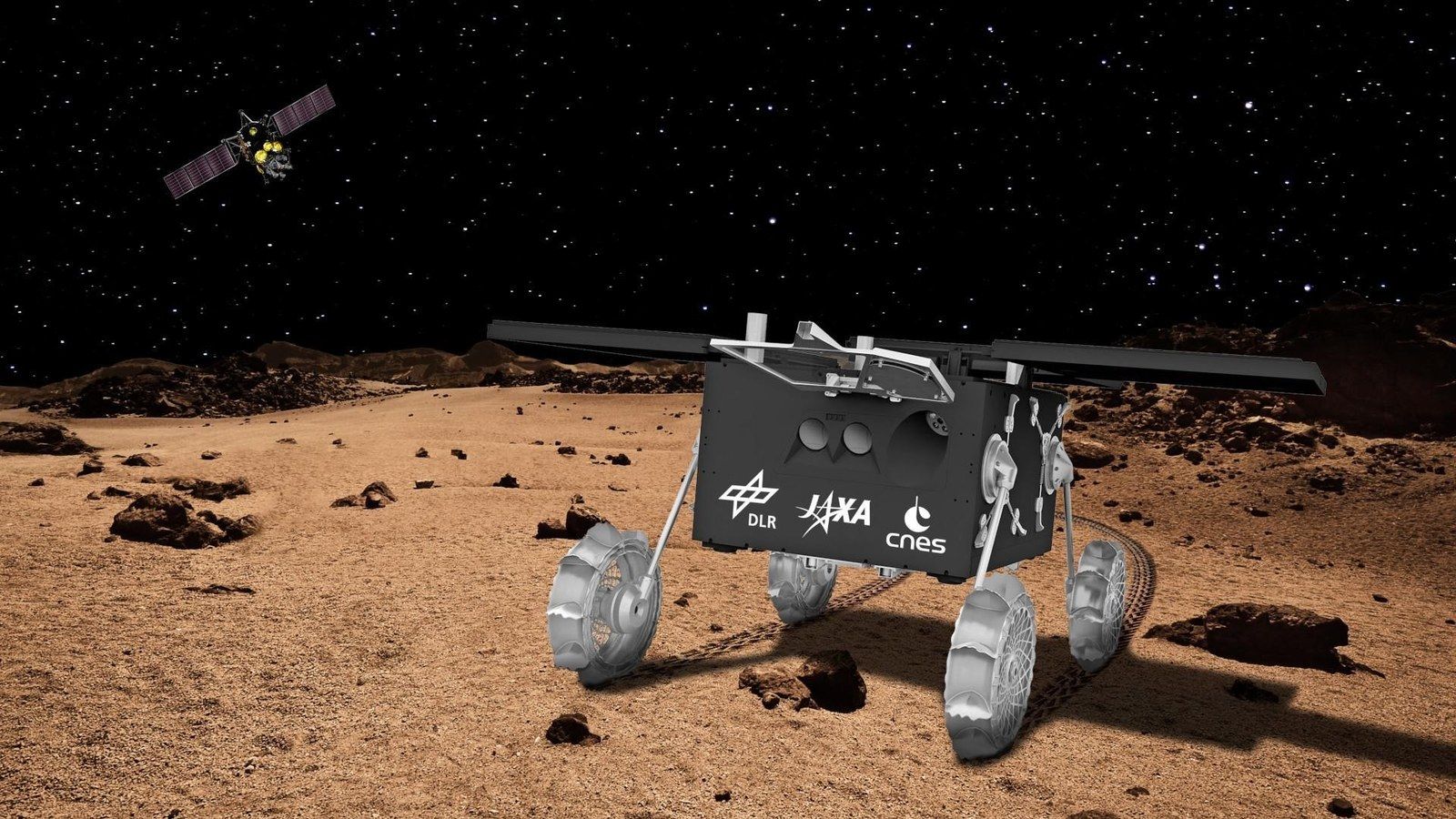
Japan's Mitsubishi Electric built MMX's three main modules, with the French space agency CNES (Centre National d'Études Spatiales) and Germany's DLR (Deutsches Zentrum für Luft-und Raumfahrt) jointly developing IDEFIX. The little rover is named for a dog in the 1960s French comic "Asterix," in a nod to the country's first satellite, Astérix, which launched in 1965.
IDEFIX carries a suite of cameras, as well as the Raman Spectrometer for MMX (RAX) and miniaturized radiometer (miniRAD) instruments to analyze Phobos' surface composition and temperature.
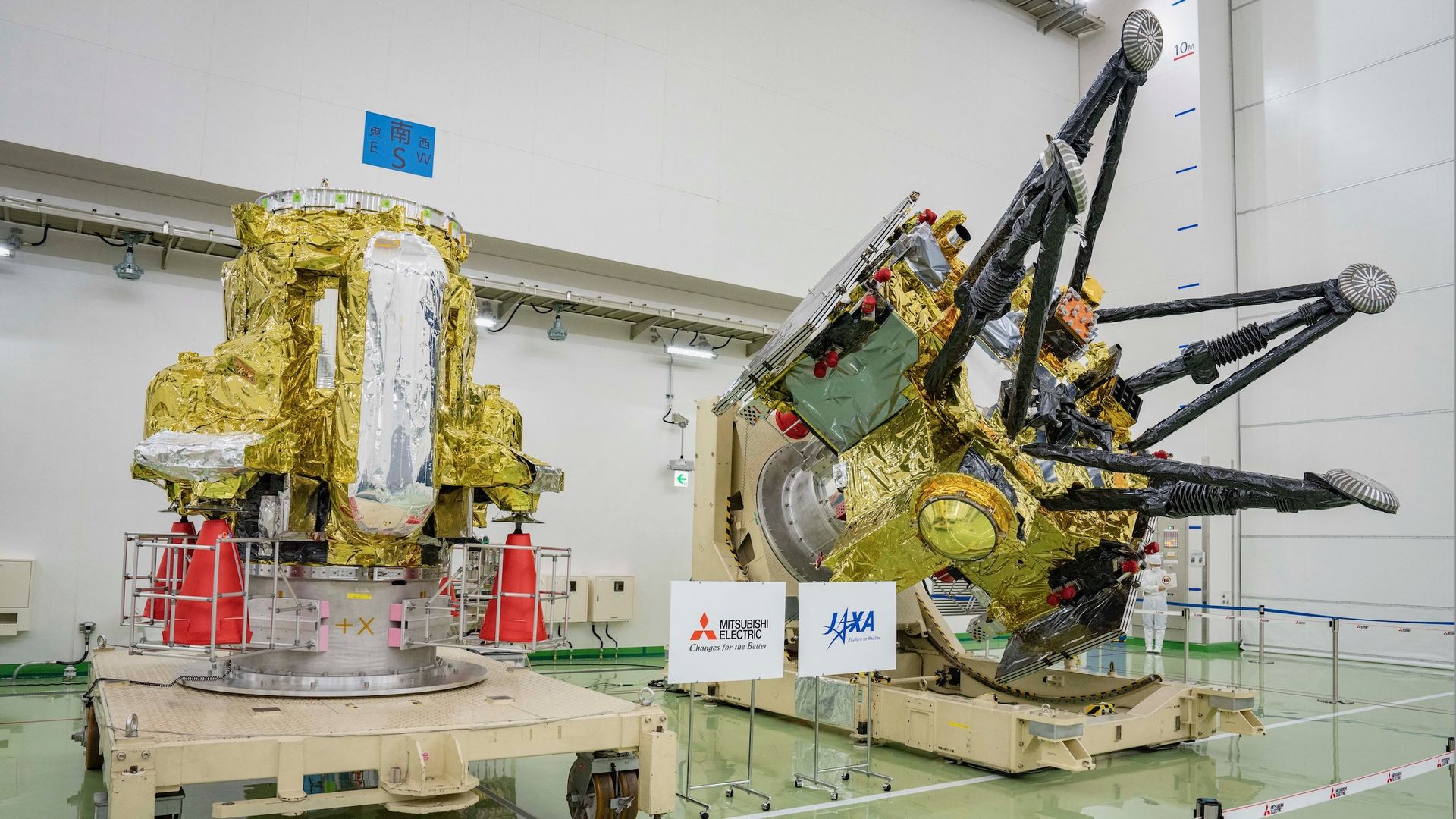
Most of MMX's scientific instruments are housed on the exploration module, like NASA's Mars-moon Exploration with Gamma rays and Neutrons (MEGANE, pronounced "meh-gah-nay") device, a gamma-ray and neutron spectrometer built by the Johns Hopkins Applied Physics Laboratory (APL), and France's MIRS (MMX InfraRed Spectrometer) instrument.
The exploration module also houses the Japanese-built TENGOO (TElescopic Nadir imager for GeOmOrphology) tight-zoom camera, wide-angle OROCHI (Optical RadiOmeter composed of CHromatic Imagers) multispectral camera, laser altimeter (LIDAR) and Mass Spectrum Analyzer (MSA). The return module, meanwhile, carries Japan's Circum-Martian Dust Monitor (CMDM) and Interplanetary Radiation Environment Monitor (IREM).
The mission
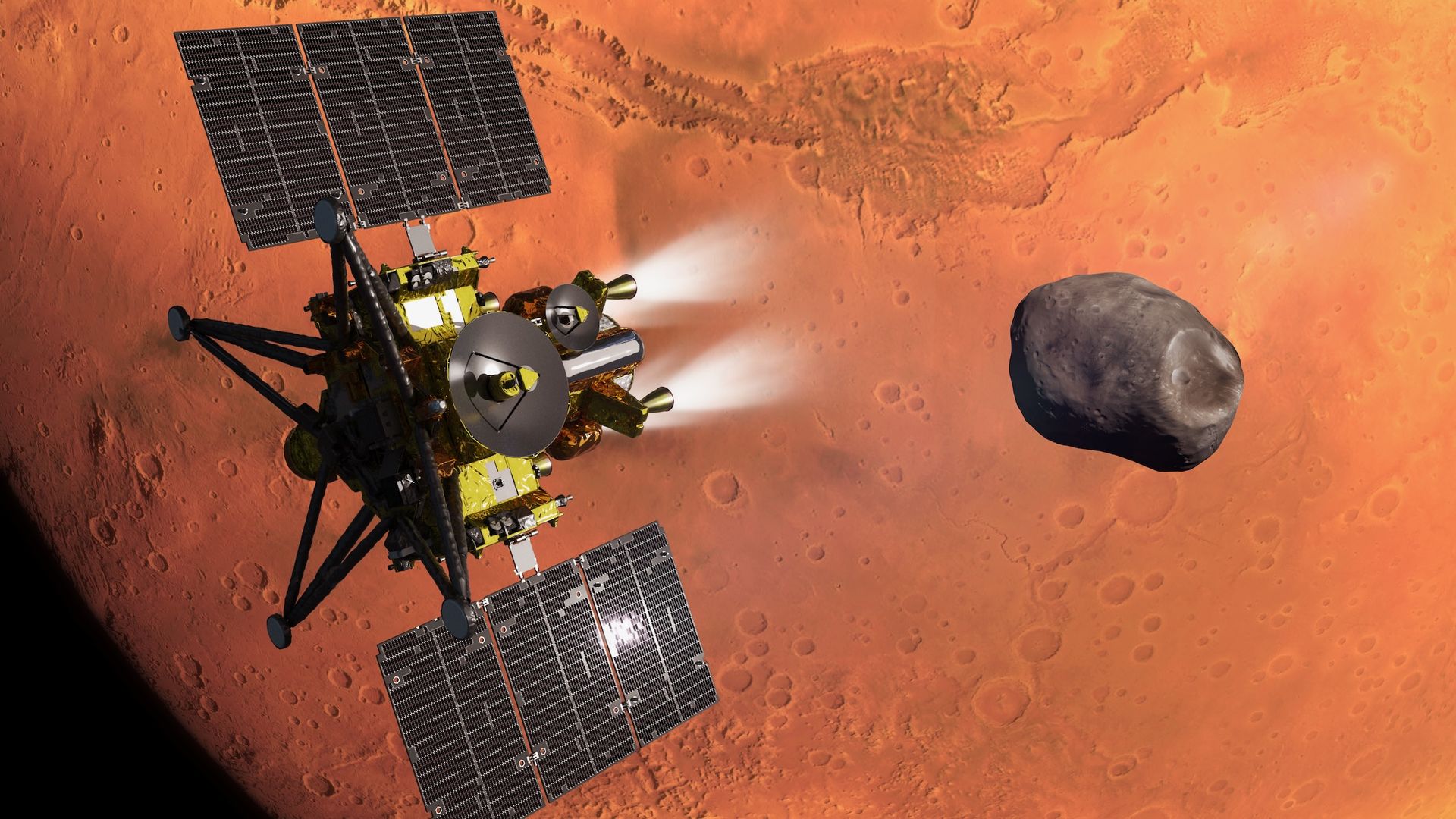
MMX will arrive in orbit around Mars in August 2027, at which point it will shed its propulsion module and transition into a quasi-satellite orbit (QSO) around Phobos that allows the probe to fly in a sort of formation with the small, asteroid-sized moon as they both circle the Red Planet.
The spacecraft will spend its first few months in the Martian system observing Phobos from different altitudes, using its TENGOO and OROCHI cameras, LIDAR and MSA to map the moon's surface, study its composition and select potential landing sites.
IDEFIX will be released in late 2028 or early 2029, during the first of two MMX landing rehearsals, at about 130 feet (40 meters) above Phobos. Due to the 14-mile-wide (22 kilometers) moon's extremely low gravity, the rover will be able free-fall to the surface damage-free (hopefully), right itself after a few bounces and begin exploring to gather data on the terrain and surface conditions.
MMX sample collection could begin as early as December 2028, the acting director of NASA's Planetary Science Division, Lindsay Hays, said during a mission briefing on Oct. 15. The spacecraft will attempt two collection landings, with its exploration and return modules descending and returning to orbit as one vehicle.
On Phobos' surface, two different sampling mechanisms — the Corer Sampling Mechanism (C-sampler) and Pneumatic Sampling Mechanism (P-sampler) — will extract and collect at least 10 grams (0.35 ounces) of material for stowage inside the spacecraft's return capsule before MMX lifts off again for orbit. After its first touchdown and sample collection, MMX will return to QSO near Phobos before descending to a second landing site for a similar attempt and subsequent return to orbit.
MMX will end its observations of Phobos after about three years focused on the Martian moon, and will transition into a higher, resonant orbit around Mars in 2030. That course will repeatedly intersect Deimos' path for a series of flybys to collect and compare data with those from Phobos observations as scientists aim to investigate the moons' origins.
Near the end of 2030, the exploration module will separate, leaving the return module to fire its engine out of Mars' gravitational influence and begin an eight-month journey back to Earth with the collected samples. As MMX closes the last stretch of void during its approach to Earth in 2031, the sample-return capsule will separate and enter the atmosphere for a targeted parachute landing in Australia's Woomera region, where its contents will be recovered for laboratory analysis by Japan and its mission partners.
Phobos and Deimos
Those samples, and the data collected by MMX, could tell scientists a lot — about the moons' composition, geography and, perhaps most importantly, how they came to exist in the first place. There are two leading theories for Phobos and Deimos' origins, both of which point to very different versions of ancient Martian history.
"Phobos and Deimos are interesting, but not just in their own right. Their presence is a key piece of the larger story of the Mars system," said Tom Statler, MMX program executive and scientist in NASA's Planetary Science Division, during the Oct. 15 mission briefing. "By uncovering the moons' origin, we'll gain new insights into the history of both Mars and Earth, especially those events that shaped both planets billions of years ago and helped create the worlds we see today."
Both Phobos and Deimos are relatively small and irregularly shaped, and bear several resemblances and spectral characteristics to primitive D-type asteroids — ancient bodies thought to preserve material dating back to the solar system's formation about 4.6 billion years ago. Those similarities suggest Phobos and Deimos may have formed elsewhere in the solar system and were later captured by Mars' gravity.
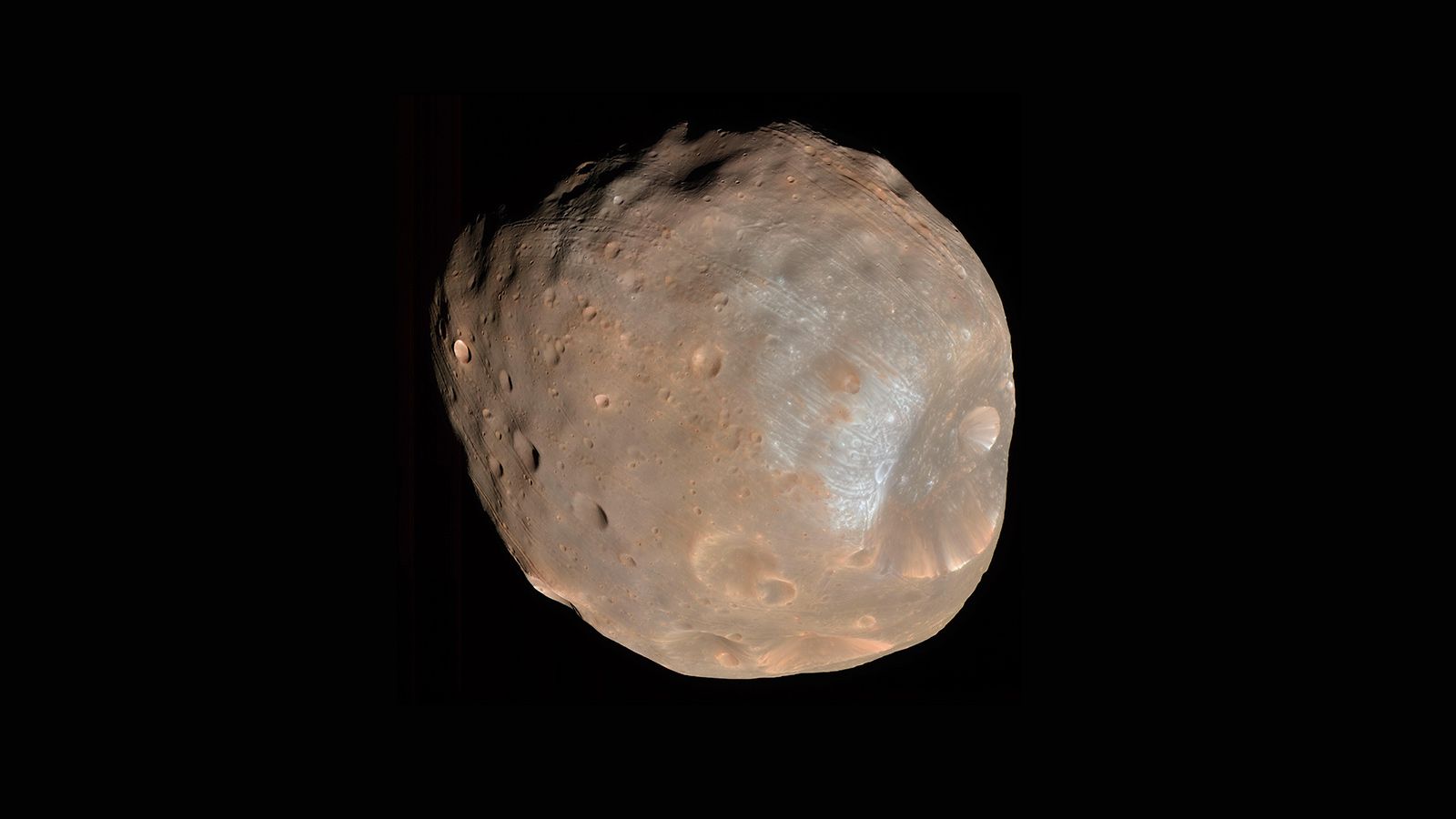
Their near-circular, equatorially-aligned orbits around the Red Planet, however, somewhat complicate that theory. For example, a captured asteroid would be much more likely to have entered an elongated and tilted orbit akin to the direction and velocity of its original approach, scientists say. A competing hypothesis, therefore, offers a much more violent, but somewhat familiar, narrative for the moons' origins.
An enormous collision with ancient Mars could have blasted material into orbit to form a debris disk from which the two moons eventually coalesced. Such a process, which would be similar to the formation of Earth's moon, could explain their circular, equatorial orbits.
The contradicting geological and orbital observations for Phobos and Deimos collected to date have prevented scientists from definitively establishing one hypothesis over the other. MMX aims to provide an answer.
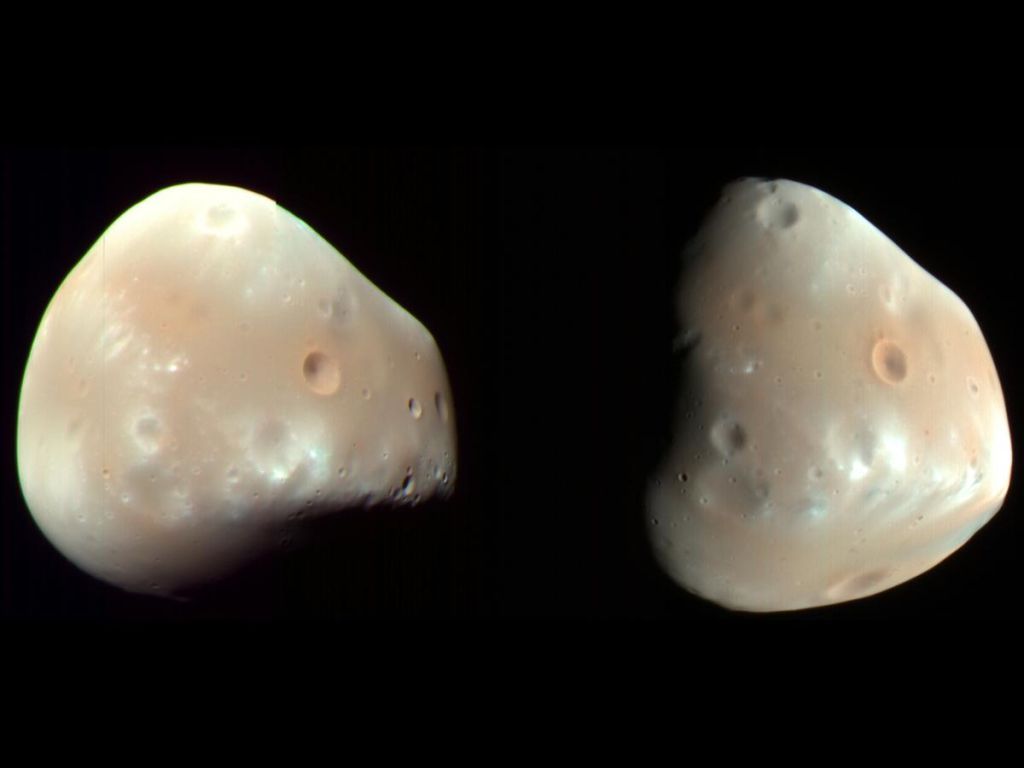
"It's two totally different lines of evidence that point in two different directions. That's what makes it an interesting puzzle," Statler said. Several theories have also been presented for hybrid scenarios combining the two, he added.
"There's all kinds of different ways, all kinds of different combinations of those two basic scenarios," Statler explained. "But that's the puzzle from the start, the two seemingly contradictory lines of evidence that are pointing us to what … the real history was, but we don't know what it is yet."
The science
Each theory for where Mars' moons came from predicts different chemical characteristics for their surfaces. Presumably, captured asteroids would preserve chemical signatures of material originating elsewhere in the solar system, potentially rich in volatile elements like hydrogen. Moons formed through a planetary impact, however, would contain a mixture of Mars and impact material, altered by the intense heat of such a violent collision.
Determining which scenario is more likely could reveal whether Mars experienced a massive moon-forming collision or acquired its moons from elsewhere in the early solar system. Either answer could offer new insights into the planet's evolution and the events that shaped the terrestrial planets like Earth billions of years ago, mission team members say.
"At this point, we know nothing about the composition of Phobos," David Lawrence, MEGANE principal investigator at APL, said during the Oct. 15 briefing. "We have information about mineralogy, but no elemental composition. And so, elements are really a key way to get at some of these foundational questions."
MMX's scientific suite has been carefully calibrated to make those determinations. The cameras and sensors on the MMX exploration module's TENGOO, OROCHI and LIDAR instruments will map Phobos' terrain, geological features and variations in surface materials from orbit, to provide clues about the moon's formation and evolution. Complementing those measurements, MIRS is designed to detect and classify Phobos' surface minerals and search for organic compounds to further differentiate its possible origin as an asteroid or ancient chunk of Mars.
The RAX spectrometer and miniRAD instrument aboard IDEFIX will add localized context to those observations by examining surface mineralogy and their thermal properties up close.
Back in orbit, NASA's MEGANE instrument will measure Phobos' elemental composition through gamma-ray and neutron spectroscopy that can scan tens of centimeters beneath the moon's surface for signs of volatile elements. Higher abundances of hydrogen, chlorine, sodium and potassium, for instance, would favor the asteroid-capture hypothesis, while lower abundances of those compounds could point to the heat and chemical deterioration associated with a planetary impact.
"In Japanese, 'megane' means eyeglasses," Lawrence said. "So we like to think of MEGANE as being an instrument that will look at Phobos with gamma ray and neutron glasses."
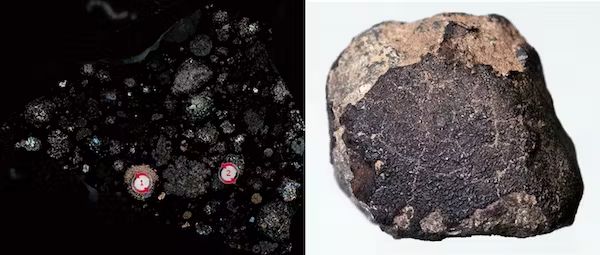
When compared to the samples MMX will return to Earth, MEGANE's findings could help scientists determine if volatile depletion found on Phobos reflects the intense heat of a post-impact formation or billions of years of subsequent erosion from the natural effects of space exposure.
MSA, meanwhile, will measure charged particles around Phobos, searching for evidence of subsurface ice and investigating how solar wind exposure has altered the moon's surface. It will also study atmospheric particles escaping from Mars. CMDM will measure dust around Mars, including particles potentially ejected from its moons by impacts.
Comparative observations of Deimos after MMX's final departure from Phobos will help establish whether the moons share similar compositions and, potentially, a common origin.
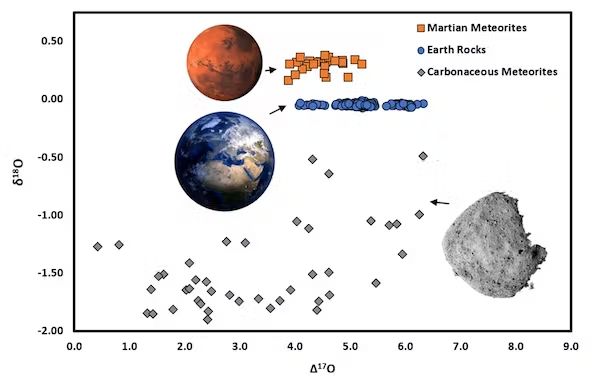
Once safely returned to Earth, laboratory analysis of the Phobos samples will allow scientists to examine chemical composition and mineralogy with a precision beyond that of MMX's onboard instruments. Tests like isotopic analyses — measuring subtle differences in the atomic makeup of elements — can help identify the samples' origins by comparing their chemical fingerprints with those of Martian rocks and asteroid material.
JAXA (Japan Aerospace Exploration Agency) scientists think some returned material could even originate from Mars itself, deposited on Phobos after ancient asteroid impacts blasted rocks off the Red Planet's surface, potentially holding evidence of its geological past.
International effort
The JAXA-led mission represents interagency partnerships with NASA and the European Space Agency (ESA), which are providing hardware and communications support through the Deep Space and Estrack networks.
NASA's contributions to MMX also include MEGANE, the Honeybee Robotics-built P-sampler, and an approximately $87 million investment through the end of the mission. NASA is funding the United States scientists on the MMX team, who will, alongside NASA's astromaterials experts, "be fully involved in the examination and scientific analysis of the Phobos samples when they are delivered to Earth," Hays said during the mission briefing. "We get all of the value and all of the scientific participation at a lower cost total [than funding the entire mission]."
For its role, NASA will receive at least 15% of the returned samples, with materials to be preserved at the agency's Johnson Space Center in Houston for analysis and long-term preservation. To that end, MMX's scientific impact could extend far beyond the mission's conclusion.
"The Phobos samples will be historic," Statler said, with the potential "for future research to answer the questions we don't even know yet how to ask."