 BURST
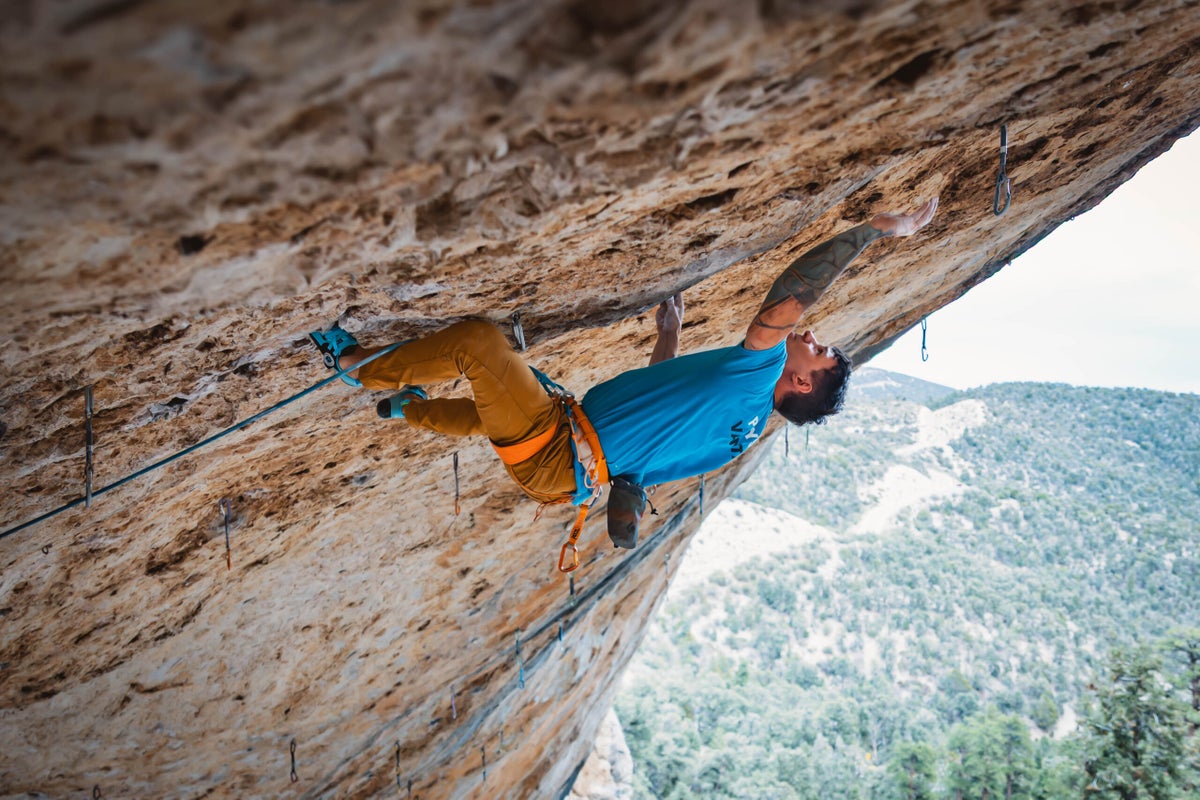
Justin Salas is on fire. On Friday, October 9, the 33-year-old sport climber and boulderer made the hardest known ascent by a visually impaired athlete, ticking America’s Most Wanted (5.13c) at Mount Charleston near Las Vegas, Nevada. The 35-foot cave climb starts with a tough V7, proceeds up through a series of power endurance moves to a second V7 crux, then continues onward to the chains at the top of the Robbery Cave roof.
“In really light or bright-colored limestone cliffs, where everything’s gray or tan, I can’t see any of the holds,” Salas told Climbing after his ascent. “So I feel completely blind.”
Ever since he started climbing at 21, Salas has been pushing the limits for visually impaired climbers. He ticked his first V11, Worm Turns in Joe’s Valley, in 2018 after just three years of climbing. Since then, he’s knocked down more than 20 double-digit boulders, accrued six national titles, and won a paraclimbing world championship.
But America’s Most Wanted represented more than simply another personal challenge. It was also his answer to being excluded from participation in the 2028 Paralympics. Just four months prior, Salas found out, along with the rest of the world, that when it comes to visually impaired climbers, the Olympic debut of paraclimbing will only include the men’s B1 (most blind) category and the women’s B2 (second-most blind) category.
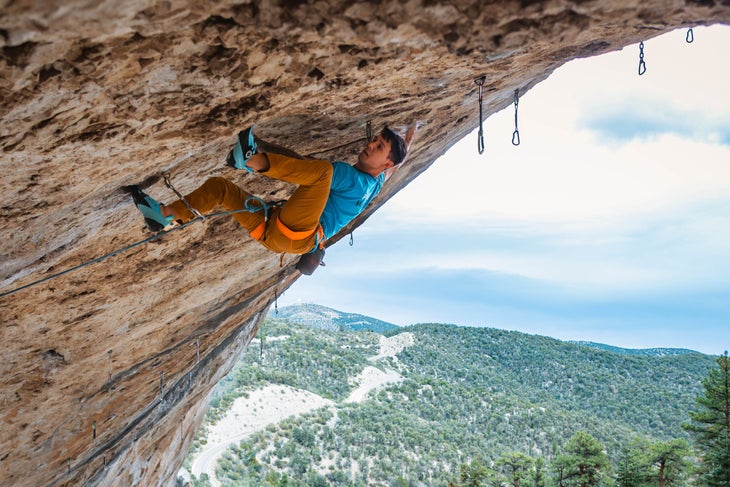
Salas, who developed bilateral optic atrophy at age 14, can only compete in the B2 category. He retains his peripheral vision, but has no central vision in either eye. Like other paraclimbers have said, Salas says he would have preferred if the International Paralympic Committee combined all categories into one category, rather than exclude whole groups of athletes.
“I got pushed out of the Olympics,” he said, “and it hit me really, really hard. I’m not going to lie. It’s still hard to think about.”
America’s Most Wanted came about as a new project when Salas and his spouse, April Davidson, moved back to Vegas. Salas started to shift his focus from bouldering to sport climbing. “The movement’s crazy rad,” said Salas, adding that climbing in the cave felt particularly disorienting.
When I called Salas to get the play by play, I wasn’t surprised to hear that his movement relied on extensive beta memorization. What did surprise me, however, was all of the additional expertise he had to command in order to climb at the 5.13c level. Not only did Salas have to hang onto each hold for longer than a sighted climber, but he also had to anticipate which direction every single quickdraw was facing. On America’s Most Wanted, in fact, he had to stop relying on his innate sense of body positioning that had served him so well in bouldering and on other routes. “My biggest strength became my greatest weakness,” he said.
Read on to learn about Salas’s journey on America’s Most Wanted, why the redpoint crux still feels like a blackout in his mental map, and what it’s like to navigate a professional athlete career with a disability that’s not immediately obvious to others.
A conversation with Justin Salas
The following interview has been lightly edited for concision and clarity.
Sam MacIlwaine: Back in 2018, you became known as the first paraclimber to send V11. Now, you’ve just sent a 5.13c cave route. How did you go from V11 bouldering to 5.13+ sport climbing?
Justin Salas: When I was really hitting the ground running with professional rock climbing, I was primarily bouldering and I was only training sport for competition. I’ve always been relatively gifted with being strong—not necessarily in finger strength, but just physically gifted. I grew up lifting weights and doing powerlifting with my younger brother. I think because of losing my sight at the age that I did, 14, I was still struggling with the idea of being blind—and I still do right now. I have a really hard time coming to grips with it. It’s been almost 20 years now, and I can’t flow with it. I haven’t accepted it still.
I want quick rewards. I want to be strong. I want to feel like I did. I want success, and I want to win. That’s what bouldering was giving me for a long time. Then [V11] happened in three years. That was a pretty quick journey into being a double-digit climber. And it didn’t stop. As soon as I found out I could climb at that level, I continued. I’ve climbed more than 20 double-digit boulders now. Last year, I flashed my first V8, which was crazy for me because as a blind guy, I’m not very good at flashing.
MacIlwaine: If you were having so much success in bouldering, what compelled you to shift your focus toward sport climbing?
Salas: Over the last two and a half years, I’ve started working full-time. I’m helping the founder of a company I work for, Perspective Tester, build a digital accessibility technology company. It’s been a ton of work because it’s a startup. In the beginning, it was anywhere between 40 to 80 hours per week. When I would go climb, bouldering wasn’t satisfying. Not that it’s not fun. When I did get that chance to go climb, I wanted to go get on a rope, whether that was doing easy trad or sport climbing or following people up multi-pitches. Not only was it the physical side, it was the mental, the physiological, the overcoming fear. There was a spiritual component to being back out in nature and being connected with creation again.
MacIlwaine: What’s it like doing a sport climb with your particular type of vision loss?
Salas: I have to memorize everything. It has to be really simple for me to do well with onsighting, especially longer sport climbs or trad routes, because I can’t see any of the holds. I have no idea where the feet are. Yes, I have peripheral vision still, but if you could imagine staring up at the wall and using your peripheral vision to be able to see your feet, that’s what I’m working with. It’s really challenging to try to onsight things. I might as well be completely blind, especially on limestone. Where everything’s gray or tan, I can’t see any of the holds, so I feel completely blind. I can orientate myself in space, but I don’t know where the holds are at all.
MacIlwaine: Why did you select America’s Most Wanted as your project?
Salas: [In February 2024, April and I] ended up back in Vegas. That’s when I was like, “I just want to go climb the things that are exciting to me that look rad, regardless of how hard they are.” [America’s Most Wanted] was the first one. I just thought it looked the sickest. I don’t remember when it was bolted, but it’s one of the easiest things in the cave because everything else in the cave is freaking nails. The next easiest thing is 5.14b, so it’s an entry-level hard climb for that cave—for the elite climbers that come to Vegas and live here in the climbing community. It’s like a rite of passage for hard sport climbing.
MacIlwaine: What were your initial impressions when you started trying it?
Salas: Last October 2025, I tried it for two sessions. I don’t know why; it just did not go well. I’ll be perfectly honest: It felt too hard. And I was out of shape. I was still climbing V10 at Red Rock, but being able to execute short sprints of hard climbing, versus having the fitness to climb America’s Most Wanted. It’s not the longest thing in the world, but I didn’t even have the fitness, so I decided not to try it again until this year. I finally sunk my teeth into it sometime between late June and mid-July.
MacIlwaine: What does America’s Most Wanted feel like to climb?
Salas: The movement’s crazy rad. The position’s outrageous. Climbing in that cave is really sick. The cave is not just a flat piece of ground with a big dome over you. It’s like a diagonal slot in the mountain, and the cave rises up with the landing. So you’re not really climbing linearly. It’s like you’re traversing at the same time. It’s disorienting. It feels weird when you first get in there to figure out where you are in space.
Being in a cave was way more exciting for me because I use heel hooks, toe hooks, bikes, and a lot of cave technique to stay on the wall longer, as someone with blindness. I can use some trickery and increase my time on the wall before I pump out and fall. I’m naturally more geared toward going to those types of climbs.
America’s Most Wanted has a really sick hold set. All the grips are not really bad. They’re mostly full-pad edges and jugs, but they’re not traditional jugs. They’re really unique shapes and cool pods. There is a lot of trickery with doing the toe hooks and biking and body tension, and a lot of core tension involved.
MacIlwaine: How does your vision loss impact clipping the bolts?
Salas: Clipping the bolts are moves by themselves, because you have to figure out, “How the hell am I going to clip this bolt in this position?” There is one clip in particular where you have a left toe jam and a right toe hook, and you’re biking off this toe jam and right hook. It doesn’t feel like it’s going to work until you get into the position. It’s really unique, pretty novel.
MacIlwaine: When you’re climbing at Mount Charleston, do you have a sight guide calling out the holds, like in indoor competition?
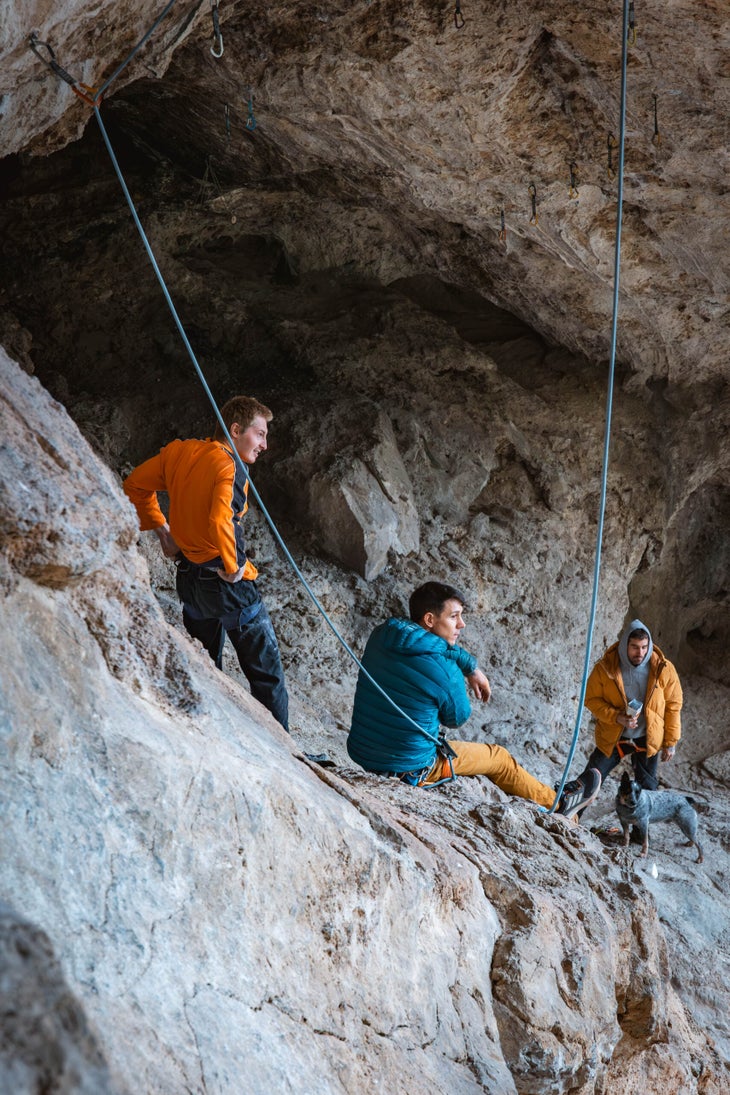
Salas: In the very beginning of trying anything, it definitely looks like that—working pretty closely with a sight guide to find the holds. In the [send] video, it won’t look like I’m super blind because it’s so dialed by now. This is like 20 sessions deep by this time.
You’ll notice I do this hilarious little tapping thing with my feet. It looks like I have Elvis leg, but each tap, if you can imagine, is like a drop in a puddle. There are ripples that come out from that drop. The ripple is the understanding of what I’m trying to put my foot on. So I’m looking at the hold with my foot while you watch my foot tap quickly on things. But if you were to have watched me at the beginning of trying this route, someone is belaying me and someone else is shouting to me where the holds are, where feet are.
MacIlwaine: What’s the process of choreographing your beta while someone else is helping you find the holds?
Salas: I’m like, “If this hold is here, I want a foot here. Is there anything over here?” Because I know how to climb; I just don’t know where the feet are. It’s like, if I were a routesetter, I would put a foot here. But I don’t know if there’s a foot over there. [Someone will say] “Put your hand out,” and they’ll guide my hand to where they think something’s going to be. Then I’ll feel it, and I’ll be like, “That’s too small. I need something else. Is there another option you can see?” We do that process from the first bolt to the last.
Then there’s a full three or four sessions of layering. So the first session is memory, the second session is better memory, the third session is even better memory. The fifth session I’m starting to do links and connecting areas together. At some point, I don’t need a sight guide because it’s so dialed. Or maybe my belayer just needs to cue me here and there: “Yeah, that’s the foot, you’re on it, good. Get your hips up.”
MacIlwaine: After you had all of the moves memorized, what was the crux (or cruxes) of the route for you?
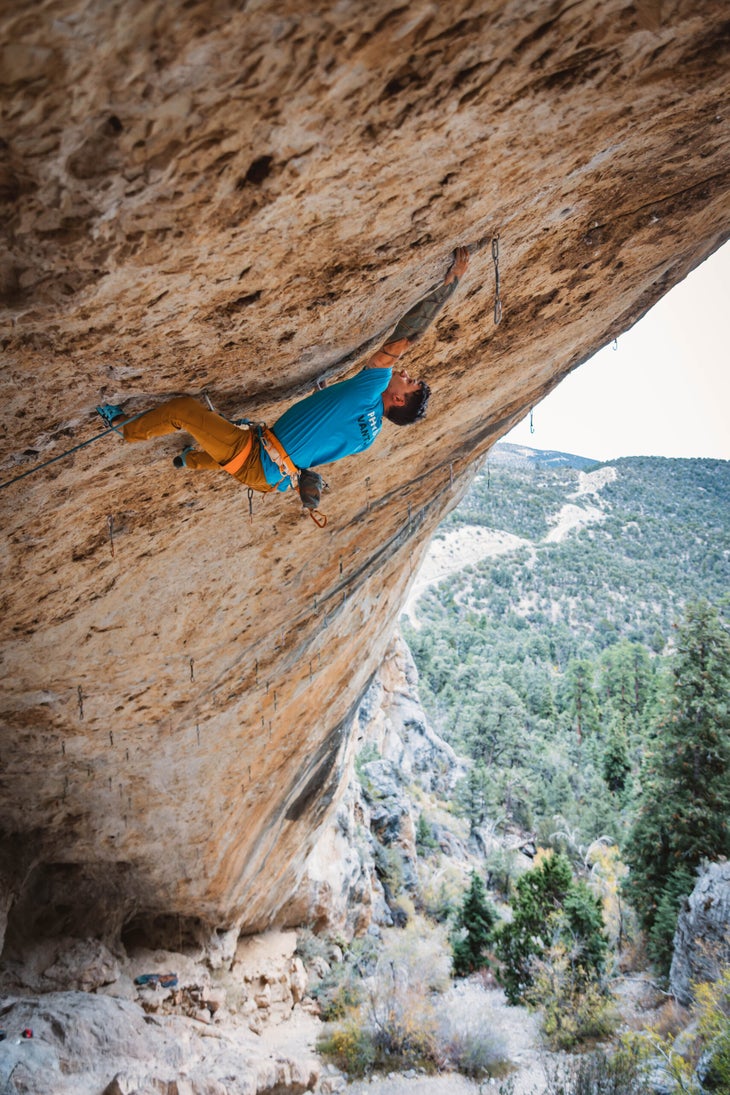
Salas: This is the best part of the whole shit. The first move off the ground of America’s Most Wanted is objectively the hardest. It’s a single V7 move just to start the climb. There’s a really uncomfortable, left-hand side pull that’s slightly undercut, a right-hand undercling, and good feet, but you’re diving backward over your head into this really stupid crimp that’s got a hood on it—protected, so to say. It took me a long time to even figure that move out. But because it’s the first move, you do it fresh, so you have the best chance of executing the hardest single move on the climb right away.
Then there are probably eight more moves to get to the redpoint crux: another single V7 move. You get this big double undercling. It’s a fat jug, mad incut and super positive. You build your feet up really high and launch super far—full wingspan for me—to a three-finger drag. It’s slightly incut, full pad, really good hold. I fell there many, many, many dozens of times.
MacIlwaine: So you’re going full wingspan into a three-finger drag, without being able to see it?
Salas: Yeah. It’s a super accuracy-dependent move. I’m not a stranger to doing accuracy-dependent moves. I’ve done quite a few really hard dynos to small grips. That’s just a part of bouldering. You have to be accurate because you’re thrashing to small grips and in hard positions. This was no exception to that. If anything, it suited my style well, being already really accustomed to climbing quite a few double-digit boulders in limestone roofs.
But once I got the first half dialed, I would climb to this redpoint crux and fall, pull back on, do the move, and go to the chains. This was probably for 15 sessions, maybe more. I was living in this hilarious purgatory of, “I know what’s going to happen this session.” And what was happening was I would fall, sit in the dog, pull back on, and do the move immediately.
That’s the crux for everybody because by the time you get there, you’re tired, but I had one of the biggest realizations of my climbing on this route because of that move.
MacIlwaine: What realization did you have?
Salas: I couldn’t feel how my body needed to be in the space to execute the move. Even now, I couldn’t tell you what that grip looked like. But what was happening was that by the time I would get there from the bottom, I didn’t have the sensitivity in my body to understand where my body needed to be in space to do that move.
So my biggest strength became my greatest weakness for this route. I wasn’t pumped, but I was tired enough. All of my proprioception and the sensitivity I had was gone.
MacIlwaine: What do you mean by ‘My biggest strength became my biggest weakness?’
Salas: I had to go away from intuitive climbing to like, logic-brain climbing: “This knee has to do this thing.” My right knee has to tag the wall when I’m at the top of the swing, but I still need to execute the swing in full. There was so much about what my body was doing that I needed to break down to the nth degree because it wasn’t going to work with just intuitive climbing.
I had to understand the move logically to be able to do it. Otherwise, I had no sensitivity to how the move was going to work.
MacIlwaine: At what point in the process were you able to break out of the pattern of one-hanging?
Salas: I was talking with my best friend, Matt Frederick. He’s been my sight guide in competition for the last 11 years. He was like, “Break that context window up. Show up to the crag with someone else.” Just throwing out random ideas, right? “Wear different clothes, eat something different, start the day off differently. Break the cycle, because you’re in a bad loop right now.”
I have a tendency, as someone that relies so heavily on the way that I feel while I climb in muscle memory. If I get in a bad loop, I’ll continue to fail habitually because I’m stuck. So I was trying everything I could to change everything about it.
MacIlwaine: What sort of routine deviations did you try?
Salas: I started going up there with Joe Kinder and Cam Hörst more. I was being mentored by these dudes that are so much better at climbing than I am. I’ve looked up to Joe basically for my entire life of climbing, and Cam and I have a long history of going out to Red Rock together in 2020 with our friends Drew Ruana and Brooke Raboutou. So reconnecting with him, going back to the Roost, sessioning with him again, and going out there with Joe were more ways for me to change the context. It wasn’t just going with friends; it was going with mentors.
MacIlwaine: How did leaning into logical knowledge, instead of relying on your intuition, change how you were able to visualize the redpoint crux move? Were you eventually able to visualize it?
Salas: I’ve described these tapping sensations I do with my feet—if you can, imagine Sonar, where each tap gives me an idea of what I’m about to put my foot on. I can visualize the grips with my mind because I’ve touched them, because I know how they feel in my hands or on my feet.
[But] now that I’ve done it and have thought about it, I still don’t know what that crux hold is like. I legit have a blackout moment right there. The mental map is smooth and the redpoint crux comes and there’s nothing. Then I remember the rest of it after that.
MacIlwaine: What was it like to climb through a sequence you can’t see and can’t visualize, either?
Salas: Everything about it was total blindness, total hope and prayer that I would eventually stick the move. It would eventually start fucking with my head space. It was like Russian roulette: I’m not climbing anymore, just gambling. It was frustrating for a moment. It was like, “Am I going to do this route because I’m a capable enough climber to do this route? Or am I going to do this route just because I get lucky?” I don’t like the latter option. I want to be able to actually be a capable rock climber.
MacIlwaine: Prior to America’s Most Wanted, had you ever experienced the inability to sense your body position in relation to the route?
Salas: There was a climb in Arkansas—It was my first V8 outside, called Kung Fu, [in 2016]. It was a really long V7, and then you get into the final dyno. Back then, this was the first year of me climbing, so I was numbing out every time I would get to the end of Kung Fu. It was the same thing. I tried Kung Fu for probably 20-odd sessions. I hadn’t had that level of shutdown on an accuracy-based move like that [until] doing America’s Most Wanted. But we’re talking about a full decade later. Sometimes you think you grow, and you get better, but at some point, you’re reintroduced to the same bullshit.
I was numbing out on Kung Fu because I was a newer climber and I was struggling with being fit enough. But for this one, I wasn’t numbing out because I was too pumped or too cold. It was like the communication between my body and my brain was fizzling out. By the time I got to that redpoint crux, I didn’t have the sensitivity in my body to understand how to put my hips into the box to stick the move.
MacIlwaine: So let’s take it back to the moment of truth. You’re switching up your routine. You’re still completely unable to visualize your body in this move, but you keep going back again and again. You’re one-hanging in the same spot, every go. How did you manage to overcome that?
Salas: Cam started coming and staying with us more frequently because he was trying to clean up some—I think he’s got one more 5.14c in the cave to do, and then he’s basically done everything.
When I first started getting out and traveling by myself—this might sound hilarious and not that big a deal, but when you lose your vision, you lose a lot of confidence. So I was always going on trips with friends or with people that were guiding me on my travels. And when I started going to Vegas with Drew Ruana and Cam Hörst, it was me going out on my own. I would travel through the airport on my own; I would Uber around on my own. Everything was just completely on my own.
So that’s the context I had with Cam. Actually, my first time going out [to America’s Most Wanted] with him, I stuck the [redpoint] move from the ground. That was my third or fourth try, and I was scared at the top to not skip the last quick draw. I knew I should skip the last quick draw, but I felt like I needed to clip it. I don’t know; I got scared. And I clipped the quick draw and pumped out and fell out. I fucking punted, Sam.
MacIlwaine: But you made it through the redpoint crux. How did that change things for you?
Salas: I don’t even know if I was super disappointed because I was mad tired, but something had changed showing up to that session with [Cam]. I hadn’t climbed with him in many years. It felt like the context of being back on, having confidence again, and going back to whenever we first started going to Red Rock together.
But it wasn’t for many more weeks that I would have that again. After I had the punting session where I did the move and should have sent, it was two or three more weeks of trying again and again and again and again, where I would do that same thing.
It wasn’t until last Friday that Cam and I went out. Instead of punting, I actually did the crux and I skipped the last quick draw, then was able to have enough energy to clip the chain.
MacIlwaine: Did you know when you were projecting this that it would be the hardest route that any blind climber had ever sent?
Salas: In 2021, when I first heard about it, I thought it could be, but then in between that time period, Nicolas Moineau had climbed 8a/5.13b on a rope. I was like, “Damn, I don’t know if I’ll ever be able to do that. That’s pretty fucked up, dude.” It’s just absurd to think that people with low vision and blindness are climbing at that level.
Then I had my first session in 2025 on America’s Most Wanted and was like, “I can’t. This is too hard.” But then when I started getting closer to doing it, I was like, “Man. I’ve never heard about another visually impaired or blind climber being able to climb at this level.” So I started doing research. I asked Nicolas if he knew anybody that had climbed harder than him or if he’d climbed harder since then, and he said no. Then I went to Javier [Aguilar], a Spanish climber—freaking crazy strong. He’s climbed at least a couple 5.12d’s, but he also said he thinks Nicolas is the only one who’s climbed the hardest.
After everyone I’ve talked to in the community—all the best, most prolific blind climbers in the world—I really tried to figure out what the hardest known ascent is by a visually impaired athlete. I think this is it.
MacIlwaine: What does doing the hardest ascent by a visually impaired athlete mean to you?
Salas: I feel like it’s cool to continue to bring awareness to VI [visually impaired] athletes because being a VI athlete can be hard to qualify. It’s not an obvious disability. When you see amputees or people who are seated, it’s obvious.
I got pushed out of the Olympics because they don’t have my category. So I’m not going to be in the 2028 Olympics. It hit me really, really hard. I’m not going to lie. It’s still hard to think about. There were a lot of other athletes included in that, who weren’t ever going to be able to compete in the Olympics. It doesn’t sit well with any of us because we all want representation for our categories. In my mind, I’m just like, “Be one. Aggregate everyone. Let’s just have a great representation of athletes.” But that’s not the decision the Olympic Committee made.
MacIlwaine: Do you think you’ll try to go for the Olympics in 2032, if the B2 category male climbers are no longer excluded by then?
Salas: I brought this up to a peer [who is going to the Olympics] and they said, “There’s always next time.” I was like, “Seriously? That’s your answer?” I’m going to be in my late thirties then, and I might not even be competitive. On top of that, it’s not the debut Paralympic round. This is so much bigger.
MacIlwaine: What else do you want the climbing community to understand about your process on America’s Most Wanted that we haven’t talked about?
Salas: I think the thing that still plagues me—just to go complete transparency mode with you—I feel very stuck in the middle. I’m not fully blind, but my visual impairment is severe enough that in certain contexts of lighting and rock coloration, I can’t see the holds at all. And in certain times when I have things really memorized, I can flow a little bit more and I feel less disabled than I am because it becomes so dialed.
I feel like I’m stuck between worlds. I’m not fully sighted, but I’m not fully blind. It’s hard to convey. If you know a handhold is coming up and you stare at that handhold, it disappears. Anywhere you look, it disappears.
MacIlwaine: What’s it like to navigate a professional athlete career while being “stuck in the middle,” as you called it, between sighted and 100% blind?
Salas: It’s hard when you’re trying to sell your disability in an era where people have such short attention spans, and the onus of the content is placed on the athlete because the brands can rely on the fact that everyone can create content. That’s just part of it, right? But for me, spending time on my phone is a pain in my ass. It takes forever. It probably takes me an hour to make an Instagram post because of the way that Instagram works with my assistive technology. It’s not the most ideal, so I probably don’t post as much as I could and it just frustrates me.
Then you add in other components. I’ve gotten so close to getting a global deal, and I didn’t get it because of whatever reason. Then I see that same deal get offered to an amputee, and good for them; they should have it because they deserve it. But I just know there’s an underlying sense of, the world understands the obvious. The world does not understand ambiguity and living in between the lines and grayness.
MacIlwaine: Now that you’ve climbed harder than any blind climber in history, are you still interested in pushing your sport grade? What are you thinking about broadly, moving into the future?
Salas: That’s a good question. I know that it closes this chapter, which is nice because it ended up being a bigger chapter than I originally set out to do. It’s really an absolute blessing to get it done, especially because Charleston season’s about over. I thought I was going to run out of time. I did that, then Cam and I went up Saturday, and Saturday night it started raining from Hurricane Rachel. So it was cutting it close.
Closing the chapter on America’s Most Wanted gives me more mental freedom to think about work again; I’m trying to build this company, you know? As far as climbing is concerned, I think what really changed my mind was hearing my friends that climb 5.15 say, “You have so much more to give than that route, dude.” Like, “I know it’s hard for you to climb longer things with a visual impairment, and this is the first time you’ve ever actually invested a lot of time into a sport climb.” It gave me a lot of confidence that I should start trying 5.14s, whether that be 5.14a or 5.14b. I don’t know what kind of success I would have on routes like that. It’s definitely a step up, but I know that I have more to give.
The post Justin Salas Becomes the First Visually Impaired Athlete to Climb 5.13c appeared first on Climbing.