 BURST
BURST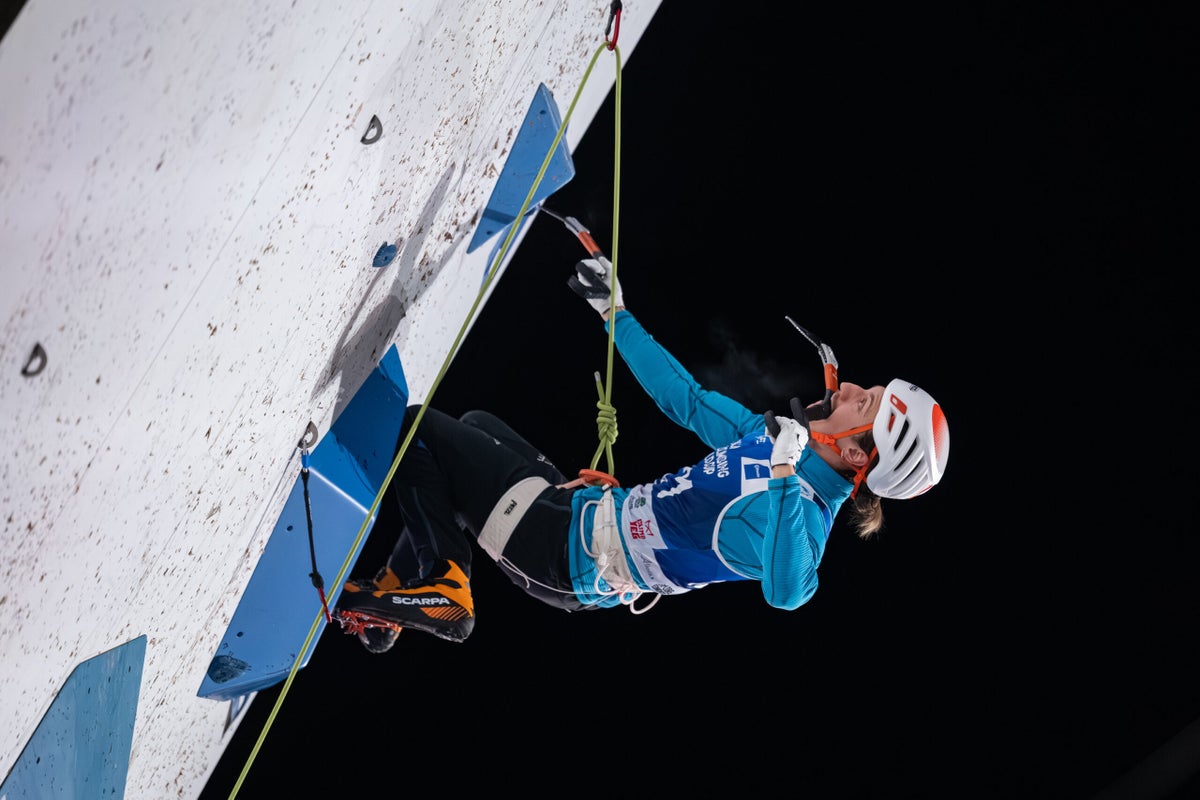
On June 2, competitive ice climbers around the world got some bad news: France has rejected a proposal to add their sport to the 2030 Games.
For over a decade, representatives of competitive ice climbing have been locked into a song and dance to catapult their sport to the Olympic level. In Sochi, Russia, in 2014, ice climbing served as a demonstration sport, with a tower and ice speed wall in one of the main areas and daily demos. Ice climbers also had a presence at the Youth Olympic Games in 2016. They took a cycle off in Pyeongchang in 2018, when the Koreans didn’t want to offer ice climbing as a demo sport. Then they submitted an application to officially debut ice climbing at the 2030 Olympics.
But the pursuit of Olympic status wasn’t guaranteed by maintaining a presence at these recent Winter Games. The relatively nascent sport of ice climbing may also have been seen as not quite fully developed in the eyes of Olympic organizers.
“The IOC are watching,” said Rob Adie, the sport event coordinator at the International Climbing and Mountaineering Federation (UIAA) that governs ice climbing. He was referring to everything from the way the UIAA structures competitions, to how much ice is really involved in ice climbing these days. The UIAA, which is based in Switzerland, announced the rejected application on June 3, the day after receiving the news from the French organizing committee.
Why comp ice climbers had their hopes up for France 2030
Aside from the diligent work the UIAA and athletes had put into forging an Olympic path for the sport, a few specific factors had seemed to signal a strong chance of the sport making it into the next Games.
“Back to the alpine”
For one, the branding around the upcoming Winter Games centers upon bringing winter sports “back to the alpine.” Adie says that he felt ice climbing was particularly well-suited to the focus of Alpes 2030. “We are at the elite end of alpinism,” he said.
A strong French team
Another cause for hope had been the strong performance of the French ice climbing team. In 2020, the International Olympic Committee (IOC) shifted the decision-making of taking on new sports from itself to the national organizing committee of the host. In other words, if a host country thinks it will rank highly in a certain sport, they’re more likely to take it on to increase their medal count. So with the 2020 Games in Tokyo, the inclusion of climbing had been in part motivated by the caliber of the Japanese climbing team. Adie says that with the French ice climbing team doing very well, they had felt optimistic that France would want to take on the sport.
But the limited participation of other Western European nations might have negatively impacted ice climbing’s chances. Organizers may have felt that Germany, Italy, and Austria didn’t have large enough teams to properly represent their alpine chops. “Those three are the biggest winter alpine nations that have a huge amount of power and sway at the Winter Olympic level,” Adie explained. “That’s one glaring thing. We need to increase participation.”
The logistical and financial ease of ice climbing at the 2030 Olympics
Another cause for hope had been that ice climbing is quite economical, according to the UIAA, compared to other sports. “In the scheme of things, we think our sport is relatively cheap,” said Adie, who had even made a field visit to France to scope out possible sites and facilities. While he had been working with the organizing committee for the last nine months, they hadn’t gotten as far as specific formats, medal counts, or athlete quotas yet, all of which would have come after an accepted proposal.
But another applicant for the 2030 Games is also a low-lift from a financial and logistical point of view. Skimo (or ski mountaineering) debuted at the 2026 Winter Games in Milan. France decided to greenlight skimo again for Alpes 2030, perhaps in part due to its “tried and tested” status in Italy. If France was only able to pick one additional sport, skimo would be “the obvious choice,” according to Adie.
That said, the case for adding ice climbing to the mix in France seemed strong. “I personally believe that the French Games were the best chance we’ve had,” Adie told Climbing.
As to whatever other factors might have been at play in the rejection of ice climbing, the UIAA isn’t yet sure. While the bad news for ice climbers arrived in early June, the IOC hasn’t delivered any further feedback for their proposal.
Where’s the ice?
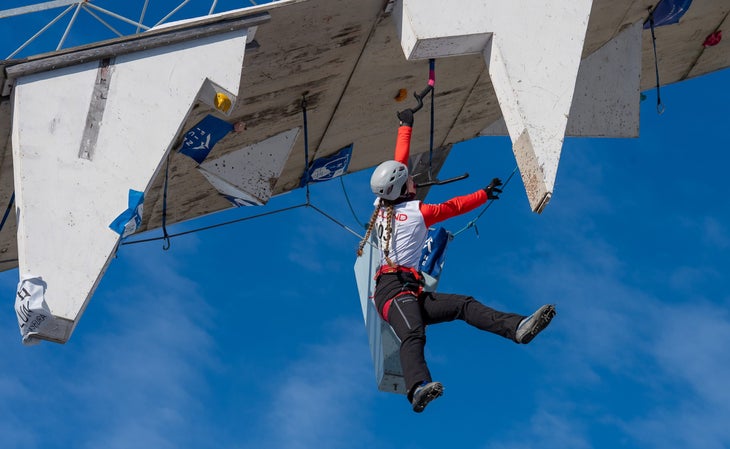
One of the issues ice climbing might have in making it to the Olympics is the amount of ice actually involved. Outside of ice speed climbing, the challenge in competitive ice climbing centers upon artificial, overhanging, and sometimes even moving features. Without the ice, this pursuit is more commonly known as drytooling. Spandex-clad athletes pick their way across wood blocks and plastic holds with ultralight ice tools and sleek boots with integrated crampon points.
“Once you’re strong, it’s easy to climb and athletes want more of a challenge,” Adie explained. “Whether the IOC understands that evolution is another thing we need to work on. It has ice, but you could argue someone who is new to the sport might ask, ‘Where is the ice?’”
In their search in earnest for Olympic facilities, Adie said that they had wanted to use as much real ice as possible. While it all would have been farmed ice, they were committed to keeping ice in the equation.
Is ice climbing too niche?
Another possible concern could be how niche competitive ice climbing is. The gear and movement aren’t remotely familiar to rock climbers—or even to your standard ice climber who sticks to ice pillars and sometimes the rock between them. While a few more drytooling gyms have popped up around the world in the past few years, it remains about as specialized as it gets when it comes to training, equipment, and venues for actually doing the thing. But Adie dismissed that concern.
“There are other sports you could perceive as quite niche in the Games already that are not as well known as football or swimming,” Adie observed. And he’s right that many niche pursuits currently exist in the Olympics, from skeleton and curling, to synchronized swimming.
Furthermore, with its figure fours (when a climber wedges their leg over their arm), acrobatic finesse, and Spiderman-like moves, competitive ice climbing is quite fun to spectate.
How would-be Olympic ice climbers are reacting
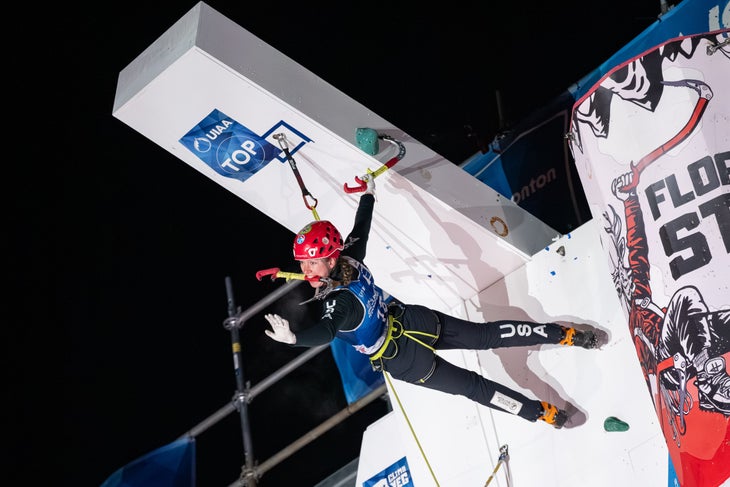
Many athletes and Adie himself admits that the news about France rejecting ice climbing was disappointing. “A lot of athletes were super motivated to be part of the Olympics and really wanted it to be accepted,” Adie said.
Czech climber Aneta Louzecka, who competes in both the Speed and Lead ice disciplines, shared her disappointment on Instagram when she heard the news. But she added that she did believe ice climbing would become an Olympic sport one day.
View this post on Instagram
“I was pretty bummed,” said Cat Shirley, an American ice climber who was hoping to represent the U.S. at the Olympics. In the most recent 2025-2026 World Cup, Shirley ranked third in Women’s Lead and fifth in Women’s Speed.
Shirley added that she and other ice climbers weren’t shocked to hear that ice climbing hadn’t been accepted, especially because they thought they had a good shot with France. She felt like the strong performance of the French team was a positive indicator, but she was also realistic about the hurdles new sports face in going Olympic. “We were all hoping,” Shirley told Climbing. “It’s hard not to hope.”
What does the Olympic path for ice climbing look like now?
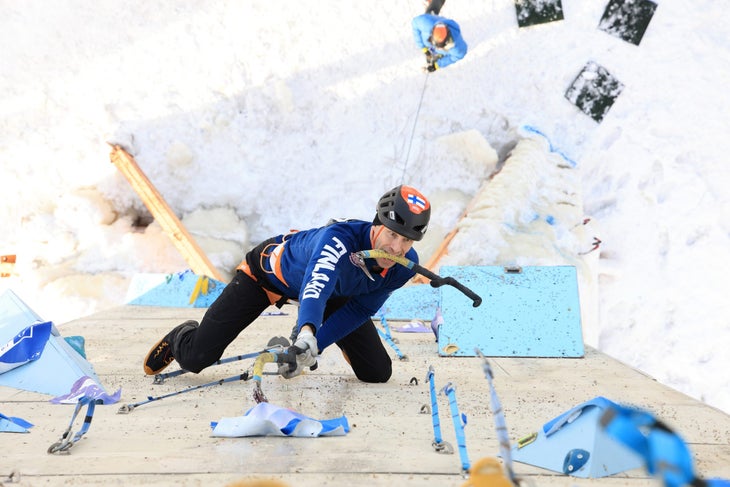
Whether the UIAA will continue to pursue inclusion in the Olympics remains a heated debate among athletes and organizers.
Will the UIAA propose ice climbing at the 2034 Winter Olympics?
The 2034 Winter Games will take place in Salt Lake City, Utah, which seems like a strong location to debut ice climbing with its role as the birthplace of competitive climbing in the U.S. at Snowbird, and the active ice climbing scene.
While the potential exists, the UIAA also dedicated significant resources to this most recent Olympic bid and feels a bit hamstrung by appeasing Olympic organizers. Adie said that a four-year cycle off from the Olympic push could allow the sport to sharpen its identity and improve. Then the sport could “get into a better place without this Olympic thing hanging over us.”
What does better competitive ice climbing look like? Adie said they’ll begin trying to answer that question now as they speak with athletes and host training camps this summer. It might be new formats like dueling leads, mixed gender teams, or even foregoing the ice altogether.
“It gives us the freedom to be more flexible and play with a few ideas that we haven’t been able to,” Adie said of the possibility of tabling their Olympic pursuits.
But Shirley hopes that the UIAA continues to pursue Olympic status for ice climbing every cycle. She added that as a hub of international sports with a drytooling training facility, Utah makes sense as the first-ever venue for Olympic ice climbing. Furthermore, the American ice climbing team is “up and coming,” according to Shirley. Americans have earned a total of 16 medals since the UIAA established the Ice Climbing World Tour in 2002, and the American youth presence is strong.
The world of competitive ice climbing scrambles on
As for whether ice climbing will have any presence at Alpes 2030, the answer is probably no. The IOC’s Agenda 2020 did away with demo sports as a path to becoming institutionalized at the Games.
But as ice climbing sits this one out and the sport does some soul searching, Shirley hopes that budding fans tune into next winter’s World Cup, where all the athletes that would have gone to the Olympics will be figure-fouring, figure-nining, and otherwise contorting themselves up steep walls. “Tune into that,” Shirley advised. “It’s totally wild to watch.”
The post The 2030 Olympics Rejects Proposal to Add Ice Climbing appeared first on Climbing.