 BURST
BURST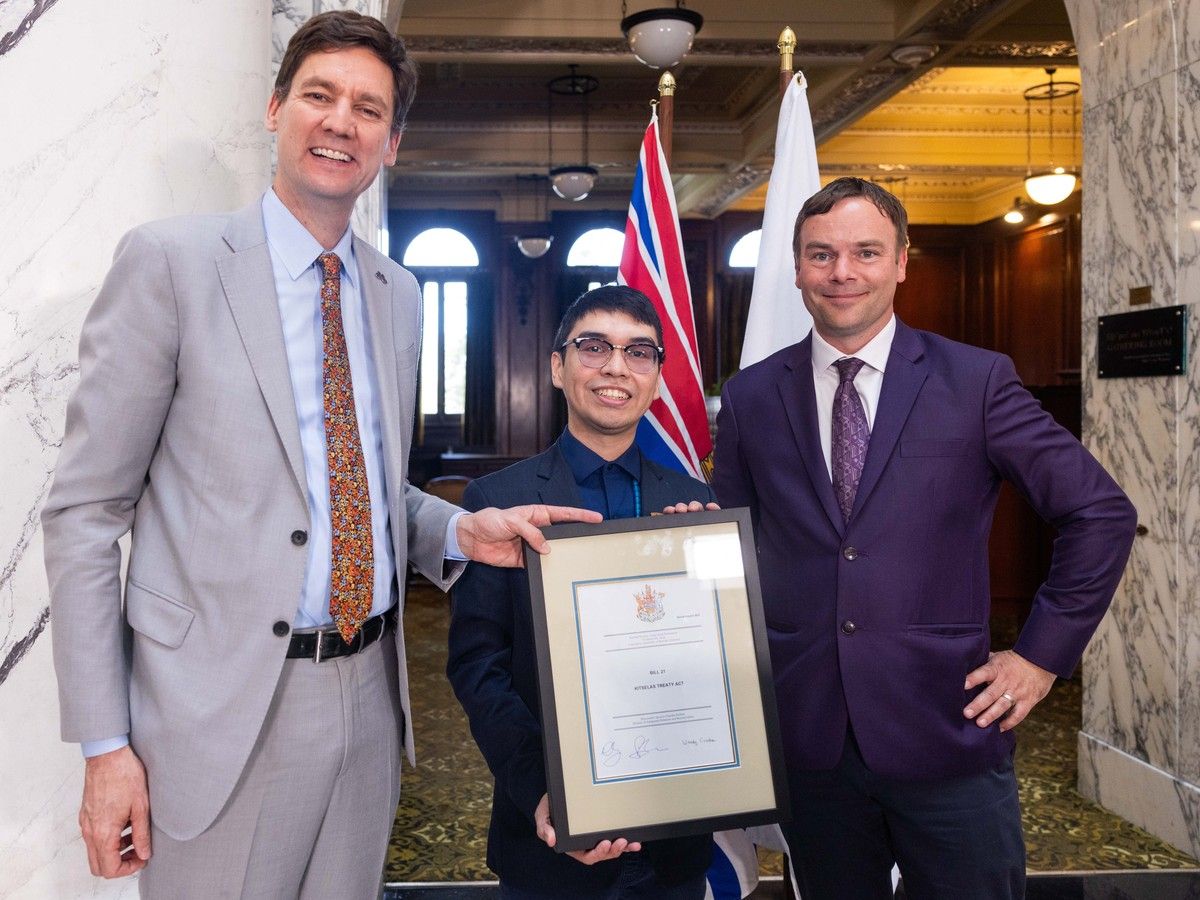
The Kitselas First Nation will receive ownership of more than 38 square kilometres of land, self-government over those lands and $148 million in one-time transfers and continued funding, in a treaty reached with B.C. and Canada.
On Wednesday, after more than 30 years of negotiations, the B.C. government introduced legislation to implement the treaty, which kicks off the province’s ratification process.
It’s the second treaty rolled out by the B.C. NDP government in as many days, and the sixth modern treaty to be reached in B.C.
The Kitselas voted in favour of the treaty last year, and the federal government is expected to start its ratification process later this year.
The treaty, which will provide the First Nation’s 746 members sweeping powers over their lands, could become effective by 2028.
The Kitselas treaty, and another treaty with the K’ómoks on Vancouver Island that was introduced on Tuesday, are the first to reach the finish line in more than 10 years.
“This treaty is not just a treaty for Kitselas, but it is a treaty for the province of British Columbia, a means of moving forward together,” Kitselas Councillor Cyril Bennett-Nabess said during a short ceremony with B.C. Premier David Eby before the legislation was tabled.
“We look forward to the hard work ahead,” added Bennett-Nabess.
Eby said the treaty helped bring long-standing injustices closer to resolution.
“It’s long overdue,” he said.
“This will bring certainty. This will bring opportunity. This will bring a future of healthy and strong community for the Kitselas people, but not just for the Kitselas, for the entire region and for our province,” added Eby.
All but $20.4 million of the cash is being provided by Ottawa. The value of land in northwest B.C. provided by the province is pegged at $31 million.
The introduction of legislation in B.C. to implement the two treaties comes as tensions have been rising in the province over the Eby government’s handling of First Nation issues.
After the B.C. Court Supreme Court ruled in 2025 that the province’s open-entry mineral claims system was inconsistent with the B.C. government’s implementation of the United Nations Declaration on the Rights of Indigenous Peoples, Eby said there would be changes to the laws implementing the U.N. declaration. Recently, the premier instead has promised to suspend key sections of B.C.’s Declaration on the Rights of Indigenous Peoples Act for three years to address legal uncertainty, which has angered First Nations leaders.
There has also been an increase in public anxiety about reconciliation and legal uncertainty over Aboriginal land title following a 2025 B.C. Supreme Court decision that found the Cowichan Tribes held Aboriginal title to land in the City of Richmond, including privately held homes, farms and commercial lands. It was the first time a court had included private land as a remedy.
The Kitselas treaty was welcomed by the B.C. Conservative opposition, which wants the Declaration Act repealed.
Claire Rattée, the party’s MLA for the Skeena riding where the Kitselas live, said in the legislature: “This is not just a milestone that’s built over years, but is the result of generations of vision, perseverance and commitment.”
The land provided to the Kitselas is made up of provincial land, some land purchased recently by the province for the treaty, and the Kitselas’s existing nearly 11 square kilometres of First Nation reserve lands.
The treaty lands will be owned in fee-simple by the Kitselas and will no longer be subject to the Indian Act.
The land is largely in the Terrace area, with parcels to the northeast along the Skeena River and south around Lakelse Lake.
The province will retain ownership of public roads and highways, and primary resource roads, and there will be “certainty of access” provided to adjacent private properties.
Some recreation sites and parks will become Kitselas treaty lands, and the First Nation has agreed to maintain public access, including sections of Kleanza Creek Park.
The Kitselas First Nation will have broad law-making authorities over its lands, including for resources, child protection, health services, family and social services, and education, and for the first time, administration of justice. But provincial and federal laws are generally applicable on treaty lands.
The treaty also provides the Kitselas forestry and fishing rights.
Earlier this week, the Nine Allied Tribes and the Lax Kw’alaams Band said they had been blindsided by the “eleventh-hour” notice from B.C. it intended to table legislation this week to implement the Kitselas treaty.
The neighbouring First Nations say the treaty lands extend into their claimed traditional territory.
Spencer Chandra Herbert, B.C.’s minister of Indigenous relations, said the treaty has been publicly discussed and initialled two years ago, so he didn’t think anyone could be blindsided about it.
“There will continue to be much respect for the Lax Kw’alaams and their interests and we need to work together, and neighbour to neighbour, and I know that Kitselas and Lax Kw’alaams will have those conversations,” said Chandra Herbert.
B.C. and Canada have implemented a significant change in how they settle treaties, which now do not extinguish or modify existing Aboriginal rights but instead define how those rights will be implemented through the treaty.
The treaties are considered living documents and contain 10-year renewal provisions that allow for changes to be made.