 BURST
BURST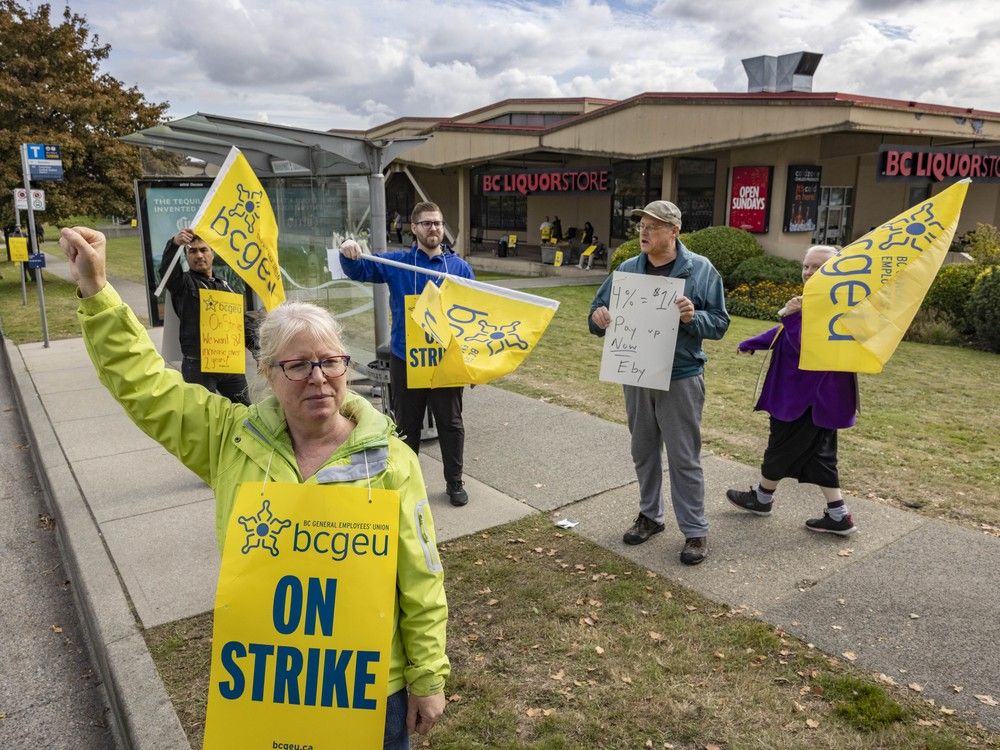
The B.C. General Employees Union grabbed the provincial government’s — and the entire province’s — attention last year, embarking on a long eight-week strike after months of talks broke down.
In the end, the union and the province reached a four-year agreement that includes an annual raise of three per cent a year, along with provisions for further salary top-ups for the lowest-paid workers and the development of a faster grievance process. The deal was ratified in November.
But labour negotiations are never straightforward, two-sided issues, despite how headlines and news releases may frame it as an ‘us versus them’ scenario.
“(The public) will hear about a few high-profile issues in any given dispute but it is rarely that simple,” said Trevor Sones, an adjunct professor with the University of B.C.’s Sauder School of Business and a labour mediator. “There’s often a number of issues in a complex space of assessment and considerations, and it’s about finding a balance that works for both sides.”
While it seems like business as usual with the BCGEU, there’s a number of other groups in B.C. that are now bargaining for new contracts and could shake things up in 2026.
Here are just a few of the B.C. unions that will be bargaining in 2026 and who could be on strike:
TransLink maintenance workers and transit operators
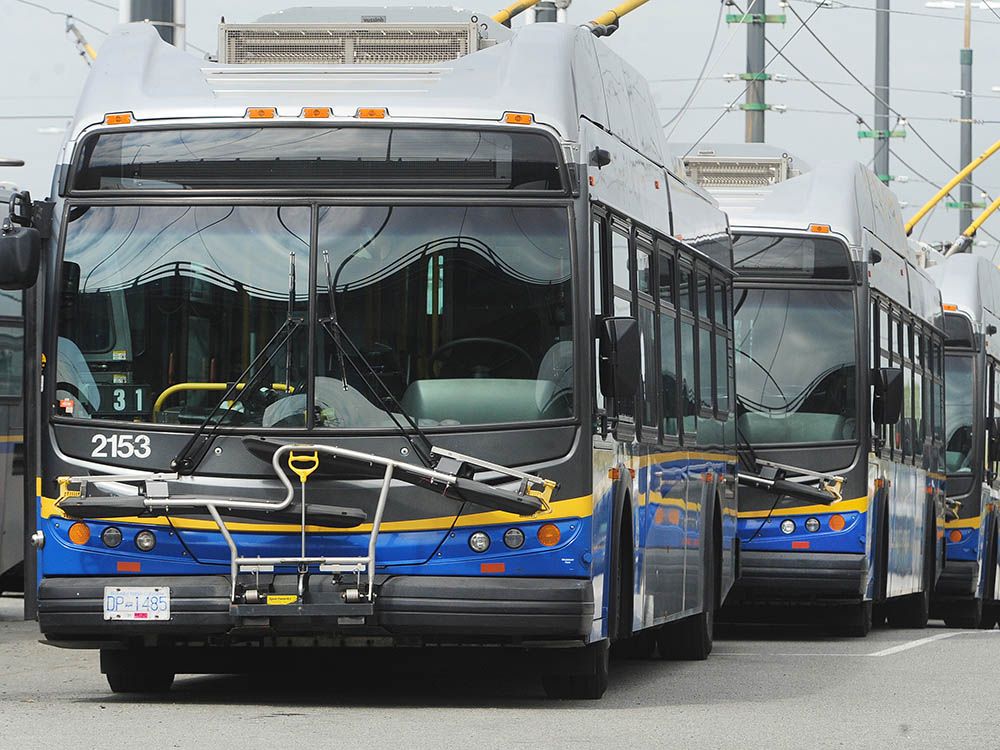
Unifor Local 2200 represents 1,100 maintenance workers, tradespeople, support workers and SeaBus workers, and Unifor Local 111 represents more than 4,000 drivers at the Coast Mountain Bus Company, which is owned by TransLink.
CURRENT STATUS: Both Unifor 2200 and 111 are covered by the same contract , which was signed in April 2023 and is due to expire in March 2026. As of Jan. 7, there were no bargaining dates scheduled, according to a Unifor statement.
WHAT TO KNOW: In January 2024, transit supervisors represented by CUPE 4500 walked off the job for two days after talks broke down with Coast Mountain.
While Unifor 2200 and 111 weren’t directly involved, their members refused to cross CUPE 4500 picket lines. The result was a two-day shutdown of transit services across Metro Vancouver.
WHAT EXPERTS ARE SAYING: While talks have yet to begin between Coast Mountain and Unifor, Sones says public transit strikes affect many members of the public immediately.
“It impacts their economic ability to earn money, to get to work, but it also, for many people, it’s an important component of their daily lives,” he noted. “So in that sense, it’s a much more immediate consequential impact than other industries.”
While labour unions do warn the public before launching strikes and picket lines, it’s not uncommon for citizens to be caught off-guard if they’ve not been on top of the latest developments.
B.C. teachers and support workers
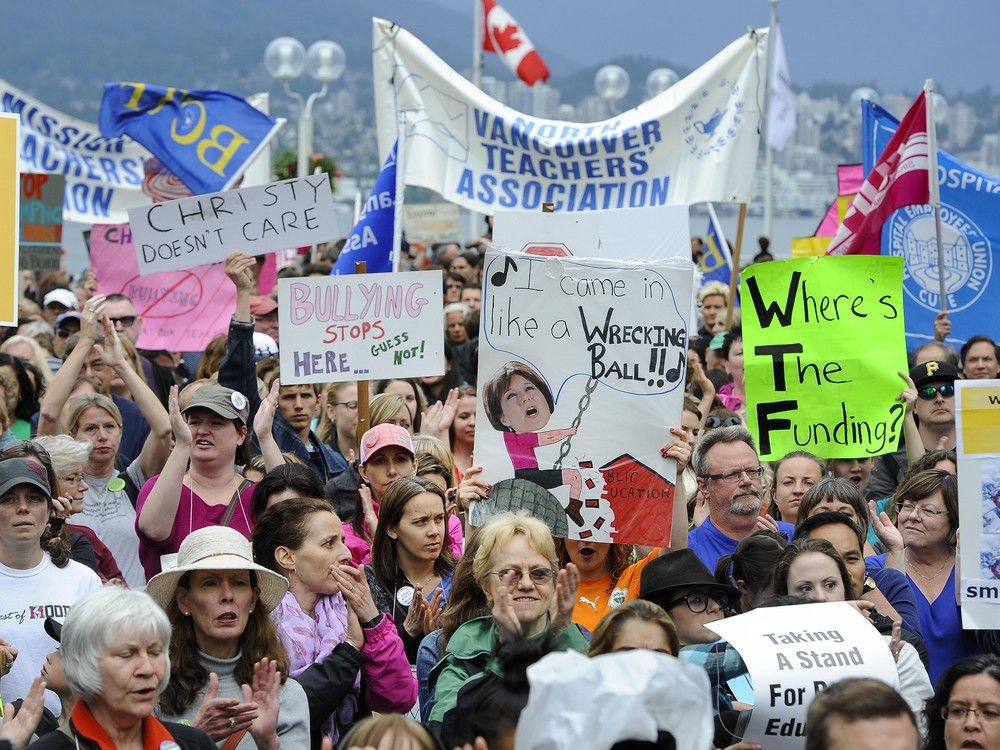
The B.C. Teachers Federation and the CUPE K-12 Presidents’ Council represents 51,000 teachers and 30,000 education support workers across the province.
CURRENT STATUS: The most recent contract between the teachers and the B.C. Public School Employers’ Association came into effect on July 2022 and expired last June 30 . Talks for a new contract began in March. The most recent bargaining took place Dec. 16 and 17.
Dates are being set for support workers this month.
The agreement between the Presidents’ Council and the employers’ association also expired on June 30 . The two sides have met six times in recent months, according to the union’s Dec. 18, 2025, update.
“Progress has been made on several key priorities but it is proving to be a particularly difficult round of bargaining,” said the update.
According to the employers’ November update, “agreement has been reached on 11 items with the BCTF and nine items with the K-12 Presidents’ Council and support staff unions. Both tables continue to discuss monetary items.”
WHAT TO KNOW: In June 2014, B.C. teachers walked off the job until September of that year. But much of the historical conflict between teachers and the province wasn’t about pay raises, but working conditions like class sizes .
In 2002, the B.C. government under then-Premier Gordon Campbell passed a law that stripped provisions from teachers’ contracts that dealt with class size, the number of special needs students who could be in a class and the number of specialized teachers required. The province also passed a law that denied teachers the right to bargain those issues.
The Supreme Court of Canada ultimately ruled in favour of the teachers , restoring the original contract language.
WHAT EXPERTS ARE SAYING: Jason Ellis , an associate professor in University of B.C.’s faculty of education, points out that negotiations with the teachers differ from other labour disputes in that there are generally two streams of issues: pay and compensation, and working or teaching conditions.
The negotiation of class size and composition limits has always been a major sticking point, whereas other sectors may see working conditions as a management prerogative, said Ellis.
“It’s different because when you negotiate the salaries … the province can anticipate costs with salary and benefits,” he said. “And that’s fairly easy to sort of predict.”
But when negotiating class sizes and limits, the employer wouldn’t be able to calculate salary costs. Instead, the changing number of students and classes would dictate how many teachers are needed — and what salary costs would be.
Ellis also noted that the teachers and the province had “a bit of a truce” during COVID-19, when the issue of class sizes was set aside in favour of reaching their last deal but that it may play a bigger role in the current round of bargaining.
“If you’re going to fight the government on those things and get concessions … there are other things that are going to be left on the table and those things are probably going to be pay and benefits,” he noted. “So there’s a trade-off. If you want to negotiate those conditions as stridently as the BCTF does, then you’re likely going to be giving up something in return.”
B.C. nurses, health-care workers and more

The coming year could be a busy one for health unions across B.C., with a number of health-care unions in search of new contracts.
While health workers in B.C. are members of different unions and work across different sites and jurisdictions, talks with the province are conducted based on the type of work being done. These bargaining associations are responsible for negotiating contracts for all workers who do the same type of work, regardless of what union they’re a part of.
Among the major negotiations to watch are:
Health Science Professionals Bargaining Association: The association represents health science professionals (including members of the Health Sciences Association, the Hospital Employees Union, the Canadian Union of Public Employees, the Professional Employees Association, and the B.C. Government Employees Union). They include technologists, therapists, psychologists and pharmacists.
Their contract expired at the end of March 2025. After talks broke down in the fall, 90.1 per cent of members voted in favour of a strike . Bargaining is set to resume this month.
Nurses Bargaining Association: This association represents nurses working in hospitals, acute and long-term care, mental health and home support, and more. It includes members of the Health Sciences Association and the B.C. Nurses’ Union.
Its contract also expired at the end of March 2025. Bargaining is underway.
Community Bargaining Association: This association represents health-care workers in community health services and includes members of six unions.
The association’s contract expired at the end of March 2025. In November, members voted 92.33 per cent in favour of a strike. Negotiations are continuing.
Community Social Services Bargaining Association: This association represents workers in community social services such as those at transition houses, child development centres, family services agencies, mental-health facilities, and young offenders and rehabilitation programs.
Its contract also expired at the end of March 2025. Bargaining continues this month to talk about money.
WHAT TO KNOW: In a recent bargaining survey conducted by the nurses union , 78 per cent of nurses who responded say they would need to take more sick time if their health benefits such as massage therapy were capped in a new contract. Another 54 per cent would likely pick up fewer shifts and 25 per cent say they would consider leaving the profession if health benefits were inadequate.
The province is still inviting U.S. doctors, nurses and other health professionals to consider moving here to alleviate pressures on B.C.’s health system. In September, the province said it had received more than 1,400 applications from U.S. health professionals to fast-track their credentials and work in B.C., while 140 qualified professionals had accepted job offers.
WHAT EXPERTS ARE SAYING: While it may sound complicated having members of different unions represented by various bargaining associations, the co-ordinated representation allows for more efficient bargaining.
“Health care is a large and complex employment space … ” said Sones.
However, he points out that the bargaining associations were developed as “a structured system of representation to deal with this scale and complexity.”
“There are always trade-offs to any large and complex system of negotiation, however, it’s worth noting that this method of representation, these bargaining associations have been in place for a very long time, and the parties have been successfully negotiating and ratifying collective agreements,” he said. “So there is a model of success here.”
On the subject of job action and health care being designated an essential service, Sones says there’s “an involved and long-standing process setting these levels” and that they’re reassessed any time the parties are in bargaining.
“Considering the potential for job action doesn’t mean they’re going to go out and initiate job action because they’re doing essential-service levels, but they often work on negotiating those levels in the event that any one of these groups may be in a position of requiring to take job action,” said Sones.
“But these minimum levels exist … to make sure that there’s a minimum threshold of health-care work that is provided to protect the health, safety and welfare of the residents of British Columbia.”
B.C. ambulance paramedics and emergency call-takers

The Ambulance Paramedics of B.C. represents more than 4,500 ambulance paramedics and emergency dispatchers. The Emergency Communications Professionals of B.C. (CUPE 8911) represents more than 700 911 operators, call-takers, dispatchers and other support workers.
CURRENT STATUS: The paramedics’ most recent three-year contract was in effect from April 1, 2022, to March 31, 2025. Negotiations started in September but broke down just before Christmas. The union is now considering its options, including the possibility of a strike. The call-takers’ most recent contract just expired on Dec. 31, 2025. No bargaining dates for that group have been made public at this time.
WHAT TO KNOW: As part of negotiations, the paramedics are seeking better mental-health supports, especially as death-by-suicide rates have increased among paramedics in recent years. In the first half of 2025, there were four deaths by suicide; previously, the union reported one death by suicide per year among its members.
WHAT EXPERTS ARE SAYING: The paramedics union has been vocal in recent years about the need for more mental-health support, something that may or may not factor into labour talks.
“It’s not for me to assess to what degree one party, one side or the other, is being effective or not in engaging the public but public support is one very important variable of influence when it comes to bargaining,” said Sones.
“But so are the needs of the workers doing the work, so are the needs of the employers providing the work, and so are the needs of the individuals receiving the services.”
“So yes, public support is important but it is one important variable in a series of major considerations that have to be addressed in the balance of finding a negotiated deal.”