 BURST
BURST
When Jessica Kennedy’s maternity leave ended she had a job to return to, but had to scramble to find a child-care spot.
The single mother from Langley had signed up at six to eight daycares, touring centres in Langley and Surrey, but struggled to find a spot for one-year-old Caleb, with centres either full or carrying wait-lists.
“It was literally the last minute when I heard back from the daycare my son goes to now,” said Kennedy, who works as a unit clerk at Ridge Meadows Hospital in Maple Ridge.
She considers herself lucky to have found a spot at a centre that charges $630 a month, on the lower end of the prices she encountered.
“Most of the prices ranged between $700 to $1,100 or $1,200, and that’s with the government reduction,” she said.
Kennedy had already pulled her elementary-school aged son Colton out of before- and after-school care when she was on maternity leave because she couldn’t afford to keep paying the fees. Now that she is back at work, she still hasn’t been able to find another program.
Instead, she has been cobbling together care from people nearby.
“I’ve been winging it, asking friends and neighbours for help,” she said.
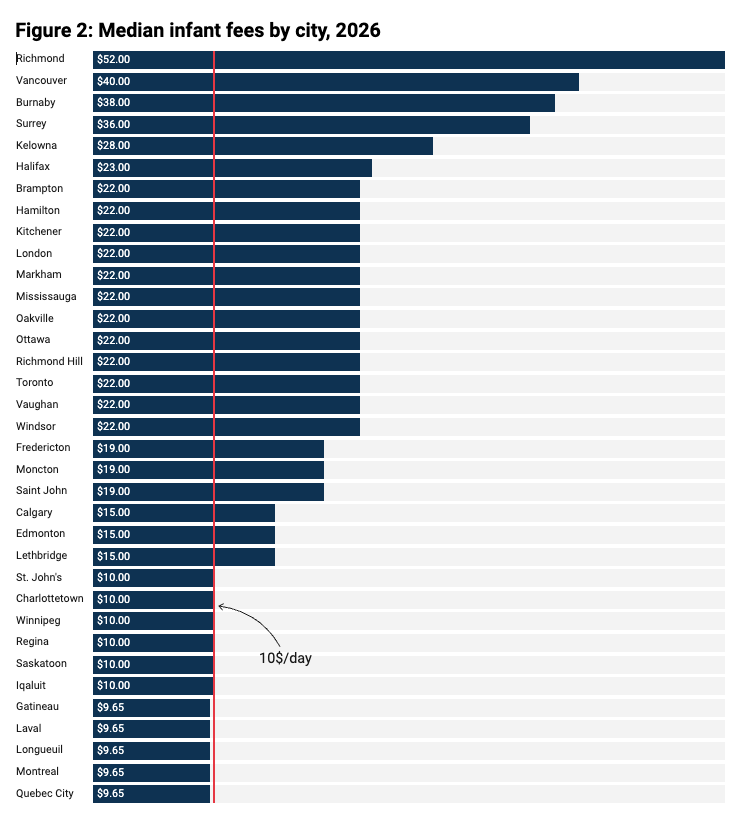
Kennedy’s experience is familiar to parents and caregivers across B.C. where parents face the highest and most uneven child-care fees in the country, according to a new Canadian Centre for Policy Alternatives report examining child-care expenses in Canada’s largest cities.
B.C. cities topped the report’s rankings for child-care fees, led by Richmond where median daily fees were $52 for infants and $42 for preschoolers. Vancouver followed at $40 and $32 respectively, and Burnaby, Surrey, and Kelowna rounded out the top five.
“It didn’t used to be like this,” said report co-author David Macdonald. “B.C. used to be a leader, but the progress has stalled.”
B.C. led the country in 2018 when the NDP government launched its $10-a-day child-care program.
In 2021, the province signed onto the federal Canada-wide early learning and child-care program, which aimed to bring average fees down to $10 a day within five years, backed by billions in federal funding. Five years later, B.C. is lagging behind, said the report.
Unlike most provinces, which have moved toward set fees for funded spaces, B.C. and Nova Scotia continue to rely largely on a market-based system where providers set their own fees, and government subsidies reduce what parents pay.
Alberta has adopted a flat $15-a-day fee for funded spaces, while Ontario has a $22-a-day cap for providers participating in the federal program.
For families who can get one, a $10-a-day space can be a boon. But access remains limited. Just 12 per cent of B.C.’s full-time, non-school-age spaces are covered, the report found.
“This has led to the most complex systems for parents, and the highest fees,” it said.
Macdonald said most provinces that have reached $10 a day started with set fees, but acknowledged the transition would be challenging.
B.C. would have to replace more of the revenue currently generated by parent fees and develop a funding formula based on factors such as geography and children’s ages. For-profit operators could also push back against tighter fee controls and greater financial disclosure.
“Other provinces are wrestling with it while B.C. has not started creating a funding formula that makes sense. … They are not even trying to be there,” said Macdonald.
Meanwhile, fees charged by providers have continued to rise, said the report. B.C.’s provincial fee-reduction amount has not changed since December 2022, while providers have generally been permitted to increase their fees by three per cent a year.
B.C.’s Education and Child Care Ministry said families are paying an average of $20 a day per child, compared to about $50 a day without the province’s affordability programs, which include the fee-reduction program, the $10-a-day program, and the income-tested affordable child-care benefit.
“Parents are paying less than half of what they would have otherwise, saving on average over $7,200 a year,” Child Care Minister Lisa Beare said in a statement.
That said, the $20 a day average is calculated based on child care programs across the province, with more expensive child care fees concentrated in metro areas. In a statement, the province noted that “affordability benchmarks under the CCFRI program for each region reflect differences in the cost of providing child care, including staffing and operating costs.”
“Metro Vancouver generally has some of the highest operating costs in B.C., which can influence the fees charged by providers,” the statement read.
The government has heard about inequities in the province’s $10-a-day program and is working with families and providers to design a more inclusive, affordable and sustainable child-care system, she added.
The ministry said the government is providing over $2.9 billion over the next three years to improve child care in B.C., including building more before- and after-school spaces.