 BURST
BURSTLots of news happened on the monopoly front. Bernie Sanders suggested nationalizing big AI firms, states look like they are preparing to try and block the Paramount-Warner merger, and the stock market fell sharply on Friday.
But this week, I want to start with a discussion about a deeply bitter political battle over the Senate candidacy of Maine Democrat Graham Platner, which is roiling the Democratic Party. I try to avoid discussing political races in BIG, but this one has broad implications for finance and market power.
Let’s start with some context. The emergence of monopoly in America is a fundamentally political phenomenon, based on choices made by policymakers over the last fifty years, from the late 1970s onward. The intellectual organizers of that era, on both sides of the aisle, argued the New Deal had been too rough on capital, and proposed deregulation, rolling back antitrust, and releasing the energies of Wall Street.
From Ronald Reagan to Bill Clinton, they constructed a heavily financialized society, and a set of dominant firms, led by high technology. Part of this order was a security model based on an alliance with Israel, American dominance of the Middle East, and increasing foreign elite investment in the U.S. stock market and dollar assets.
This system almost ended multiple times. The 9/11 attacks and the war in Iraq were shocks. But an even bigger moment occurred in 2007-2010, during the great financial crisis fostered by Too Big to Fail banks. At the time, there was an opportunity to reorder our philosophy of governance, to distribute power to ordinary people and away from Wall Street. The system had lost its popular legitimacy, no one believed that markets were free. But the Bush, and then Obama administrations, made a decision to double down, and, as Simon Johnson noted in 2010, build an oligarchy.
Just after that set of choices, the anti-monopoly movement was born. Lina Khan started doing journalism, Zohran Mamdani got into politics. And an angry bartender at a D.C. spot called the Tune Inn served drinks. Graham Platner was a veteran, having served four violent tours abroad, and loathed the banks. His bar was where Congressional reporters gathered, and discussed their views of politics, Congress, and power. He eventually returned to Maine, and began oyster farming.
Voters have been getting angrier and angrier since the financial crisis. Donald Trump was one symptom. This bartender, who declared for Senate last year and caught fire among Democratic primary voters, is another. In ordinary times, a random person like Platner would be laughed out of a Senate race. But America is looking for newcomers, and Platner is certainly that.
In the early 2020s, debates on the right were what mattered, because there was a fight over how Donald Trump would govern. A party out of power has flexibility to fight over ideas, without the responsibility to govern. The monopolists and proponents of the status quo on security architecture by and large won that debate, and Trump’s second term is the result.
Now the battle is happening among Democrats, and market power is an important subtext. I’ve written about this dynamic before, when I discussed the Democratic Party’s cult of powerlessness, how split Democrats are when it comes to oligarchy, and New York City mayoral candidate Zohran Mamdani’s shocking win last year. Right now, as odd as it seems, this debate is happening through the veil of Graham Platner.
Platner has a clear anti-corporate philosophy, which we saw last year when he coherently discussed, of all things, lobster regulations.
“The state of Maine has passed laws over the years that have regulated the lobster industry in a very specific way, and it means there’s one boat, one captain, one license. Fishing can only be conducted while the captain is aboard. This has entirely disincentivized consolidation,” he explained. “The result is a half-a-billion-dollar-a-year industry for the state of Maine that has almost no corporate ownership.”
Platner is a populist. He rejects corporate PAC money, supports breaking up health care monopolies, called to “bring the hammer of antitrust” down on the Paramount-Warner merger, and has even gone after the Fanatics monopoly for screwing over sports fans. And his broad view is that big business today is simply too profitable.
He also has a basic opposition to the U.S. alliance with Israel and the broad security architecture underpinning the post-Cold War world. Like Mamdani, Platner does not see a world dominated by American finance as a safe place, or worth preserving. And that is a frightening prospect to most political and economic elites, whose positions of prestige and wealth are dependent on this particular architecture, and whose last real challenge was during the Great Financial Crisis.
In the primary, Platner faced a lethargic and disliked establishment candidate, Maine Governor Janet Mills, and easily defeated her. In the general election, he will go up against Susan Collins, a 30 year institution in the state, widely respected for her bipartisan gravitas and powerful ability to bring home Federal funding to Maine.
So that’s the setup.
This week, the New York Times initiated a scandal, publishing allegations of a professional conservative political operative, Lyndsey Fifield, who dated Platner, and called his behavior “unsettling,” saying he hated women, and was “cavalierly contemptuous of women’s emotions, of our ‘weakness.’” She claimed he “yanked her out of a cab by her wrist after an argument when she wanted to stay in the car.” Platner has well-known struggles with PTSD, and covered up a controversial skull and bones tattoo he got in Croatia, a common thing for U.S. soldiers, but also associated with Nazi imagery.
After the Times published this story, the party exploded in acrimonious argument about Platner’s character. The scandal is layered onto typical intra-party discussions about who is best set up to win a particular political race. Can Platner win the Senate seat? Will the Democrats be giving up on the Senate? Is he electable? The debate seems to be about allegations of sordid behavior. Some believe her, others do not. I do not have any particular insight in this race or this scandal, I will simply note what has been revealed so far has not been enough to derail Platner’s candidacy among voters.
But if you look at the money in this race, another possible way to understand the situation is to see scandal and electability as a fulcrum to discuss ideology. Today, with AI data centers and foreign wars deeply disliked, it would be extremely unpopular to explicitly articulate a pro-oligarchy and pro-Iran war posture. It’s much easier to allege a sordid scandal. As with Mamdani’s alleged anti-semitism, those topics become the way we have a discussion about the social order.
The money involved in the race gives us a hint of what this debate is about. For instance, the biggest donor to Susan Collins is a hedge fund billionaire named Ken Griffin, who gave her $2.5 million. Griffin became a Collins supporter in 2017, after she single-handedly rescued a tax break that lets hedge funds and private equity firms pay less in taxes. She’s also a big recipient of AIPAC money, and a billionaire-associated SuperPAC has already reserved $23 million in ad spending for her. These are not criticisms of Collins, but simply observations that her constituency is the existing political and economic elite.
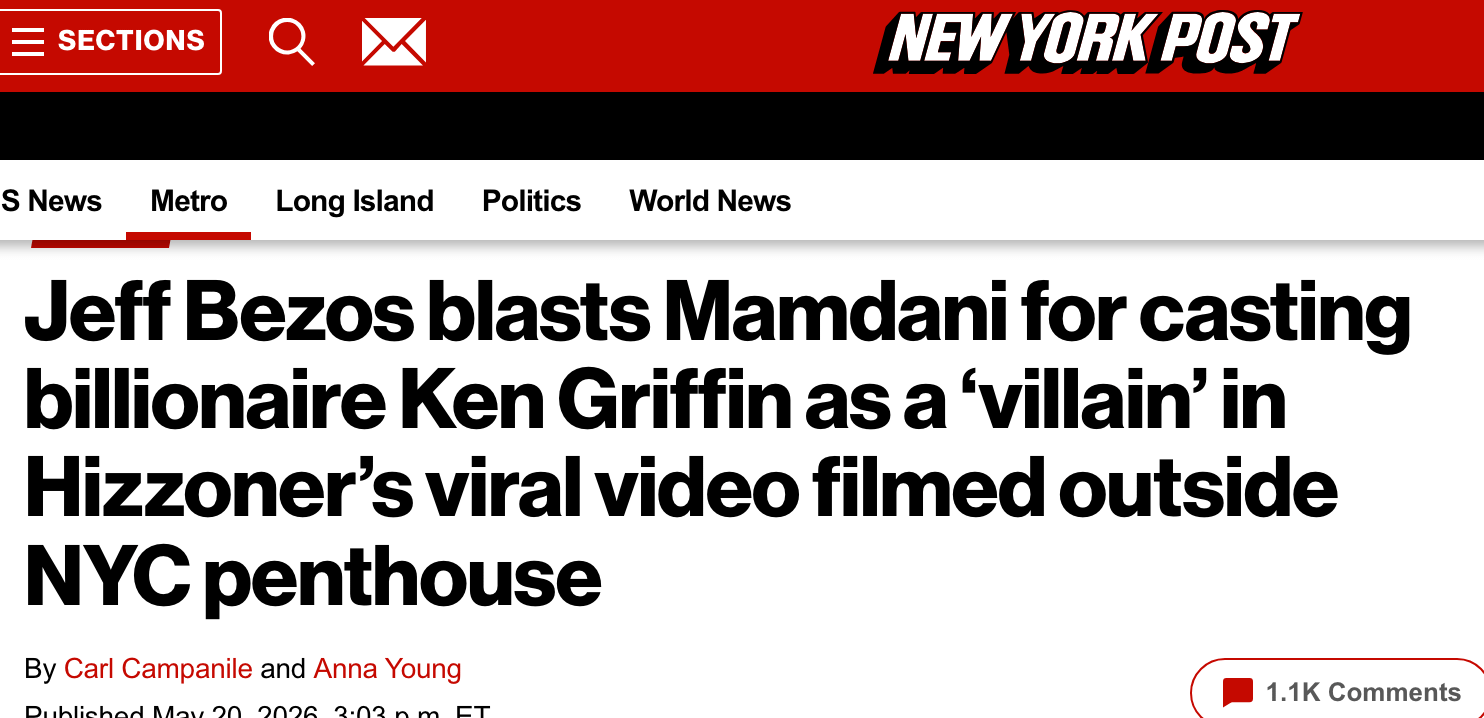
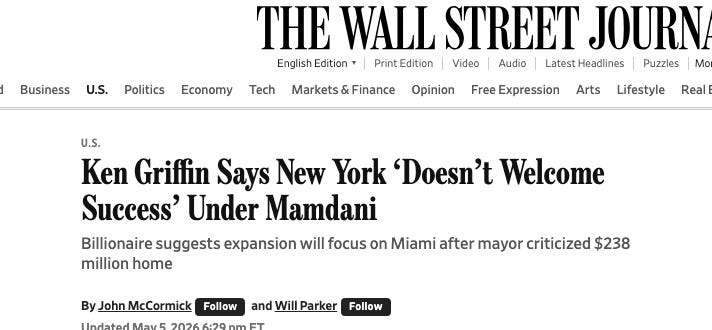
And Griffin is not just a random rich guy, he’s a politically connected monopolist. His company, Citadel, has an important position in the equity market structure, he was a big part of the GameStop market saga. He is an important creditor of Spirit Airlines, and helped throw that company into insolvency. He’s also politically savvy. He declared war on Mamdani in New York City after Mamdani suggested he should pay more in taxes. As a proponent of the U.S.-Israel alliance, Griffin is part of the economic elite who sees immense value in the existing global security and financial architecture. And while he is a supporter of Trump, Griffin had harsh words for the President over his tariff policy.
Griffin, in other words, shows that the campaign against Platner and that against Mamdani have the same financial and political organizers. Griffin is an important leader that other powerful billionaires, such as Jeff Bezos, are rallying around. Both ex-Fed Chair Ben Bernanke and ex-Fed Chair Janet Yellen were on his firm’s payroll. The campaign against Platner is coming from politically connected organizers of capital.
Of course, that’s on the GOP side. On the Democratic side, a huge chunk of the party, including validators, lawyers, lobbyists, and advocates, are hostile to Platner as well. Here are just a few examples:
Israel supporter and CNN commenter Van Jones, who received $100 million from Jeff Bezos, said it’s a “moment of truth” for Democrats if they accept Platner.
David Frum, who coined the term “Axis of Evil” while a speechwriter for George W. Bush during the Iraq war, but has become a centrist writer for the Atlantic, argues Democrats should “cut Platner loose.”
Democratic celebrities on The View disagreed on whether to “hold their nose” and vote for him over these scandals.
Consultants for Democratic Majority for Israel are pretending to be ordinary Maine voters who dislike Platner, and Democratic lobbyists who work at a firm on Saudi Arabia’s payroll are writing opeds criticizing him as indecent.
Centrist Senators Maggie Hassan, Elissa Slotkin, and Jeanne Shaheen are all concerned about Platner.
CNN, the New York Times, The Nation, the Washington Post, and the New York Post are all regularly suggesting that Democrats are torn about Platner.
On occasion, someone lets something slip through the veil of scandal, and mentions the actual policy stakes. Here’s Kellyanne Conway, a Ticketmaster lobbyist and GOP establishment figure, making that point.
From the other side, Senators Bernie Sanders, Sheldon Whitehouse, and Elizabeth Warren are defending Platner, but mostly what’s happening is that Democratic voters in Maine seem to be resentful these scandals are the topic of politics. As with the anti-establishment trend on the right a few years ago, these voters have lost faith in their party leadership and are looking for something new.
This race matters more than a normal Senate contest. Every 2028 candidate will be watching it, to see if the primary voters really do want something different. And with what looks like an AI bubble soon to deflate, politics could become very important very soon. This race is in some ways a prelude to a financial crisis and implies who will have power afterwards.
The political chatter is deeply connected to this dynamic, because it is a re-run of the fights during the Obama era. The difference is that this time, a post-financial crisis generation has come into adulthood, and they want a crackdown on oligarchy, to the chagrin of the establishment.

And to connect all of these threads, I’ll note that one of the most hostile pundits towards Platner is Nate Silver. Silver is a somewhat famous guy who does professional election prognostication, after his breakthrough doing accurate demographic and polling analysis in 2008.
But Silver isn’t a pure operative, he also has policy views. In 2009 he wrote an essay titled “Give Geithner a Break,” in which he said “this is the time for expert opinion” and called for destroying the populist skepticism of the then-bank bailouts. There are always scandals, and questions of character and decency, and elections are sort of random. But what is going on, as we see with Silver, is that concerns over policy are being laundered through the unanswerable question of electability.
So while I am paying attention to scandal, and to rhetoric about partisanship or winning a Senate seat or decency of anything of the sort, I suspect what is truly happening with the Platner controversy is that the Democratic Party, and America, are debating the shape of our society, and the power of the financiers who want to keep running it. It’s an ugly way to have that conversation, but then, if our politics were organized around more honest lines, we wouldn’t be in such a bad state.
And now, the rest of the monopoly round-up. Bernie Sanders says he wants to quasi-nationalize big AI firms, and OpenAI’s Sam Altman immediately takes him up on the offer. Sketchy! Plus, the Obama library is set to open, and the architect is quietly embarrassed that it looks like the inside of a “Klingon prison.” And Warner’s stock skids as it looks like state attorneys general are prepping a suit.
That, and a lot more, after the flip. Read on.