 BURST
BURST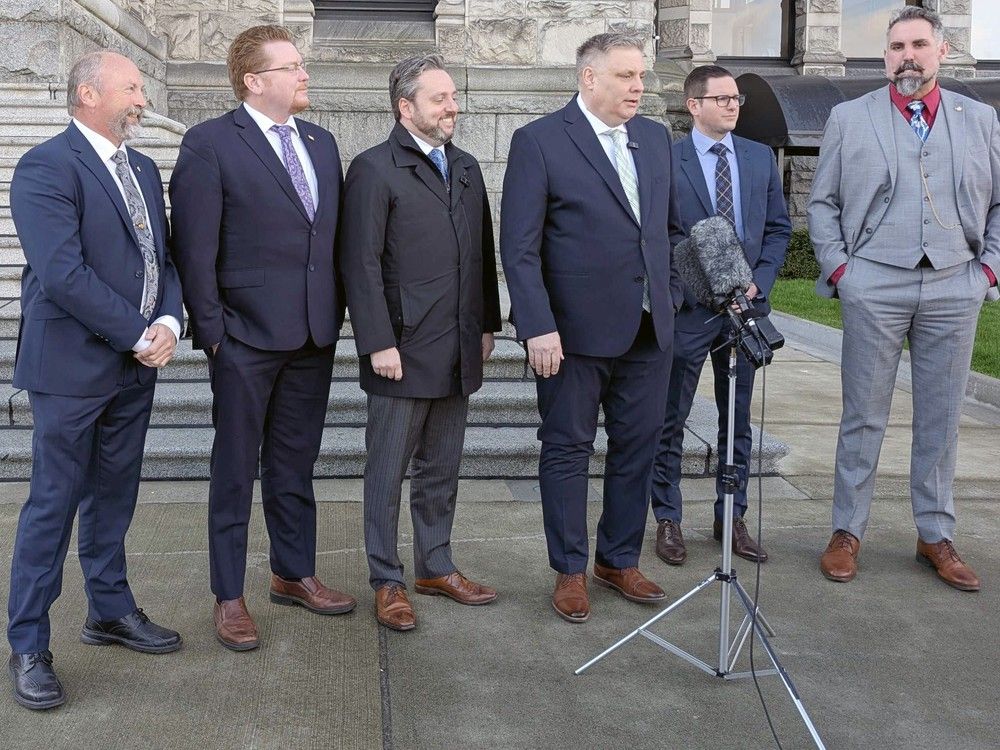
As the B.C. Conservative party continues vetting 11 unofficial candidates vying to be the next leader of the official Opposition — and, potentially, the next premier — at least one member has lined up colleagues to endorse him.
Peter Milobar, the MLA for Kamloops Centre, stood on the front steps of the legislature on Wednesday flanked by caucus colleagues Brennan Day (Courtenay-Comox), Gavin Dew (Kelowna-Mission), Kiel Giddens (Prince George-Mackenzie), Scott McInnis (Columbia River-Revelstoke) and Ward Stamer (Kamloops-North Thompson).
The endorsements are the first indication of where the loyalties of certain MLAs lie, an important element in determining whether any one candidate can unite the Conservatives. The party has faced fractures over the past year, including the resignation or ejection of five MLAs from caucus and the resignation of previous leader John Rustad.
“Peter will be the leader who can unify our entire caucus, our entire membership, and all British Columbians,” said Giddens.
“Let me be clear, each and every one of those leadership candidates would be a better premier than David Eby. We are saying that caucus will unify behind a leader. We believe it’s Peter, and we want to make sure that that’s clear. We’re happy to support our caucus colleagues who are also in the race.”
Besides Milobar , there are four other members of the Conservative caucus who have announced they will be running, including Abbotsford South MLA Bruce Banman, Langley-Abbotsford MLA Harman Bhangu, Richmond-Queensborough MLA Steve Kooner and Sheldon Clare of Prince George-North Cariboo.
Rounding out the 11 prospective candidates are former provincial cabinet minister Iain Black, political commentator Caroline Elliott, Capilano University Chancellor Yuri Fulmer, former Conservative MP Kerry-Lynne Findlay, former Pattison Food Group President Darrell Jones and Rossland contractor Warren Hamm.
Along with their formal application, each candidate had to collect 250 signatures of existing party members and raise $5,000 by the Feb. 15 nomination deadline.
The party’s election organizing committee is now vetting all the candidates and making sure they don’t have any troublesome past activity before allowing them move forward.
Once cleared, each candidate will have to pay the party $10,000 no later than three business days after their application is approved. Another instalment of $40,000 is due April 1, with a final instalment of $60,000 due April 18.
Milobar said Wednesday that he will have more to say on his campaign’s fundraising and membership sign-ups in the future but, for now, the endorsement of his colleagues shows the growing momentum of his campaign.
To win the leadership race, candidates will have to garner support from across the province, with 100 points given out per riding based on each candidate’s voting percentage in that riding. If there are less than 100 votes by party members in a riding, less than 100 points will be handed out. The candidate with the fewest votes in each round will be eliminated, with their votes going to the other candidates in order of preference.
“It’s very heartening to me to know that this is happening within caucus,” said Milobar. “Every campaign has a different strategy around endorsements, either with elected or non-elected people.
“First week of February, I hit 20 cities in seven days. I was up Island at the end of last week and did another four or five stops. I’ve been making stops down in the Victoria area at night, while we’re in session, I’ve been over in the Lower Mainland. We have a great ground team around this province. We’re very well organized. We have a very strong team of people actually on the ground selling memberships, which is ultimately how you actually win a leadership race.”
Milobar said he plans to reveal further endorsements soon, with Delta South MLA Ian Paton indicating he will be among the next tranche of caucus members to show their support. Paton said he expects four or five MLAs from around the Lower Mainland to endorse Milobar, making him the chosen candidate of around 20 per cent of caucus.
Former Premier Christy Clark says it is hard to compare the leadership race she won with the B.C. Liberals in 2011 and the current Conservative race because her party had a series of rules that were well understood. The Conservatives, on the other hand, are testing their rules for the first time.
“There may be more surprises in this race because the party is very young. Almost nobody running has ever been in government before,” she told Postmedia.
“It will be the first time this party’s ever really done a leadership campaign. So I think there’ll be some surprises that, you know, for candidates that weren’t there when I ran, because I was running with a party that had already won three elections on the name, and then we won another two.”
UBC political scientist Stewart Prest says Milobar is positioning himself well when it comes to getting endorsements from caucus colleagues and believes he could be one of the front-runners, alongside Elliott, Fulmer and, potentially, Bhangu.
At the same time, Prest said other candidates may have problems keeping up given their relatively lower profiles.
“When I look at this race, I do see it eventually coming down to a contest between one of these, these many candidates who will emerge from the more populist side of the party, and someone emerging from the more moderate wing of the party,” said Prest.
“Almost a kind of Highlander-style conflict where there can be only one from each of these wings and then, ultimately, one will prevail in the final vote.”