 BURST
BURSTLots of monopoly-related news, as usual. Inflation picked up according to the official numbers, kick-ass anti-monopolist Rohit Chopra got a powerful job as a California regulator, and the Supreme Court took a step towards re-regulating trucking.
Before getting to that, I want to observe a pick-up in rage from the wealthy, as they begin to hear the public disdain for what they stand for.
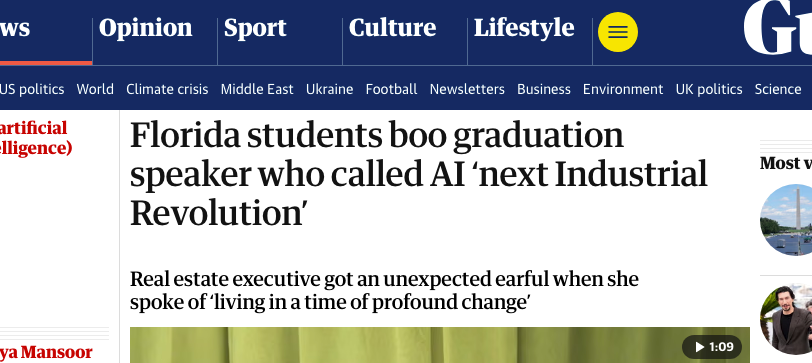
Let’s start with something that has been happening to a few commencement speakers at college graduations. They bring up artificial intelligence, and get booed by the students getting their diplomas. It’s a spontaneous expression of frustration and disrespect for the powerful, by the next generation. This kind of move stings; public speaking is difficult, and having people reject you en masse stays with you. And it even happened to former Google CEO Eric Schmidt.
The public is extremely angry, and they are centering their anger on AI. Seven out of ten Americans oppose data centers being built nearby. It’s not hard to see why.
AI and tech CEOs seem almost proudly villainous. Anthropic CEO Dario Amodei routinely says that half of white collar jobs are going to disappear because of his technology. Sam Altman, CEO of OpenAI, noted that “AI will probably most likely lead to the end of the world, but in the meantime, there’ll be great companies.” And Alex Karp, CEO of Palantir, said during an earnings call that “This is a revolution. Some people can get their heads cut off.”
Voters are no longer brushing these comments off. They have experience with social media and enshittification, they don’t believe in the promise of the future. And even if they did, business leaders seem to luxuriate in explaining how terrible things will soon be for the little people. So they are starting to respond with frustration.
Yet, the pushback from public opinion isn’t informing the superrich, it is angering them. They are having their various libertarian think tank people frame opposition to data centers as ill-informed or emotional.
Sometimes, they take action directly. Shark Tank star Kevin O’Leary accused critics of his giant Utah data center project of working for China and seeking to undermine American national security. A better strategy would be to try and listen to the anger, and then modify the development of AI technology so it doesn’t terrify everyone. China, for instance, is putting in place rules that companies are not allowed to replace workers with AI.
But American oligarchs refuse, because doing so is part of their ideology. In fact, they react with rage at any mild attempt to impose any sort of limit on their wealth and power, or even just basic criticism. We saw this situation when Lina Khan at the Federal Trade Commission sought to block a few mergers. The Wall Street Journal, the U.S. Chamber of Congress, and the Republicans in Congress caught a case of Lina Khan Derangement Syndrome. They alleged Khan was a secret Marxist, she had “a disregard for the rule of law,” used “dishonesty and subterfuge to pursue her agenda,” and engaged in an “abuse of power.”
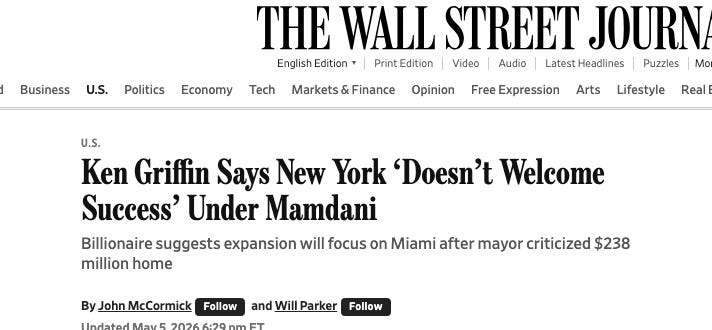
This same derangement syndrome is recurring, only much broader. Over the past few weeks, New York City mayor Zohran Mamdani has been proposing a tax on vacation homes in New York City to balance the budget. As part of this campaign, Mamdani did a video outside Citadel billionaire Ken Griffin’s apartment, which Griffin had purchased in 2019 for $238 million.
Griffin went on a rampage, organizing the New York Governor, much of the New York City press, and even Donald Trump, to harass Mamdani. He claimed that Mamdani had put his life in danger, and threatened to move more of his operation to Miami as a result. “Mamdani is making it really clear: New York doesn’t welcome success,” he said.
People in the business press began referring to Mamdani’s gaffe, mistake, or scandal. A public assault of this ferocity for something so mild is unusual, and Mamdani’s people were no doubt questioning themselves. Did Mamdani do something wrong? Did they go too far? Of course, the answer is no. This kind of campaign is typical, a mild criticism of the wealthy leads to exactly this dynamic, a kind of mass gaslighting.
Griffin’s firm Citadel is a financial institution and hedge fund that, among other instruments, helped crater Spirit Airlines, which was an important airline for New York City. You’d think, therefore, that New Yorkers wouldn’t like that he largely escapes taxes. But the super rich have an outsized voice.
And that’s always how it goes. During Amazon’s search for a “second headquarters,” Jeff Bezos pulled out of New York City, miffed that there was any local opposition at all. The New York press and the wealthy in New York wailed in unison at the disastrous demands for any community or labor rules. Of course, Amazon continued to expand in the city anyway, and recently has been laying off people in its “second headquarters” in Northern Virginia. So the threats rarely matter, but most people don’t know that.
And it’s not just Griffin; here’s an anonymous wealthy resident sniping to the Financial Times on Mamdani’s tax on second homes. “I think it’s shameful,” he said. “I provide a lot of money to people who are blue-collar workers who work for me, servers in restaurants.” It never occurs to him, or anyone else in that orbit, that New York City itself might have intrinsic value. They are the givers of prosperity, the job creators, so they can take that prosperity away.
Since the 1980s, the wealthy have been beloved, admired, and enriched in America and globally. They were told they are special, and they believe it. Their success is what morality means, and any attempt to suggest otherwise is evil. Here’s real estate tycoon Steve Roth offering a good window into his thinking: “I must say that I consider the phrase ‘tax the rich’ — quote, tax the rich — when spit out with anger and contempt by politicians both here and across the country, to be just as hateful as some disgusting racial slurs and even the phrase, ‘from the river to the sea.’”
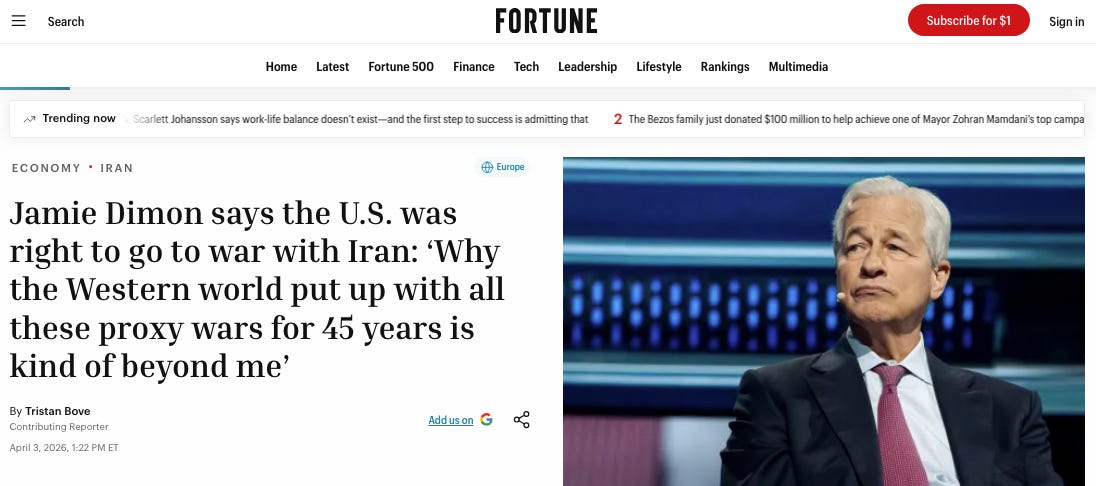
This insular view has led this group to develop a very strange and deeply unpopular understanding of how the world works. The love of AI, and its ability to take the future away from ordinary people, is just the start. I watch CNBC pretty often, and it’s a rare day that some billionaire isn’t on air talking about how great the stock market is and how the attack on Iran was long overdue. Most recently, Donald Trump ran on restoring prosperity, and is now telling Americans that they will have to pay higher gas prices for the foreseeable future so he can organize a war with Iran.
But that era is over. Over the next six months, and beyond, we are going to see the superrich get more defensive and embittered as the public rejects their values and views.
Why do I say that? So far, the super rich have had their allies in charge of all parts of politics. But the public is gradually feeling around for a way to attack the economic elites who control their society - the Epstein Files was just the start. in the U.S., something very unusual has been happening for the last twenty years - change elections. In 2006, 2008, 2010, 2014, 2016, 2018, 2020, 2022, 2024, and almost certainly 2026, voters threw out incumbents in one or both Congressional chambers, and/or the Presidency. The House of Representatives has changed majorities four times, soon to be five, and that hasn’t occurred in a twenty year period except 1874-1894. The Senate has never flipped four times since the modern party system emerged.
Different kinds of candidates are emerging. Trump seemed to offer something new, but he did not break from war and plutocracy, instead doubling down on it. So now it’ll be the Democrats’ turn, again. A variety of candidates are taking a shot, and most of them are standard Democratic establishment characters, mimicking Bill Clinton or Barack Obama, the last perceived successful leaders. Be nice to big money, say a few things about fairness, that’s it. Usually that works, because Democratic voters tend to like their party leaders, and by extension, the status quo.
But after 2024, something odd happened. Polling showed that Democratic voters had come to distrust their leadership. It’s important not to overstate the point, since just two incumbent Democratic Senators are even having a real primary challenge. However, there are some interesting changes. Mamdani is different. And he’s not alone. In Maine, populist Graham Platner easily defeated the establishment pick, Governor Janet Mills for the Democratic Senate nomination. In Michigan, anti-monopolist Abdul Al-Sayed is running a surprisingly strong race for that Senate seat.
There’s more than just those three, basically it’s a next generation of Bernie Sanders populists who learned their politics of ignoring establishment norms from Trump. And regardless of how many win, the next few years are going to see genuine populist policy. It’s not just anger at data centers everywhere, it’s gambling, it’s Israel, it’s corruption. On the economic front, Americans absolutely despise surveillance pricing, where they are offered a price based on their personal information. The Epstein class is facing some actual demands on their power.
This dynamic isn’t unique to America. Keir Starmer in the UK, a Labour Prime Minister, is going to be tossed out of office soon, with Great Britain cycling through leaders at a historic pace. French President Emmanuel Macron is loathed, as is Germany leader Friedrich Merz. Mark Carney in Canada has a temporary anti-Trump boost, but it won’t last. Across the West, our politics is simply out of kilter with where voters are, and it’s not a temporary phenomenon correctable by an election or two.
The superrich seem to have all the advantages. They control the Supreme Court, they have endless amounts of money to confuse voters, they own much of the press, Republicans love them and Democratic members of Congress are meek and frightened, they control corporate America, and so on and so forth. But their big disadvantage is pretty simple. They don’t just want to be rich, they demand to be loved. And they aren’t. That’s why Griffin is so infuriated to be criticized, even mildly, by Mamdani.
One thing to understand is that the superrich are very good at selling their ideas. Most of them, after all, are salesmen. And they have all the money in the world to market. Since their vision isn’t appealing, they are going to do the next best thing, which is attack the people offering criticism, and argue that democracy itself is a fraud and can’t work. They will threaten to withdraw their wealth from different regions, they will call people stupid and ignorant, and they will use credible organs and validators on their payroll to do so.
If you’re not used to their level of anger, it can be surprising and scary. But over time, such threats diminish in power. Again saw this dynamic when Khan ran the FTC. The Wall Street Journal editorial page published an article criticizing her once every eleven days for her entire tenure. Policymakers generally get scared when a big newspaper attacks them, but it happened so often and in such constant bad faith that it became a joke and a point of pride. Other regulators began seeking to have the Wall Street Journal attack them.
And that’s how it’s going to happen as more populist political arguments emerge. It’s inevitable, Trump is wildly unpopular, and the superrich have tied themselves to him. As people start to fight about the post-Trump era, as Democrats organize some sort of governing agenda, with investigations and policies - even mild ones, they won’t even mean to antagonize the super rich. But just the idea that someone other than an oligarch gets to have a say in *anything* will prompt a level of backlash and rage that will seem scary, and then weird, and then just dumb.
Such is how an oligarchy ends, not with a bang, but with a bunch of whiny billionaires crying about taxes.
And now, the rest of the monopoly round-up. Inflation is heating up officially, Hawaii is challenging the Citizens United decision allowing unlimited corporate cash in elections, and farmers are noticing the anti-monopoly fight in Hollywood. That and a lot more after the paywall.