 BURST
BURST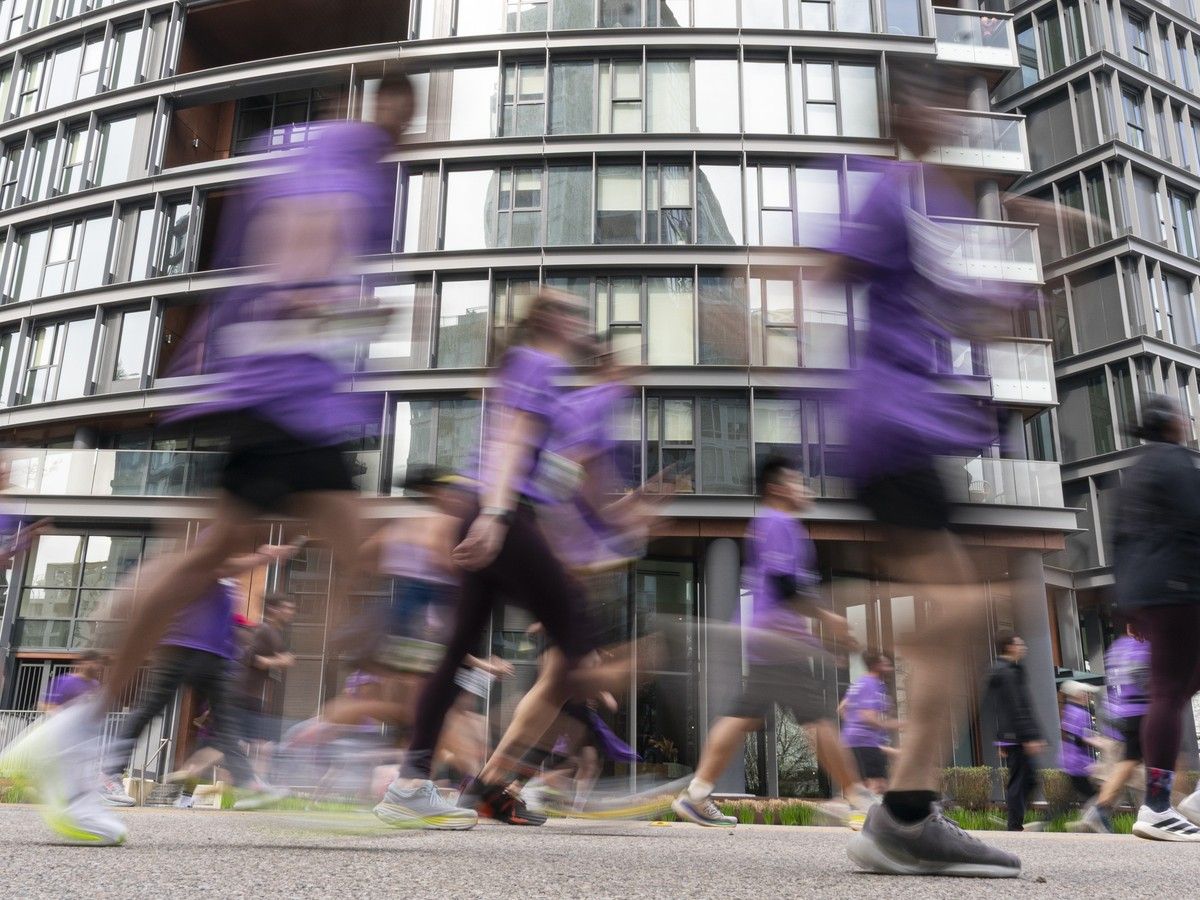
I can’t think of anything more loathsome than jogging — well, no, there’s Trump, and global warming — but the idea of voluntarily getting up off the couch and interrupting your binge-watch of Bridgerton to jog will always be the opposite of my idea of a good time, unless someone happens to invent a version of jogging that incorporates margaritas.
Anyway, the Sun Run.
In its early days, certain employees of the Sun were encouraged to take part in the Run, and participation came with VIP benefits — a hotel room downtown the night before the race, a pre-race breakfast, a start position sequestered from the unwashed hordes, a post-race buffet, and complimentary massages by attendants selected solely on the basis of their attractiveness, though possibly I made that last bit up.
As awful as the running was, the perks were too good not to be taken advantage of, in the same vein of miraculously being bumped up to business class for your flight to Italy.
I was significantly younger in age in those first versions of the Run, and I trained diligently, and set a goal of running the 10 kilometres in under an hour. My daughter, Emily, and I were on our way to achieving that goal one year when, on the long flat section down 6th Avenue, an elderly runner in front of us fell heavily to the pavement and hit his head. He was out cold and bleeding.
Emily, a pediatric nurse at the time, stopped and did what she could for him until, minutes later, another jogger stopped, announced he was a doctor and said he would take it from here and that we could go. So we left him to it, got up and resumed running. We finished five minutes past an hour. I never did find out what happened to that fallen runner, if he finished the race or if the race finished him.
Emily and I decided to run the race again this year. I was pushing 75, with knees as brittle as sponge toffee, so I set a goal of running it under 90 minutes. Emily, with two young daughters and a full-time job, had a real life to live and thus little time to train, and the longest she had managed to run before the race was 20 minutes. I trained on a treadmill at my local community centre’s gym, and had run for as long as an hour a couple of times, but in terms of being race-ready I was a poor risk for life insurance.
The weather on the day of the Run was glorious, a warm spring day with blue skies. By the time we had taken the SkyTrain in from Richmond, the starting corrals were filled to capacity with thousands of runners, and the concentration of all that humanity was a sight — a loud, happy, antsy horde that stretched back down Georgia a half-dozen blocks from the starting gate.
Every age and body type were there — babies asleep in strollers, elementary school kids, the elderly, and, most annoyingly, the disgustingly fit whose perfect, Lululemon-clad physiques appeared to have been Photoshopped. There were groups of runners whose bibs identified them as team members, and gag runners dressed in costume, including a couple of guys in silver space suits, a guy in a monkey suit, a guy dressed as the Japanese manga character Sailor Moon, and a guy in a banana suit who was handing out bananas. As for the footwear, the overwhelming trend were runners with soles as thickly cushioned as sofas.
The crowd was so big that the race started in increments, and Emily and I took an hour of shuffling forward to get to the start line. We started off at a slow, comfortable pace, letting the crowd’s momentum carry us along, and the first kilometre — down the gentle downward slope of Georgia to Denman — was an easy one. Then it was another easy run along Denman, where, to our delight, we passed the two-kilometre mark without breaking a sweat. This was going to be easy!
And then, as we made the turn onto Beach Avenue, everything suddenly seemed to go downhill — by which I mean uphill. We started a slow, gradual climb along Beach, and the Burrard Bridge loomed before us, and, straining up its slope, we slowed to a belaboured trudge. It was here runners first started running out of gas and began walking, but Emily and I kept at it and made the bridge’s crest. Then it was an easy downhill run on the opposite side, and we enjoyed a momentary period of relief. So far, so good.
Then we reached the six-kilometre mark on Sixth Avenue. It was here my upper thighs asked me what in hell I thought I was doing, and that if I continued with this insanity they were considering inducing a heart attack so they could call it a day.
I started sweating in sheets, and I looked over at Emily, and she was clearly labouring, too, and at the seven-kilometre mark she said she had to stop and walk for five minutes. We did. Then we started running again — it was agony, that restart — and when we reached the eight-kilometre mark, we walked for a bit again. Another restart, and we passed the nine-kilometre mark exhausted, but the finish line was in sight, and cheered by that thought we kept running. We reached the finish line hand-in-hand and hugged.
Our official times:
Emily came in 33,891st, with a time of 1:23:25.
I came in 33,888th, with a time of 1:23:24 — a second earlier than Emily, a discrepancy due to the fact I had crossed the start line just before her.
We had beaten our goal of 90 minutes by six minutes.
At home, I medicated with several glasses of Pinot Noir. I went to bed at 6:40 p.m. The next morning, my thighs were still chirping at me, but, after the morning’s first coffee, I resolved to do the race again in 2027, and keep running against time as long as I could.
Related
For more health news and content around diseases, conditions, wellness, healthy living, drugs, treatments and more, head to Healthing.ca – a member of the Postmedia Network.