 BURST
BURST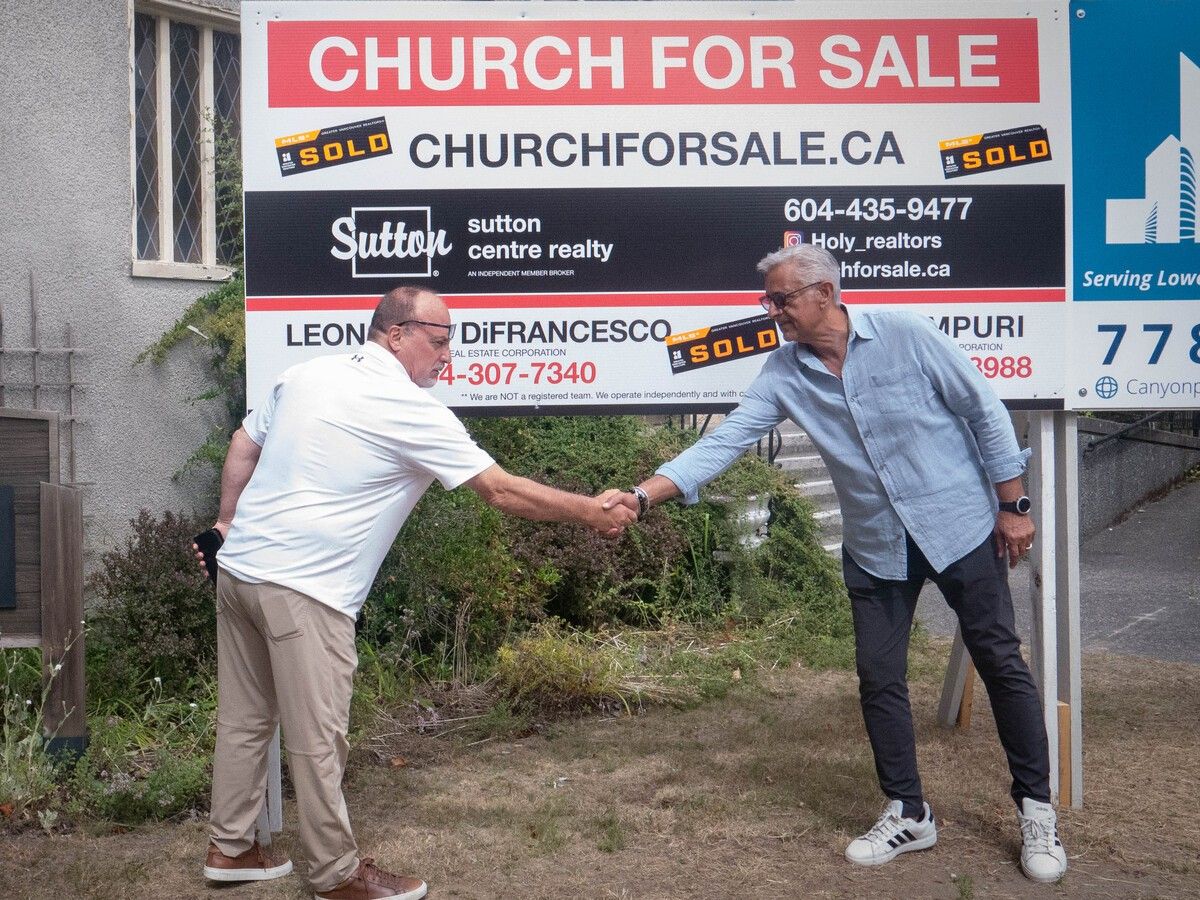
On a warm July day outside a church at 12th Avenue and Trimble in Vancouver, a small crowd gathered for a brief ceremony that was bittersweet for some but exciting and promising for others.
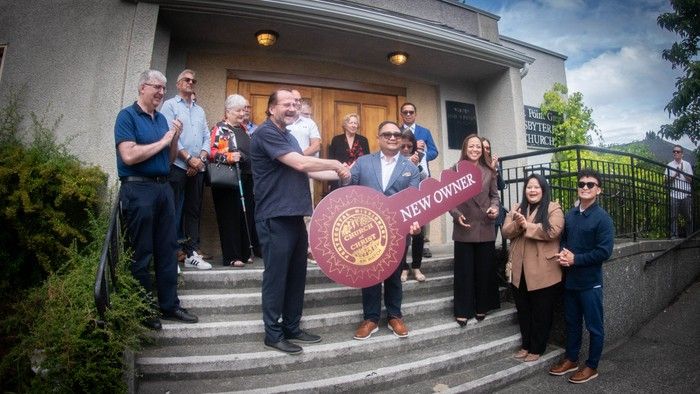
In the early afternoon, Rev. Richard Watson, representing West Point Grey Presbyterian Church, handed a symbolic cardboard cutout key to Pastor Joseph Concepcion of the Pentecostal Missionary Church of Christ (4th Watch) and, with it, ownership of the 100-year-old landmark.
It was a day of celebration as children paraded with red-and-yellow balloons while parishioners crowded around, and photographers and videographers captured the moment.
Now a minister at Kerrisdale Presbyterian Church, Watson prayed the new parishioners would continue ministry there for another 100 years.
The three-lot prime location in affluent Point Grey had just sold for $6.4 million, even though a year earlier a developer offered $7.5 million and, two years ago, it was listed at $10 million.
Ian Rokeby, chair of the committee overseeing Presbyterian real estate in the Lower Mainland, said after initial expectations that the church would be demolished and redeveloped, he is glad it is being passed to another congregation — one that is growing.
“The number of worship spaces in the Lower Mainland is diminishing every year, so we were anxious,” Rokeby said. “One of our priorities is to preserve houses of worship.”
When it closed three years ago, West Point Grey Presbyterian had only 19 people attending. With dwindling attendance, the 200-seat church couldn’t afford a full-time minister or keep up maintenance of the aging building.
Many mainline congregations are facing the same difficult choice — continue despite waning attendance or close and sell to a more prosperous congregation or property developer.
“(There are) a handful of people who are doing way too much, and so they actually aren’t doing any outreach in the community, which is one of the primary objectives of the church,” said Rokeby.
It is dispiriting when all a congregation can manage to deal with is broken plumbing, he said.
Many congregations are relying more on rent revenue to cover the costs of building maintenance, pay the pastor, minister or priest, and finance community outreach.
When Jeff Rock, coordinating minister at Canadian Memorial United Church in Vancouver, was ordained 15 years ago it wasn’t unusual for 90 per cent of a congregation’s income to come from tithes or offerings.
Now, he said, that number has dropped to 50 per cent, with the other half coming from rent.
In Vancouver’s competitive land market, churches often rent space to daycares, community events, concerts and support groups.
“I get a request for space usage almost every day. People are just desperately looking,” he said. “A lot of spiritual communities have found themselves becoming, really, rental agencies.”
According to Statistics Canada, religious demographics in B.C. have changed over the decades. Between 2011 and 2021, the proportion of people identifying with mainline Christian denominations has decreased, with Anglicans down 42.9 per cent, United Church members down 49 per cent ands Presbyterians down 40 per cent, since 2011.
Anglicans in that decade dropped to 2.8 per cent of the B.C. population from 4.9 per cent, United members dropped to 2.6 per cent from 5.1 per cent, and Presbyterians dropped to 0.6 per cent from one per cent.
Over that period, the proportion of the B.C. population identifying as “non-religious” or secular grew from 44.1 per cent to 52.1 per cent.
Other denominations are offsetting the decline.
For example, the proportion of people identifying as Sikh increased 25.5 per cent, the number sayibg they were Muslim was up 44.4 per cent, and the number of Hindus was up 54.5 per cent respectively.
The Pentecostal Missionary Church of Christ (4th Watch) in Vancouver has grown, despite those identifying as Pentecostal or other charismatic denominations also dropping 42.9 per cent since 2011.
Rock said that over the past decade places of worship have felt the same financial squeeze as many households and residents.
Attendance levels drop and people who still attend church are not able to donate as much as before, he said.
“I’m lucky that I’m in a spiritual community that’s vibrant and is thriving. But I know many of my neighbours are feeling that attrition rate more and more.”
Ownership out of reach
When Watson handed over the key of the Presbyterian church, one door closed while another opened for another congregation. But the prospect of church ownership is out of reach for many religious groups.
Growing congregations look, often for years, to purchase places of worship. Many are priced out of the market entirely. With few churches available, their capacity to grow and practise their faith hinges on whether congregations selling their churches view the property as financial assets or as community institutions.
Growing congregations often don’t have the capital to buy, and they are purchasing from a limited supply of land that is also sought after by other congregations and property developers.
Rokeby said many religious communities have “dreams” of owning a place to worship, but “no cash.”
Devin Roberts, the church realtor representing the Pentecostal Missionary Church of Christ, compares those congregations that are growing to the average millennial unable to break into the housing market. If they can’t afford to buy, their only option is to rent. But renting comes with its own challenges.
Compared to Vancouver, Surrey and Maple Ridge, where zoning is more flexible, Roberts said Burnaby, the Tri-Cities, Pitt Meadows, Mission and White Rock have stricter regulations that limit where congregations can gather in commercial areas.
“A big fat ‘no’ to anything other than an actual church building,” Roberts said.
The Pentecostal Missionary Church of Christ had not had a permanent home since it was established in Vancouver nearly 26 years ago. Members gathered in hotels, industrial and commercial buildings, and even in family homes.
For eight years, Pastor Miziel Rivera searched for a permanent place for her congregation in New Westminster, Richmond and Surrey. When they did find a potential location in Surrey, another congregation outbid them by $1 million.
When they gathered Sundays at a hotel, a volunteer had to arrive at 6 a.m. to set up chairs, musical instruments and the pulpit. For weekday services, when the hotel wasn’t available, congregants would gather in restaurants or parishioners’ homes.
Founded in the Philippines in 1977, the Pentecostal Missionary Church of Christ has grown steadily in Vancouver since the 1990s. As more people joined and the congregation grew from 80 to 100, hotel space became inadequate.
At the first meeting after the Pentecostal Missionary Church of Christ purchased the church, everyone was in tears, Rivera said.
“We’ve been negotiating, and it was a back and forth. I’m just grateful to West Point Presbyterian Church. (They were) very patient with us,” Rivera said.
However, without the financial support of the global Pentecostal Missionary Church of Christ denomination they are a part of, Rivera said they wouldn’t have been able to purchase the church.
Of the more than 30 congregations that Philippines-based Pentecostal Missionary Church of Christ has across Canada and the Caribbean, only three own their places of worship, in Edmonton, Toronto and, now, Vancouver. It was hardest to find a church in Vancouver, said Concepcion, who serves as the church’s Canada district coordinator.
It’s difficult for congregations to host events, programs and fellowship without a space of their own, he said. “I believe that these programs in the church help believers to mature and grow and to be connected.”

Unlocking revenue to continue
While the Point Grey church sale represents a continuity of faith, other church sales represent a combination of faith and property development.
Acquiring and consolidating lots for a traditional land assembly is costly and difficult for developers. Collaborating with a church is relatively simple and a more attractive form of property development, according to Tim Law, a lawyer at Lawson Lundell in Vancouver.
Law, himself a regular churchgoer, said property development, whether for social or market housing, is a way for congregations to “unlock” revenue and continue.
Lawson Lundell posted in February 2026 about the opportunity congregations have to redevelop their property for major projects. They said congregations with old or aging churches can build new developments to help pay for new facilities and infrastructure.
Marcela Corzo, the founder of LinkQuest Development, said religious institutions in Vancouver are sitting on more than $3.4 billion in asset value, giving congregations a unique opportunity to continue their worship and mission.
The common denominator for congregations deciding to redevelop their land is the age of their churches, she said. “They have 100-plus years of lifespan, and they are coming to an era when they need to spend a lot of money in capital expenditures. More than 50 per cent (of places of worship) are facing very expensive capital expenditures.”
Tim Dickau, director of the non-profit Citygate Vancouver and former pastor of Grandview church, said congregations aren’t just developing property to keep their lights on.
Citygate works with a community network to support social programs, including by helping churches better utilize their properties to engage in neighbourhoods. For many congregations, Dickau said, it’s part of a larger mission to support community.
Rock said redevelopment projects represent a balancing act between competing interests. For example, in a space that might have housed an education wing or gym, a congregation might choose to partner with a developer to prioritize condos or commercial space instead.
For example, Oakridge United Church, which redeveloped in 2018 to include 49 residential units and a coffee shop, now has fewer rental spaces than before, said Rock.
“I think most churches that do some kind of a redevelopment are downsizing their space rather than creating more community spaces for rent,” he said.
One municipality encouraging property development at places of worship is Burnaby. It allows up to six storeys of housing if it’s for uses such as dormitories, supportive and transitional housing, and non-market housing. If congregations or property developers want to build higher than six storeys and include market-rate housing on the property, they need approval from council.
“They really see churches as a low-density use with kind of underused land,” said Roberts. “They really see housing as a big issue. They don’t see churches as a big issue.”
Carl Isaak, city liaison to the Burnaby Housing Authority, said the city is prepared to allow even more housing to be built on place-of-worship property if community amenities are built with it. Isaak said the density of the residential housing is “essentially unlimited” provided churches and developers include community benefits and amenities reflective of the development potential.

One door closed, another opened
In Point Grey, the Presbyterian church tried for more than two years to sell. When the property was listed at $10 million near the peak of the booming real estate market, there were discussions about developing housing while retaining a place of worship on the property.
As the property market cooled, they eventually received an offer for $7.5 million from a developer. Zoning allowed for up to six dwellings in a small apartment building, or eight rental homes. But if they agreed to the sale, the church would have to take on risk for rezoning of the property, Rokeby said.
Eager for a clean sale, the church approached Leonardo Di Francesco and Rav Rampuri, two church realtors with more than 30 years experience. The two helped find the Pentecostal Missionary Church of Christ. They say they have sold nearly 100 churches to Christians, Sikhs, Muslims and others, sales that reflect shifting religious demographics and immigrant trends of the past three decades.
But it’s difficult for local congregations to break into a market with such limited supply, they say. When a church does become available, many don’t have enough capital to purchase, or can’t get financing.
Francesco said banks are hesitant to give loans to religious institutions. “If they foreclose on a church, it will be all over the newspaper.”
It leaves congregations like Pentecostal Missionary Church of Christ, which exist within large international groups, and property developers as the only customer base for the region’s expensive places of worship.
For six months, the two groups negotiated before settling on $6.4 million, which was $3.6 million less than the original listing price.
Rokeby said they accepted the offer for several reasons: the cooling property market, fatigue from the length of the sale, and the opportunity to have their church pass to another congregation.
Buying a church was the conclusion of a long-held dream, says Wilma Calica, a member of the Pentecostal Missionary Church of Christ and one of those at July’s key-exchange ceremony.
There are “no words” to describe how she feels, she said, adding that congregants are “overwhelmed” with happiness.
After the key exchange, and before entering the church sanctuary, Concepcion prayed with the congregation.
He prayed for church communities to grow, for the few to become many: “This is not material treasure. This is not money. These are people … I pray that this place will be filled with rare, beautiful — not material things, not beautiful clothes — (but) beautiful people.”
On Sept. 27, The Pentecostal Missionary Church of Christ in Vancouver will celebrate 26 years.
It will also be the first time they celebrate an anniversary in their new church. The first time in a place of their own.
Marc Guido Bolen is a 2026 recipient of the Langara College Read-Mercer Journalism Fellowship. This feature was produced through the fellowship.