 BURST
BURSTLots of monopoly news this week, as usual. There’s more drama on Paramount-Netflix-Warner, Trump will give the State of the Union speech on Tuesday, a judge ruled Ticketmaster will have to stand trial for monopolization, and California Democrats blocked a speech by a member of Congress on “the Epstein Class.”
The big news from last week is the Supreme Court striking down the legal authority Trump used for his tariffs, so that’s what I’ll focus on.
First, I want to note that BIG had an impactful few days. On Tuesday, I broke some news on Paramount’s legal strategy to sidestep Federal antitrust review by seeking a risky but unusually fast approval from the administration. The next day, eight Democratic Senators demanded answers from Paramount, followed by stories from the Hollywood Reporter, the Financial Times, and Bloomberg on this legal gambit. California Attorney General Rob Bonta signaled he’s concerned and may challenge the Paramount acquisition if it wins the bid. I don’t know if state officials will act without the Feds, but at least they have some warning of what could be coming.
And now, let’s get to tariffs.
On Friday, the Supreme Court released a decision striking down Donald Trump’s use of the International Emergency Economic Powers Act to levy tariffs. This decision nullified a majority of the levies on foreign goods put in place by the administration, but left Trump with the ability to use other statutes to replace them. And sure, enough, that’s what he subsequently did, announcing a 15% global tariff using Section 122 of the Trade Act of 1974, for 150 days.
Trump’s tariff strategy is among the least popular policy choices of his administration, with virtually no support anywhere. It is also one of the few issues on which Trump splits with Wall Street, so we hear about it a lot in the media, linking it to inflation.
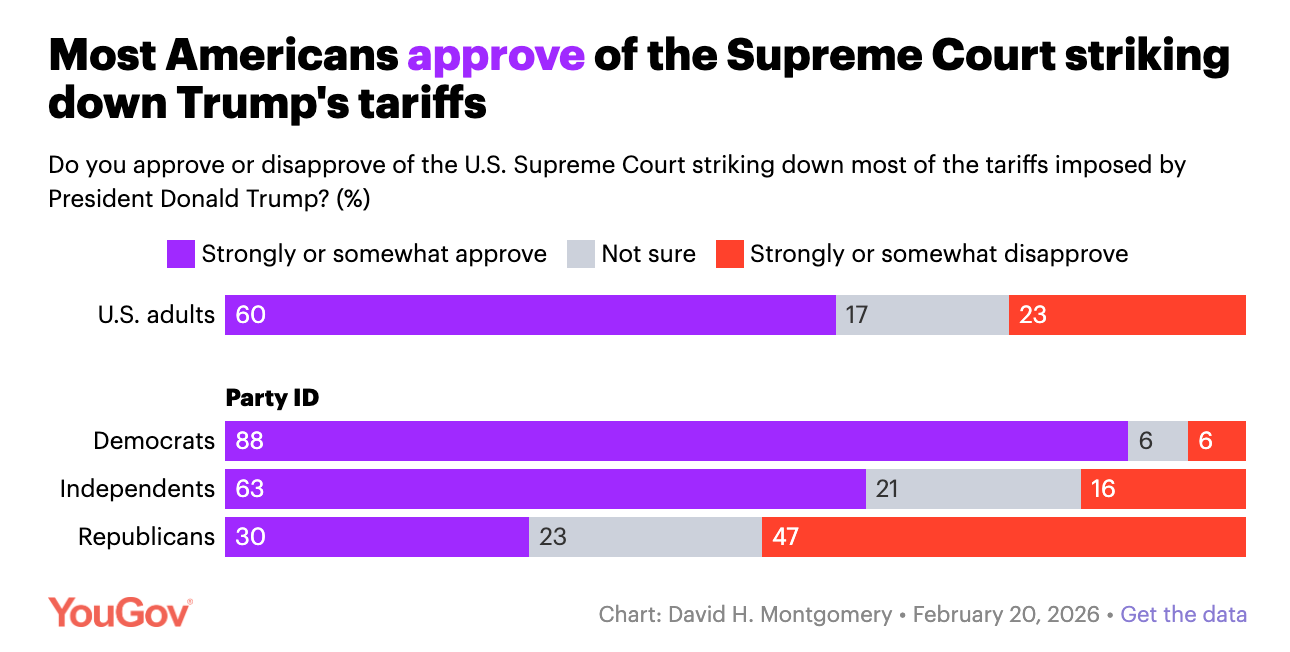
The economic consequences of these tariffs is vastly overstated in the press. But while the details of these tariff changes are less important than the headlines suggest, the political impact of Trump losing his favorite tool is devastating.
Let’s start with the specifics of the Supreme Court decision. The ruling was that IEEPA, a statute providing presidents with broad-based economic powers to respond to emergencies, does not include the word “tariff,” so it does not authorize the President to levy tariffs. It’s a bit of a weird reading of the law, and it’s inconsistent with the reading of lower courts that specialize in trade. Those courts struck down Trump’s tariffs as arbitrary, but said that the law does authorize the President to do temporary targeted tariffs in response to an emergency. And if you look at the statute, the lower court readings make sense. IEEPA allows the President to issue licenses, regulate, and otherwise do a lot of stuff involving trade. Here’s some of the text of the law:
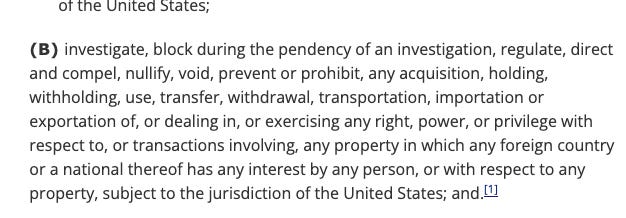
The word tariff is not in there, but all sorts of mechanisms to regulate trade that would in aggregate involve charging duties are. Still, the Supreme Court held with a 6-3 decision that IEEPA can’t be used for tariffs, with various justices arguing with each other about how to read the statute and what powers can and can’t be delegated. It’s a good outcome now, but a bad decision in the long-term as it’s part of the court’s campaign to strip the government of any ability to touch corporations. Still, what Trump has been doing with tariffs is obviously outside the scope of IEEPA.
So that’s the law. What about the economic impact of striking down the use of this law for tariffs? Here’s a five day chart of the Dow Jones. See the moment that the Supreme Court acted? Neither do I.
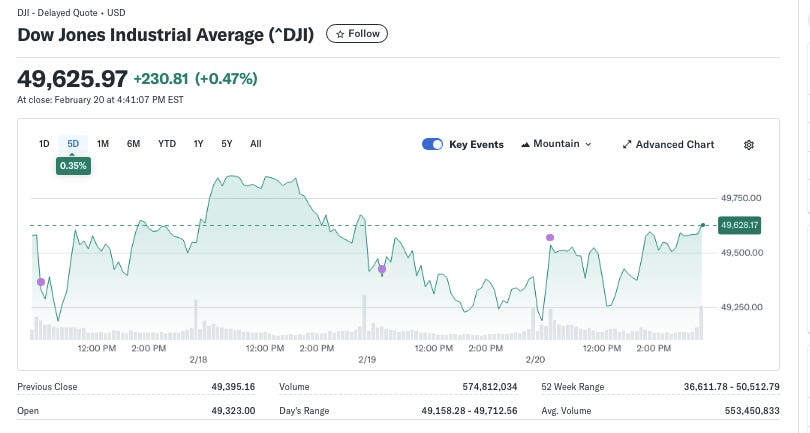
While one reason the market didn’t move is because Wall Street expected the decision, a more important reason is that it won’t matter much to our economy in any event.
First, it may not impact most tariff levels. For the last year, Trump’s trade negotiators have been preparing to use other trade authorities if they lost this case. There are a bunch of other laws allowing Trump to levy tariffs. The President can use Section 338 of the Trade Act of 1930, which allows a president to proclaim tariffs of up to 50% on countries that discriminate against U.S. trade. There are national security tariffs under Section 232, and Section 301 tariffs to counteract unfair foreign practices.
USTR chief Jamieson Greer even said that the deals they’ve cut will remain. Reading between the tea leaves, they seem likely to use that time to reconstruct most of the tariffs they had in place, using different authorities. Here’s Greer:
“We don’t have the same flexibility that IEEPA gave us” but “we’re going to conduct investigations that can allow us to impose tariffs if it’s justified by the investigation”, Greer told CBS. “So we expect to have continuity in the present tariff programme.”
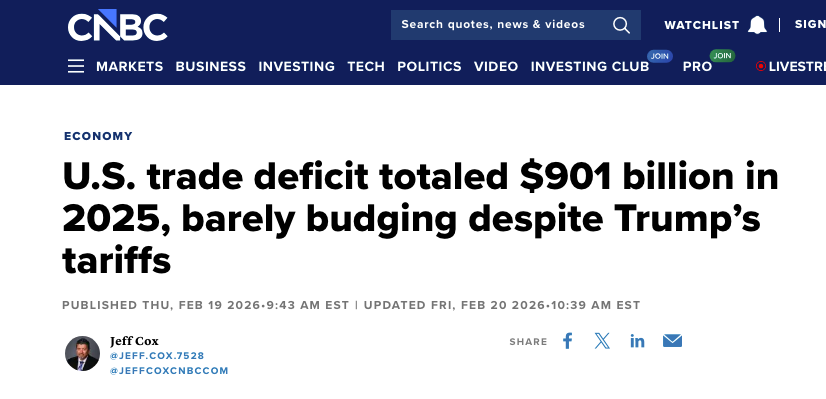
Even the maintenance of these tariff levels doesn’t matter that much to the economy. There have been a number of stories over the past showing that Trump’s tariffs, while given a lot of publicity, just aren’t very significant in terms of macro-economic impact.
When Trump ran for office, he promised big tariffs, and a real reassessment of our relationship with China. He started down that path. But when the stock market wobbled in April, he reversed himself, and his use of tariffs has been fairly modest ever since. He’s talked like there are trade wars, foreign leaders get mad about trade wars, but he hasn’t actually shifted the U.S. international position much in the broad terms of trade, though who we import from has changed.
Trump’s climbdown on China has been even more extreme, even as Europeans start to recognize they must actually cooperate with the U.S. to address the second ‘“China shock.” Trump has perhaps the most deferential approach in America history, offering to change American defense posture so he’ll be allowed to beg Xi Jinping in person to buy a few more soybeans. Indeed, one possible consequence is Trump may quietly use the decision to have levies against China go down, while levies against countries who have cut deals with the U.S. could go up.
But just because Trump doesn’t use tariffs to restructure the U.S. trade position or re-industrialize, doesn’t mean he stopped using them at all, or that they aren’t important. They are. Since he gave up on his economic strategy after Liberation Day, Trump has used tariffs mostly as a mechanism to bludgeon people and countries he doesn’t like. Good examples are when used them to threaten European countries over Greenland, or Brazil over its choice to put Jair Bolsonaro on trial for an attempted coup. That’s arbitrary coercion, though it’s not part of the larger economic strategy he promised when running for office.
And while it’s true Trump has other authorities, those require an actual process, not the whim of one guy. Section 338 is a sort of exception here, but it will be subject to a court challenge if used. In other words, the real change is that Trump has lost his favorite tool to throw his weight around. Everyone in power, both here and abroad, knew the Republicans were going to be shattered in the midterm elections, and that Trump has lost his popular support. Now he can’t even pretend to wield instant and unlimited IEEPA tariffs.
What is the practical effect of his loss of prestige? Well, the Trump administration will soon seem a bit like Joe Biden’s Presidency after the wildly unpopular withdrawal from Afghanistan in late 2021. Biden still had formal authority and power, but increasingly was sued and thwarted when he wanted to act. His people were tied up in administrative knots. Judges questioned his lawyers more aggressively, and corporations and institutional leaders understood they should wait him out and align with the coming GOP tide. Biden became a laughingstock and a political liability, ultimately leading his own side to lose its confidence and legitimacy.
That’s starting to happen to Trump and the conservative movement. Already, this tariff decision is going to throw problems his way. The government has collected $175 billion in IEEPA tariffs, and now it has to offer refunds. How will those be disbursed? That’s not clear, and the Supreme Court didn’t say. Democrats won’t let this one go, it’ll be litigated for years.
Moreover, there’s a corruption angle. Trump’s Commerce Secretary, Howard Lutnick, through his kids, has been buying tariff IOUs for 20-30% on the dollar, betting against his own boss’ legal strategy. That’s going to be investigated.
You’re starting to see other serious cracks in the administration. Earlier this week, Susan Rice, a Netflix board member and former Obama National Security Advisor and Biden Domestic Policy Council chief, publicly said that corporations and law firms who illegally do Trump’s bidding are going to face investigations if there’s a change in control during the midterms. Trump’s response was to demand that Netflix, which has a bid pending for Warner, fire her.
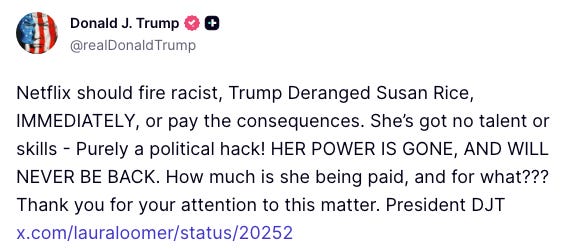
Now the pressure is on Netflix to either prove her point by firing her, or stand up against Trump. Trump’s leverage here is that he can challenge Netflix’s attempt to buy Warner Bros Discovery. Of course, he can’t block the deal, a court must do that. All his Department of Justice can do is bring a merger challenge. And the defense strategy will be that there’s a lack of regular order at the DOJ, and that the President is leveling a direct threat at Netflix. That will likely weigh on a judge, unless Democratic state officials join in the challenge.
That said, I was shocked by Rice’s comment. She’s among the most cautious and pro-corporate members of the Democratic establishment, so if she’s demanding investigations of big business, that’s a sign the center and center-left believe they have to create an incentive for corporations to stop cooperating with this administration. Here’s 2028 potential candidate Ruben Gallego, making the broader point.
Rice’s comments aren’t tied directly to the tariff decision, but political capital is fickle. Trump had it, and everyone was scared. He’s lost it, and fewer and fewer people are. Most foreign leaders have cottoned on as well.
Trump, it seems, is now a lame duck.
And now, the news of the week. Bernie Sanders came out as an AI apocalyptic doomer, a judge threatened Mark Zuckerberg’s entourage with contempt for wearing AI Meta glasses in court, and human resource divisions are overwhelmed with AI-generated slop grievances. Oh, and the Trump Antitrust Division brought a pretty good health care case.
That and a lot more after the paywall.