 BURST
BURST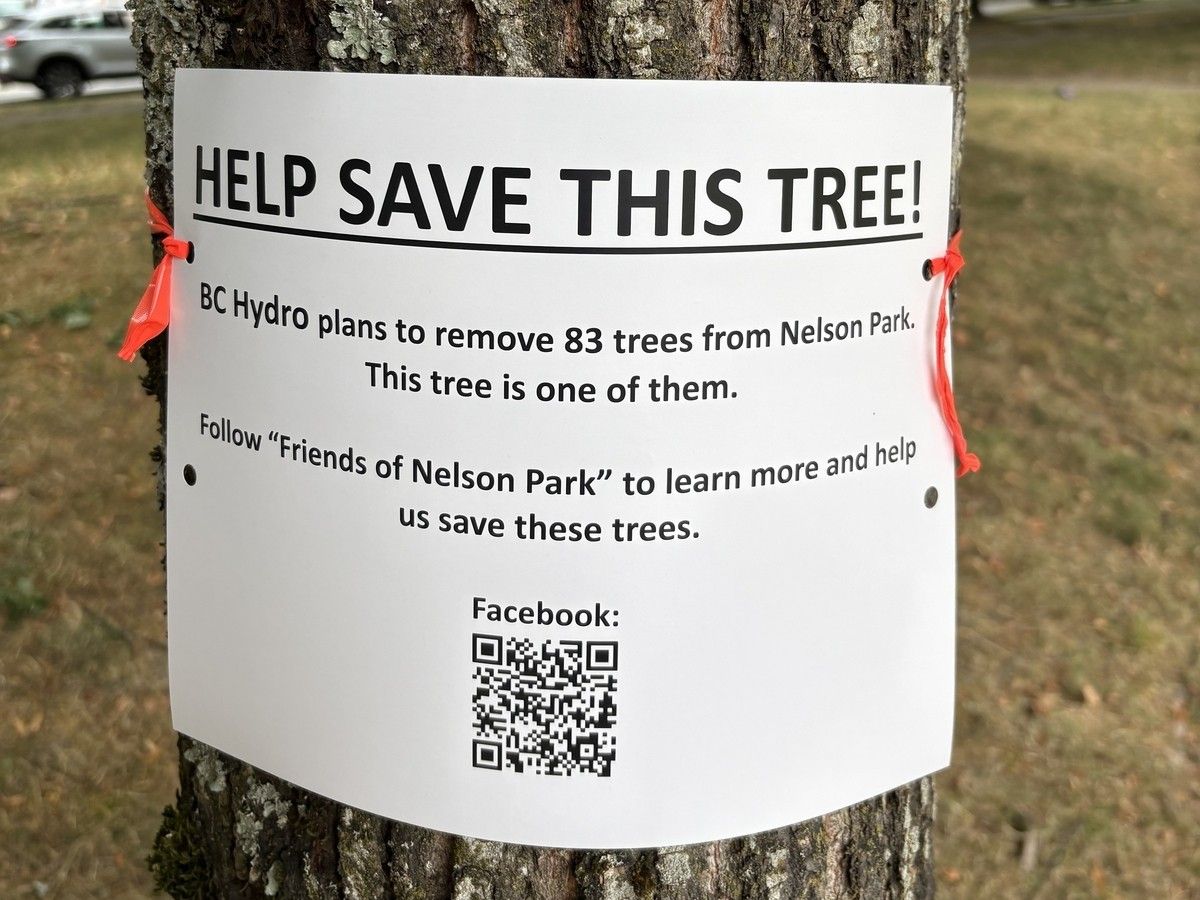
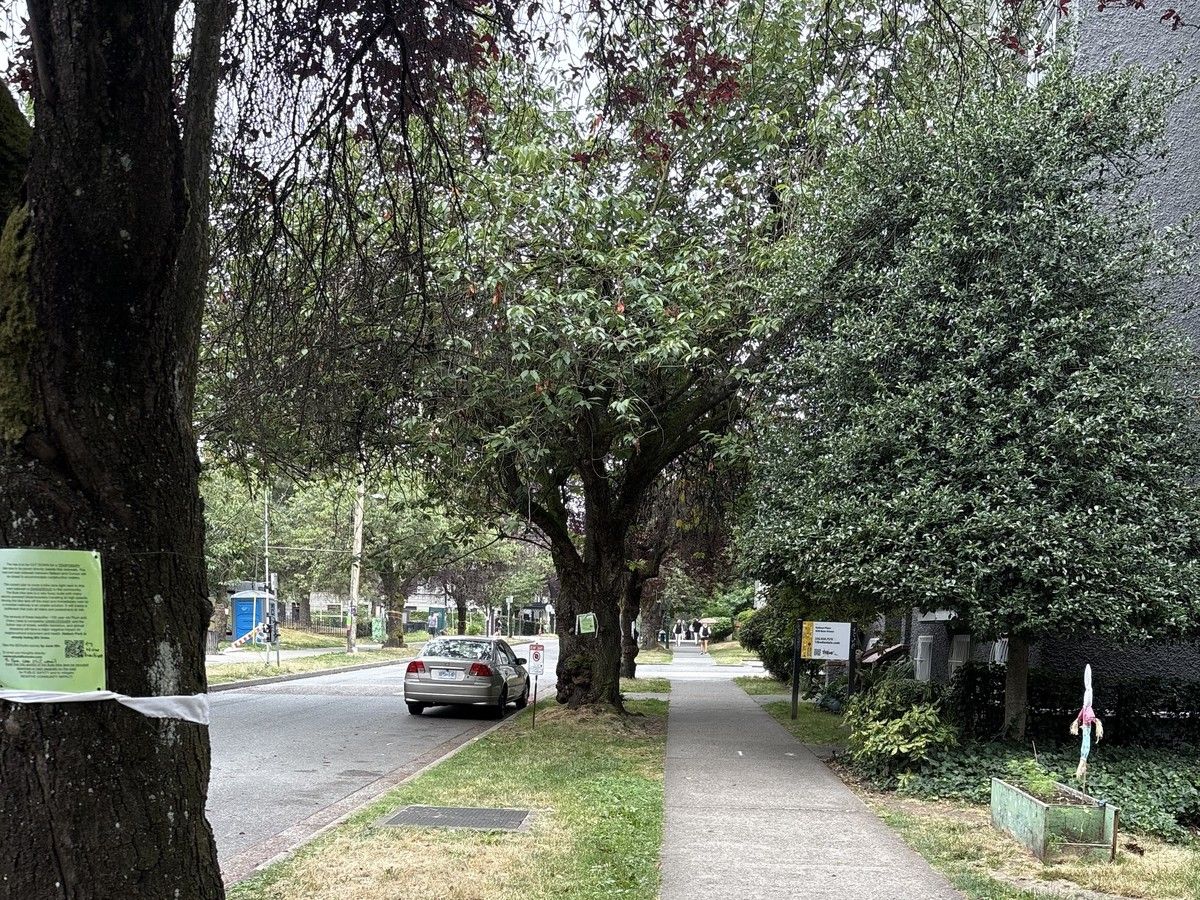
At a park in Vancouver’s West End, small handwritten signs have been tied around dozens of tree trunks with ribbon.
“ On death row ,” they say.
The display is the latest effort by a group of residents to draw attention to B.C. Hydro’s proposed $1-billion underground substation, which they worry could lead to the removal of up to 83 trees, many of them decades old .
Approval for the project is currently under review by the B.C. Utilities Commission, which is holding a public hearing into B.C. Hydro’s application.
Hydro says the new substation is needed to replace the aging Dal Grauer Substation on Burrard Street, which has supplied electricity to downtown Vancouver since 1953. The utility says the existing facility cannot be rebuilt in its current location and a new one is needed to support future demand and serve about 50,000 downtown customers.
One of the residents who helped tie the signs around tree trunks throughout the park last week is Guy Cormier. Each marker includes a QR code directing passersby to information about the project and encouraging them to write to the utilities commission before its Aug. 4 deadline.
Cormier is a member of Friends of Nelson Park, a group that formed to oppose Hydro’s plan to build an electrical substation beneath Lord Roberts Elementary annex, which has been used as extra classroom space while enrolment has grown. In the 2024-25 year, the school was at capacity with a waitlist for registration.
“Those trees are higher than my four-storey apartment. Some of them I can’t even put my arms around,” said the 58-year-old, who has lived in the neighbourhood for two decades.
To make way for excavation work, the school’s annex building would need to be demolished. B.C. Hydro says construction of the underground substation is expected to take about five years, after which a larger replacement school has been proposed for the site above the area currently used as the school’s playground.
While the Vancouver school board recently submitted a development permit application for the replacement Roberts Annex, the project’s future remains uncertain.
In an email statement to Postmedia, the board said it sold the underground portion of the Lord Roberts Annex site to B.C. Hydro in 2018 for $65 million to help fund two downtown school projects — the new cəw̓as Ch’elxwá7elch Skwuláw̓txw Seaside Elementary school and a replacement for the Lord Roberts Annex.
It said nearly $42 million has been committed to the Seaside school in Coal Harbour, with the remaining funds set aside for the Lord Roberts replacement. But “significant cost escalations” over the past eight years have created a funding shortfall for the Roberts Annex replacement project, which the board estimates will cost $194 million in its latest five-year capital plan submission to B.C.’s Ministry of Infrastructure.
“This has resulted from material costs, supply chain challenges, shifting labour availability, and overall escalation,” it noted. “As a result, there is now a funding gap to complete the replacement school.”
“While we did not receive funding approval this year, we will continue to list a new school at Lord Roberts Annex as a priority in subsequent annual funding requests,” the board said.
The uncertainty around the annex replacement comes as the school board prepares to open a new Seaside Elementary in September, a project first identified as a priority several years ago.
While Friends Of Nelson Park says it supports the need for improved electrical infrastructure, residents say the project would come as a huge loss for the neighbourhood.
“The park isn’t going to be anything like it is now after construction,” said neighbour Carol Reardon.
Nelson Park had major upgrades in 2007 and 2008, transforming it from a grass patch into a public space with walkways, a plaza, a playground and other neighbourhood amenities.
If approved by the B.C. Utilities Commission, B.C. Hydro says connecting the new facility to the existing electrical system by underground cables requires the removal of up to 83 trees and will affect other areas of the park, including its community gardens, water fountain and public plaza.
While B.C. Hydro says it will plant 107 new trees to offset the canopy loss, they cannot be planted on top of the underground substation for operational reasons. Instead, that area will be turned into a playing field.
“Just take a look at downtown Vancouver’s Cathedral Square substation,” Reardon told Postmedia on Thursday. “The new school property will be like a slab of concrete just like that, with most of the trees only replanted on the street’s corridors, not as much allowed in the park.”
“The West End is already deficient in green space and deficient in schools,” said Reardon, who pointed to B.C. Hydro’s initial application to the utilities commission, which said the utility considered 11 potential sites for the new substation.
The potential canopy loss comes as Vancouver is trying to expand its urban forest. A 2020 Metro Vancouver report found significant differences in canopy coverage across the city of Vancouver, with West Side neighbourhoods having less protection from extreme heat. That same year, the park board approved a strategy to plant tens of thousands of additional trees over the coming decades to increase the city’s tree canopy.
B.C. Hydro has conducted community consultation on the project for the past two years. In 2022, the utility reached an agreement with the Vancouver park board to install underground transmission lines beneath Nelson Park, along with an access driveway and temporary construction areas, for $8 million.
In April, the Crown corporation awarded a construction contract to PCL Constructors Westcoast to help plan the project.
Reardon, who has attended B.C. Hydro’s public consultation on the project in recent years, said she felt the community’s concerns had already been decided against.
“It just breaks my heart,” she said.