 BURST
BURST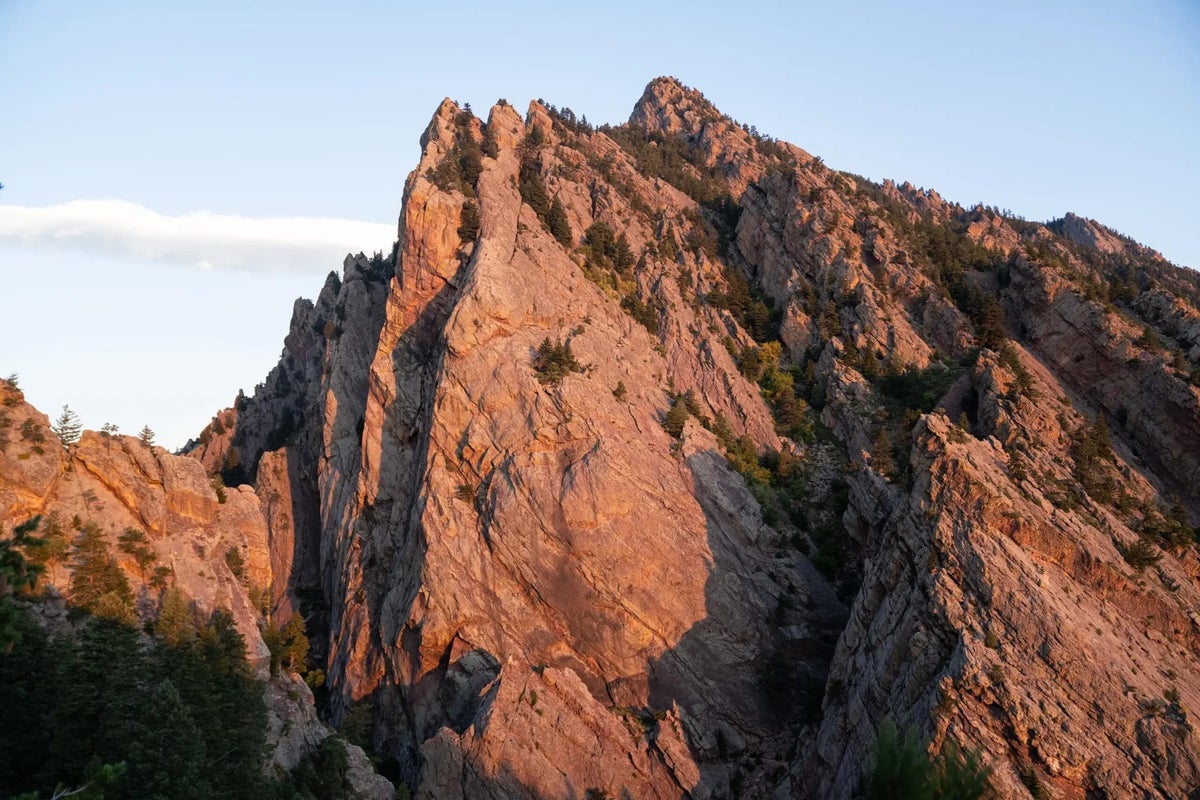
On the night of Sunday, April 12, a mountain rescue team from Boulder, Colorado, rescued three climbers from the fourth and fifth pitches of the state’s most famous route: The Naked Edge (5.11b; 460ft) in Eldorado Canyon. At least two of the men were shirtless, perhaps in a nod to the route’s name, and one of the reasons they needed outside help—none were prepared to withstand the Front Range temperatures, which can plummet from 80 to 30 degrees after the sun sets in April.
Three days after the rescue, the Boulder County Sheriff’s Office released a statement along with a movie-trailer-like video of the process, which has since gone viral.
According to the statement, the Rocky Mountain Rescue Group (RMRG) established verbal contact with the lead climber, who was on the final pitch, at 10:19 p.m., 2 hours 4 minutes after the rescue call went out. They “assisted” the lead climber to the top, although it was unclear what this involved. To reach the lower climbers at the top of pitch four, the rescuers rappelled down on fixed lines from the top, then helped them ascend. By 2:25 a.m., all three reached the trailhead, safe and sound. Climbing has reached out to RMRG’s Public Information Officers for more detail.
I’m not one to shame a climber for calling for a rescue; we’ve all done things that have embarrassed us and forced us to learn. Still, for a group of volunteers like RMRG, every emergency call takes significant time and energy out of their week. It’s worth extracting any lessons we can from this amusing rescue, if only to save these volunteer teams some sleep. We know from the report the climbers were healthy and uninjured. They didn’t have headlamps or jackets, but what else stopped them from getting off the mountain?
I called up my friend Kate Kelleghan, a bona-fide Naked Edge expert who’s climbed the route 89 times and holds the women’s speed record on it, to help me understand what situation those climbers were facing.
A brief overview
The Naked Edge is the sharpest, most prominent arête of Eldorado Canyon’s tallest peak, Redgarden Wall. After a 200-foot “approach” pitch, it ascends for 460 feet up to its summit, after which a walk-off trail brings you safely down. With its “climb up, walk off” set-up, glorious exposure, and conglomerate sandstone that feels more like granite than anything you’d find in the desert, the past 10 years have seen The Naked Edge turn into what Climbing contributor James Lucas called “Colorado’s local racetrack.”
Its five pitches consist of a 5.11a finger crack, a 5.10b arête sequence, a 5.8 reprieve, the notorious 5.11b bombay chimney, and an 5.11a boulder problem pitch that ends in a steep hand crack. Most climbers consider the fourth pitch the crux; others say the start of the fifth is just as hard.
Bare exposure
Despite being ultra-popular, The Naked Edge is not the easiest climb to retreat from. According to Kelleghan, only pitches one, two, and four have bolted anchors; the rest rely on gear, pitons, or slung blocks. Pitch three is 34 meters long, so rappelling it with a 70-meter rope would be a rope stretcher, and building a gear anchor midway carries heightened risk due to the chossy rock. While some parties may be able to get down from the top of pitch three, if they’re careful, pitch one is the realistic turnaround point for most people.
When the April 12 call for rescue was made, two of the three climbers were below the final pitch, either unable or unwilling to complete it in the dark. So what’s one to do, if you’re the leader at pitch five and your partners can’t make it up one of the cruxes?
“If it were me, I’d finish out the route, then rig ropes down to the bombay [chimney] and have [my partners] jug out on that route,” says Kelleghan, who served two years on Yosemite Search and Rescue and is an AMGA-certified Apprentice Rock Guide. “But that’s because I know exactly where to drop ropes that hang down into the bombay.” A beginner, she admits, wouldn’t have that knowledge.
How to avoid ending up in a Boulder County Sheriff’s Office promo video
The Naked Edge isn’t the only route where the turnaround point comes before the hardest pitches; if the crux is at your limit, going for the full send may be a gamble. So how should you know if you belong on this ultra-classic route?
Kelleghan, who lives in Boulder, recommends Vertigo (5.11b) and Yellow Spur (5.9+) as Eldo classics to help prepare climbers for The Naked Edge. “[Vertigo] is only three pitches, but has more descent options and puts you through a test of figuring out the descent,” she says. “It’s not super straightfoward.” By contrast, she calls The Yellow Spur much easier, but also “a long, somewhat committing route” that shares a descent with The Naked Edge so climbers can get familiar with it.
Ultimately, while the climbers may have found themselves in a spot they were unable to retreat from, there were still several things they could have done to be better equipped to finish the route. According to the Sheriff’s Office statement, none had brought headlamps or warm layers in case they were slower than anticipated. Kelleghan recommends bringing at least a wind shell or puffy, “even if it’s hot,” when multi-pitch climbing. “There’s a lot of packable puffies out there,” she adds.
She also recommends that climbers take a self-rescue course, which can teach them how to haul, rappel with a too-short rope, tandem rappel, or otherwise help an injured partner. Climbing festivals often host clinics that teach self-rescue, and local guides also offer instruction. These situations are also when aid climbing comes in handy. “Knowing how to leverage your gear in more ways than just protection,” she says, “could have helped them get out of that.”
However, in the situation at hand, Kelleghan concludes that the party of three made the right decision in calling for rescue. “People have been shitting on them,” she says, referring to the social media ridicule, “but there is a point where if you feel like if you’re not in a good headspace or mental capacity to make safe decisions for your entire team, or you don’t have the experience to get out of a situation like that, it’s better to just call for help instead of trying to figure it out—and potentially getting hurt.”
Rescue video shared with permission of the Boulder Emergency Squad.
The post Shirtless Climbers Rescued from ‘The Naked Edge’ in Boulder, Colorado appeared first on Climbing.