 BURST
BURST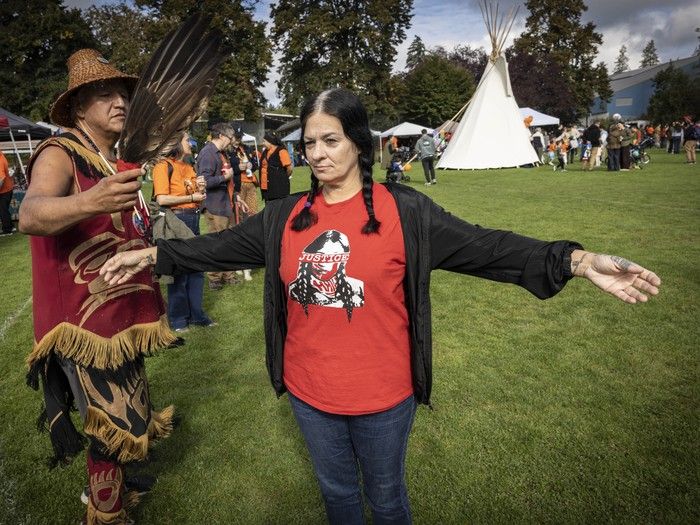
The gathering of hundreds under the warm autumn sun and mostly blue skies could have been mistaken for any fall fair, with the deep-fried smells from the food trucks and arts and crafts vendors.
But the event held at New Westminster’s Queen’s Park on Wednesday to mark the National Day for Truth and Reconciliation was “not a celebration,” said William Nelson, a survivor of Canadian’s Indigenous residential school system.
Nelson, whose Indigenous name can’t be spelled in English, was one of several speakers to share what it was like to attend the school or have parents who attended.
He recounted how he wasn’t allowed to speak his language or engage in Indigenous practices at the school.
“Maybe one day it will be a celebration,” he said.
But now was the time to remember those who suffered at the schools, including the physical and sexual abuse as reported by the National Commission of Truth and Reconciliation in 2015.
And to those who didn’t come home, Nelson said, referring to loved ones of students who died at the schools. The commission at first documented the number at 3,200 and commissioner Murray Sinclair later said the number was likely higher than 6,000.
Nelson and another speaker, Cliff White, also known as Ma’Awta and who is from the Gitxaała Nation, spoke of the continuing need of Indigenous Peoples affected by the schools to keep witnessing their stories, especially in light of reports of members of white supremacists wearing all black and their faces hidden by white bandanas who rallied in Kamloops last week.
Nelson and White said there is still denialism expressed about the death of children at the 140 schools, the first of which opened in 1831 and the last of which closed in 1996.
In May 2021, the Tk’emlúps te Secwépemc Nation in Kamloops announced that a ground-penetrating radar survey had detected 215 potential or suspected unmarked graves at the site of the Kamloops residential school. The band declined to dig up the site to verify what the radar detected, leading some to question the existence of bodies.

Albert Wesley, of the Nisga’a and Tsimshian Nations and a program manager at the Spirit of the Children Society, spoke of how having two parents attend the schools affected him growing up.
“There was alcohol, there was domestic violence, there was instability,” he said. “When I was a child, I didn’t know the term intergenerational trauma. I didn’t understand residential school policy. I didn’t understand colonization.”
“I certainly wasn’t sitting there thinking, I wonder what the historic causes of all this are,” he said. “I was a kid.”
He said the trauma didn’t stay at the schools, it was carried into the students’ homes, which affected their relationships and their parenting.
“Understanding trauma doesn’t mean excusing every behaviour,” he said. “But it does mean asking an important question: What happened to this person? Instead of asking what’s wrong with this person.”
Wesley said his parents were separated from their families and he, their child, lost his children for two years to the Ministry of Families and Children.
“When I look back, there is a connection that is difficult to ignore,” he said.
He raised healthy children and now has grandchildren and works helping others deal with the ministry.
“Orange shirts are important, ceremonies and acknowledgements are important. But the reconciliation has to continue when Sept. 30 is over,” he said.
Reconciliation requires relationships with non-Indigenous, people who are “willing to listen to their uncomfortable history without becoming defensive,” he said.

Anneliese von Kanel, also know as Satoya from the Squamish Nation, drummed and sang with her teen son, and spoke their language.
As a ‘60s Scoop child, one of many Indigenous children who were placed in white foster homes during the 1960s, she only recently learned of her Indigenous heritage and is sharing it with her child.
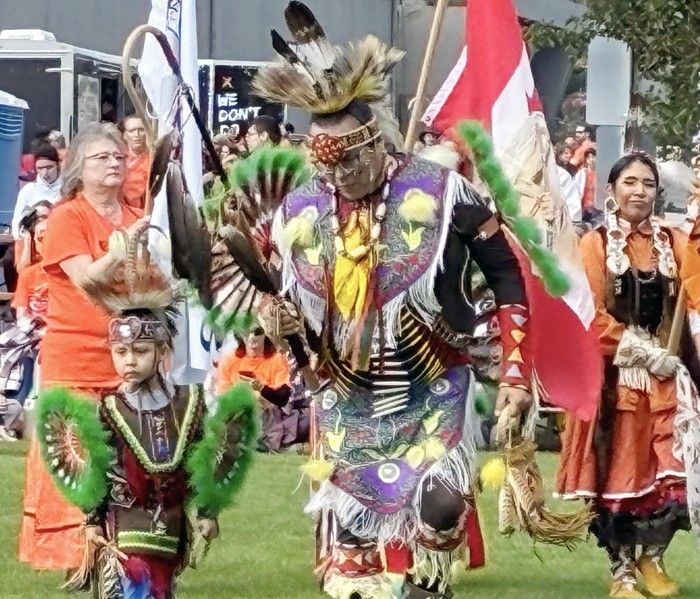
The program on Wednesday included a powwow and drumming circle.
The 350 or so attendees, more than 90 per cent of whom were wearing orange shirts that symbolize the lost children, were invited to be “smudged” through the ritualistic burning of sage grass.
They also had the opportunity to buy Indigenous art and clothing, such as ceremonial ribbon skirts, and to sample the traditional fried bread called bannock. The lineup for the bannock truck was the longest of all the food trucks, numbering 50 people at one point.