 BURST
BURST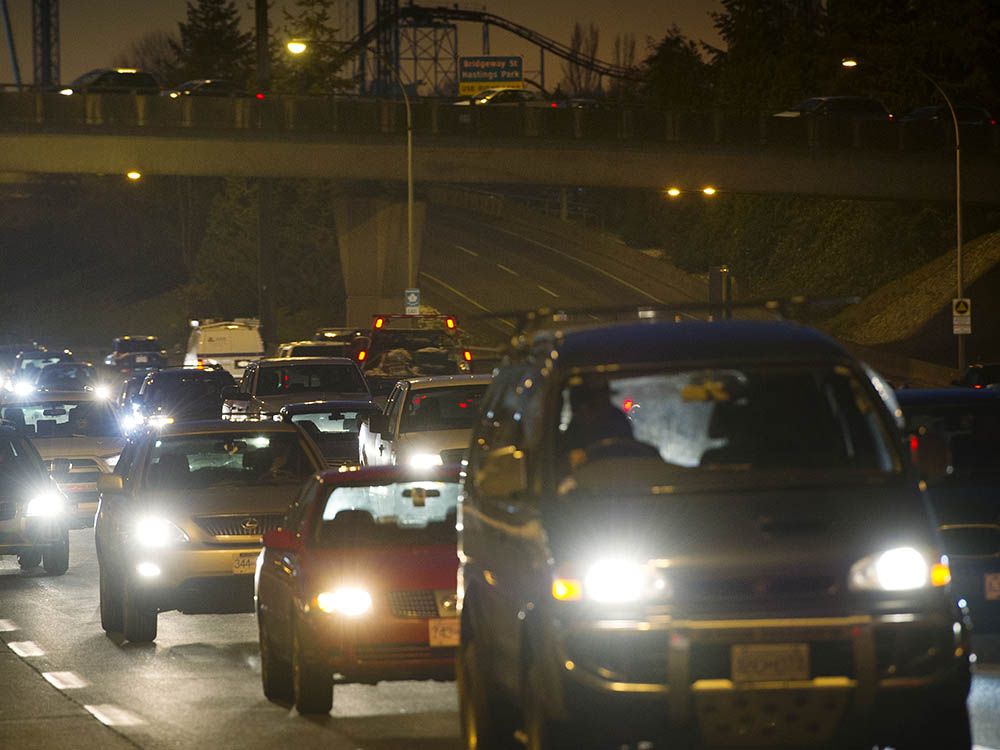
It’s the time of year when it feels like the sun makes an occasional cameo, while a perpetual gloom is the lead actor. So it’s also a good time to talk about your car’s lighting system.
Since 2021, all new vehicles in Canada must have one of three things: tail-lights that come on automatically with your daytime running lights, or headlights, tail-lights and side-marker lights that turn on automatically in the dark, or a dashboard that stays dark to alert the driver to turn on the lights when natural light grows scarce.
Cpl. Michael McLaughlin of the RCMP’s highway patrol said most vehicle manufacturers choose the second option: automated headlights with a sensor that turns them on when it gets dark.
Unfortunately, some drivers still end up driving with no tail-lights in darkness, because they aren’t using the automatic light feature that comes standard on their vehicle. And if your car is from before 2021, it doesn’t necessarily have its tail-lights illuminated when your daytime running lights are on.
As McLaughlin notes, it isn’t easy to figure out if you have the automated lights on.
“Every manufacturer has slightly different light settings,” he explains. “Some have light settings in a switch on the dash, some have a lever on the steering column and there are slightly different icons depending on the manufacturer.
“In many (but not all) cases, a green light on your dash with a headlight icon will be activated only with full driving lights.
“The only surefire way to make sure you are using your full driving lights is to get out of your car and compare the functions in the driver’s seat with what is actually happening with your lights,” he explains. “This is something you should be doing periodically anyway to ensure that all of your lights are working properly.”
If you fail to turn on your headlights and tail-lights at night or they’re broken, you can get hit with an $81 fine. If your vehicle doesn’t have working lamps that comply with B.C.’s Motor Vehicle Act Regulations , the fine is $109.
Transport Canada made the 2021 changes to running lights to ensure drivers can see and be seen better, but there’s a better way, says McLaughlin.
Drivers should have their full-power, low beam headlights on all the time, especially in the winter with frequent rain, fog and gloomy weather.
“There is virtually no downside, and your visibility will improve to other drivers,” says McLaughlin.
It’s especially a good idea with an older vehicle, which may not be equipped with daytime running lights or have tail-lights that may not activate along with them.
The visibility from having headlights on can reduce your chances of a daytime collision by up to 15 per cent, according to studies over the years.
Finally, a note about high beams: They should only ever be activated when you’re driving on an unlit road at night and there are no vehicles approaching or in front of you.
That includes flashing your high beams to try to alert other drivers to a speed trap or hazard, or to try to get them to turn on their own unlit headlights. The law forbids using high beams when you’re within 150 metres of an oncoming vehicle.
B.C.’s public insurer has a guide to your vehicle’s equipment, including your lighting system, at icbc.com .