 BURST
BURSTToday, Donald Trump is in China negotiating with Xi Jinping, with the possibility of reordering the global economy. As with most of these kinds of summits, the symbolism and pomp is rich. Trump understands imagery, and he brought with him a group of CEOs. In this picture, where Trump is greeted by Chinese Vice President Han Zheng, you can see Elon Musk and Nvidia CEO Jensen Huang in the background.
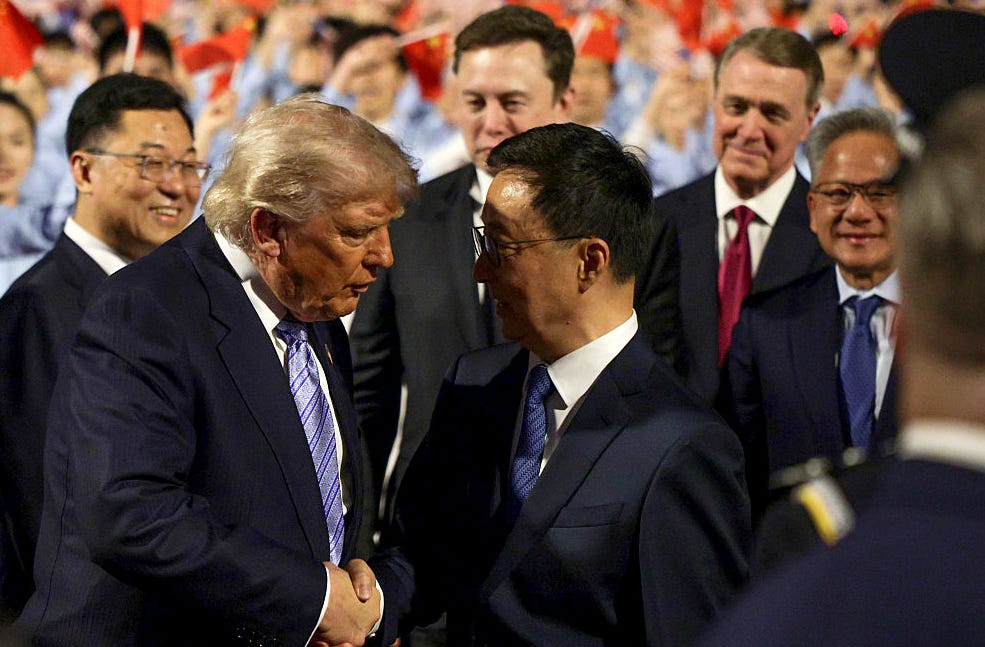
These men are both worth over $100 billion, and they project Trump’s view that dominant American firms represent the strength of the nation.
What has happened so far? Rush Doshi, a savvy China analyst, noted there were few promises here and there, but ultimately not very much has yet occurred.
The reason for that is simple - Chinese leaders are happy with the status quo, and they don’t feel there’s any reason to change what they perceive as a winning hand against the U.S. And when I say winning, I mean something specific - they are in the process of monopolizing the industrial base and high tech industries of the entire world. Increasingly everyone depends on China for vital goods, while China systematically removes their need to import anything from anyone else. We saw this most obviously when China cut off rare earth magnets to the U.S. and the rest of the world last year, but the vulnerability exists across many sectors.
For a long time, I’ve been labeled a China “hawk” in D.C. parlance. Hawk is often seen as a proxy for war, and that conflation is intentional, because it confuses the left around the world. My concern is not about the need to mobilize for war, China is a nuclear power and there is simply no winning in any conflict. The concern is economic; there are certain important predatory practices that China is using to monopolize industrial production and technological development. I do not want to live in a world where China controls all commerce, because it means very bad things for everyone else.
There’s a lot that China does well, and I’m going to talk about that. But first I want to start with why China is a toxic actor in the global economy. If you look at consumer spending in a country, in most countries that share is between 55-65%. The U.S. is at 67% or so. Most of what we produce goes back to the people themselves. China is different; Chinese consumption rates are at roughly 40% of GDP, with about that same amount going to investment. Those are insane levels.
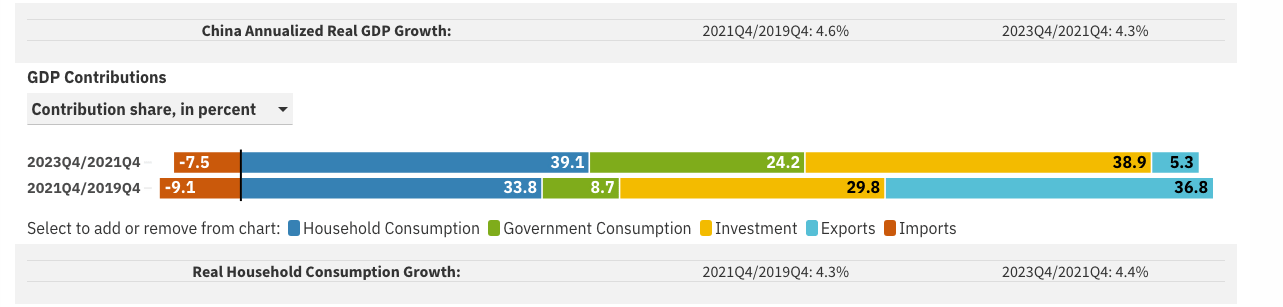
That means Chinese people just don’t get the fruits of what they make. Instead, the Chinese government, mostly through their banking system but also land management policies, takes that capital and gives it to their own local producers of everything from high tech carmakers to plastic Christmas ornaments. To many people, such a system looks benevolent. China is offering cheap solar panels and great cars to a world starved of such products, and doing so without the military aggression of the U.S.
But as with Amazon offering cheap prices until it monopolized the e-commerce market, this short-term strategy will not work well for anyone. The Chinese system is organized around having massive levels of unnecessary industrial capacity, which it turns towards waste and exports. To give you a frame of reference, if the U.S. subsidized domestic manufacturing by $7 trillion a year, that would be the equivalent of what China does. No one can compete with that level of state support.
This excess capacity is why American manufacturing disappeared. It’s also why manufacturing everywhere from the Philippines to Germany to Russia is disappearing, causing friction globally between China and the entire world. It’s a different type of tension than that between the U.S. which is a chaos agent in the Middle East, but it’s very real. With just a few more years of this trend, the entire global auto industry will be in China, with the pain and autocratic tendencies that accompany deindustrialization everywhere.
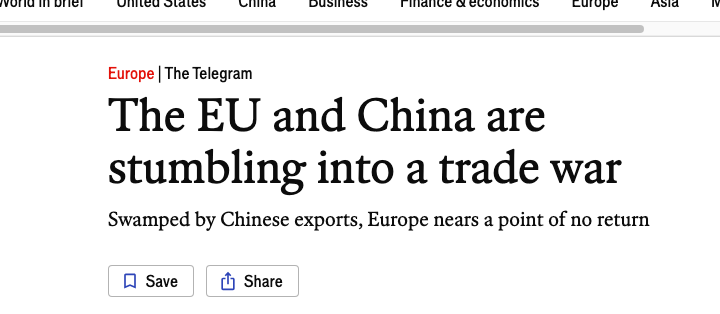
As we’ve seen with the pandemic, it’s a terrible idea to pool production of one vital thing, let alone everything, into one area.
There’s a lot more to say about this dynamic, including the need to rebalance trade through currency changes, tariffs, and whatnot, but there is another point to make about China: while they are a toxic actor on a macro-level, their industries on a micro-level have become very good at making and inventing things. And this has happened at the same time the U.S. and Western operational capacity has declined. There’s an inverse relationship here; China prioritizes production and crushes finance, the West prioritizes finance and crushes production.
A lot of people think this dynamic is a result of an authoritarian regime versus liberty in the West, but that’s false. China is using the competition policies that the U.S. itself had prior to the 1980s, with high levels of investment and competition, trade and investment protections, as well as intellectual property rules prohibiting monopolization. So their companies have become better and more efficient. In the U.S., it’s the opposite. As our companies have become more financially valuable, they have become worse at building things.
It’s been honestly frustrating to write about this dynamic, because it’s been so obvious for so long. In 2019, I first discussed it in-depth, talking about how the New Deal created the high-tech electronics industry, and how now that regime no longer exists in the U.S. but instead exists in China.
This open regime, along with government spending, is the origin of Silicon Valley, because small firms ended up commercializing the technology. But from the 1980s onward, we closed off innovation by tightening IP laws and enabling monopoly. This older regime disappeared, and even its memory evaporated. Open IP regimes and markets are now alien to American lawyers. I found a law review article written by a former FTC lawyer in the early 2000s on a suit antitrust suits with Xerox involving patent divestment. It was, he wrote, like finding a “previously undiscovered ancient culture.” He also found the suit unsettling, he argued, because the FTC’s remedy “seems to have done a world of good.”
Today, American intellectual property is locked into dominant firms, who spend large amounts of money making sure no one else can use it. Apple for instance spends $1 billion a year on its legal division, and Disney is right now suing people online for using Baby Yoda memes. China, however, has a way around our IP laws; it just hacks our corporations or legally forces technology transfer, and then moves this knowledge throughout its technology sector. Thus American know-how floods into China, while Americans are locked out of the wisdom we developed and paid for.
More than just the transfer is the ecosystem of business development and investment. China is innovating on top of our knowledge, which the America government has legally blocked Americans from using. Our venture capitalists and entrepreneurs shy away from competing with giants or accidentally stepping on patents. In other words, China is de facto living in the incredibly productive legal environment America had for our own technology sector from the 1950s to the 1970s. Their ability to innovate on top of our technology, combined with our inability to deploy that same technology, is now a huge national security vulnerability.
But it goes back much further. In the 19th century, there were a variety of anti-monopoly rules, such as patent laws and state chartering, that had similar effects. In the 1880s, for instance, a single machine tooling shop in Boston, which was part of the industrial ecosystem of the time, supplied the practical engineering skills and materials to innovate around telegraphy, electricity, and telephony. Alexander Graham Bell was a speech therapist attending lectures at the Massachusetts Institute of Technology, and he went to this machine shop to build the telephone.
Today, America has virtually no machine tooling anymore, whereas China leads the world. So Xiaomi, a phone producer, became a top tier carmaker in just a few years. And this dynamic is not isolated to cars.
China has better drones, batteries, hypersonics, nuclear technology, and is set to overtake the U.S. in pharmaceuticals. It can also make enormous amounts of stuff we can’t, including nylon products, optical scanners, consumer robotics, electronics, all types of clothing, specialty chemicals, and, well, metal drinkware.
There are a few areas where the U.S. still has capacity, such as biotechnology, but even there, China is now wrecking the U.S. industry for similar reasons.
There’s one area that seems to differ, where the U.S. is in the lead – generative artificial intelligence. And that’s worth looking at, not just because it’s a focal point of the Xi-Trump summit, but because the strategies of the two countries explains the real political problem that is leading to the U.S. decline.
For the last five years, I’ve been listening to two inconsistent narratives from U.S. policy elites on AI. The first is that Western AI chips, designed in the U.S. and made in Taiwan, are so much better at mass compute than Chinese chips, that we must protect our lead in artificial intelligence by refusing to export them. We did a bunch of subsidies through the CHIPS Act, we’ve enacted export controls, and we’re financing $1T of data centers in 2026. And the second is that China is nipping at our heels with its own artificial intelligence models, just a few months behind. How can both of these be possible?
The answer is something that Exponential View’s Azeem Azhar calls China’s “efficiency moat.” Azhar is not some AI doomer, he’s a zealot for the technology. He discusses it endlessly for various investment and research tasks, and his token budget is 100 million a day. So we’re not talking about someone who thinks it’s a bubble, or a fraud.
Azhar just got back from a tour of Chinese AI labs, and published what he found. First, the inconsistency I noted is real. The U.S. compute gap keeps widening to the point where America is three years ahead. Here’s a chart he published.
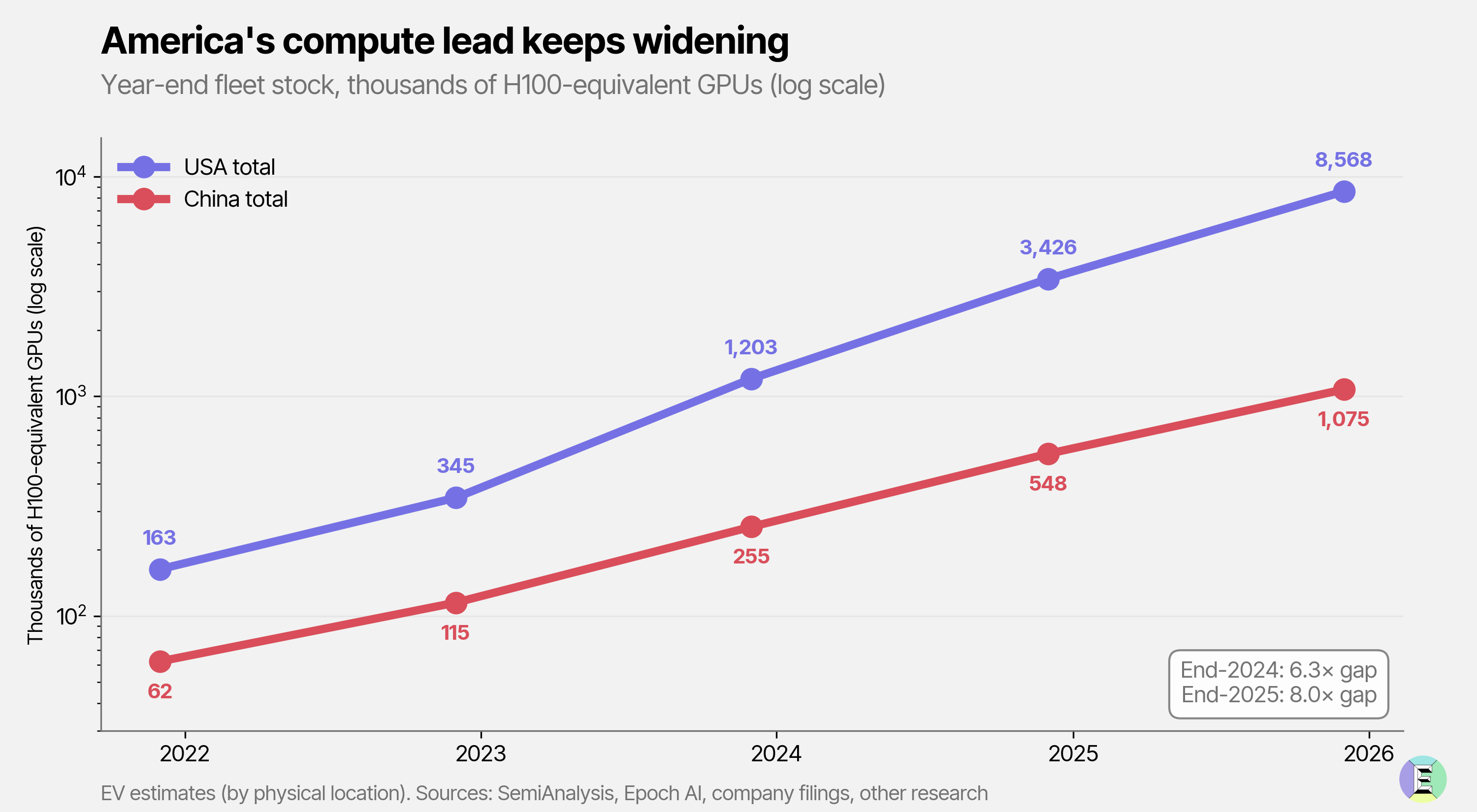
But he also wrote that Chinese models are just “three to six months behind the US on benchmark performance, according to DeepSeek, and 8 months according to the Center for AI Standards and Innovation, a US government agency.” But “Chinese labs,” he noted, “are extracting 4-7x more intelligence per unit of compute than naive scaling predictions would suggest.” Chinese companies have this “efficiency moat,” insofar as what they do has to do so much more with so much less.
The driver, he argues, are chip constraints and competition. “In the US,” he wrote, “five key frontier labs dominate training compute: OpenAI, Anthropic, Google DeepMind, Meta and xAI. In China, a thousand flowers are blooming.” Chinese labs are competing with each other over the best most efficient way to train AI, instead of relying on just a few hyperscalers, as we do in the U.S. They publish their research, their models are usually open source, and they swap efficiency techniques across the industry in an attempt to deploy their models in real practical situations at scale.
I don’t know why they selected the open source route, but my guess is the Chinese government had a hand in the choice. The Chinese government has a robust and aggressive program to support tens of thousands of small businesses in high tech industries, known as ‘Little Giants.’ Doshi described it to Congress:
To become “Little Giants,” firms must hit growth targets, spend on research and development, and fit into prioritized government sectors. Once they obtain the coveted “Little Giants” designation, they receive access to an impressive package: preferential loans, direct subsidies, state equity investment, quick patent processing, university research support, streamlined stock market listings, and mandatory integration into the supply chains of state-owned enterprises (SOEs)
The net result of firm entry and competition is a lead in lots of industries. In AI, what it means is that the training of Chinese models and the cost of running them, inference, is much lower for their firms. They can’t compete by building huge bloated AI models, they have to be efficient. Here are the pricing differences.
DeepSeek’s V4 Pro, their flagship model, is comparable to Claude’s Opus 4.6, in some ways. Opus 4.6 was released in Feb 2026, and is not Anthropic’s latest model. Cost-wise, though, you can see the difference. DeepSeek charges $0.43 per million input tokens and $0.87 per million output tokens. Opus 4.6 is 11 times more costly in input and 28 times more expensive in output.
These are not promotional one-offs. Across the Chinese frontier, Kimi K2.6 sits at $0.95 input (among the cheapest models in the global top 10 by GPQA Diamond), and Alibaba’s Qwen models are priced in a similar band. The cost-to-serve inference is a function of three factors: the actual cost of serving the model, its compute complexity and energy costs, and the margin the provider is willing to give up.
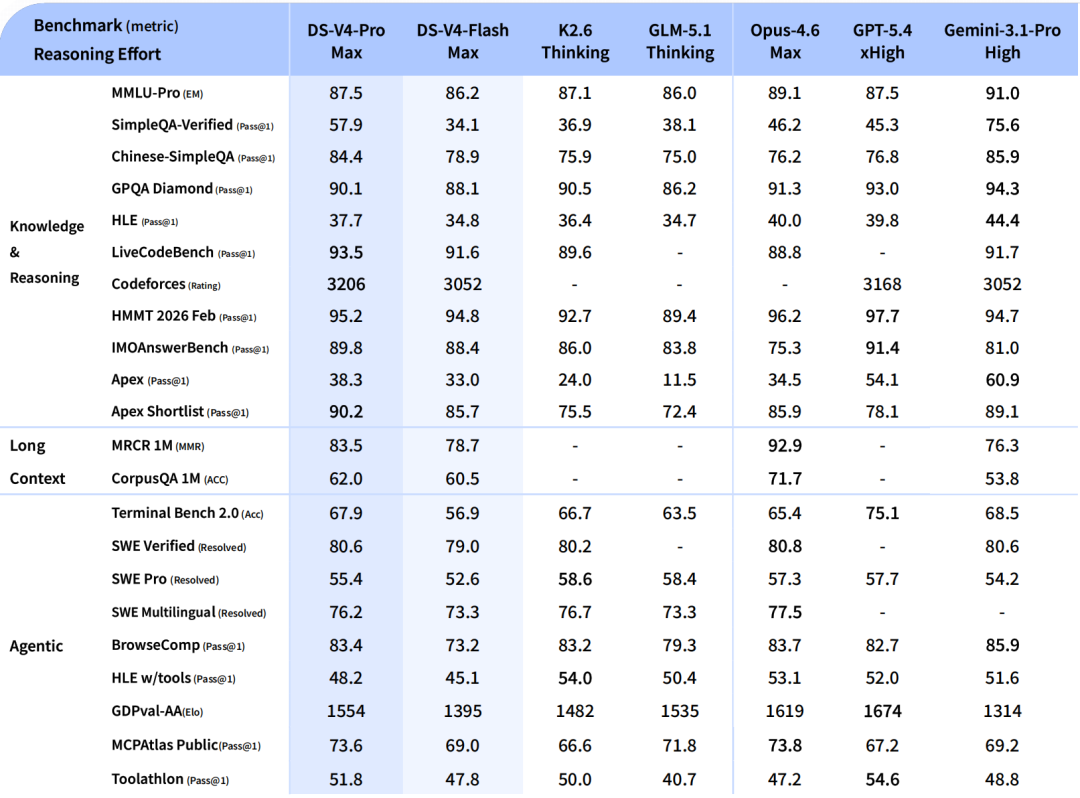
This story isn’t necessarily one of direct subsidies; these firms are profitable, with excellent margins.
Since Chinese models are more efficient and cheaper, they are being adopted internationally, and even inside the U.S. Azeem himself recently switched to Chinese AI because it’s so much less expensive. As AI goes onto edge devices, like phones and robots and personal computers, all of which are computing constrained, Chinese AI will have a structural advantage.
Azhar analyzes the Chinese industry, but why the American one is just a few months “ahead” even though we have a giant computing advantage is just as important. The U.S. market is not a particularly competitive ecosystem. All five of the big spenders run closed models, so they don’t share information as easily across the ecosystem. They are also vertically integrated into cloud computing either directly (Google) or through investments by cloud providers (OpenAI and Anthropic).
This vertical integration creates a few dangerous conflicts of interest. First, the combination of cloud computing resources and AI models in a vertically integrated stack thwarts entry of new firms. If you want to train a foundational model to compete with a hyperscaler, you have two options. One, you have to use a hyperscaler to build it, meaning a competitor has to give you permission. Two, you can buy your own chips, if you have access to billions of dollars. That limits the pool of builders to a few men in America. In addition, if you do succeed in creating something good, you’ll face Google engaged in predatory tactics, like pricing its consumer AI products below cost, as it is doing right now to OpenAI. In other words, there’s a tight oligopoly at work that restricts entry.
Second is what happens in this oligopoly. Not only do U.S. firms not have to be efficient, because they can get the chips and data centers they need, but they make more money if they are inefficient. Remember, they sell tokens, not performance. Think of the American companies like oil giants who make cars - of course they want to sell you gas guzzlers.
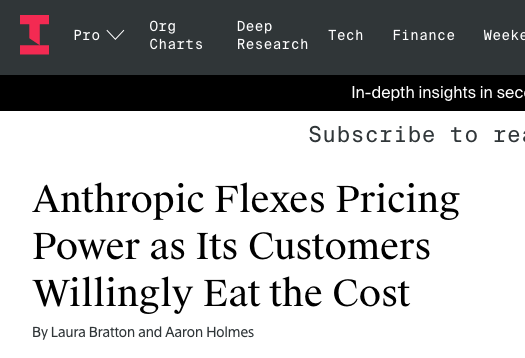
The Chinese companies, however, don’t make money on oil, and they are in a competitive system, so they are selling fuel efficient cars. Already, Uber and ServiceNow have complained about busting through their token budgets. For big U.S. corporations, adopting Chinese AI, as the rest of the world has, isn’t far behind.
Nvidia CEO Jensen Huang made this same point a few weeks ago in a different way. He was asked on the Dwarkesh podcast why he wants to export chips to China, considering China could build something as powerful as Anthropic’s Mythos model. His response was as follows:
First of all, Mythos was trained on fairly mundane capacity, and a fairly mundane amount of it. By an extraordinary company. The amount of capacity and the type of compute it was trained on is abundantly available in China.
In other words, the Nvidia chip advantage just doesn’t matter that much. As AI scientist Gary Marcus notes, there are fundamental limits on how much computing scale can really do for reasoning. Finance, however, is good at scaling, not at creativity.
So one way to understand what’s happening with Chinese AI versus U.S. AI is that we are simply doing different things. The U.S. goal is to keep the stock market up, and to do that you create monopolies with large market capitalizations. The Chinese goal is to create useful technology, with market capitalization mostly irrelevant. So with an unimaginably large amount of more computing power, the U.S. is only slightly better the usefulness of models, but far outstrips China in terms of the financial value of its firms.
That’s just fine with the Chinese leadership, and it’s just fine for Wall Street and all the CEOs on the trip with Trump. It’s why Wall Street have been key lobbyists against any attempt to restrain Chinese industrial might. As long as the Chinese government helps reduce the labor power of Americans and boost U.S. stock market valuations while stripping our national security capacity, the bankers are happy. Indeed, Elon Musk takes subsidies from Beijing and said China is “awesome,” Mark Zuckerberg once asked Xi Jinping to name his child, Google planned to launch a censored search engine in China, and Apple’s Tim Cook regularly obeys Chinese dictates.
But it’s also why they are in the lead and in process of wrecking most American industries, as well as the American the working class. China controls not only their corporations, but effectively our corporations as well.
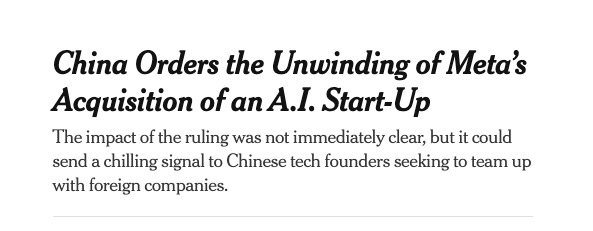
There’s one last example that makes the point. Recently, Meta paid $2 billion for a Chinese originated firm, Manus, which makes AI software tools. In the U.S., this kind of deal would be seen as an immense success; Manus was started in 2022, to have a huge sale just a few years later would be incredible. But to the Chinese government, it was not.
Manus had moved its corporate headquarters to Singapore to evade Chinese jurisdiction, and closed the deal. It didn’t matter. Four months later, the Chinese government simply told Meta and Manus to reverse the deal, because it wants to keep its AI technologies under domestic control. They essentially said, “Don’t want to do it? Can’t figure out how to do it? Then it’s handcuffs.” The deal got unwound.
By contrast, Chinese companies have bought trillions of dollars of foreign assets, “concentrated in knowledge-intensive sectors, and the knowledge-intensity of investment targets intensified following the release of the Made in China 2025 government initiative.” The U.S. and Europe barely noticed.
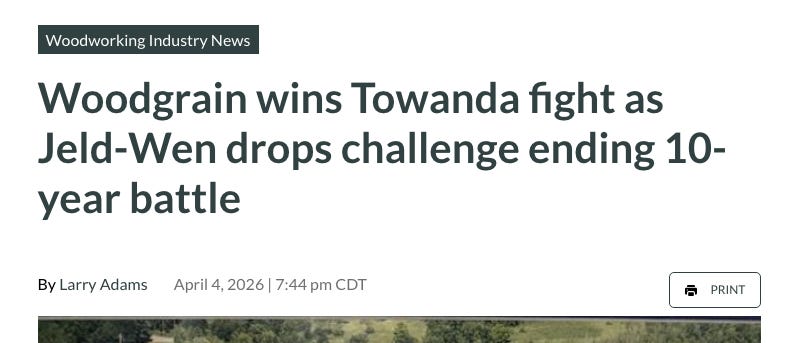
In the U.S., we rarely reverse mergers. The last time was in 2025, after a ten year saga to just get one door company, Jeld-Wen, to undo a factory acquisition, with endless bullshit litigation and appeals.
That’s not because due process is a Constitutional right. Using authority isn’t authoritarian, it’s a fundamental part of all statecraft. It’s because the U.S. just doesn’t do public governance over corporations anymore for any purpose but increasing financial values, while China does.
In other words, right now we are playing out two underlying theories of what constitutes value. In the U.S., we have decided that value is measured by the number of zeroes in a bank account of an oligarch. In China, they have decided that value is measured by the ability to make things people and nations need. We structure our rules differently as a result. In some sense, we are both succeeding at what we put our systems to work for.
There’s one final point to make. The left is often fooled by the ‘hawk’ and ‘dove’ rhetoric on China, because they can’t tell the difference between war and economic relationships. But it has always been the neoconservative hawks in the Middle East who have been the most ‘dovish’ towards Chinese economic relations, just like Wall Street. The people who oppose both war and predatory Wall Street/Chinese policy is labor.
Honestly, the China hawk/dove debate is sort of over. The U.S. is no longer capable of balancing China on its own, we have destroyed too much of our industrial health to do that. That doesn’t mean shifting our system is pointless. In a few years, unless we change strategies and restructure our relationship with finance and China, the U.S. won’t have any industries left. We’ll be a hungry and desperate oligarchy, wondering how we can beg a few more scraps from that high tech nation across the Pacific. I’d prefer to avoid that. Xi Jinping, and most of Wall Street, is fine with it.
And that’s why the people at the Xi-Trump summit are fine with no outcomes. The status quo, for all those American CEOs and the Chinese leadership, is working out. It’s the rest of us who are in trouble.
Thanks for reading! Your tips make this newsletter what it is, so please send tips on weird monopolies, stories I’ve missed, or other thoughts. And if you liked this issue of BIG, you can sign up here for more issues, a newsletter on how to restore fair commerce, innovation, and democracy. Consider becoming a paying subscriber to support this work, or if you are a paying subscriber, giving a gift subscription to a friend, colleague, or family member. If you really liked it, read my book, Goliath: The 100-Year War Between Monopoly Power and Democracy.
cheers,
Matt Stoller