 BURST
BURST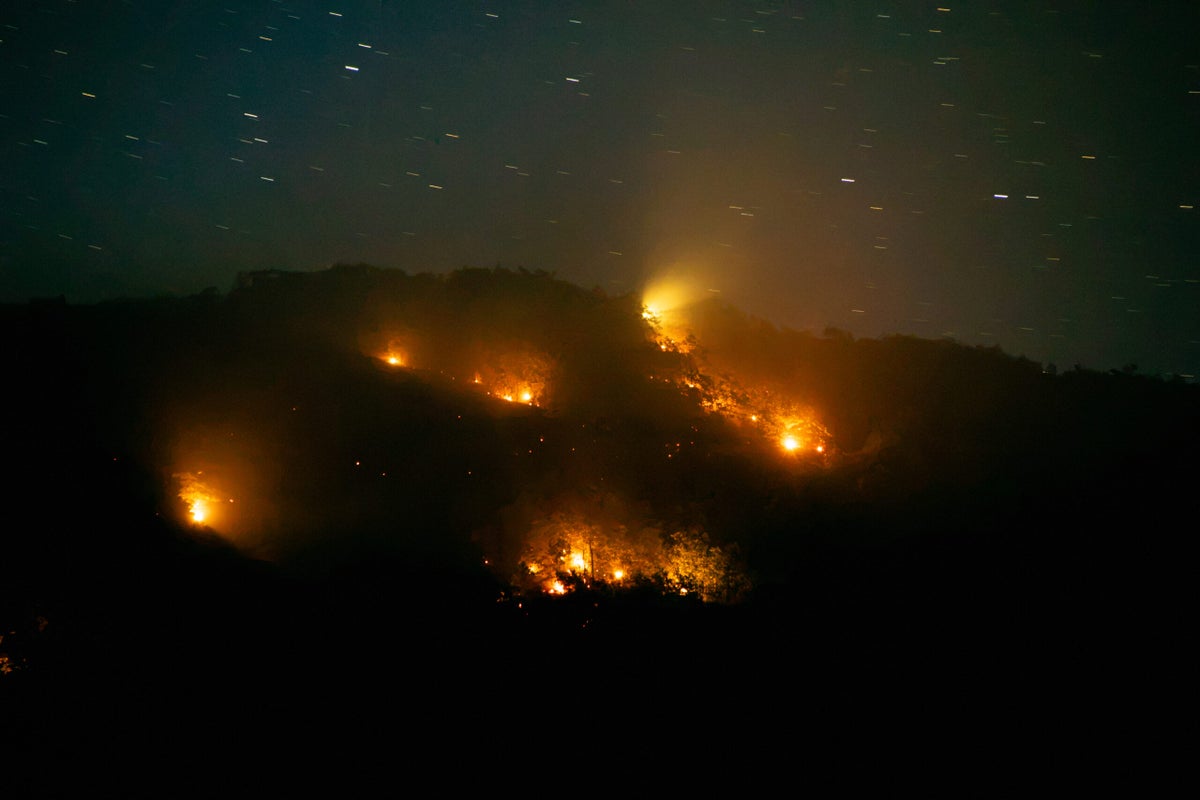
Last week, a wildfire gave the iconic U.S. climbing area of Rumney in New Hampshire a serious scare. While Rumney was fortunate enough to escape severe impacts, it’s just one of many crags that have been threatened or severely affected by wildfires this summer. We spoke with locals from Rumney to find out how the climbing there has been impacted, and take a look at where else wildfires have shut down climbing so far this year.
Inside the wildfire in Rumney
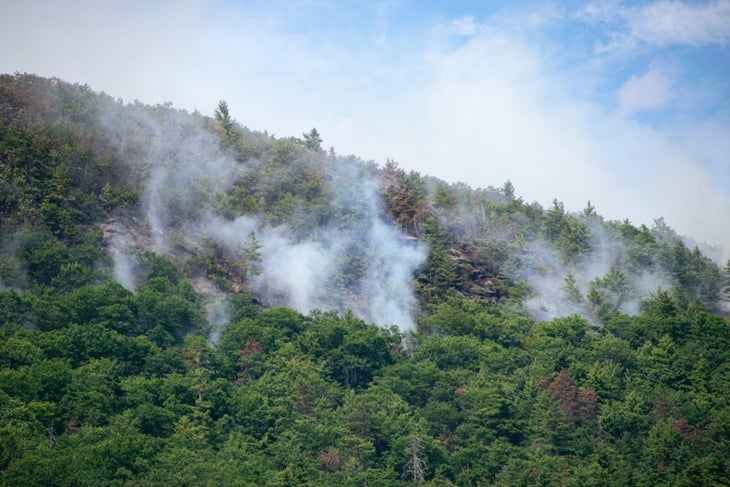
On Friday, August 14, local fire departments responded to a fire near New Hampshire’s Rattlesnake Mountain, where the world-famous Rumney climbing area is located. For a week, climbers and hikers were ordered to avoid the cliffs before they reopened on August 21. The fire is estimated to have impacted 14 acres, starting near the summit of Rattlesnake Mountain, and a cause has not been confirmed.
“There’s a whole northwest section of crags higher on the mountain [like the Prudential and Hinterlands] that most climbers don’t go to because of the longer approach,” Ladd Raine, president of the Rumney Climbing Association (RCA), told Climbing. “But that’s typically where fires occur—there’s more wind, it’s drier, and there’s a ton of leaf litter and downed trees. Most of the cliffs, like Orange Crush, are lower on the mountain’s shoulder and weren’t affected by the fire.”
With over 40 crags and 2,000 high-quality limestone routes, most of which are fully bolted sport climbs from 5.3 to 5.15a, Rumney’s significance to the American climbing community cannot be overstated. Its proximity to major urban areas like Boston, Portland, and Connecticut, coupled with its short approaches and extensive selection of routes rated 5.10 and under, makes it the most popular sport climbing area in the Northeast U.S. Of course, there is no shortage of testpieces at zones like Waimea. One storied classic is China Beach (5.14b), which has an entire podcast dedicated to it.
Now that the cliffs are back open, Alex Teixeira, owner of Rumney-based Mooney Mountain Guides, still advises that climbers watch for hazards caused by the fire, like dead timber.
“If you see a bunch of ash and scorch marks on a route, perhaps consider climbing elsewhere,” said Teixeira. “It’s really a great time to seek out other climbing opportunities in the state rather than trying to overwhelm what’s now an even more limited resource.”
Where wildfires impacted climbing around the world in 2026
While no damage has been confirmed to Rumney, other crags this summer haven’t been so lucky. In the past three months, the threat of losing a climbing area to sudden wildfire has almost become commonplace. Below are four of the biggest climbing areas where fires have threatened to shut down access or worse.
Fontainebleau, France – Fontainebleau Forest Fire
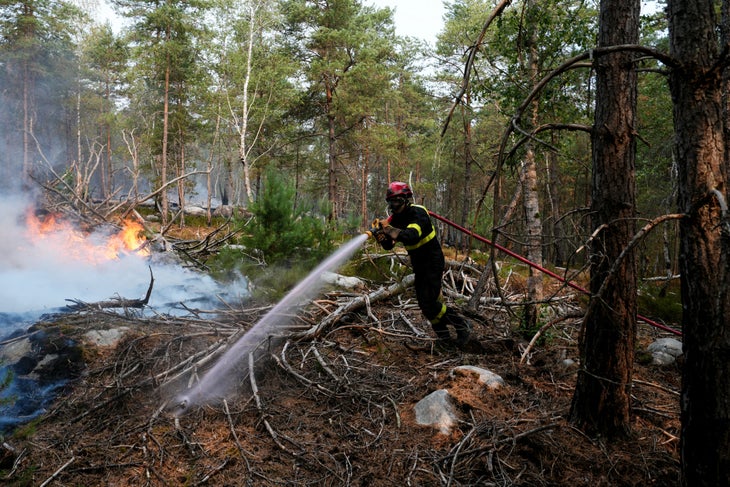
On July 12, an arsonist ignited a blaze across Fontainebleau, France, home to the birthplace of modern bouldering and more than 40,000 boulder problems. More than 1,000 nearby residents in the town of Fontainebleau were forced to evacuate. Although the forest reopened a month later on August 22, more than 5,000 acres burned, including several of the climbing zones. The Font community is currently awaiting a full evaluation of which areas will remain closed for safety reasons.
Ouray, Colorado — Gold Mountain Fire
Ignited in late June, the Gold Mountain Fire threatened the very existence of the mountain town of Ouray, home of the Ouray Ice Park, the largest of its kind in the world. The fire also threatened hundreds of rock, natural ice, and alpine routes in the area. This still active fire has burned nearly 40,000 acres and is currently 87% contained.
Indian Creek, Utah – Babylon Fire
In July, the Babylon Fire came disarmingly close to Indian Creek, just as the Trump administration eliminated large swaths of the iconic Utah climbing area from Bears Ears National Monument. Though the fire burned over 100,000 acres, road closures temporarily impacted climbing in the Creek and cut off access to the nearby Needles district of Canyonlands National Park. The Babylon Fire finally reached 100% containment just a few days ago.
Reno, Nevada – Hawk Fire
Just this past weekend, the Hawk Fire broke out in Reno, Nevada, a gateway town to Lake Tahoe’s climbing and skiing. Currently, it has burned through 15,000 acres and stands at 27% containment. In the past few days, 42,000 people were evacuated, and another 45,000 remain ready to evacuate.
Why are fires everywhere this summer?
It’s not exactly a mystery: Global temperatures are at an all-time high. According to the U.S. National Oceanic and Atmospheric Administration (NOAA), July 2026 tied with July 2024 as the hottest July on record. A NOAA spokesperson told the World Meteorological Organization that both months are most likely “the warmest months on record for the globe since 1850.”
In the U.S. specifically, Time reported on July 27 that the U.S. was at its “worst levels of wildfire preparedness” following the second-driest winter in history. Additionally, the more fires that happen at the same time—such as what we’ve been seeing in July—the fewer resources are available to fight each new one. So far, in 2026 alone, the U.S. has seen 51,063 wildfires over more than 7.8 million acres, according to the National Interagency Fire Center.
Even if you don’t pay attention to the news, look out for fire warnings across wilderness and other climbing areas. The free Watch Duty app is one of the most reliable for active fire tracking. Regardless of official closures, however, make sure to tune in to local community organizations for the latest climbing advice.
The post Rumney Just Had a Close Call with Fire. Other Crags Haven’t Been So Lucky. appeared first on Climbing.