 BURST
BURST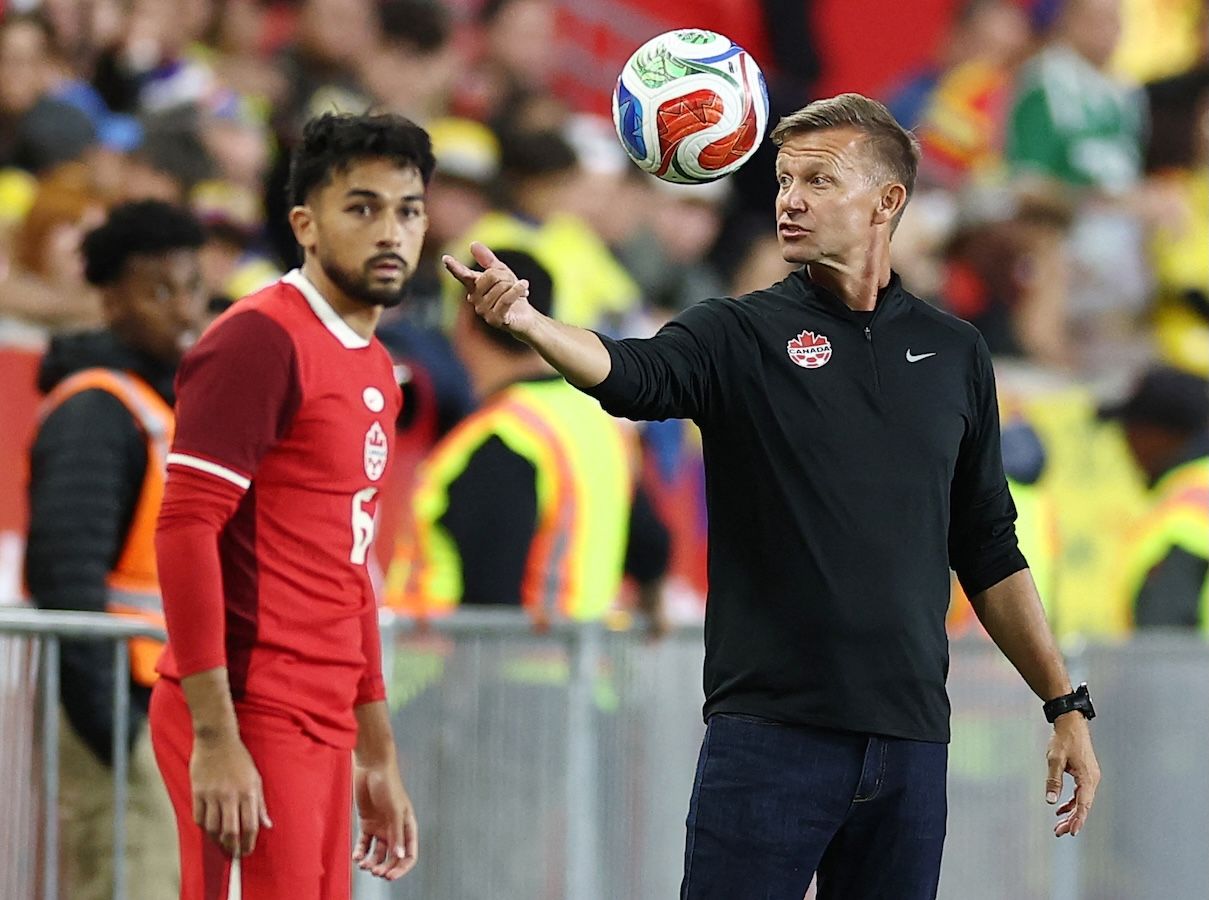
There is hope, and there is reality, and for the vast majority of the 48 teams in the World Cup this summer, never the twain shall meet.
There are some passionate sports fans who can willingly suspend their disbelief, fervently convinced their team can bulls-eye a womp rat , but that personality type leans heavily into emotionally masochistic tendencies. Like Canucks fans.
This summer’s World Cup is studded with soccer’s studliest countries. France. Brazil. Argentina. Spain. All multiple winners of the world’s biggest sporting event, a tournament even bigger after being supersized — American style, “it’s yuge” — to 48 teams.
For Canada, the reality is that we won’t be lifting the cup at the end of it all, unless midichlorians are a real thing. Fact is: We have yet to win a game at the World Cup. Canada hasn’t even tied one. Heck, we’ve only scored a single goal ( thanks Alphonso Davies! ) in six games.
The Reds join Panama, Iraq, Qatar and New Zealand as the only teams who have qualified for 2026 without a World Cup win to their name. (Not including debut teams Cape Verde, Curaçao, Jordan and Uzbekistan.)
Panama scored twice in their 2010 run, which saw them in an impossible group with Belgium, England and Tunisia.
Iraq made it in 1986, the same year as Canada’s first appearance, and had three heart-breaking, one-goal losses in the group stage against Mexico, Paraguay and Belgium.
New Zealand, which has now qualified three times, went undefeated in their last World Cup (2010) with three straight ties against Slovakia, Paraguay, and Italy, the then-defending champs. But it wasn’t enough to exit the group.
Basically, out of this year’s World Cup Sad Club teams , Canada’s resume should be near the bottom, historically speaking. But this year’s squad is ranked 30th in the world, higher than the rest of those winless teams, and brimming with confidence.
So where do hope and reality inch closer to a loving embrace, without leaching into the realm of delusion?
Let’s take a look at what Canada can realistically accomplish at this tournament — and what we hope can happen.
THE OPPOSITION: Group B
Switzerland: 19th
I pity the fool that tries to score on the A-Team. Yes, that’s one of the team’s nicknames. And the Swiss flex more defensive grit than B.A. Baracus has gold.
In qualifying, they gave up just two goals in six games, finishing with shutouts in four of them.
Sunderland midfielder Granit Xhaka is the defensive field general, sitting just in front of a back four and using an exceptional ability to read the game to break up offensive pushes and key their own. They are extremely tough to crack, and are a flexible unit that can flip both formation and tactics on the fly without substituting players. They move, they morph, they rarely stand still.
Canada’s Red Bull-infused “Maple Pressing” — their high-octane, high pressing style — runs directly counter to a team that is poised, fluid, and near unflappable. They have shown a minor weakness at tracking aerial long-box balls in the box, but Inter Milan centreback Manuel Akanji is one of the best at the position.
As the 19th-ranked team in the World, and highest in the group, it’s assumed the Swiss will top Group B. They look to be in form, too, taking a 2-0 lead on top-10 team Germany in a March friendly, before falling 4-3 in a back-and-forth battle.
There was a flicker of hope when their best striker, Breel Embolo, was unable to join his team at basecamp in San Diego this week. Visa issues stemming from a past non-violent conviction had seen him banned from entering the U.S., but news broke late Thursday that he has been cleared to join the team.
Bosnia and Herzegovina: 64th
They say never to let them see you sweat. And Bosnia-Herzegovina was bone dry during qualifying. Their path to the World Cup involved two dramatic playoff games — first Wales, then Italy — cooly winning both on penalties.
They were possibly a little too cool, maybe even ice cold, in their last World Cup warmup, a lacklustre scoreless draw with North Macedonia last week. But it’s tough to put much stock in that result, as Zmajevi (The Dragons) fielded a squad mixed with youth, hopefuls and players working back from injury.
A physical and direct team that primarily plays in a 4-4-2, they like to clog up the midfield and counter, but they are vulnerable to teams with speed on the flanks, and lack true depth. They like to target their forwards with crosses in the final third, with Bundesliga’s Ermedin Demirović in the middle using his head to score, and hold-up play to set up on-rushing midfielders.
Also of note: The roster includes Edin (The Bosnia Diamond) Džeko, now an elder statesman now at 40, but considered one of his country’s best all-time strikers.
This weekend’s friendly against Australia in St. Louis will show a more accurate picture of the team, before they settle into their home base in Sandy, Utah — using the same facilities the Vancouver Whitecaps did during their COVID-relocated season — before the opener against Canada next week.
They are ranked 64th in the world, but when you take out Italy in a high-stakes, winner-takes-all match, it’s hard to discount the result.
Qatar: 55th
The Qataris were the first host nation to fail to win a group stage game when they hosted in 2022, so they will be more than happy to put the pressure on Canada when they face each other on June 18 in Vancouver.
Fun fact: The Maroons are the most home-grown team in the tournament, with 25 of their roster playing domestically. Which is probably why manager Julen Lopetegui — former Spain, Real Madrid, and Wolverhampton boss — has the most name recognition.
Winger Akram Afif, a two-time Asian Player of the Year, and Asian World Cup qualifying top scorer Almoez Ali have proven chemistry and are the backbone of their offence, but chemistry might be overselling it. The team has just two goals in its last five games.
The book on Qatar is to play them tough and physical, and frustrate them into mistakes and cards. They fell behind 1-0, five minutes into last week’s friendly — sorry, World Cup warmup — with Ireland, and despite the Irish losing Jack Moylan just before halftime, couldn’t close the gap. It slammed shut when striker Ali saw his own red in the 78th minute.
Lopetegui got Hassan Al-Haydos, the most-capped player on the team, to come out of international retirement for this World Cup, as they both felt he could be a calming and steadying influence in the locker room.
The Qataris also had two other exhibition matches, against Serbia and Argentina, scuttled in March after bombs started flying in the Middle East.
Canada: 30th
Coach Jesse Marsch said that this is the best Canadian team in history. And despite being younger, on average, than their 2022 World Cup squad, they have more experience, more European-based players, and more players from a top-five league than they did the last World Cup cycle.
The biggest question mark for Canada is: How healthy are they going to be?
Don’t expect to see Alphonso Davies for the opener against Bosnia, and probably not against Qatar a week later, either. He is being treated delicately as he recovers from yet another injury setback, and they don’t want a repeat of 2025 — when he tore his ACL with Canada, and Bayern nearly sued the CSA over it. Circle June 24 against Switzerland as his likely return.
“The first game is coming up pretty quickly,” Davies told media earlier this week. “The thing we talked about, me and the coach and the people that were in (a meeting regarding his fitness), I think we understand how important the first game is. But we understand recovery is always an important thing. If I’m recovering as good as possible, let’s see. If not, then there’s no need to rush, just keep continuing the recovery.”
He’s not the only one. Marcelo Flores ruptured his ACL this week, ending his World Cup aspirations and robbing the Reds of one of their most creative and dynamic attackers. A host of other core players are newly or nearing recovery from injuries, and the final roster — which was announced last week — was going to be set after Friday’s friendly against Ireland.
Canada’s high-pressure style puts a lot of physical demands on the players, and if they’re not at 100 per cent, it will degrade their ability to drown the opposition in their Maple Press.
THE ROAD AHEAD
Canada vs. Bosnia, June 12 (Toronto)
Canada’s very first game in the tournament might just be the most important one. To even challenge for the first in the group, they can’t slip up against Bosnia. But Canada’s squad, especially if Jayden Nelson gets the callup for the injured Flores, has speed to burn on the wings, one of the chinks in the B&H armour.
And opening at home, in Toronto, the site of so many triumphs the past few years, should buoy the home side to victory.
Canada vs. Qatar, June 18
This will be the first West Coast game for Les Rouges, and all they need do is pressure, pressure, pressure and they should crack the Qatari defence, forcing the mistakes to poach on. A winnable game for Canada, and a draw likely wouldn’t do.
Canada vs. Switzerland, June 24
This is the game that will likely decide if Canada plays more games at B.C. Place, or not. If they top the group, they would play the first knockout round game at home. The second, too, should they emerge triumphant.
On paper, and betting sites, it’s shaping up to be the biggest game in the country’s history.
On the reality front: The Swiss have been in six straight World Cups, and the two goals they conceded in qualifying are the fewest by any of the World Cup teams. They pumped four goals past both Mexico and the U.S. in friendlies last year, Canada’s CONCACAF rivals and peers.
On the hope front: Switzerland has never made it past the Round of 16. They’re dark horses and not front-runners for a reason. They’re not invulnerable. Slovenia (58th) and Kosovo (78th) held them to draws of 0-0 and 1-0, respectively, in qualifying last year.
HOPE: WHAT COULD HAPPEN
Round of 32 (Group B Winner vs. TBD), July 2
There is a realistic world where Canada and Switzerland finish with a 2-0-1 record in group play, and first place comes down to tiebreakers. First goal difference, then goals scored. While unlikely, there’s a chance that the Reds finish with better marks than the Swiss and host the third-place team from Group E/F/G/I/J, which could be anyone from Mo Salah and Egypt to Norway and Erling Haaland.
Win this game, which wouldn’t be considered a long shot, and the reward is another game at B.C. Place in the Round of 16 — against Ronaldo and fifth-ranked Portugal. The only win over a top-10 team was in November 2021, when they took down No. 9 Mexico, dropping El Tri to 14th.
REALITY: WHAT WILL PROBABLY HAPPEN
Round of 32 (Group A runners-up v Group B runners-up) June 28, Los Angeles
The pre-tournament math seems to favour this as Canada’s likely destination in the knockout round. Who the second place team out of Group A will be is a toss-up. Could be anywhere from El Tri to Bafana Bafana, and potentially might pose an easier route — at least to the next round. At that point, all the indications are the Netherlands would be waiting for the winner of this game.
REALITY BITES: WHAT COULD HAPPEN
There is a scenario where Canada finishes third in the group, but is one of the eight top third-place finishers. Points are the first tiebreaker, followed by goal difference and goals scored. It could mean either a trip to Boston to take on (probably) Germany, or one to the Bay Area to face the winner of the Group D, the group of Death-ish quartet of the U.S., Paraguay, Australia or Türkiye.
Canada making it out of the group stage isn’t a pipe dream, but an actual likely outcome. And then, while it’s uncharted territory for the Canadians, it is conceivable they could make it to the round of 16, even into the quarter-finals, though that would require a 100 per cent healthy team and a lot of good fortune. But belief isn’t one thing that’s lacking in the group.
“I wanted to create a process where I help this team believe that they could truly beat anyone,” Marsch told media this week. “And the beauty of right now is we know we’re there.”