 BURST
BURST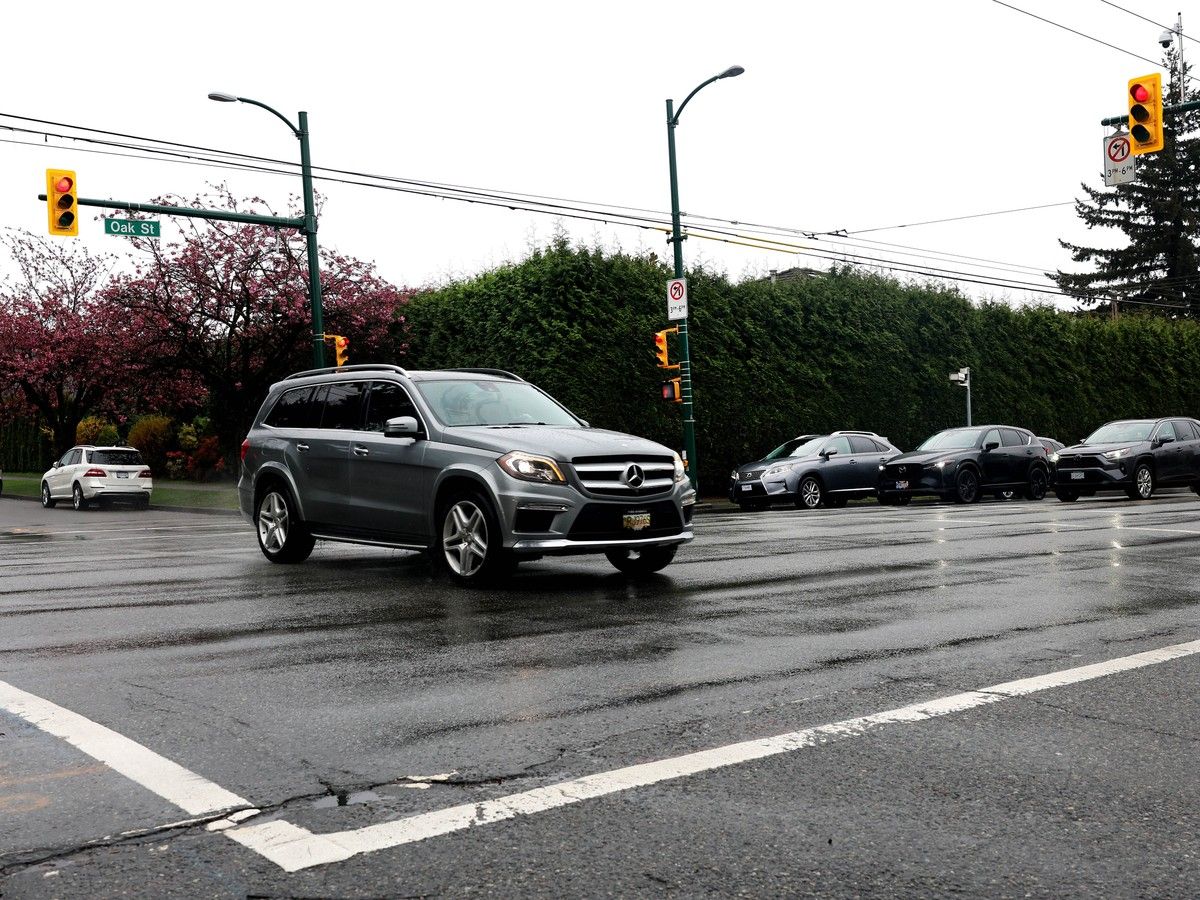
More than 128,000 B.C. drivers were ticketed for speeding or running red lights last year under a traffic camera program that a local medical health officer says should be expanded because it saves lives.
Research from Canada, the U.S., Australia and Europe all show that traffic camera programs reduce crashes that result in injuries and fatalities, according to Brandon Yau, a medical health officer at Vancouver Coastal Health.
“They’ve been pretty well-studied internationally, and so the evidence is relatively conclusive,” Yau said.
He said programs, such as the installation of traffic cameras, that aim to reduce speeding and running red lights led to a roughly 40 per cent reduction in fatalities, and a 20 to 50 per cent reduction in injuries.
“Most importantly, we have really good evidence that it impacts driver behaviour,” he said. “If people know that there’s a red light camera or a camera to watch their speeding, they’re adjusting their behaviour.”
A Postmedia News analysis of provincial data showing the number of violation tickets issued at Lower Mainland intersections installed with cameras found that the intersection at Nordel Way and 84th Avenue in Delta had the most violators in 2025. The data showed 4,612 vehicles were caught speeding through that intersection last year, and another 2,550 vehicles were caught running red lights.
The intersection with the second-highest number of violators was Oak Street and West 57th Avenue in Vancouver. The camera at that intersection caught 4,563 speeders and 1,847 red-light runners.

Cameras at Grandview Highway and Rupert Street in Vancouver, and at Lougheed Highway and 207th Street in Maple Ridge, each captured over 3,000 vehicles speeding through those intersections.
According to the Transportation Ministry, cameras are installed at intersections where crashes frequently occur. There are 140 so-called “intersection safety cameras” in B.C. — 105 monitor red-light violations and 35 capture both red-light and speed violations.
The vast majority of the cameras are in the Lower Mainland. There are only six cameras on Vancouver Island, seven in the Interior and one in Prince George.
“Sites were selected based on extensive data analysis of 1,400 intersections across B.C., to identify locations where incidents were most frequent and resulted in serious crashes,” the Public Safety Ministry wrote in an email.

Over the past three years, the impact of adding speed enforcement at 35 locations “led to a 52 per cent decrease in drivers exceeding the speed limit by more than 25 km/h,” the ministry wrote.
Red-light infractions decreased by 13 per cent and the number of repeat red-light offenders declined 29 per cent in the past five years, according to the ministry.
Yau would like to see the program expanded across more of the province.
“A majority of collisions occur at intersections, but we know that there are large sections of highways that are a significant concern,” he said. “I think we need to expand this significantly.”
Yau acknowledged that traffic cameras can sometimes become a political issue.
In Ontario, the Ford government recently banned municipalities from operating speed-enforcement cameras, saying it was “ protecting taxpayers .”
In Alberta, the government largely ended the use of automated traffic cameras across the province in April 2025.
B.C.’s photo radar program — which used unmarked mobile vans equipped with radars and cameras to catch speeders — was initially rolled out in 1997 and then scaled back in 2001 after community pushback, Yau said.
“It can become a political challenge, and that’s why we’ve seen a very careful approach to expanding the program here in British Columbia,” he said.
The Public Safety Ministry didn’t say if the government was considering expanding the program.
But Carson Binda, director of the B.C. chapter of the Canadian Taxpayers Federation, said the cameras should only be used to reduce crashes, not as a “cash cow.”
“There also needs to be accountability on how the government collects and uses data through this program,” Binda said.
A 2024 poll from the Research Co. found that seven-out-of-10 British Columbians supported automated speed cameras.
“The use of speed-on-green cameras, which is currently in place in British Columbia, remains popular across the province,” Mario Canseco, president of Research Co., said in a news release at the time.

According to the Public Safety Ministry, traffic-camera tickets don’t result in penalty points to a driver’s licence or vehicle impoundment for excessive speeding.
The systems also earn money for the province. About 95 per cent of tickets were paid in 2025, for a total of $22 million, according to the ministry.
Yau said making money off of the cameras isn’t the point.
“We want people to change their behaviour. We’re not interested in these programs to punish people or to generate revenues,” he said.
He said a lot of work still needs to be done to communicate to the public why the cameras are in place and how effective they are at improving road safety, by showing the number of crashes before and after cameras are put in place, for example.
“I think that gets a lot more buy-in than just somebody getting a ticket and getting angry,” he said.
Related